
The man who helped build the AI that beat the world champion at Go says today’s AI is broken — and today, October 20, 2026, he launched the company he claims will fix it. Metis Reasoning, co-founded by AlphaGo co-creator Thore Graepel, went live in London with a compute-efficient alternative to frontier models from OpenAI and Anthropic.
The pitch: LLMs are fluent, but their reasoning is unreliable and leaves no audit trail. In robotics and engineering — where a wrong answer costs real money — that’s a dealbreaker.
The launch: what we know
Thore Graepel left Google DeepMind this summer, where he co-created AlphaGo — the program that beat human Go players — and holds the Chair of Machine Learning at UCL.
Metis Reasoning — named after the Greek goddess of reasoning and wisdom — is based in London, with part of the team in Singapore. The launch team: 12 people — researchers, mathematicians, robotics experts, and tech entrepreneurs.
Graepel’s co-founders:
- Piers Ingram, serial tech and biotech entrepreneur; his ventures have raised $350M+.
- Michael Warren, robotics and autonomous systems expert, ex-Boeing.
- David Berman, head of AI at Cambridge Consultants; AI advisor to the UK government and NATO.
Funding: understood to be raising tens of millions initially (Bloomberg via Tech.eu). Graepel declined to comment, but investor interest is reportedly strong — Sutskever’s and Silver’s startups raised billions.
Why Metis says LLMs hit a wall
Metis credits LLMs’ progress — fluent answers, instructions, multi-step tasks — but says how they reason is the problem.
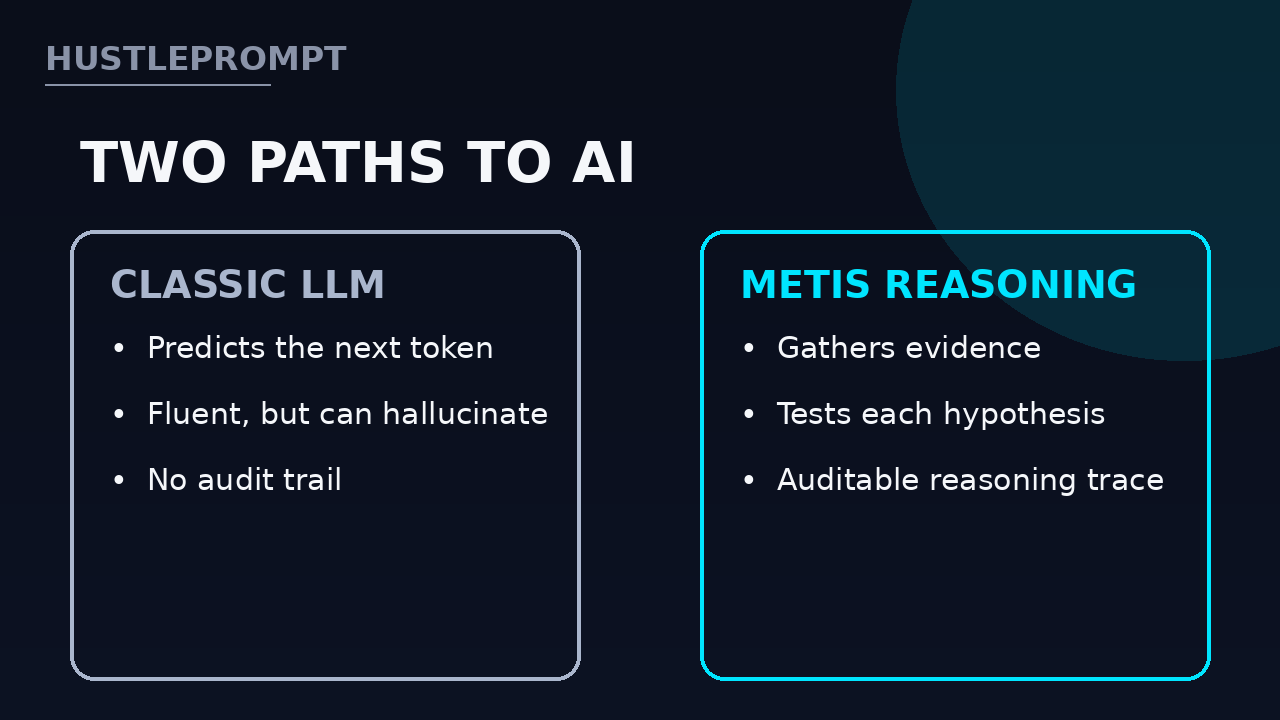
An LLM predicts likely next tokens — no evidence gathering, no hypothesis testing, no audit trail. Metis calls that a real barrier to AI adoption.
Graepel: “I’m a scientist at heart. I think that the scientific method is really the only way for humans to reliably create new knowledge.” On the system: “It knows what it knows. It knows what it doesn’t know.”
“Compute-efficient” means frontier AI without the enormous budgets of today’s biggest models. Fellow AlphaGo architect David Silver raised $1.1B at a $5.1B valuation for Ineffable Intelligence in April 2026. Metis bets the cheaper, auditable path can win.
The evidence: Metis at a glance
Metis Reasoning: the launch facts
Sources: Tech.eu’s launch coverage and Pathfounders’ interview with Thore Graepel.
Metis vs. classic LLMs vs. AlphaGo: how they compare
| Metis Reasoning | Classic LLM | AlphaGo-style | |
|---|---|---|---|
| How knowledge is stored | Explicit record: known, uncertain, evidence per claim | Implicit, baked into neural weights | Learned via self-play |
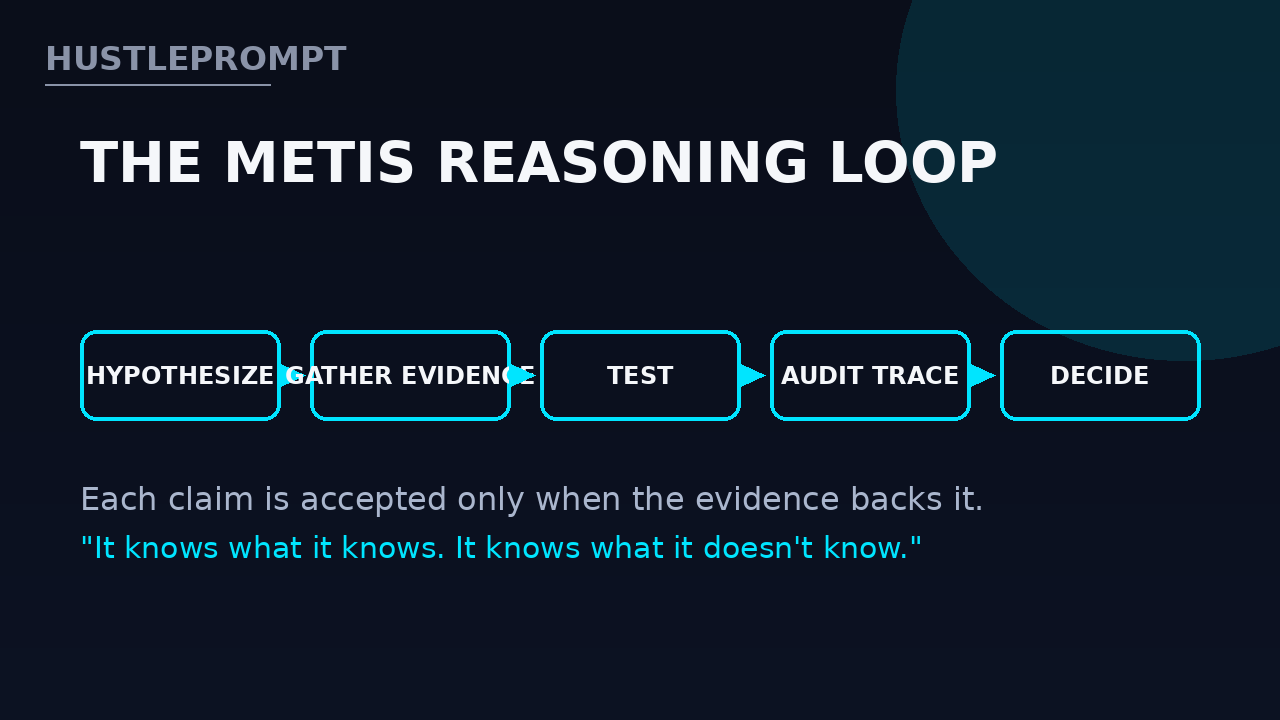
| How it reasons | Hypothesis → evidence → test → audit → decide | Predicts likely next tokens | Search + reinforcement learning |
| Auditability | Full auditable reasoning traces | None — work is hard to verify | Game tree is inspectable move by move |
| Compute approach | Compute-efficient alternative to frontier LLMs | Scale up compute and data | Massive self-play compute |
| Failure mode | Fails transparently: shows what it doesn’t know | Hallucinates confidently | Limited to its game |
| Target industries | Robotics, engineering | Chat, content, general tasks | Games, research demos |
How the reasoning loop works
The Metis reasoning loop
How Metis says its AI will think — each step checked before moving on.
Four ideas from the launch white paper “The Age of Reasoning”:
- Knowledge separated from reasoning: an explicit record of what’s known, uncertain, and backed by evidence.
- Claims need evidence, not plausibility.
- Every step logged: fully auditable.
- Neuro-symbolic by design: neural nets plus explicit knowledge representation and structured reasoning — the AlphaGo lesson.
Graepel’s endgame: “Ultimately, I think this kind of AI system has the potential to replace all existing AI systems because we want that reliability, that safety, and that auditability.”
How to profit from the post-LLM reasoning wave
No product, no public API, no announced investors yet — that is the opportunity. Positioning early pays. The playbook:
- Audit where LLM hallucination costs you money. In robotics, engineering, legal, or finance, list workflows where one wrong AI answer costs $500+. Those are your auditable-AI pilot candidates.
- Learn the verifiable-AI stack. Neuro-symbolic systems, probabilistic reasoning, and AI safety auditing are premium skills in the making — and training material is still thin.
- Sell AI safety auditing. Companies deploying AI agents need independent verification. Offer a monthly retainer: review logs, score outputs against evidence, report failure rates.
- Follow the capital. Ineffable raised $1.1B, Reflection raised for “Beam,” Metis is raising tens of millions. When Metis announces its round, the investor list maps the whole ecosystem.
- Pilot auditable workflows now. Require AI outputs to cite sources, carry a confidence score, and route anything under 90% confidence to a human. Metis’s playbook, on today’s tools.
FAQ
What is Metis Reasoning?
A London startup launched October 20, 2026 by AlphaGo co-creator Thore Graepel, building auditable AI that gathers evidence and tests hypotheses.
Who is Thore Graepel?
Former Google DeepMind research lead and AlphaGo co-creator; left DeepMind in summer 2026; Chair of Machine Learning at UCL.
How is Metis different from ChatGPT or Claude?
LLMs predict likely next tokens with no audit trail. Metis separates knowledge from reasoning, accepts claims only with evidence, and logs every step.
What is “The Age of Reasoning”?
Metis’s launch white paper, signed by all four founders: reasoning strategies, evidence-backed claims, auditable traces.
How much funding is Metis raising?
Tens of millions initially (Bloomberg via Tech.eu); no investors or valuation public.
When can I use Metis’s technology?
Not yet — fundraising and team-building first, targeting robotics and engineering.