
What if you could hire a warehouse worker for $3 an hour — no breaks, no benefits, no turnover? That’s the bet Dream Labs just made. On October 19, 2026, the robotics startup emerged from stealth with a $90 million seed round and Dream-1, a robot foundation model that turns a robot’s camera feed plus a plain-English instruction into motor commands.
The founders are Joel Jang and You Liang Tan, former NVIDIA robotics researchers associated with GR00T robotics work who created DreamZero and “World Action Models.” Their pitch is blunt: the hardware is ready and cheap, but robots still ship with no built-in intelligence. Dream Labs wants to sell the brain separately — metered by the hour, like cloud compute.
The $90M Announcement: Who Is Backing It
The seed round is led by B Capital along with Kindred Ventures, with participation from A.Capital, Unusual Ventures, SV Angel, Wing VC, Scribble VC, and Adrian Aoun. Here are the facts from the company’s official press release:
| Round detail | Fact |
|---|---|
| Amount | $90M seed |
| Announced | October 19, 2026 |
| Led by | B Capital, along with Kindred Ventures |
| Participants | A.Capital, Unusual Ventures, SV Angel, Wing VC, Scribble VC, Adrian Aoun |
| Founders | Joel Jang and You Liang Tan (former NVIDIA robotics researchers) |
| Use of funds | Compute investment to expand tasks, supported robots, and user base |
What Dream-1 Actually Does
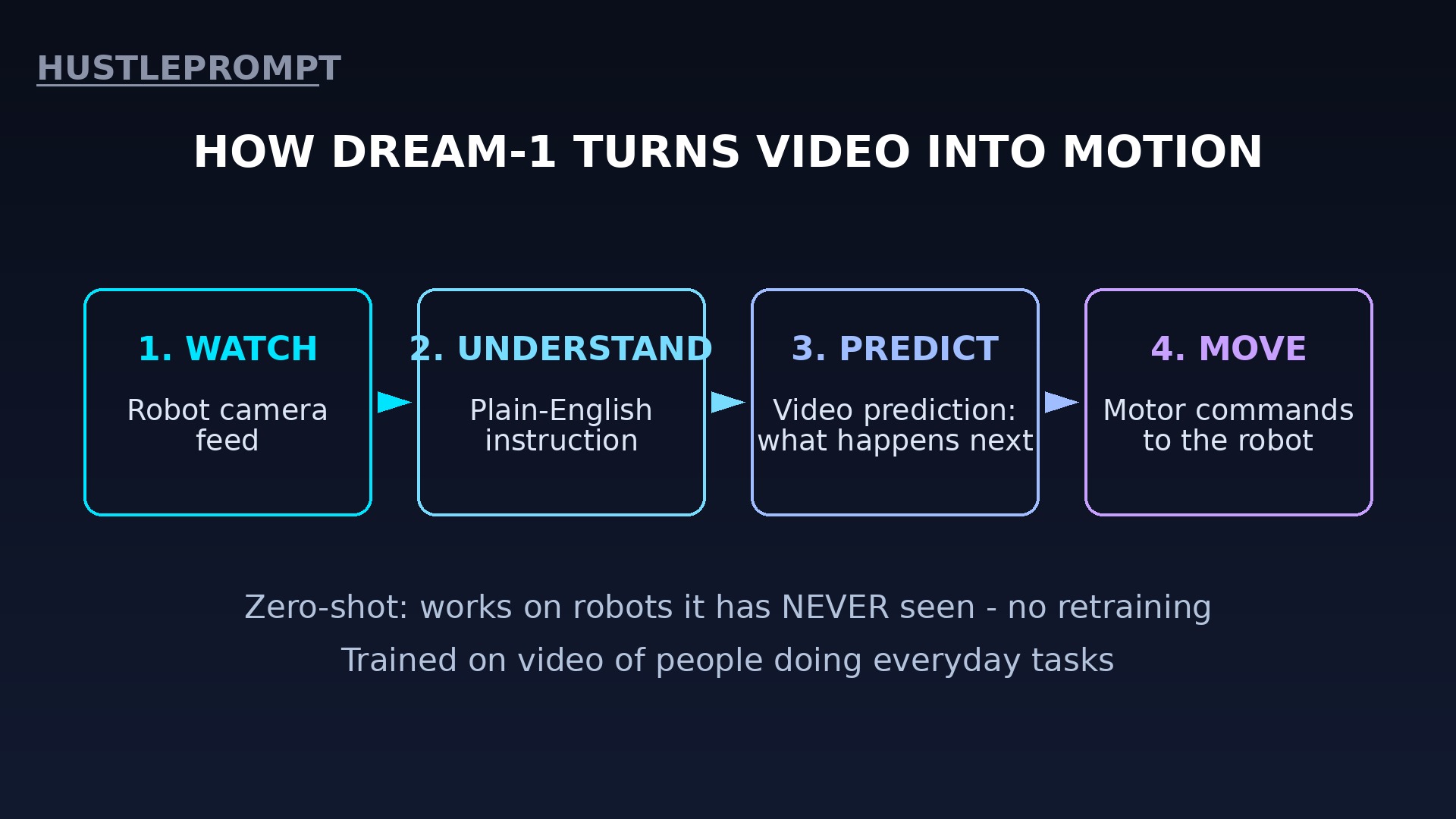
Dream-1 is what the company calls a “World Action Model.” Instead of training a robot on machine-specific data, it treats robot skills as video prediction problems. It was trained on video of people performing everyday tasks — “human egocentric training data” — and learns to predict what happens next, then derives the robot’s action from that prediction.
The product wrapper is Dream API: the first publicly available API for a robot foundation model. You feed it a camera feed and a plain-English instruction, and it returns motor commands — even for robots it has never seen before.
Zero-Shot Control: The Stat That Matters
Out of the box, Dream-1 controls bimanual robots with parallel grippers it never saw in training, on tasks it was never shown. Because it learns from video rather than from one machine, its capabilities transfer across hardware from different manufacturers — no per-hardware retraining.
- 20+ hardware partners are already on board, per the launch announcement.
- Early support: tabletop tasks — grasping, placing, folding clothes.
- Roadmap: wheeled mobile robots and more dexterous hands are next.
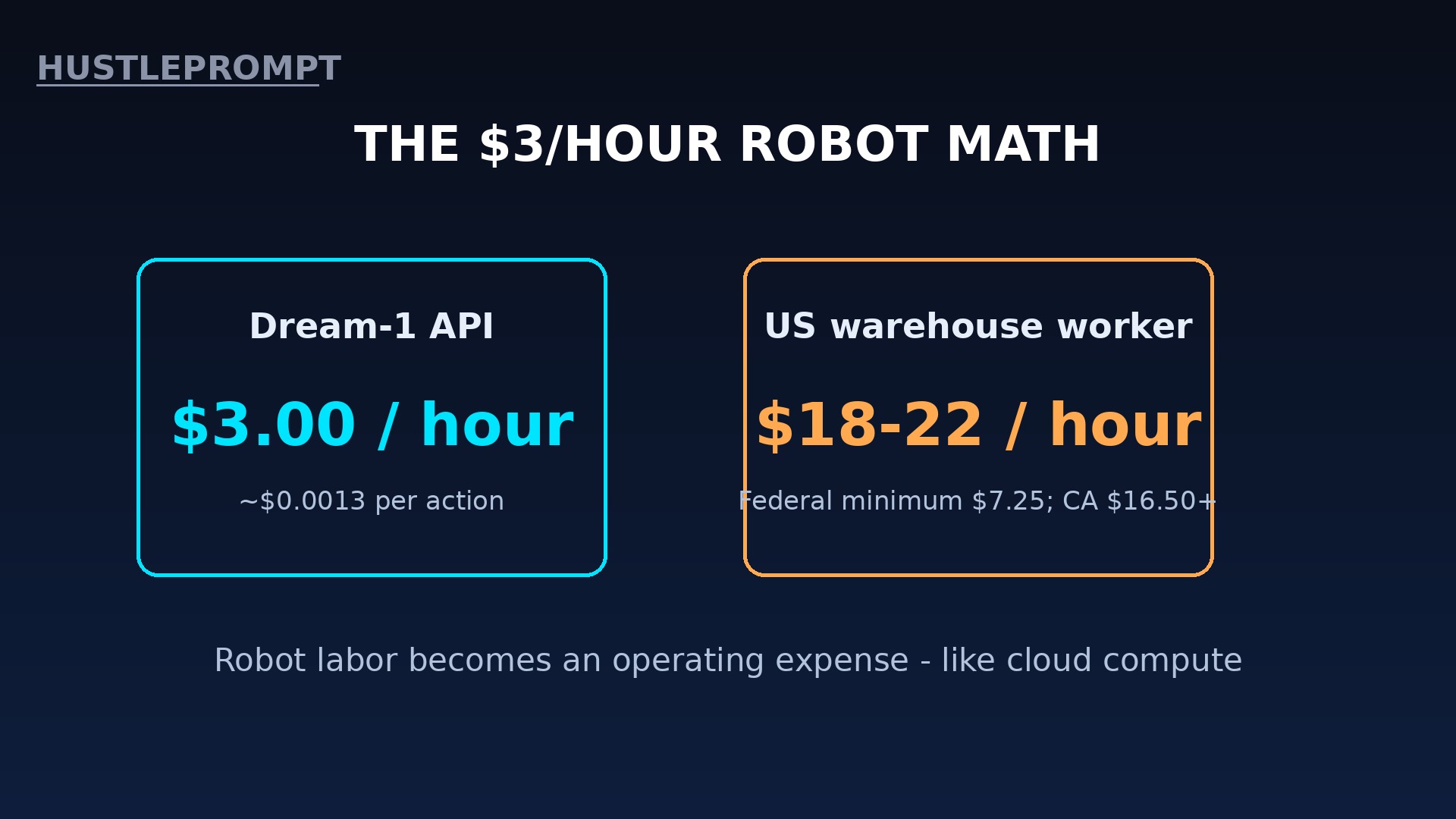
And the pricing that makes this a business story: from $3 per hour, per the company’s launch announcement. Compare that with the U.S. Bureau of Labor Statistics median of $18.38/hour for hand laborers and material movers (May 2025). Robot labor just became roughly 84% cheaper than the human median — our arithmetic, their numbers.
How It Works
Trained on video of people doing everyday tasks — so skills transfer to robots it never saw.
How to Profit From the $3/Hour Robot Economy
When robot labor becomes an operating expense, three kinds of businesses win first. Here’s the concrete playbook:
- Become a robotics integrator. Rent the Dream API, sell outcomes. Warehouses pay for folded, sorted, and packed goods — not for robots. Pilot tabletop tasks (grasping, placing, folding) with a cheap bimanual arm and charge per shift.
- Bundle hardware + brain. Low-cost robots sell for a few thousand dollars but ship dumb. Sell a kit: arm + camera + Dream API key + your setup service. Hardware makers outsourcing the intelligence stack are your channel partners.
- Run robotics-as-a-service. Charge clients $10–$15/hour for robot labor that costs you $3/hour in API fees. The spread is the business — the same model that made cloud reselling a fortune.
The math on an 8-hour shift: Dream-1 costs $24. A human worker at the BLS median costs $147.04. Even after you add hardware amortization, the margin is enormous — which is exactly why integrators, not just factories, should be paying attention.
Frequently Asked Questions
What is Dream-1?
Dream-1 is Dream Labs’ flagship “World Action Model” — a robot foundation model that treats robot skills as video prediction, trained on video of people performing everyday tasks.
How much does the Dream API cost?
From $3 per hour, according to the company’s launch announcement on October 19, 2026.
Who founded Dream Labs?
Joel Jang and You Liang Tan, former NVIDIA robotics researchers associated with GR00T robotics work, who created DreamZero and “World Action Models.”
Which robots does Dream-1 support?
Any bimanual robot with parallel grippers — including robots it never saw in training — from 20+ hardware partners across manufacturers.
What tasks can it do today?
Tabletop tasks: grasping, placing, and folding clothes. Wheeled mobile robots and more dexterous hands are on the roadmap.
How can a small business make money with this?
Sell integration and outcomes: pilot Dream-1-powered arms for warehouse tasks, bundle hardware with the API, or run robotics-as-a-service and keep the spread between $3/hour cost and client pricing.
Keep Reading
Sources: Dream Labs raises $90M seed — official press release (Business Wire); Dream Labs launch announcement on X (@dreamlabs_ai); U.S. Bureau of Labor Statistics — Hand Laborers and Material Movers