
Spending on generative AI apps grew nearly 200-fold in four years — from $9.8 million in Q1 2022 to almost $2 billion in Q1 2026, according to Sensor Tower data charted by Visual Capitalist.
A big slice is the AI companion economy: wellness coaches, tutors, accountability partners, entertainers — all paid subscriptions. And this year it stopped being the Wild West: regulation is in force on three continents, so the moat is no longer the cleverest chatbot — it’s the safest, most compliant product.
The numbers behind the boom
Anchor on what’s measurable. Sensor Tower’s measurable data (paid downloads, in-app purchases, subscriptions — not ads) puts the generative AI app category at $9.8M in Q1 2022 → $1.879B in Q1 2026.
Evidence: AI app spending by region
| Region | Q1 2022 | Q1 2026 | 2026 share |
|---|---|---|---|
| North America | $6.6M | $730.0M | 39% |
| Europe | $1.6M | $521.0M | 28% |
| Asia | $1.0M | $330.0M | 18% |
| Latin America | $0.2M | $143.0M | 8% |
| Middle East | $0.1M | $88.4M | 5% |
| Rest of world | $0.4M | $66.6M | 3% |
Source: Sensor Tower via Visual Capitalist, Oct 2026. Gross revenue, iOS + Google Play; North America’s share fell (67% → 39%) as other regions grew faster.
Two signals matter: willingness to pay is doubling — 8% of iOS ChatGPT users were paying premium as of May 2026, up from 4% in 2024 — and usage is structural: 36 billion hours in H1 2026.
Now zoom into companions. Appfigures (via Decrypt, July 2026) splits H1 2026 mobile spending into $164.8M general and $162.8M romantic/NSFW — ~$328M in six months, mobile stores alone, web billing excluded (The Loneliness Economy). General apps drew nearly twice the downloads but earned almost the same revenue: romantic companions monetize each user ~2x as hard. Intimacy carries a price premium.
Forecasts give the growth vector: The Business Research Company (Sept 2026) estimates romantic companion apps at $2.32B in 2025 → $2.91B in 2026 → $7.15B by 2030, 25.2% CAGR (WhiteLabelFans) — direction, not precision, since trackers miss web-billed subscriptions entirely.
This is a loneliness economy, not a romance story
Companion apps crossed 220 million downloads by mid-2025, up 88% YoY (Appfigures via TechCrunch, via Carla Kaas). Character.AI holds ~20M monthly active users, ~65% male, mostly 25–34. But demand runs deeper: Korea had 36.1% single-person households in 2024 (Statistics Korea), projected at 41.3% by 2052 — over half headed by people 50+. Aging, later marriage, smaller households: slow-moving forces everywhere.
So the money angle targets the broad companion economy:
- Wellness — sleep, mood, habits, senior check-ins
- Learning — tutors, coaches, language and interview partners
- Entertainment — characters, stories, roleplay, fandom
- Productivity — focus partners, accountability, briefings
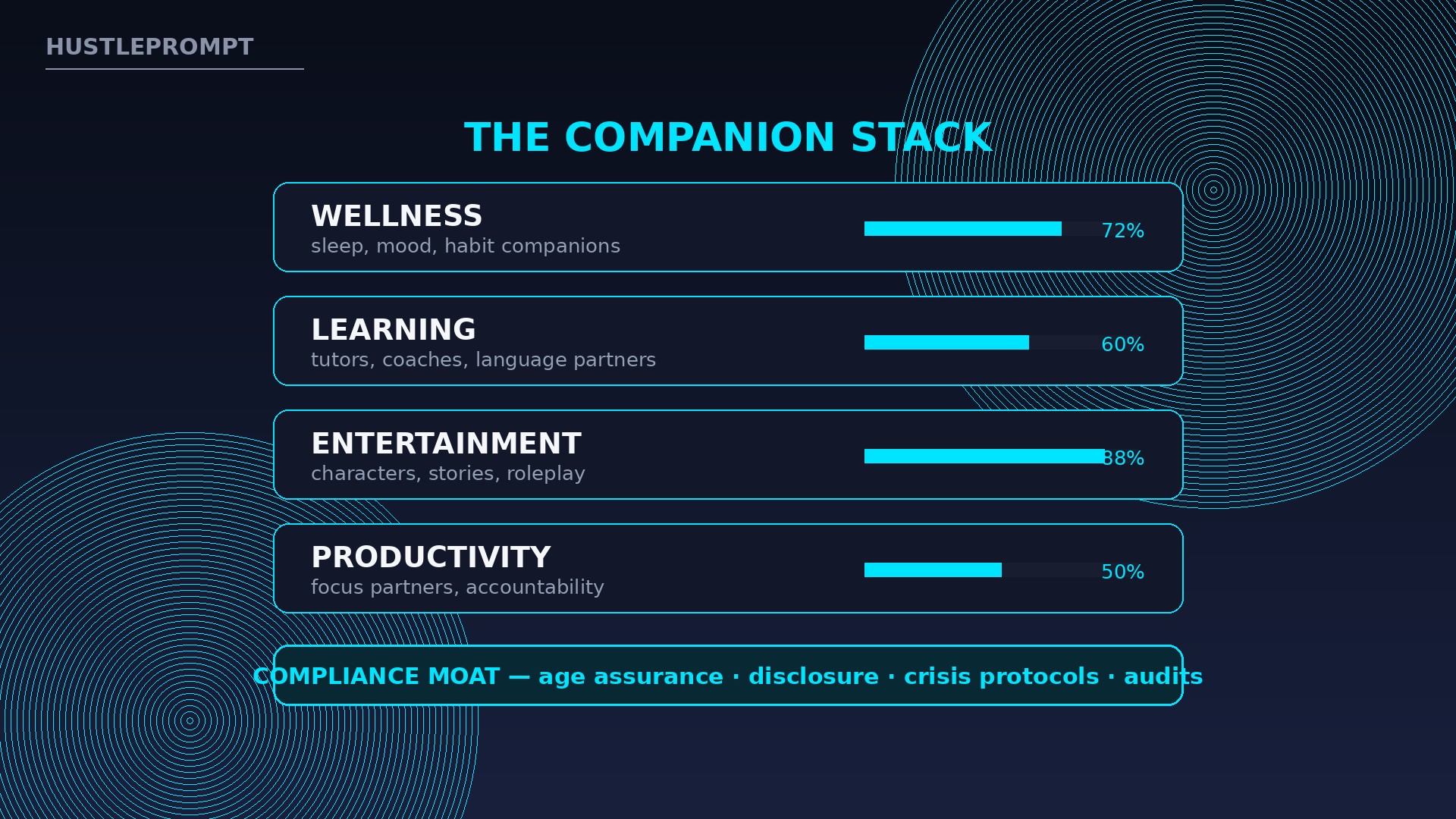
Romantic data is sizing context — it proves the payment ceiling. Durable growth sits in wellness, learning, and care.
Regulation is now the moat
This year the category became regulated — six major moves in eleven months:
Evidence: the compliance timeline
| Jurisdiction | In force | Core requirement |
|---|---|---|
| New York | Nov 5, 2025 | AI disclosure; suicidal-ideation detection, crisis referral |
| California SB 243 | Jan 1, 2026 | Disclosure, crisis protocol, minor protections, $1,000/violation private right of action |
| China | Jul 15, 2026 | 2-hour break prompts, AI disclosure, companion services banned for minors |
| EU AI Act, Art. 50 | Aug 2, 2026 | Transparency obligations for AI interaction |
| Korea AI Basic Act | Jan 22, 2026 | General AI framework; enforcement under a 1-year+ grace period |
Source: The Loneliness Economy (Oct 2026); plus the FTC’s Sept 2025 6(b) orders to seven companies on companion chatbots for minors.
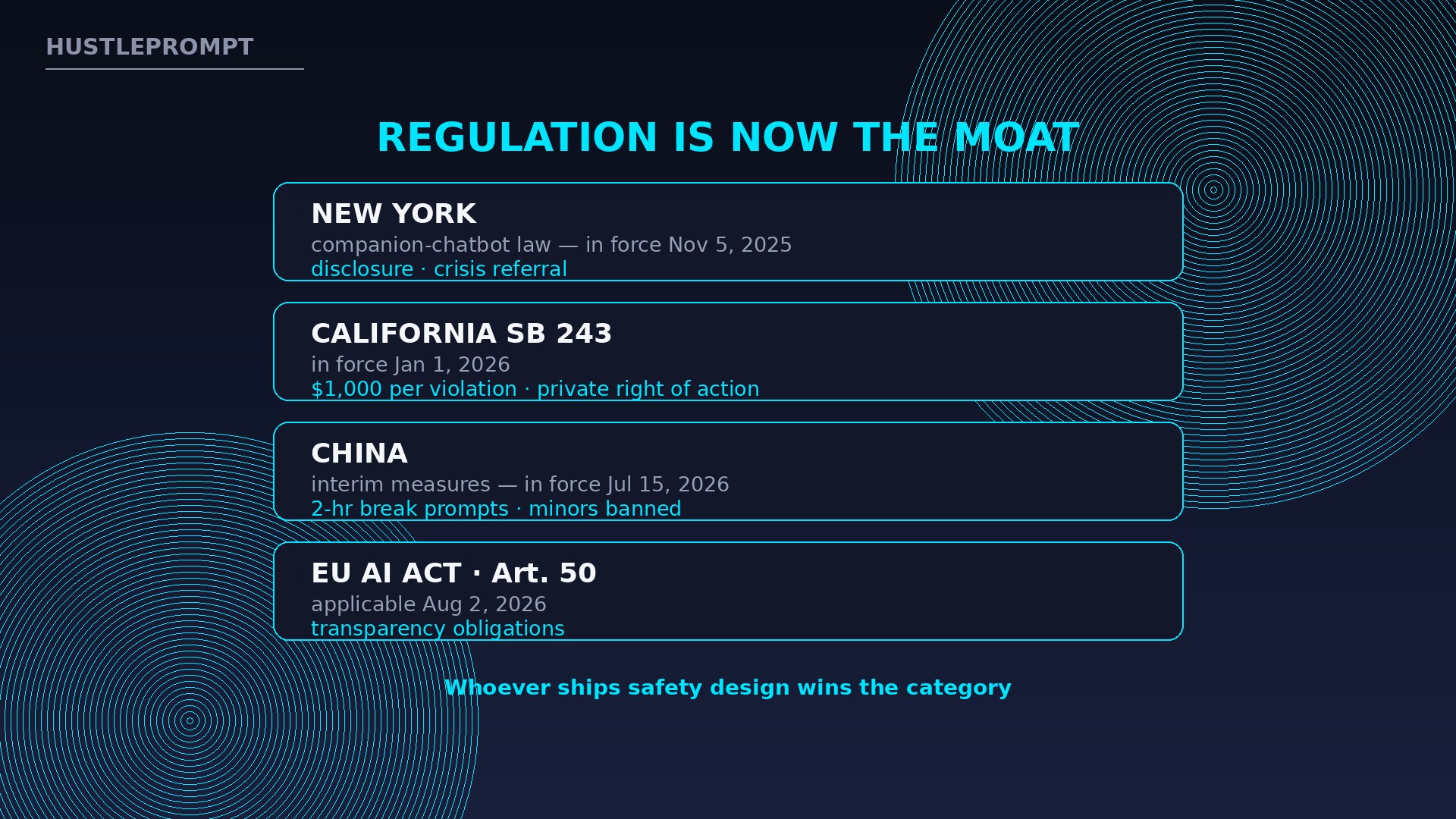
The category is winner-take-most: the top 10% of 337 revenue-generating companion apps took 89% (Appfigures, 2025); only ~33 ever passed $1M lifetime. Concentration favors operators who can afford age assurance, moderation, and crisis-response design — compliance spend is now an entry cost, pricing out hobbyist clones. China showed how rules reshape product: Doubao and Qwen reportedly switched off customizable companion personas as measures took effect.
The Companion Economy Stack
The funnel math: why this category monetizes so well
Optimized companion platforms convert ~42% of free users into payers, against the 15–25% industry average (WhatsTheBigData). Subscribers pay ~$25/month; premium tiers generate $47–$54.80 ARPU. Median entry price across 11 leading apps (Aug 2026): $9.99/month — headroom for tiers and consumables.
- 10,000 free monthly users → 42% convert = 4,200 paying subscribers
- 4,200 × $25/month = $105,000 MRR
- = $1.26M/year — one cohort, before upsells
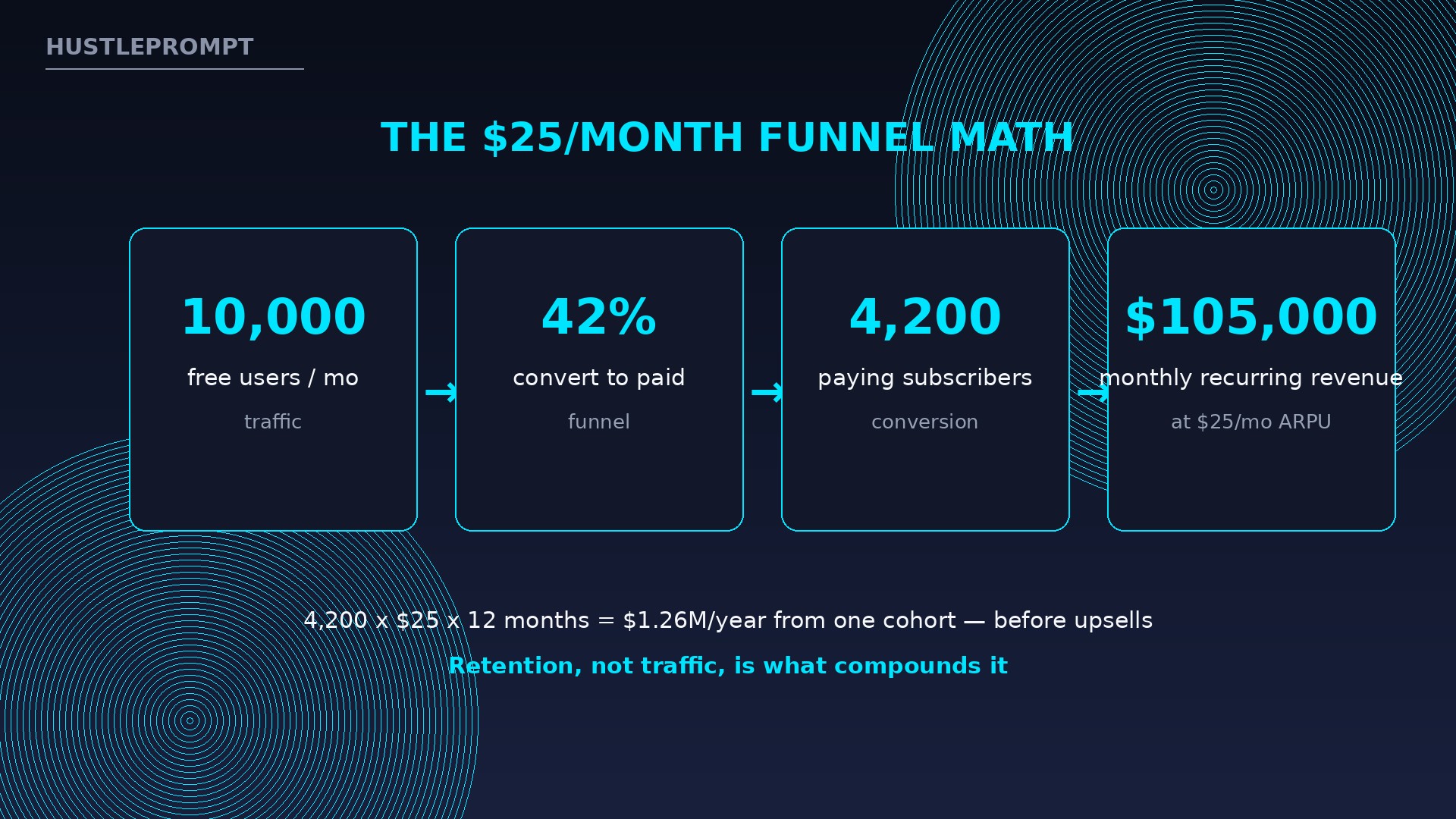
This is the documented shape: Candy AI hit $25M ARR within its first eight months of 2024 at ~$25/month per paying subscriber (~200,000 payers). Character.AI reached an estimated $50M in 2025, up 66% from ~$30M in 2024. The flip side: Replika ($14M in 2024, 25M registered users) is estimated to slide to ~$4.8M by 2026 after restricting intimate features in 2023. Cut the intimacy, lose the monetization.
How to profit: 4 plays for 2026
1. Build a niche companion app (wellness, learning, care)
Generic is locked up, but niches are thin: 17% of companion apps have “girlfriend” in the name vs 4% using “boyfriend” or “fantasy.” Pick one audience — night-shift sleep coach, exam-prep accountability partner, seniors’ check-in. Launch at $9.99–$14.99/month, optimize the funnel toward the 42% benchmark, and bake in age assurance and crisis protocols from day one. At 42% × $25 ARPU, 3,000 free monthly users yield ~1,260 payers and ~$31.5K MRR.
2. White-label companion platforms
Character AI, image generation, billing, age verification, moderation — a six-figure build. White-label platforms let partners launch branded companion sites and keep up to 60% of revenue, focusing only on traffic (WhiteLabelFans). Their example: 50,000 monthly visitors × 1.5% conversion = 750 payers × $20 ARPU = $15,000/month gross per cohort — up to $9,000 to the partner. Retention stacks the cohorts.
3. Compliance and safety-design consulting
Six regulatory moves in eleven months; California alone attaches a $1,000-per-violation private right of action; 300+ children’s online-safety measures move across 40+ US states (NCSL). Every operator needs age-verification flows, disclosure UX, crisis protocols, moderation audits. Sell the shovels: compliance audit packages, disclosure-UX kits, crisis-protocol templates — priced per app or per seat.
4. Character and persona IP marketplaces
Users bond with characters, and emotional investment makes switching platforms hard — leaders’ revenue is sticky because of it. The emerging play: licensable character IP — voices, personalities, story worlds indie builders rent instead of inventing. Build the marketplace; take the transaction cut.
What could go wrong
Research is mixed: one 2026 study found a single AI conversation cut momentary loneliness about as much as talking to a person, while a four-week OpenAI × MIT trial (~1,000 users) found heavier daily use tracked with more loneliness and dependence. Causality is unsettled — but if regulators conclude harm is causal, liability widens fast.
And: 2025 market estimates range ~$18.6B–$37.7B depending on definition, and one publisher’s own summary contradicts its table on CAGR. Size bets on observed spending and your own funnel math, not analyst models. Fragmentation is real: features legal in one jurisdiction are banned in another.
FAQ
How big is the AI companion economy in 2026?
Observed mobile spending hit ~$328M in H1 2026 (Appfigures via Decrypt, web billing excluded); generative AI apps approached $2B in Q1 2026 (Sensor Tower). Analysts imply 25–31% CAGR through 2030.
What’s the difference between “AI companion” and “AI girlfriend app” market sizes?
Definitions drive the spread. Romantic consumer companions sit near $2.9B in 2026 (The Business Research Company); broad “AI companion” estimates ($28–37B) bundle assistants and enterprise copilots. Use the narrow number for sizing a consumer companion business.
How much can one niche companion app earn?
10,000 free monthly users × 42% conversion × $25/month ARPU = $105,000 MRR, or $1.26M/year from one cohort — before token upsells. Candy AI hit $25M ARR in eight months of 2024 at ~$25/month per payer.
What regulations apply to AI companion apps?
New York (Nov 2025), California SB 243 (Jan 2026, $1,000/violation), China (Jul 2026), Korea’s AI Basic Act (Jan 2026), EU AI Act Article 50 (Aug 2026). Common threads: age assurance, AI disclosure, crisis protocols, usage limits.
Why do companion apps convert free users so well?
Emotional investment: users who bond with a character don’t want to start over elsewhere, so switching costs are high. Optimized platforms convert ~42% of free users to paid versus 15–25% for typical apps.
Is it too late to enter — isn’t it winner-take-most?
Generalists are concentrated (top 10% take 89% of revenue), but 128 new companion apps launched in H1 2025 alone. Niches — wellness, learning, care, specific communities — have thin competition and a compliance moat clones can’t easily cross.
Keep Reading
- Vertical AI SaaS: Why Niche Tools Win Big in 2026 — the niche-beats-generalist playbook behind companion app strategy
- The AI Compliance Gold Rush Has Begun — why regulation is becoming the biggest money-maker in AI
- AI Short Dramas: Inside the $14B Vertical Video Gold Rush — how AI-generated characters are already monetizing attention