
Clio, a CRM built for law firms, does over $200M in annual recurring revenue (ARR) — the number software businesses live by. Meanwhile, general AI chatbots with hundreds of millions of users are still racing each other to be free.
That contrast is the whole story of 2026: the real money in AI isn’t in being everything to everyone. It’s in being indispensable to someone specific.
What’s trending: the revenue receipts
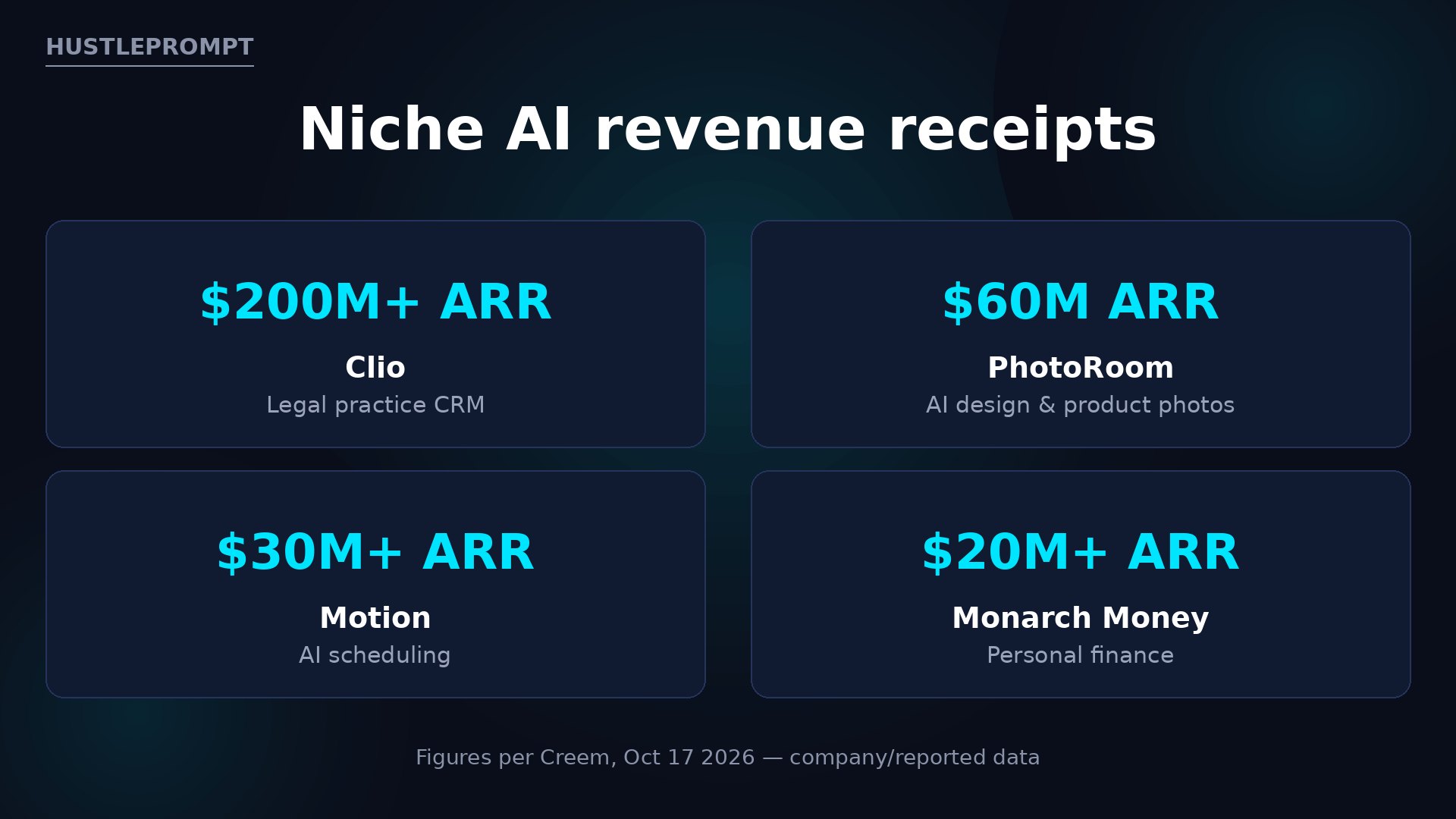
Creem’s October 17, 2026 roundup has the revenue numbers behind niche AI software:
- The giants: Clio at $200M+ ARR (legal CRM); Apollo past $100M+ ARR; PhotoRoom at $60M ARR (AI design); Motion at $30M+ ARR (scheduling); Monarch Money at $20M+ ARR (personal finance).
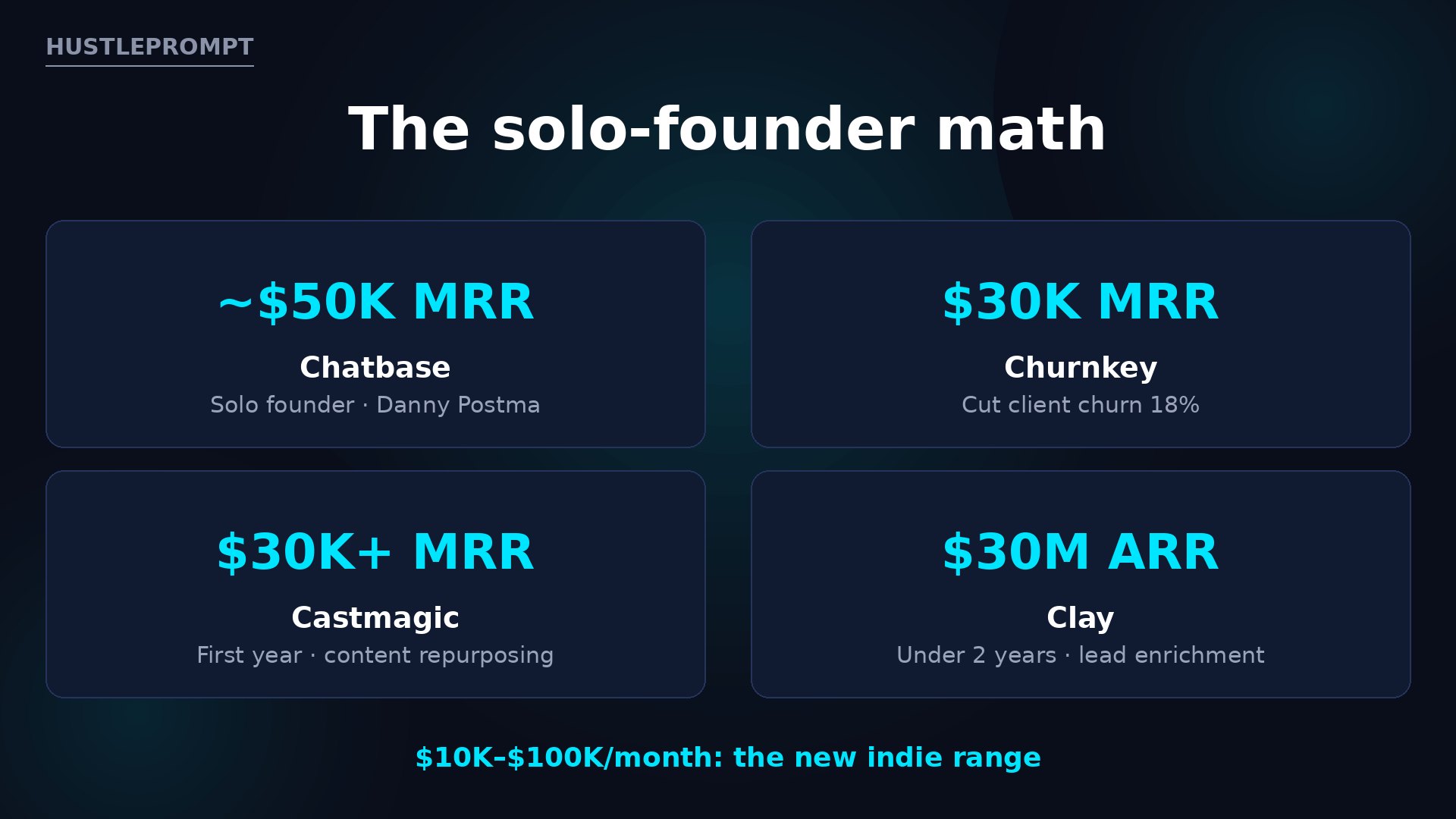
- Solo and lean teams (MRR = monthly recurring revenue): Chatbase at ~$50K MRR, built by solo founder Danny Postma (website chatbots); Castmagic past $30K+ MRR in year one (content repurposing); Churnkey at $30K MRR, documented 18% churn cut; Koala.sh past $1M+ ARR as a lean team (SEO content).
- Verticals investors pay up for: Spellbook raised $100M+ serving thousands of law firms on contract review — where lawyers charge $300–$600 an hour; Opus Clip crossed $5M ARR and raised $20M; Mintlify raised $18.5M (AI code docs); Descript raised $100M+ (podcast/audio); Otter.ai raised $65M.
- The macro tailwind: micro-SaaS is projected to hit $59.6B by 2030, growing ~30% a year — while solo developers already pull $10K–$100K a month building focused AI tools.
- Wall Street agrees: AI-related investment banking fees are projected at $8.5B globally in 2026, up from $3.5B in 2025 (Crisil Coalition Greenwich, via the Wall Street Journal); the four biggest US banks posted a combined $30B+ in Q3 profit, up ~15%.
The revenue table: 10 niche AI tools printing money
Same data, tighter view — every figure is paid subscription revenue.
| Tool | Niche | Revenue signal | Pricing |
|---|---|---|---|
| Clio | Legal practice CRM | $200M+ ARR | Paid SaaS |
| Apollo | Sales intelligence | $100M+ ARR | Paid SaaS |
| PhotoRoom | AI product design | $60M ARR | Paid SaaS |
| Clay | Lead enrichment | $30M ARR, under 2 years | Paid SaaS |
| Motion | AI scheduling | $30M+ ARR | Paid SaaS |
| Monarch Money | Personal finance | $20M+ ARR | Paid SaaS |
| Fireflies.ai | Meeting notes | $10M+ ARR (reported) | Paid SaaS |
| Lavender | Email optimization | $5M+ ARR | Paid SaaS |
| Chatbase | Website chatbots | ~$50K MRR (solo founder) | Paid SaaS |
| Churnkey | Churn prevention | $30K MRR (18% churn cut) | Paid SaaS |
Figures via Creem, October 17, 2026 — company and reported data. The “Paid SaaS” column is the tell: subscription revenue, not vanity metrics.
Why this is happening: models got cheap, workflows got valuable
Two years ago, the model was the moat. Today every frontier model drafts decent emails and summaries — so raw intelligence stopped being the product, and the value moved one layer up, into workflow integration.
Nobody pays $99 a month for “better ChatGPT” — they pay for meeting notes that land in their CRM on their own. The AI is the engine; the finished workflow is the product.
Why niches pay better:
- Willingness to pay. A lawyer billing $300–$600 an hour doesn’t blink at contract-review software — which is why Spellbook raised $100M+ serving thousands of law firms.
- Switching costs. Once your notes, schedules, and client data live inside one tool, leaving hurts. Habits beat features.
- Word of mouth. Dentists talk to dentists; lawyers talk to lawyers. Win one vertical and the niche sells itself.
Morgan Stanley CEO Ted Pick calls the AI build-out a “once in a multi-generation change”: AI-related investment banking fees are projected at $8.5B globally in 2026 versus $3.5B in 2025 (Crisil Coalition Greenwich), per the Wall Street Journal.
Micro-SaaS is projected to reach $59.6B by 2030, growing ~30% a year (Creem) — big money and small builders betting on the same thing: the niche.
Where this is heading
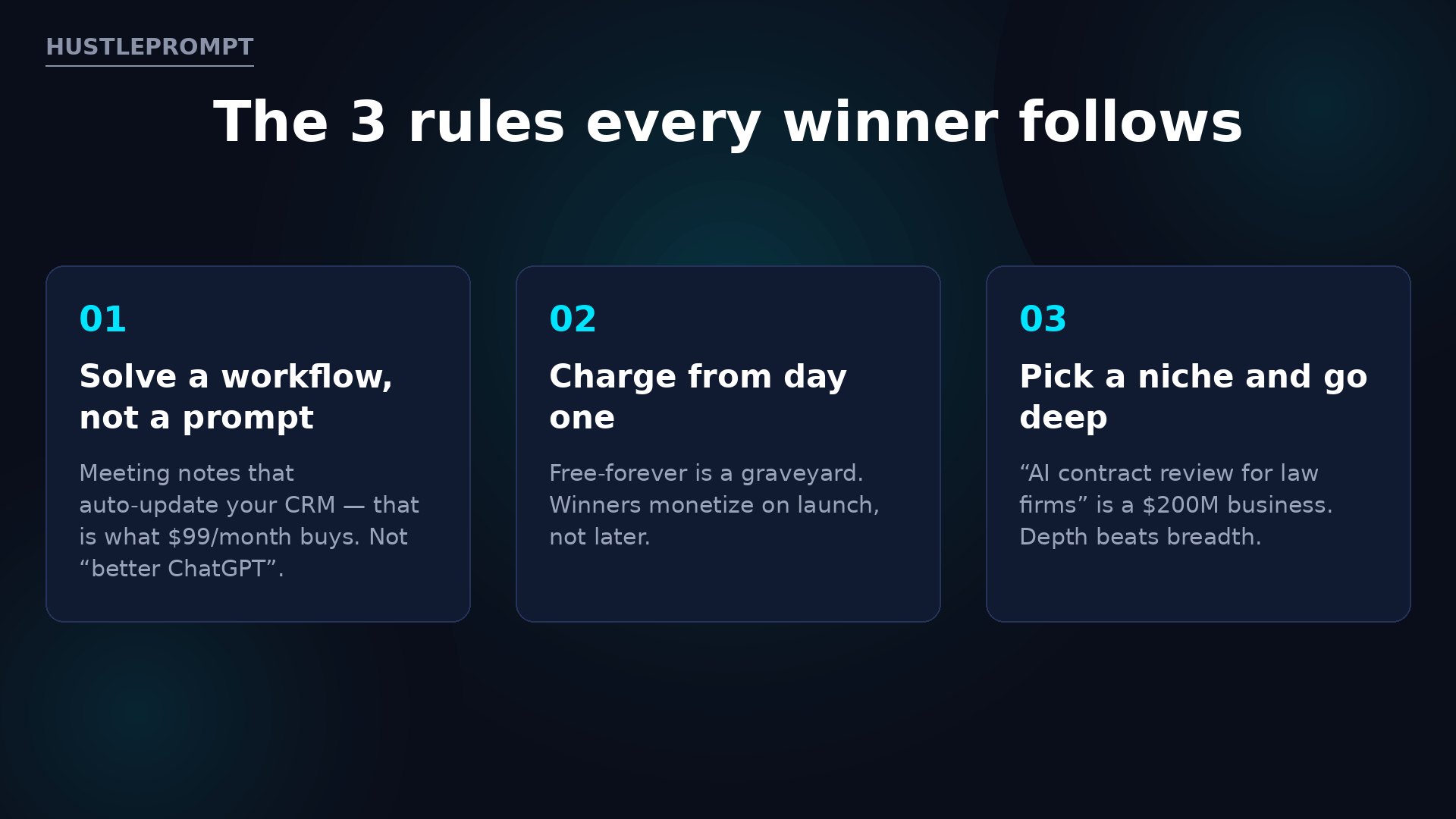
Three rules that double as a business plan:
STEP 1
Find a painful recurring workflow
- Pick an audience you understand: lawyers, dentists, landlords, agencies
- Target work that repeats weekly, costs real money, and everyone hates doing
STEP 2
Wrap it in AI that does the job end-to-end
- Not a chatbot that suggests — a tool that delivers the finished artifact
- Push output where work already happens: the CRM, inbox, or calendar
STEP 3
Charge from day one ($29–$199/mo)
- Price the workflow’s value, not your token cost
- Offer a trial — never a free-forever tier
Nail those three in a niche small enough to own, and you match every company in the revenue table.
How to profit from the vertical AI boom
Five plays, from smallest lift to biggest:
- Productize a service you already sell. If clients pay you for email sequences or CRM cleanups, the process is the product: one input, one output, one price.
Example math: $49/month × 200 niche users = $9,800 MRR. - Build a niche micro-SaaS. One painful workflow, one audience, one subscription. The indie range is real — $10K–$100K a month for solos — and Chatbase hit ~$50K MRR as a one-person company.
Example math: $79/month × 150 users = $11,850 MRR. - Resell a vertical tool as an agency. Businesses buy outcomes, not software — sell a niche tool plus setup, training, and support on retainer.
Example math: 10 clients × $500/month = $5,000/month recurring. - Buy a tiny profitable tool. Acquire a small tool with existing revenue in a niche you know, then grow it with better onboarding.
Example math: $2K → $5K MRR adds $36K in annual revenue. - Sell implementation and onboarding. Every tool in the revenue table needs setup. Charge for migration, training, and integrations.
Example math: $1,500 setup + $300/month × 8 clients = $2,400/month plus $12,000 in setup fees.
What to do now
- Pick ONE niche you understand — a past job, freelance clients, or an industry in your family. Insider knowledge beats brilliant code.
- Map the workflow on paper first. If you can’t draw the five steps, you can’t automate them.
- Ship the smallest paid version: one input, one output, one price. Charge from day one.
- Sell to ten users by hand before automating marketing. Ten manual sales teach you pricing, pitch, and objections.
- Anchor price to the cost you replace. A tool saving a $400-an-hour lawyer two hours a week is not a $19 product.
Three predictions
- By 2027, the biggest AI revenue stories will be vertical: the $59.6B micro-SaaS projection says money compounds in niches. The next Clio won’t be a chatbot — it’ll be the default tool of some unsexy industry.
- General AI becomes free infrastructure; paid value lives in workflows. Chatbots race to zero while tools that finish the job keep their pricing power.
- Solo founders take a visible slice. Chatbase (~$50K MRR, one person), Castmagic ($30K+ MRR in year one), Koala.sh ($1M+ ARR, lean team) are the template — the $10K–$100K-a-month indie range is becoming a career path.
Watch: the unsexy micro-SaaS playbook
A case-study breakdown of a micro-SaaS built inside WhatsApp — the economics of conversational software, why boring niches compound, and the revenue math for small, focused tools.
Keep Reading
- The Agent App Store Gold Rush Is Starting
Sell skills and workflows where AI agents shop. - AI Social Media Management: Sell It to Local Businesses
Productize an AI service for local clients. - How to Create and Sell Your First AI Online Course
Package what you know into a sellable product.
FAQ: vertical AI SaaS, answered
What is vertical AI SaaS?
Software that uses AI to do one industry’s job end-to-end — contract review for law firms, meeting notes that update your CRM, product photos. “Vertical” means deep in one niche, not wide across everyone. General AI answers prompts; vertical AI finishes workflows.
Why do niche tools beat general AI?
They solve a complete workflow instead of answering a question, embed in daily habits (switching costs), and charge from day one while chatbots race to free. Nobody pays $99 a month for “better ChatGPT” — but businesses happily pay for finished work.
How much does it cost to start a niche AI tool?
Less than the business it replaces. Winners started as focused wrappers around existing models — the real cost is your time learning the workflow. Start small and paid: one input, one output, one price.
Do I need to know how to code?
It helps, but the scarce skill is workflow knowledge. Winners understand a niche’s painful process better than anyone; no-code tools and AI coding assistants can handle the building if you bring the expertise.
Isn’t the market saturated?
General AI, yes. Niches, no — there are thousands. “AI contract review for law firms” alone supports a $200M business. Saturation happens horizontally; depth is still wide open.
How fast can a niche AI tool make money?
Faster than most software bets, because you charge from day one. Castmagic passed $30K+ MRR within its first year; Chatbase hit ~$50K MRR within months as a solo founder. Exceptional results, not promises.