
TorchTPU is the biggest threat to Nvidia’s software moat in a decade. Yesterday, at PyTorch Conference 2026, Google open-sourced the stack that lets any PyTorch app run natively on Google TPUs — and the migration is, in Google’s words, a configuration change, not a rewrite.
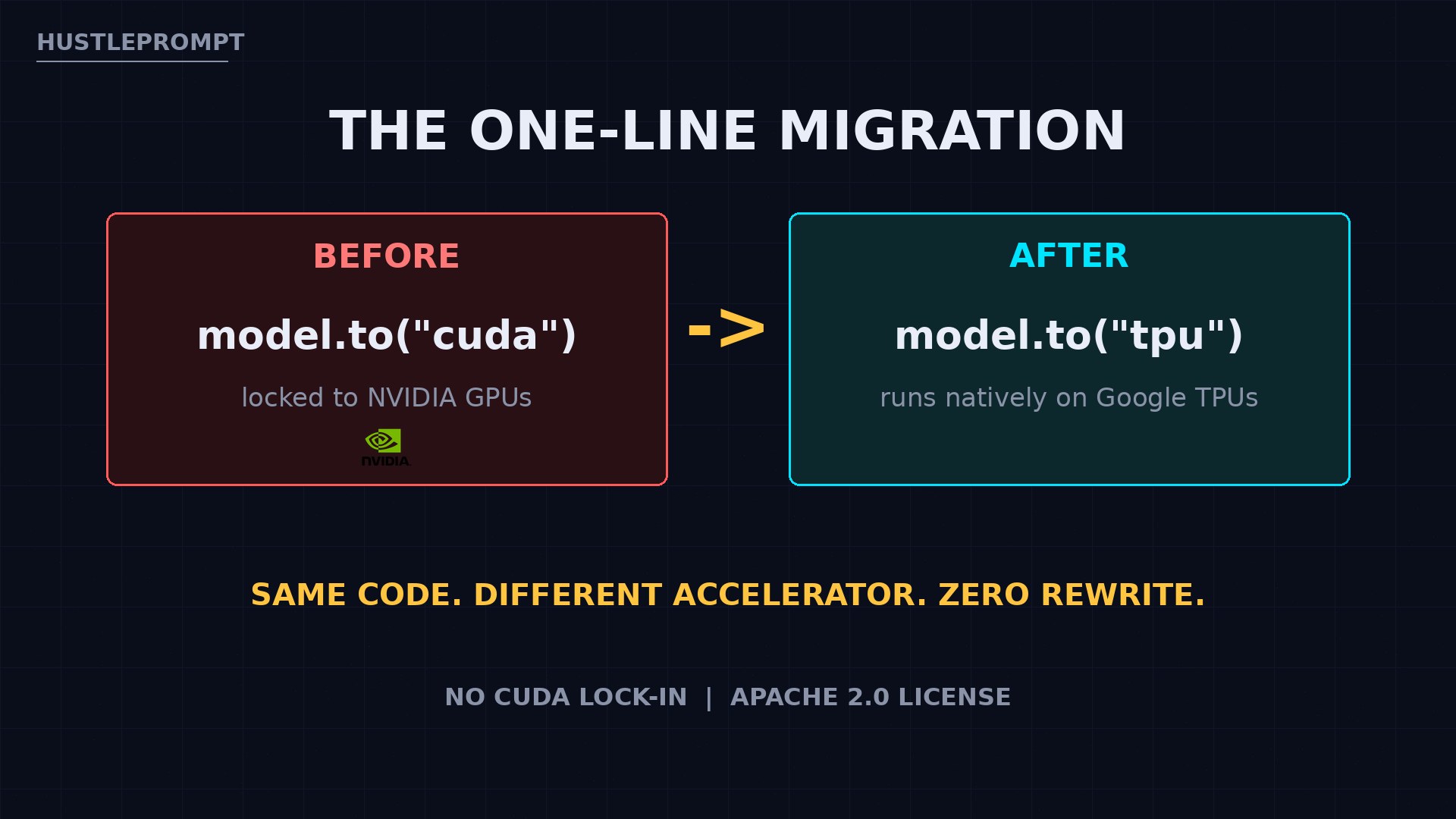
Here is the short version: if your AI app targets Nvidia GPUs today, swapping .to("cuda") for .to("tpu") points it at Google’s chips. For builders paying GPU rental bills, that turns a months-long porting project into a price comparison.
What Google actually announced
On October 20, 2026, Google’s Mark Lohmeyer (VP & GM, AI & Computing Infrastructure) and Bill Jia (VP of Engineering) published Google’s official TorchTPU announcement. The headline: TorchTPU, the native PyTorch stack for Google TPUs, is now open source on GitHub, co-developed with the PyTorch team at Meta.
“With TorchTPU, TPUs join GPUs and CPUs as a native option for PyTorch,” the post says. Developers can train, serve, and deploy models on TPUs with the tools they already run: vLLM, SGLang, llm-d, TorchTitan, Ray, Hugging Face, and LiteRT.
The mechanics matter more than the marketing. TorchTPU plugs into PyTorch’s PrivateUse1 interface, so the TPU registers as an ordinary hardware device — no subclasses, no wrappers. You debug in eager mode, then hand the same model to torch.compile for production throughput and lower memory overhead. It replaces PyTorch/XLA, the old path that forced developers to mark compilable regions. Google now recommends TorchTPU for all new workloads.
| Component | What it does | Status |
|---|---|---|
| TorchTPU | Native PyTorch backend for TPUs via the PrivateUse1 interface | v0.2.0 on PyPI, Apache 2.0 |
| vLLM-TorchTPU | High-throughput serving on TPUs (with Inferact) | Open source |
| SGLang-TorchTPU | Agentic/structured workloads on TPUs (with RadixArk) | Open source |
| TorchTitan build | Large-scale distributed training recipes | Validated to 8,192 Ironwood TPUs |
| llm-d 1.0 | Kubernetes-native distributed inference routing (CNCF Sandbox) | Production-ready |
| TPU agent suite | Automates onboarding, diagnostics, inference tuning | Preview on GitHub |
Why this is a direct shot at Nvidia’s CUDA moat
Nvidia’s grip on AI was never just the chips. It was CUDA — the software layer that made rewriting code for other hardware painfully expensive. As TechCrunch reported, PyTorch is used by about 85% of AI apps, and many of its features were built specifically around Nvidia GPUs. TorchTPU attacks exactly that lock-in. And Google is not alone: Amazon announced TorchNeuron for its Trainium chips one day earlier. Two hyperscalers open-sourcing native PyTorch backends in the same week is a coordinated siege on the same wall.
Meta’s endorsement gives the effort real weight. Jana van Greunen, Director of PyTorch Engineering at Meta, said TorchTPU lets Meta push “major LLM, Ads, and Recommendation systems workloads” onto Google silicon because Meta “cannot be constrained by a single hardware architecture.”
Hugging Face partnered too. In Transformers v5, deploying a model to TPUs is as simple as passing device_map="tpu", and the Diffusers library runs natively with eager mode and torch.compile.
The production numbers — and the honest gaps
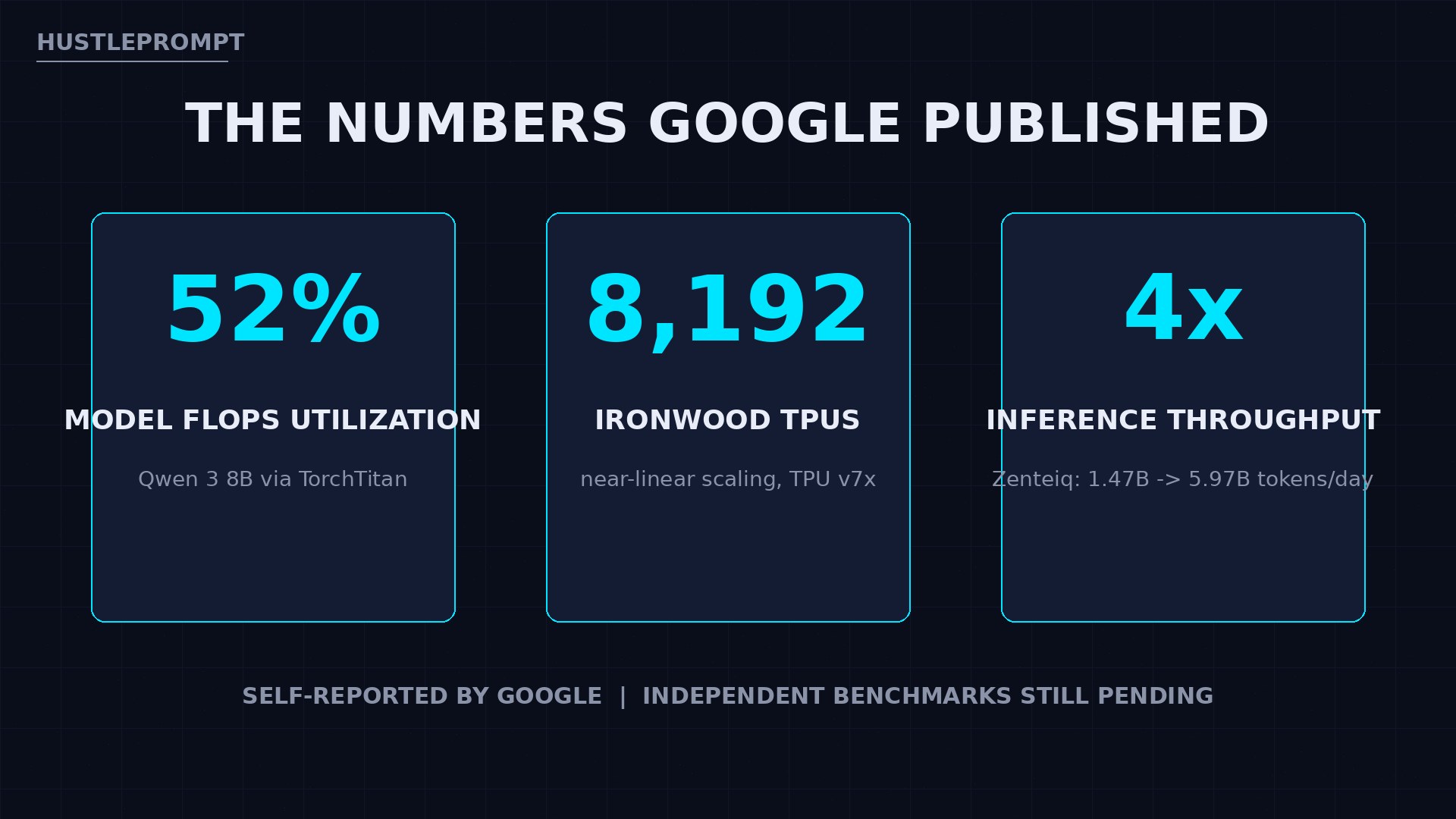
Google’s headline training figure: up to 52% Model Flops Utilization training Qwen 3 8B, near-linear scaling across 8,192 Ironwood TPUs. And Zenteiq, quoted in the announcement, reports over 4× inference throughput on GKE — from 1.47 billion to 5.97 billion tokens per day per 1,000 TPU v6e.
The honest gaps: Google published no independent benchmark suite — the framing is Google’s own. Hugging Face says its TPU test coverage is “not all green yet” (~96.5% passing). One Google test needed an attention-function swap TorchTPU doesn’t support yet.
How the TorchTPU migration works
.to("cuda")..to("tpu"). TorchTPU registers the TPU as a native PyTorch device.torch.compile for throughput and lower memory overhead.Source: Google Cloud blog, Oct 20, 2026. The predecessor PyTorch/XLA required explicit compilable regions — TorchTPU removes all three of its biggest barriers.
How to profit from TorchTPU right now
This is infrastructure news, which means the money goes to builders who move first:
- Cut your inference bill. If you serve an open-weight model on rented GPUs, benchmark the same workload on TPU v5e/v6e. TPU pricing frequently undercuts A100/H100 rentals per token.
- Sell the migration. Startups with PyTorch codebases will pay for a validated one-line migration plus performance tuning. The change is small; the confidence that nothing breaks is the product.
- Ship TPU tooling. Wrappers, monitoring, and cost dashboards for TPU inference are greenfield — the TPU agent suite is only in preview.
Frequently asked questions
What is TorchTPU?
Google’s open-source native PyTorch backend for its TPUs, co-developed with Meta’s PyTorch team. It lets existing PyTorch code run on TPUs with minimal changes.
How is it different from PyTorch/XLA?
The old path used lazy tensors and required marking compilable regions. TorchTPU registers the TPU as a native device: debug in eager mode, then torch.compile for production.
Do I need to rewrite my PyTorch code?
For most workloads, no. Google says migration is typically a configuration change — pointing the device at “tpu” instead of “cuda”. Some models may need small adjustments.
Which tools work with TorchTPU?
vLLM, SGLang, llm-d 1.0, TorchTitan, VeRL, Ray, Hugging Face Transformers v5 and Diffusers, TorchRec, and LiteRT for on-device deployment.
Is TorchTPU really free?
The software is open source under Apache 2.0. Running TPUs still costs money on Google Cloud — the savings come from TPU pricing vs. GPU rentals.
Keep Reading
Sources: Google Cloud blog (official announcement); TechCrunch. Performance figures are Google’s self-reported data unless noted.