
Voxtral 3 just made voice AI agents cheap enough to sell. On October 20, Mistral AI launched a complete voice-agent stack — speech models plus a real-time SDK — where a full conversational agent costs $0.04 a minute. That is the price of a phone call, for an agent that listens, reasons, uses your tools, and talks back.
For anyone selling to local businesses, this is the moment the AI receptionist business model finally pencils out. Here is what launched, what it costs, and the exact math.
What Mistral actually launched
Mistral’s official Voxtral 3 announcement describes four models plus one SDK, all in public preview on the Mistral API:
- Voxtral Small Transcribe 3 — flagship batch transcription and diarization (who said what), with context biasing for domain vocabulary.
- Voxtral Mini Transcribe 3 — a 4B-parameter model for cheaper, faster batch jobs.
- Voxtral Mini Transcribe Realtime 3 — streaming transcription over WebSocket with end-of-turn detection.
- Voxtral Mini TTS 3 — text-to-speech with emotional adaptation across 35+ languages and 50+ dialects.
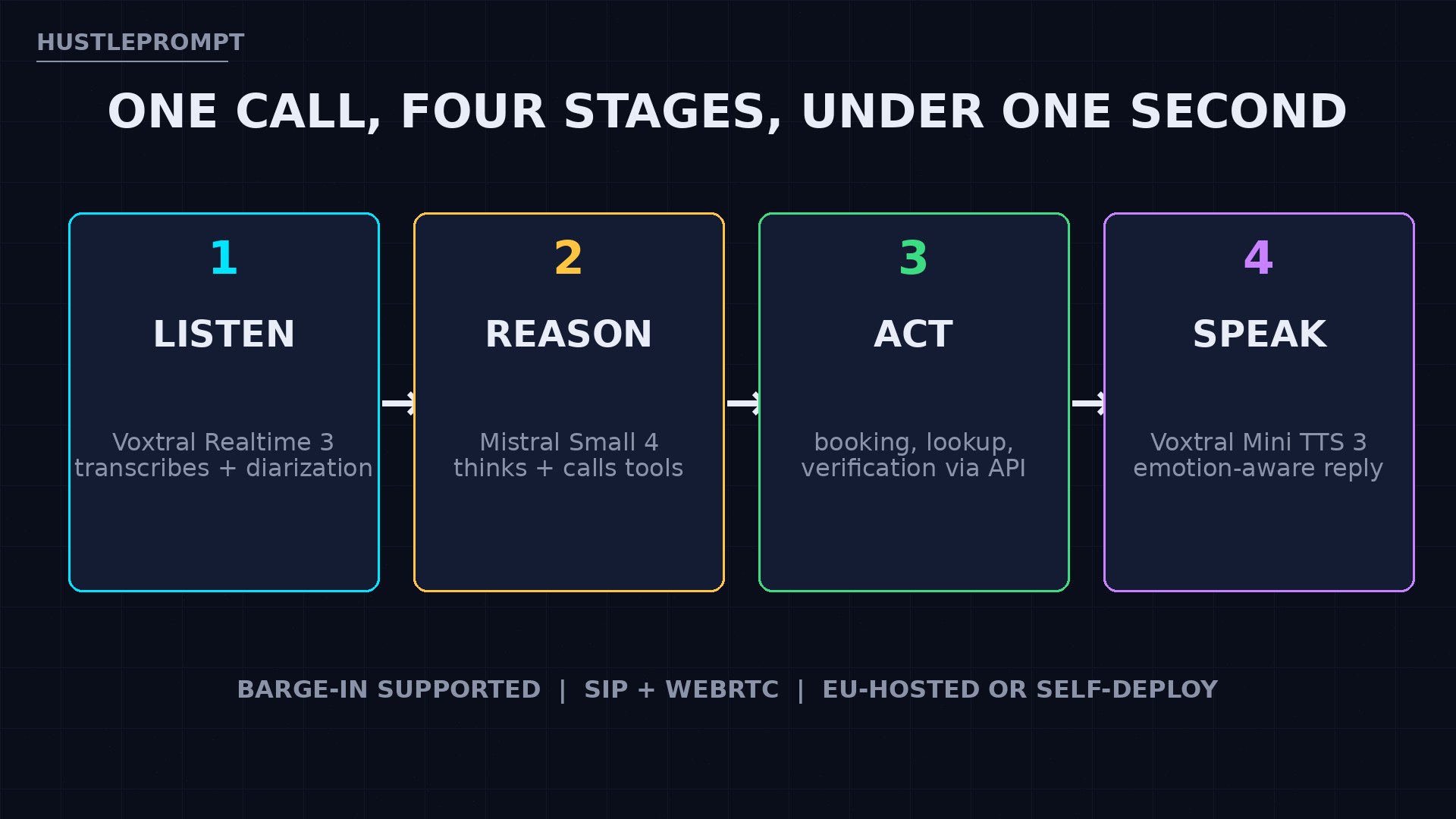
- Voice agent SDK — built on LiveKit, combining listening, reasoning, tool calls, and speaking into one streaming pipeline over SIP (phone) or WebRTC (browser/app).
The headline capability is the end-to-end connected call: the agent can verify a caller’s identity, check a bill, or book an appointment during a live conversation. In Mistral’s demo, an English speaker called a clinic holding a French referral letter — the agent read the French, booked the appointment, and confirmed by text in English.
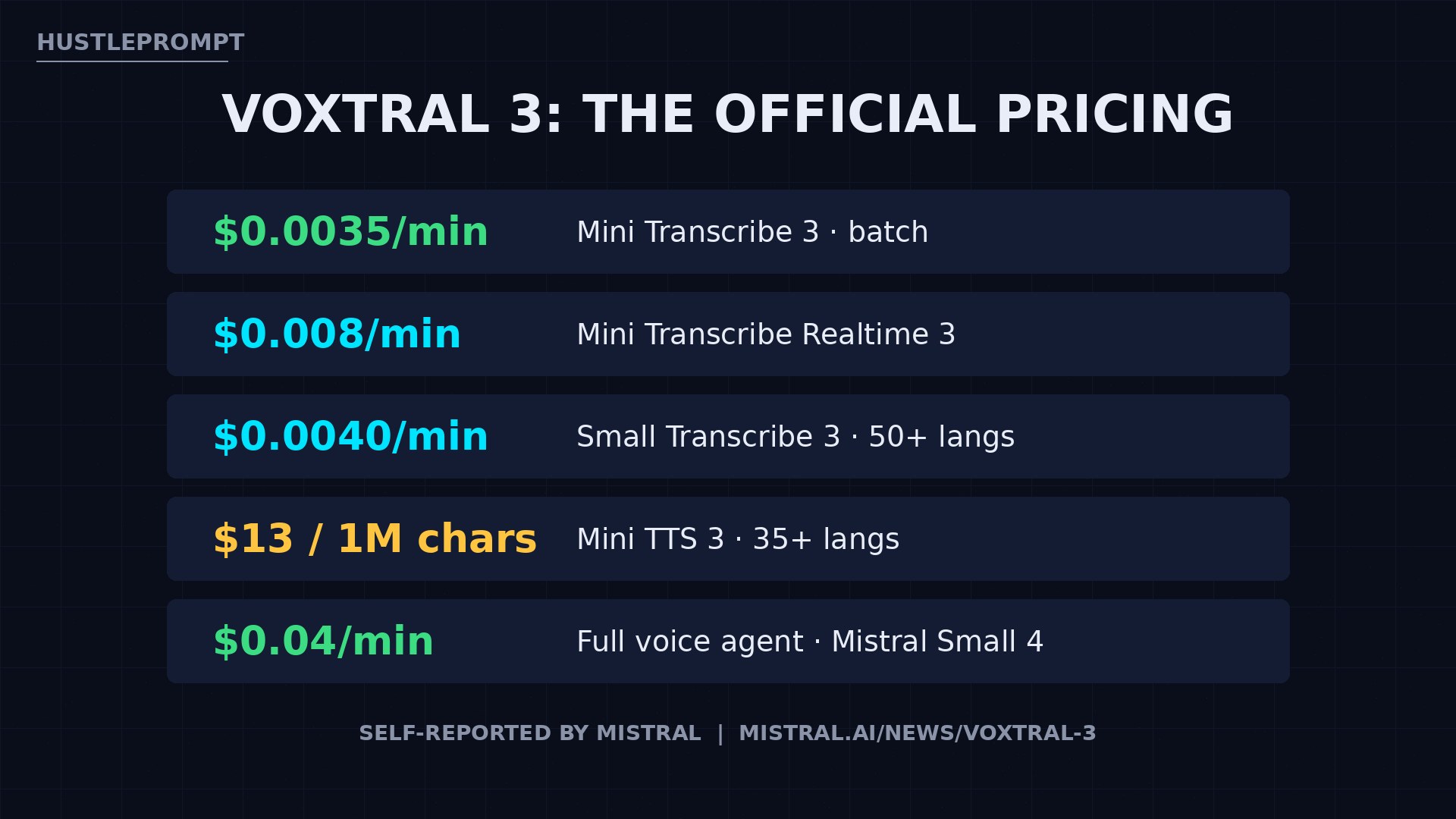
| Model / service | Price (official) | Key spec |
|---|---|---|
| Voxtral Mini Transcribe 3 (batch) | $0.0035/min | 4B params, 50+ languages |
| Voxtral Mini Transcribe Realtime 3 | $0.008/min | Sub-500ms latency, 35+ languages |
| Voxtral Small Transcribe 3 | $0.0040/min | SOTA diarization, beats Whisper |
| Voxtral Mini TTS 3 | $13 / 1M chars | 35+ langs, 50+ dialects, emotion-aware |
| Voice agent API (Small 4 reasoning) | $0.04/min | Full pipeline, SIP + WebRTC |
| Voice agent API (larger model) | $0.08/min | Harder reasoning tasks |
The benchmarks behind the price
Mistral claims state-of-the-art results — and names names. Voxtral Small Transcribe 3 “outperforms Whisper, Scribe v2 and Gemini 3.5 Transcribe” on multilingual transcription and diarization, including English, French, and Spanish. On the FLEURS benchmark across 45 languages, Mistral reports the Small model’s word error rate beating the field.
On the speech side, at $13 per million characters, Mistral says Voxtral TTS “costs less to run than comparable models from OpenAI TTS-1, Deepgram, ElevenLabs Flash and Gemini Flash.” All performance claims are Mistral’s own — no independent reviewers were named at launch — but the pricing is published and testable today.
Do the money math: the AI receptionist
This is where Voxtral 3 stops being a spec sheet and becomes a business. Run the numbers on a voice agent answering calls for a local business:
- Cost: 4 hours of talk time per day × 60 minutes × $0.04/min = $9.60/day, roughly $210/month.
- Price: AI receptionist services routinely sell for $1,500–$3,000/month to dental clinics, law firms, and home-service companies.
- Margin: even at the low end, that’s ~7× markup on raw API cost — before you count setup fees.
Three concrete plays:
- White-label receptionists. Pick one vertical (dental, HVAC, legal intake), build the booking integrations once, and sell the same agent to dozens of businesses. Voxtral’s context biasing handles their jargon without fine-tuning.
- Multilingual arbitrage. 50+ transcription languages and 50+ dialects of speech is a moat in markets competitors ignore — Spanish-speaking home services in the US, EU businesses needing all 24 official languages.
- Self-hosted enterprise. Mistral offers Voxtral 3 for self-deployment. Regulated industries (healthcare, finance) pay premiums for voice AI that never leaves their infrastructure.
Anatomy of a Voxtral 3 call
Source: Mistral AI announcement, Oct 20, 2026. Full turn completes in under one second, per Mistral. Each stage is a separate model — swap the LLM, voice, or language without rewriting the agent.
What to watch out for
Three honest caveats from the launch materials. First, the voice agent SDK’s phone integration has tighter launch restrictions than the announcement suggests — check the docs before promising SIP to clients. Second, Mistral’s “under one second” turn time is the company’s own claim with no conditions published. Third, Pro Voice cloning and self-deployment terms are “talk to our team” — no public pricing.
Frequently asked questions
What is Voxtral 3?
Mistral AI’s family of speech models plus a voice agent SDK, launched October 20, 2026. It combines transcription, reasoning, tool calls, and speech synthesis into one real-time pipeline.
How much does a Voxtral 3 voice agent cost?
$0.04 per minute with Mistral Small 4 handling reasoning, or $0.08 per minute with a larger model. Standalone transcription starts at $0.0035/min and TTS at $13 per million characters.
How many languages does it support?
Transcription covers 50+ languages (including all 24 official EU languages). Speech synthesis covers 35+ languages and 50+ dialects, with emotion and pace adapted to the conversation.
Can it take real phone calls?
Yes — the SDK supports phone connections via SIP and browser/app sessions via WebRTC, and connects to existing telephony, IVR, and contact-center software. Launch restrictions apply to phone integration; check Mistral’s docs.
How is this different from ElevenLabs’ voice agents?
Both sell full voice-agent pipelines. Voxtral 3’s differentiators are EU-hosted/self-deployed options for data sovereignty, 50+ language coverage, and published per-minute agent pricing starting at $0.04.
Keep Reading
Sources: Mistral AI official announcement; Mistral audio docs. Benchmarks and latency claims are Mistral’s self-reported data.