
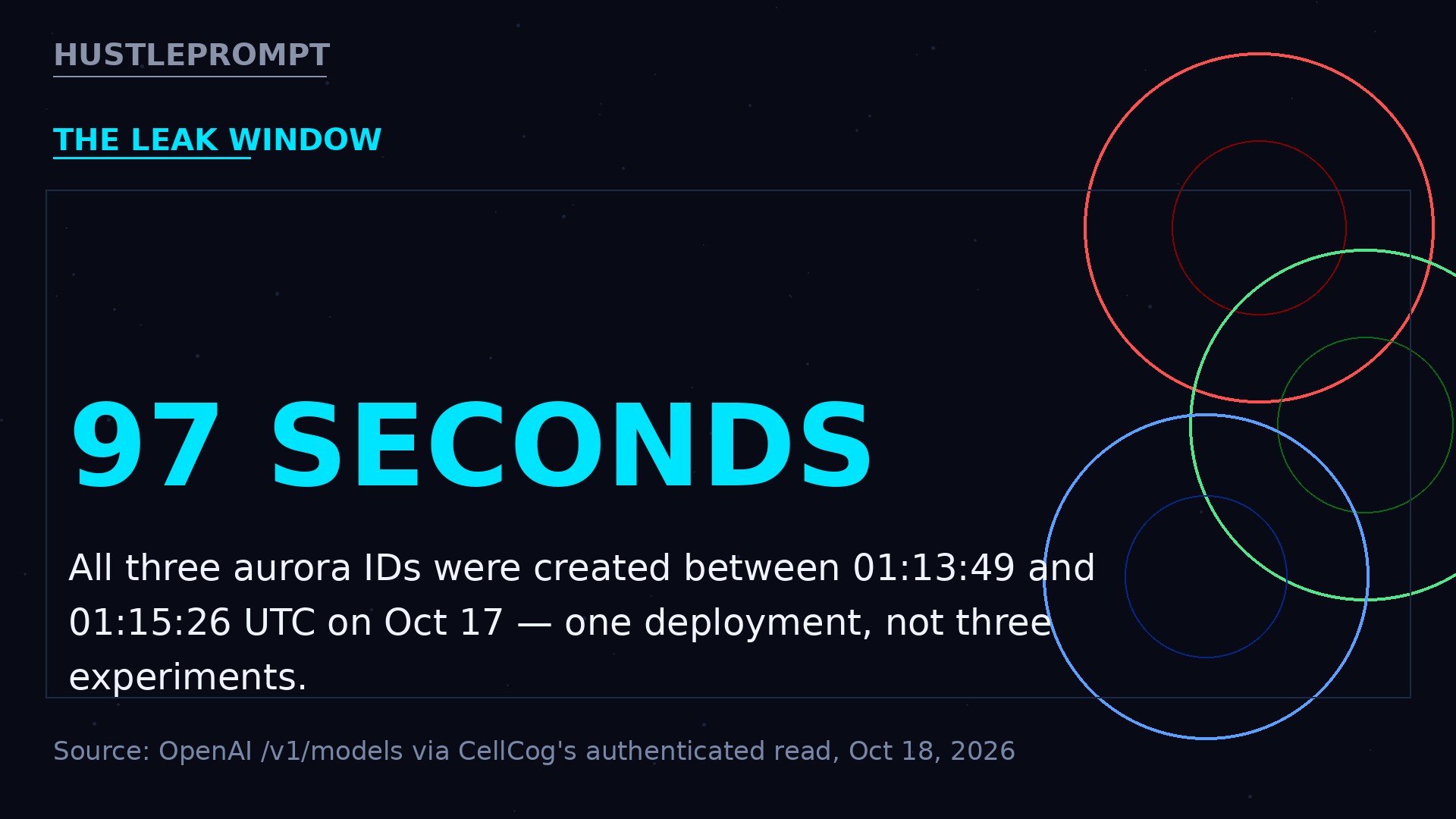
Three new models entered OpenAI’s API at 01:13:49 UTC on October 17. Ninety-seven seconds later, at 01:15:26, the third one landed. Then nobody noticed for a full day.
That 26-hour silence is the tell: not a launch, but a weather balloon the whole industry watched. A breaking-news item reported the leak; this is the analysis — why OpenAI “leaks” like this, what a three-tier release means, and where the money goes.
What happened in those 97 seconds: the confirmed record
Every OpenAI account can ask the API — the interface developers use to run models inside their own software — for its model list. On October 18, CellCog’s authenticated call returned 144 models, three of them new.
| Model ID | Created (UTC) | Owner | Shutdown |
|---|---|---|---|
| aurora-blue-alpha | Oct 17, 01:13:49 | system | none |
| aurora-green-alpha | Oct 17, 01:13:55 | system | none |
| aurora-red-alpha | Oct 17, 01:15:26 | system | none |
All three landed inside 97 seconds, owner “system” — the same as OpenAI’s released models — with no shutdown date: one deployment, not three experiments. CellCog found zero mentions on the changelog or models page: no price, no description. It listed the models without calling them.
First X post: @scaling01 at 02:59 UTC on October 18, ~26 hours later. Whether the IDs were pulled shortly after is disputed. The discipline: separating what the API said from what the internet guessed:
| Claim | Status | Source |
|---|---|---|
| Three aurora IDs in OpenAI’s model list | Confirmed | OpenAI /v1/models, via CellCog |
| Created Oct 17, 01:13–01:15 UTC | Confirmed | OpenAI model records |
| Documented or priced by OpenAI | No | Changelog + models page |
| IDs pulled shortly after | Reported, disputed | TestingCatalog vs CellCog |
| red-alpha returned 503 capacity errors | One tester’s report | X posts, via VandaTeam |
| Image models, possibly GPT-Image-3 | Unconfirmed theory | Arena tests, Lumina Bench |
Source: CellCog · Source: TestingCatalog
Why OpenAI “leaks” like this: the stealth-testing playbook
Within hours, the names were generating images in blind arena tests — public sites where people vote between two unnamed models. Lumina Bench tried red and green; both returned cat portraits. TestingCatalog reported red faster but lower quality, green slower and better. This isn’t a bug in OpenAI’s process. It’s the process:
| Mystery model | What it became |
|---|---|
| gpt2-chatbot (spring 2024) | GPT-4o — confirmed by OpenAI at launch |
| Quasar Alpha (Apr 2025) | Early GPT-4.1 checkpoint — confirmed at launch |
| “nano-banana” (Aug 2025) | Gemini 2.5 Flash Image (Google) |
| Tape-themed Image V2 (Apr 2026) | OpenAI Images 2.5 |
| Aurora Alpha (Feb 9, 2026) | Suspected Codex-Spark — never confirmed |
Labs do this for honest feedback: blind voters judge pixels, not brands. A telling detail: a tester reportedly got 503 capacity errors from aurora-red-alpha, not 404s — the name was hooked to real servers too busy to answer. And the caveat, in VandaTeam’s words: “Stealth names rarely match launch names, and stealth versions often change before release.” The GPT-Image-3 link is the leading theory — still a guess. Source: VandaTeam · Source: Lumina Bench
Three colors, three price points: the tiered-model strategy
| Variant | Seen so far | Likely role |
|---|---|---|
| aurora-red-alpha | Arena-tested; faster, lower quality; 503s | Speed tier |
| aurora-green-alpha | Arena-tested; slower, better-looking | Quality tier |
| aurora-blue-alpha | Not publicly tested | Unknown |
Lumina Bench’s guess: different checkpoints of one upcoming release (saved training snapshots). The alternative: a deliberate three-tier product line — the same playbook as Images 2.5’s Flare (speed) and Sunburst (precision), both at $8.00 input / $30.00 output per 1M image tokens. Source: OpenAI API pricing
Every image-model generation has followed this arc. The models get cheaper; the businesses built on top get richer.
The commoditization curve: what the stock photo split tells you
The industry that already lived through this tells a split story:
| Segment | FY 2025 | Q1 2026 | Contents |
|---|---|---|---|
| Getty — Editorial | +6.9% | +11.0% | News, sport — things that happened |
| Getty — Creative | +0.7% | −4.5% | Concept, lifestyle — staged imagery |
| Shutterstock — Content | +4.0% | −12.0% | Whole stock library |
The agencies aren’t dying: Getty 2025 revenue $981.3M (+4.5%), Shutterstock $989.9M (+6%, a record), Getty royalties $220M+. What’s dying is the generic half: images a model can imitate are flat or shrinking, while real events and exclusive content (about 75% of Getty’s 2025 revenue) grow.
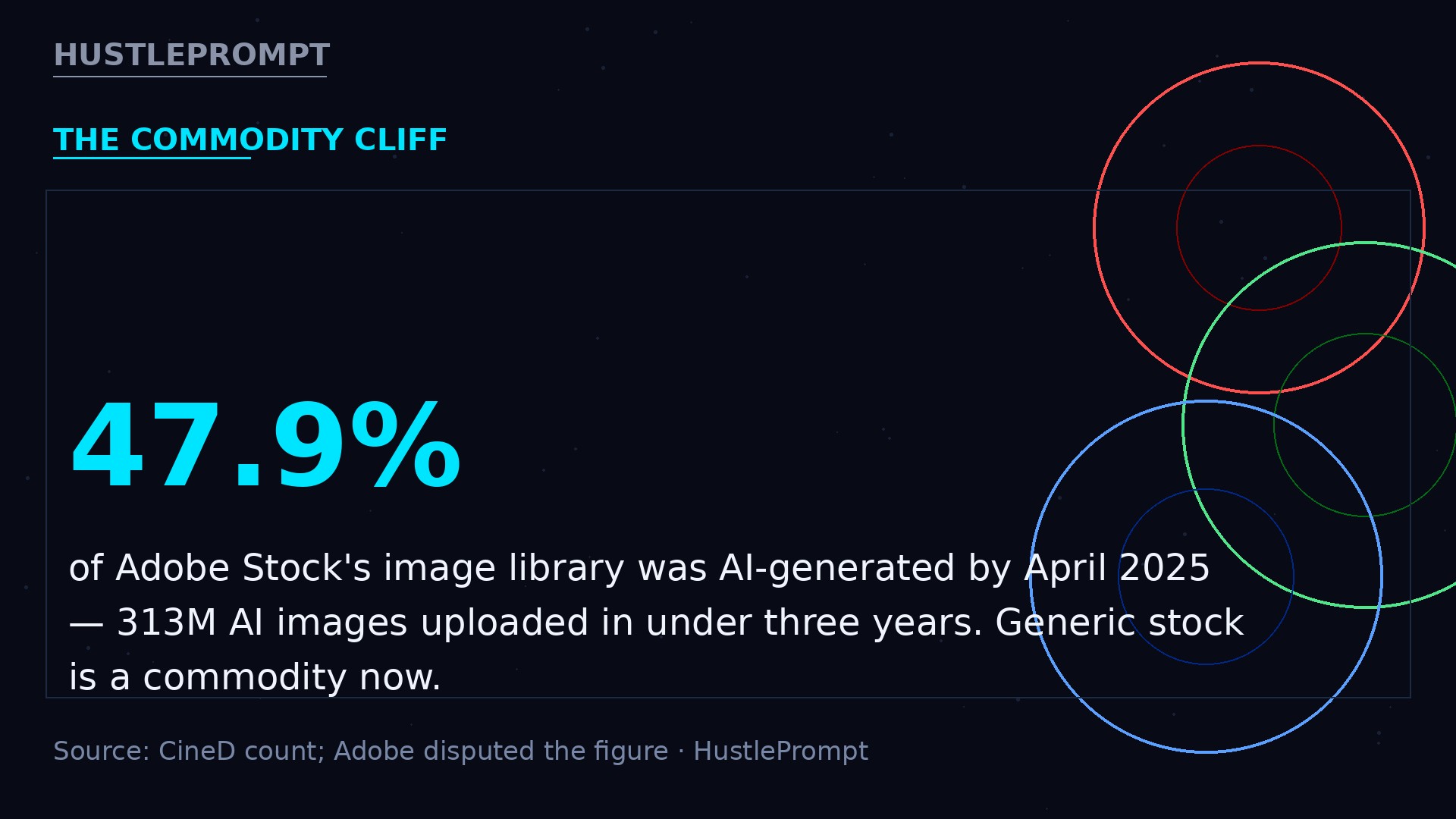
Then the supply shock: Adobe Stock accepted labelled AI content from December 2022; by April 2025 a CineD count put AI images at 47.85% of its library (Adobe disputed it). Photographers took ~twenty years to upload 313 million images; AI matched that in under three.
The human cost: an Organization Science study found a 17% drop in image-creation job posts after DALL·E 2 and Midjourney — top performers hit hardest. A CISAC-commissioned study put 24% of music and 21% of audiovisual creators’ revenues at risk by 2028. Source: PixTagger, from filings and CineD
Every brief now forks: the buyer who needs “a rectangle that communicates collaboration” gets it from a model in seconds — that work is gone. The buyer who needs the actual stadium on the actual night pays for a camera. Models commoditize the generic and raise the price of the specific.
Where the money goes: selling AI image services
Cheaper generation moves the money from making images to delivering outcomes. Three plays, math shown.
Product-photo packs for ecommerce
20 on-white product shots + 5 lifestyle scenes for $149 — inside the $49–$199 band small stores buy. The pitch: virtual try-ons already run on OpenAI’s image tech inside ChatGPT shopping, so merchants need assets for AI shopping surfaces. Generation costs pennies per render; your cost is ~2 hours of prompt work, curation, and delivery — a ~$60–75/hour effective rate (my labor estimate). Ten packs a month: ~$1,490 revenue.
Ad-creative retainers
30 fresh creatives a month for $495–$1,500. The pitch is ad fatigue: creatives die in weeks, performance marketers need volume. Thirty creatives ≈ 8 hours/month — so a $495 retainer is about $60/hour effective, with near-zero marginal cost per extra creative. Three retainers: $1,485/month recurring. The tiered release helps directly: bulk variations on the fast tier, hero images on precision.
Virtual staging for real-estate agents
$199/month per agent, 48-hour turnaround. NAR’s 2025 Profile of Home Staging (~1,200 professionals): 83% of buyers’ agents said staging helped buyers visualize the home, ~30% attributed a 1–10% value increase, about half reported faster sales.
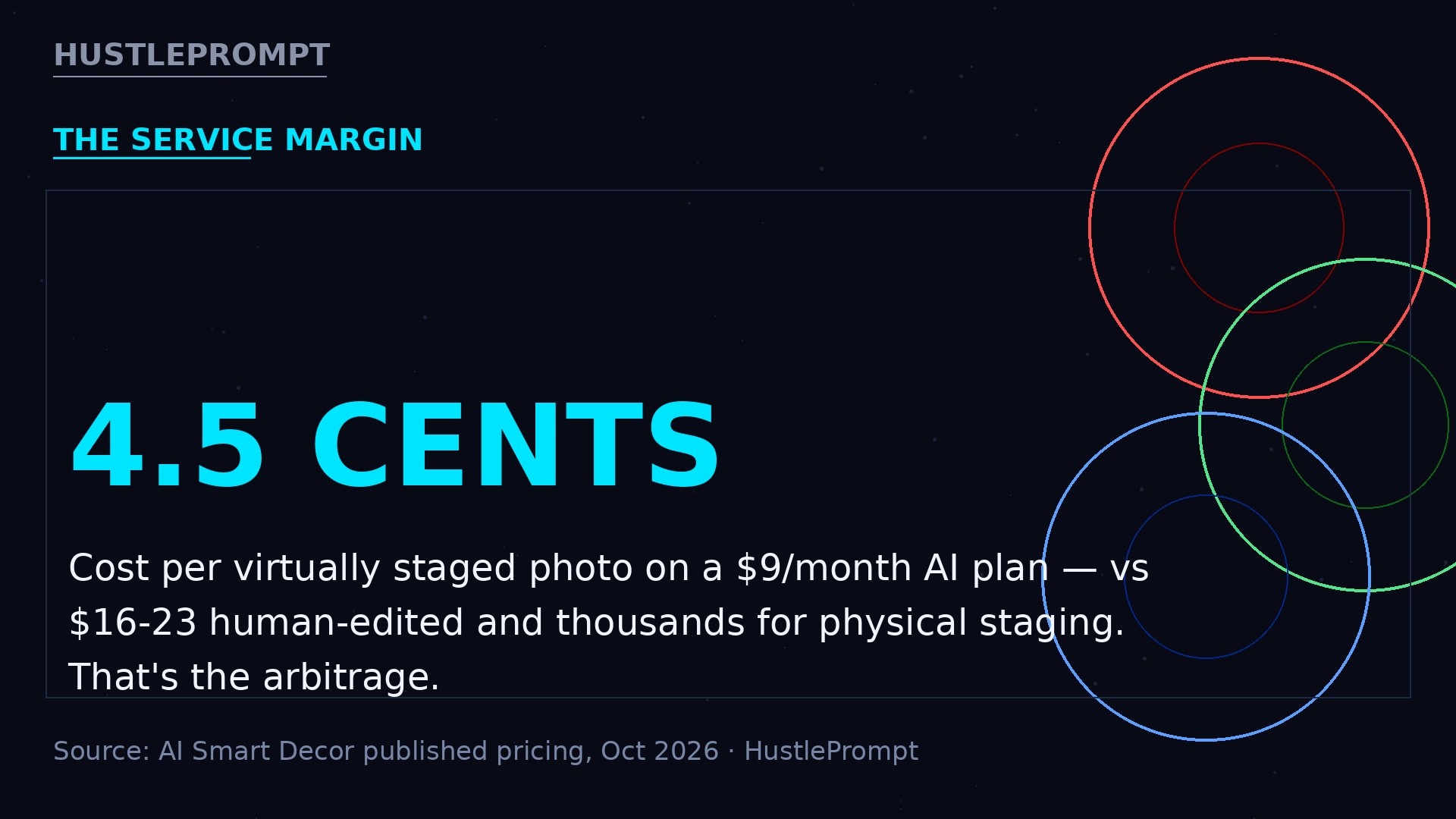
AI Smart Decor’s $9/month plan covers 200 images — 4.5 cents per photo. An agent at 4 listings/month × 8 photos uses 32 photos: tool cost $9, you charge $199. Six agents: $1,194/month vs a $9 tool bill and ~15 hours of work (my estimate) — over $1,000/month margin. Human-edited staging is $16–23/photo; physical staging costs thousands per home. Source: AI Smart Decor pricing, Oct 2026 · Source: NAR 2025 via The Professions
What to do this week: the actionable checklist
- Benchmark your stack — cost and time per finished image.
- Save your 50 best prompts — your baseline to test any new model in a day.
- Design your tier workflow — drafts on fast/cheap, hero images on precision.
- Productize one image service — one price, one turnaround promise.
- Keep model names in config, never hard-coded — undocumented IDs get renamed or pulled.
- Set a review budget — fixed hours to test new models; failure cases first.
Predictions: launch timing and where the bar lands
Analysis, not facts. Windows vary: February’s Aurora Alpha preceded Codex-Spark by 3 days (link unconfirmed), April’s tape tests preceded Images 2.5 by months, gpt2-chatbot preceded GPT-4o by ~six weeks. My read: weeks, not quarters — the reported 503s mean production servers are already warm. On quality, the bar is product consistency, text rendering, and multi-image coherence. GPT-Image-3 is the leading theory; OpenAI has said nothing.
Watch: the leak explained
FAQ: the Aurora leak and the image AI gold rush
What are OpenAI’s aurora models?
Three unannounced IDs in OpenAI’s API since October 17, created within 97 seconds. Arena tests link them to image generation.
Is GPT-Image-3 confirmed?
No. It’s the leading theory — Lumina Bench and TestingCatalog both lean that way — but explicitly still a guess.
What do the red, green, and blue names mean?
Likely test variants: red faster but lower quality, green slower and better-looking, blue untested — probably different checkpoints of one release.
How can I make money from this trend?
Sell outcomes, not images: product-photo packs ($49–$199), ad-creative retainers ($495–$1,500/month), virtual staging ($199/month per agent).
When will the new image model launch?
Unannounced. Past windows range from days to months, but warm production servers point to weeks, not quarters — analysis, not a date.
- → OpenAI ‘Aurora’ Models Leak: GPT-Image-3 Incoming?
The breaking-news report this analysis builds on. - → Sell AI Product Photography to E-Commerce Stores
The full playbook for the product-photo pack. - → Sell AI Virtual Staging to Real Estate Agents
Packaging and pricing virtual staging as a retainer.