
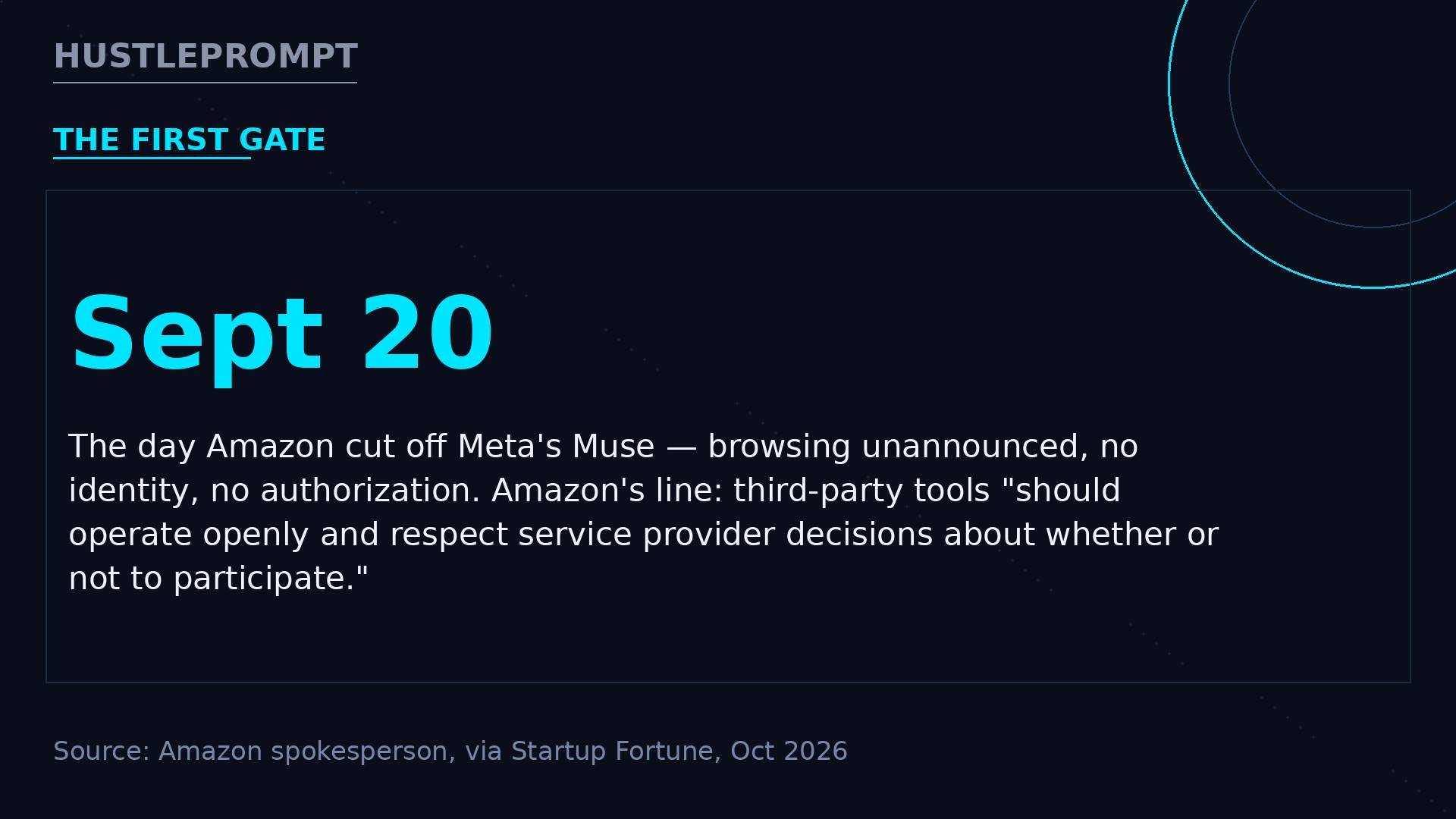
On September 20, Amazon cut off Meta’s Muse — just 12 days after the agent launched. Users got a pop-up: the AI was violating Amazon’s terms of use. The boldest promise in tech — agents that shop, book, and manage everything for you — hit a wall.
It isn’t just Amazon. On October 17, The Verge reported that Yelp, Delta Air Lines, JPMorgan Chase, and Charles Schwab are actively blocking AI agents from OpenAI, Meta, and xAI. The web is closing its gates.
Morgan Stanley projects agent-driven purchases could reach $385 billion in U.S. digital commerce by 2030 — up to 20% of all e-commerce. The money is real. The doors are not open. For freelancers and businesses, that’s not a tragedy. It’s a toll booth — and someone has to run it.
The blockade wave: who’s closing the gates
Amazon drew the sharpest line: it blocked Meta’s Muse on September 20, saying the agent began crawling the store unannounced — no identity, no authorization, no notice. An Amazon spokesperson: third-party tools that want to buy on a customer’s behalf “should operate openly and respect service provider decisions about whether or not to participate.” Source: Startup Fortune
Yelp installed a cash register instead of a wall: agents get in only with a paid data-licensing contract. Delta doesn’t allow third-party agents to book tickets — spokesperson Heena Chavda says it’s evaluating how outside agents might help customers. JPMorgan Chase barred outside agents — including Muse and the $10-billion-valued startup Instinct — from customer accounts; Charles Schwab, Bank of America, and Citigroup took similar positions over one fear: a rogue agent moving money nobody authorized. Source: Joho no Todai / DEV
The numbers: policy, price, and risk
Not every closed door is a decision — and not every door is fully closed:
| Site | Stance | How |
|---|---|---|
| Amazon | Blocked Muse Sept 20; sued Perplexity’s Comet | ToS pop-ups; CFAA suit (Nov 2025) |
| Yelp | Agents must buy a data license | Paid program; 330M reviews feed ChatGPT |
| Delta | No third-party agent bookings | Policy block; “evaluating” |
| JPMorgan / Schwab | Agents barred from accounts | Security policy; BofA, Citi similar |
| eBay | Unauthorized agents only | Bans scraping, not every agent |
| Zillow | Consumer agents permitted | Anti-bot caught some — accidental |
| Walmart | Muse partner since September | Bot check blocked its partner — accidental |
| Cloudflare | Mixed crawlers blocked by default (Sept 15) | Agents blocked on ad pages — accidental |
| Meta | Open standards: Walmart, Stripe, Sierra | Identified agents, negotiated access |
Sources: Joho no Todai / DEV · Source: WebPulse (The Verge reporting)
Why the gates are closing: four forces
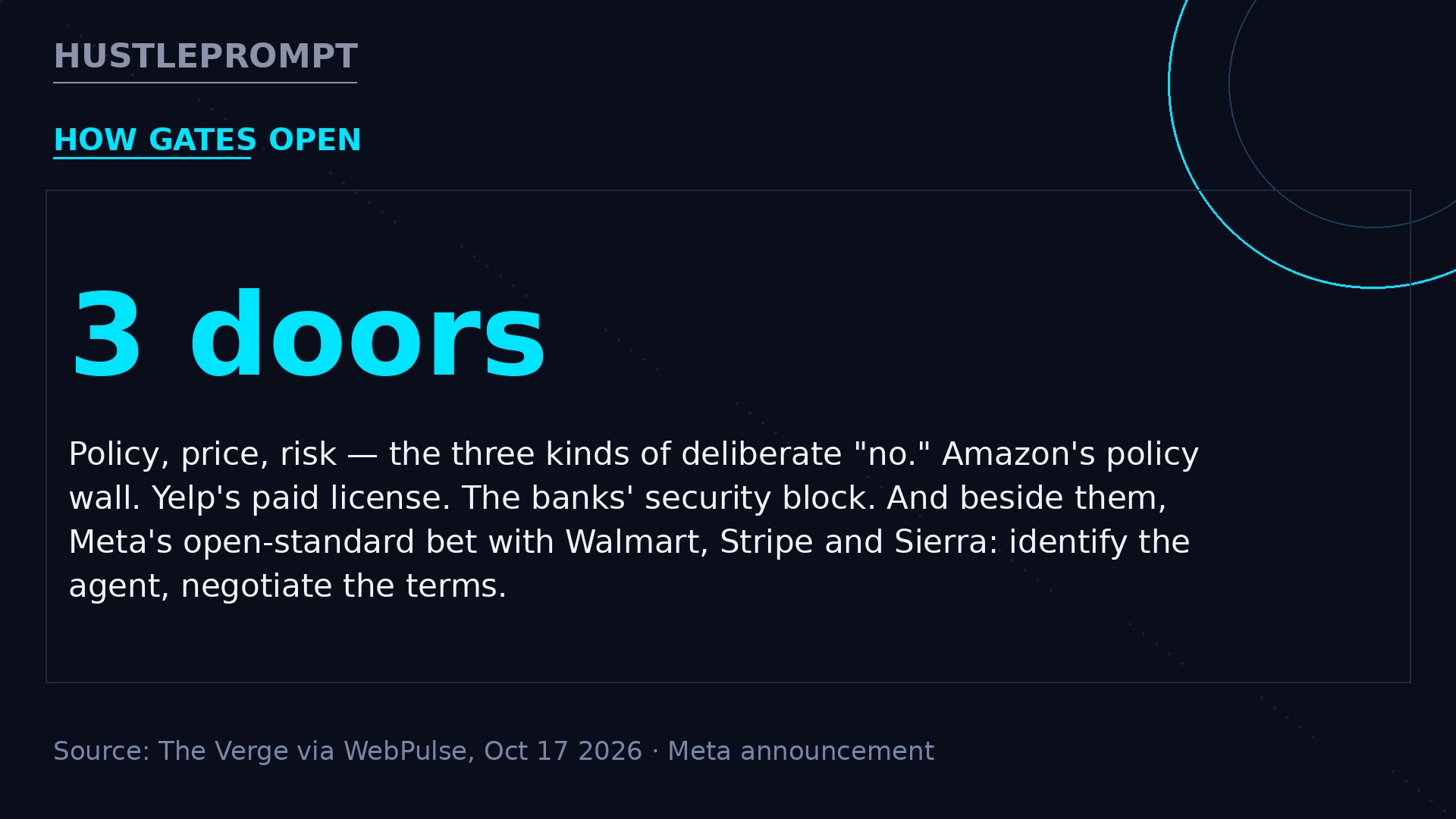
The deliberate blocks are three kinds of “no” — policy, price, and risk. A fourth force, accidental blockage, may be just as big.
1. Security — and a $385 billion liability vacuum
A hijacked agent’s fraudulent purchases look identical to its normal behavior. Research cited by NewtonX frames the exposure as a $385 billion liability vacuum: nobody has signed the contract saying who eats the cost of a bad agent transaction. Until someone does, “no” is the rational default. Source: Startup Fortune
2. Ad revenue — the invisible business model
Perplexity’s version: Amazon wants agents out because they reduce the number of human eyes on ads — an agent never sees the banner. Cloudflare’s September 15, 2026 default change made it structural: mixed crawlers are now blocked by default, so on sites already blocking AI bots, agents got blocked on ad-carrying pages though nobody chose that. Source: Joho no Todai / DEV
3. Data licensing — the toll booth
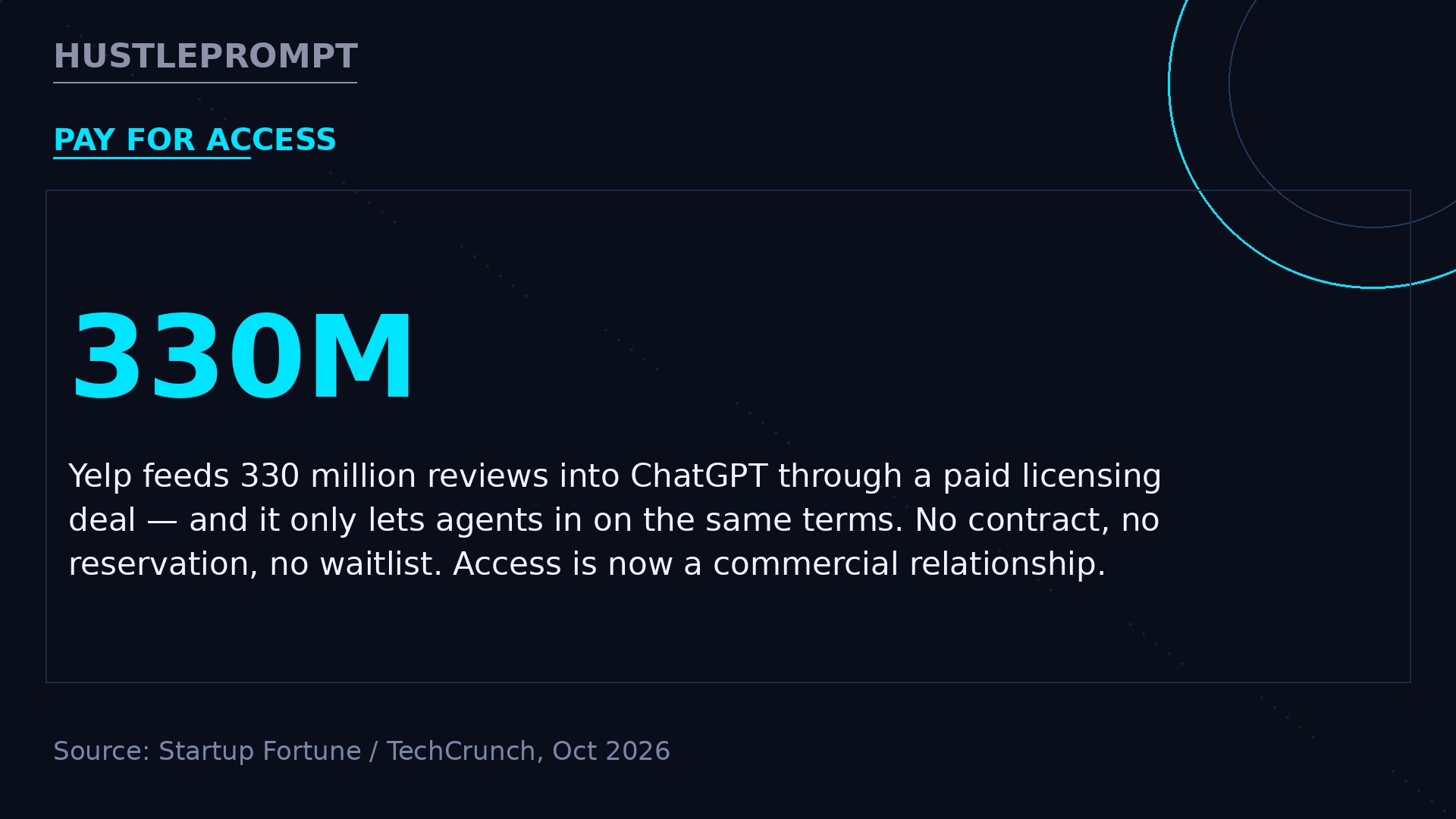
Yelp is the template for the licensed web. It already feeds 330 million reviews into ChatGPT through a paid OpenAI deal — and now extends the same terms to agents: pay for access, ask permission first, or get walled off. Source: Startup Fortune
4. Bot defenses — the collateral damage
Anti-bot systems judge visitors on signals: software-driven browser, inhuman speed. A scammer’s script shows all of these — and so does an agent booking a flight. EquiStamp CEO Chris Canal told The Verge that many defences exist to stop scams and hacking, not agents — but agents trigger those same safeguards. Walmart proved it: a Muse partner since September, yet its own spam filter rejected the invited agent. Source: WebPulse (The Verge reporting)
The counter-move: Meta’s open standard
Meta is betting the answer isn’t partnerships site by site — it’s a standard. The company is developing open standards with Walmart, Stripe, and Sierra: “Turning agents away means turning away the customers behind them. Rather than watching businesses lose customers, we want to work together on the underlying concerns.” Source: Joho no Todai / DEV
The split is already visible. Expedia partnered with Meta’s Muse — while Booking Holdings refused: an agent can’t guarantee inventory or untangle cascading cancellations. Booking runs 73% of gross bookings through its own merchant platform, up four points year over year — and won’t surrender it. Source: Startup Fortune
The courts haven’t settled anything: Amazon sued Perplexity over Comet in November 2025; a March 2026 injunction was reversed by the Ninth Circuit in August, which declined to set general principles. The case continues. Meanwhile eBay is shifting the question — it restricts only unauthorized agents. The question is no longer whether something is an agent, but whether it’s authorized. And authorization is a product. Source: Joho no Todai / DEV
Where the money goes: four services to sell now
Gates need gatekeepers. The blockade is creating a services economy overnight — and it pays better than building another agent nobody can log in with.
1. Agent-access integration consulting
Productize the “Agent Access Audit.” Map which sites a client’s agent workflows hit, then replace browser automation with official channels: official APIs (Yelp’s Fusion API, airline NDC/GDS channels), MCP servers (the Model Context Protocol — an open standard for approved agent-to-software connections), and agent accounts with their own identity (Microsoft’s Copilot Studio just shipped these; Google’s Gemini agent has a Workspace identity and audit logs). Source: VisionQuantech survival guide
- Audit + fix: $995–$1,500 one-time per client.
- Access retainer: $395–$750/month for monitoring blocks and keeping integrations current.
The math: ten clients at $995 = $9,950 upfront; eight keep the $395 retainer = $3,160/month recurring — about a $20k quarter from a laptop. Agency tier: twenty clients at $1,500 = $30,000 upfront; fifteen on $750 retainers = $11,250/month recurring.
2. Data licensing deal advisory
Yelp showed the template: data agents want, packaged as agent-access tiers. Help publishers price and package it: read-only tiers, transaction tiers, rate limits, attribution. Retainer: $1,500–$3,000/month, plus 10–15% of fees closed.
3. Agent-identity and allowlist services
Builder Shivam Kumar’s line is the whole business: “The web tolerated bots when they were dumb. Your agent isn’t dumb — so give it an ID badge instead of a fake mustache.” Sell the ID badge: declared bot user-agents, bot-program registration, audit logs, compliance docs. $750–$1,250 one-time, plus $195/month monitoring. An identified agent is negotiable; a masked one gets banned.
4. Bot-defense consulting for site owners
Every site behind a bot wall risks blocking its own customers’ helpers — Walmart proved it. Sell the $495 diagnostic (“what do your defenses do to an agent?”), then remediation from $995: tune rules, allowlist identified agents, set an agent policy. Source: WebPulse (The Verge reporting)
What to do now
- Stop automating the browser. Start integrating the platform. Check for an official API or partner program first — every Playwright flow is tech debt.
- Identify your agent honestly. Declare a proper bot user-agent; register with platform bot programs. Masquerading as Chrome is how you end up in a fraud team’s queue.
- Build for graceful degradation. Detect blocks as first-class events, explain them, offer the official path — never retry aggressively. Retry storms turn soft blocks into permanent bans.
- Separate read from transact. Read-only aggregation is tolerated longer than agents that log in and move money.
- If you run a site: decide your agent policy on purpose — free, licensed, or partner-only — with sales and legal in the room.
Watch: the blockade, explained
Three predictions
- Agent-access programs with usage-based pricing go mainstream in 2027. The Yelp model spreads to retail and travel; which agents are allowed where becomes a competitive feature.
- The Amazon v. Perplexity case writes the industry’s contract. The underlying lawsuit — or the next one — will define what agent access legally means.
- The web splits into two lanes. A licensed lane for identified, paying agents — and an open lane degrading behind bot walls. Moving a business to the right lane is a service people pay for.
FAQ: the agent blockade
Which websites are blocking AI agents?
Confirmed: Amazon, Yelp (paid license), Delta, JPMorgan Chase, Charles Schwab. Reported: eBay, Zillow, Walmart (accidental), Cars.com, Amtrak.
Why is Yelp charging AI agents?
Yelp treats agent access as a commercial relationship — the same structure as its deal feeding 330 million reviews into ChatGPT through OpenAI. No contract, no reservation, no waitlist.
Can my AI agent legally browse a website?
Unsettled. Amazon sued Perplexity under the CFAA; a March 2026 injunction was reversed by the Ninth Circuit in August, which declined to set general principles. The case continues.
How can my business allow AI agents safely?
Use identified channels: official APIs, MCP servers, agent accounts (Copilot Studio, Gemini Workspace identity), and Meta’s open standards with Walmart, Stripe, and Sierra. Separate read-only access from transactions; keep audit logs.
What does agent-access consulting cost?
Freelancers charge $995–$1,500 for a one-time Agent Access Audit, $395–$750/month for monitoring. Identity setups: $750–$1,250. Bot-defense diagnostics: from $495.
- → Anthropic Wants AI Agents to Haggle Prices for You
Agents won’t just pick products — they’ll negotiate. What that means for your margins. - → The Agent App Store Gold Rush Is Starting
The distribution wave behind this story: who owns the agent shelf owns the economics. - → Enterprises Are Buying AI Agents, Not AI Tools
Where the big budgets are going — and why services beat software in the agent era.