
Anthropic lost $80.7 billion in the first half of 2026 — and posted two straight quarters of operating profit in the same year. Both numbers come from the company’s own disclosures, and understanding how they coexist is the single most useful lesson in AI unit economics you’ll get this decade.
News reported the loss. This is the analysis: why the numbers look like this, what changes at the November IPO, and where the money goes for freelancers, founders, and investors.
The October 20 filing that opened the books
On October 20, Reuters reviewed an updated draft of Anthropic’s IPO prospectus — the S-1, the SEC filing that takes a company public. The draft shows a first-half 2026 net loss of $80.7 billion (GAAP — standard US accounting rules), widened from $13 billion a year earlier, on revenue of $16.3 billion versus $1.1 billion a year earlier, Reuters reported.
This is the first detailed look inside a frontier AI lab’s finances. The market flinched: investors discussing ~$1.5 trillion after the October 14 meeting had earlier eyed roughly $2 trillion. Meanwhile the Wall Street Journal reports Anthropic could spend up to $750 billion on compute in the coming years, including deals still being negotiated.
The trajectory: revenue 3.5x in six months, loss mostly accounting
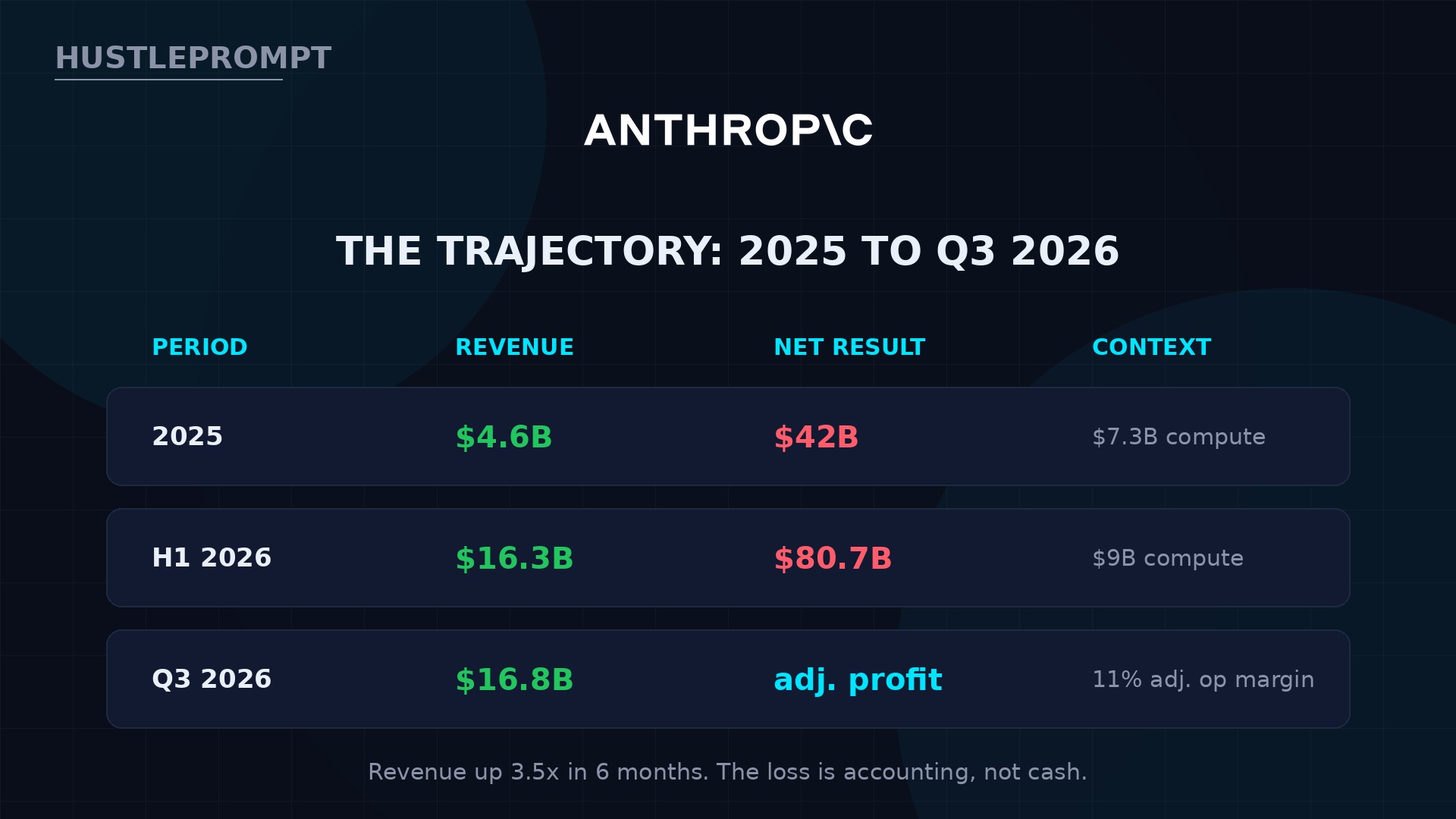
| Period | Revenue | Net result | Key detail |
|---|---|---|---|
| 2025 (full year) | $4.6B (12x from 2024) | $42B net loss; >$8B operating loss | $7.33B compute spend; $20.28B cash at year-end |
| H1 2026 | $16.3B | $80.7B net loss | Includes $72B non-cash charge; ~$9B compute spend |
| Q3 2026 | $16.8B (+45% seq) | Adjusted operating profit | 11% adj. operating margin; 2nd straight profitable quarter |
The $72 billion that never left the bank
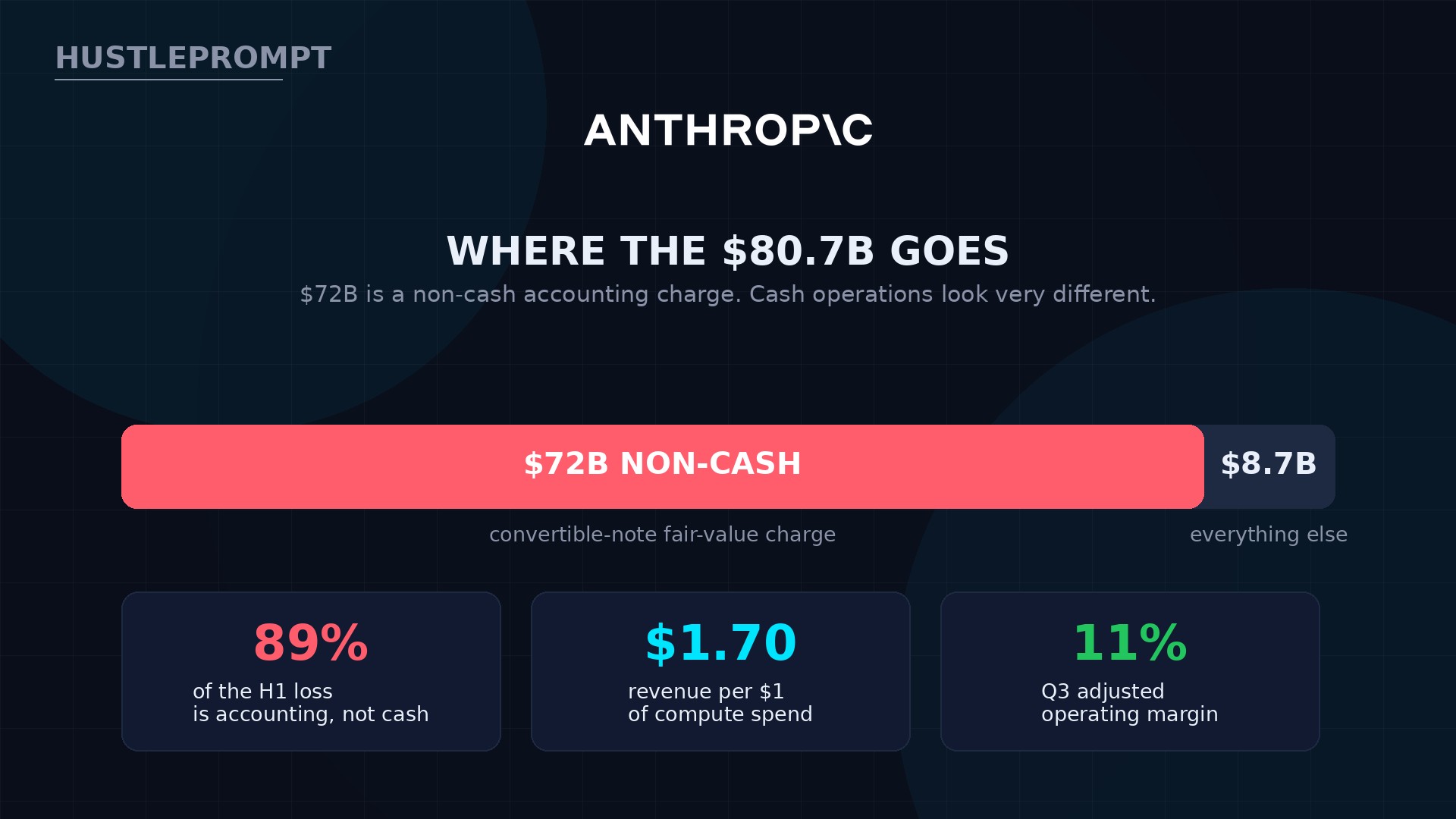
Of the $80.7 billion H1 loss, $72 billion — about 89% — was a non-cash charge, Reuters reported: convertible notes (bonds that convert into shares) got revalued as the valuation rose, so Anthropic books a paper loss. No cash left the building. Same in 2025: of the $42 billion net loss, roughly $34 billion was a similar charge — signaling shareholder dilution, not cash burn.
- $1.70 of revenue per $1 of compute spend (FT, via PYMNTS) — the ratio doing the most work in the valuation.
- 44–60% estimated 2026 gross margin, up from roughly -94% in 2024 — 80%+ before partner revenue-share and training costs (FT).
The operating business nobody’s quoting
Strip out the accounting: adjusted operating profit years before its rival. OpenAI is projected to lose ~$14 billion in 2026 and points to breakeven around 2029–2030, versus Anthropic’s 2028.
Revenue mix: 80–85% of Anthropic’s revenue is enterprise/API, holding roughly 40% of enterprise LLM spend. OpenAI entered 2026 with ~60% from consumers — a billion users paying nothing. Enterprise converts to margin; free chatbots don’t. Peak training cost: roughly $30 billion for Anthropic, about 4x less than OpenAI’s.
Three risks the valuation has to survive
Customer concentration
About one-fifth of H1’s $16.3 billion came from just two customers, per the WSJ. In 2025 it was nearly a quarter, with 47% of sales routed through Amazon and Google. The draft warns a “significant portion” of revenue will come from a limited number of customers “for the foreseeable future.”
The capex flywheel
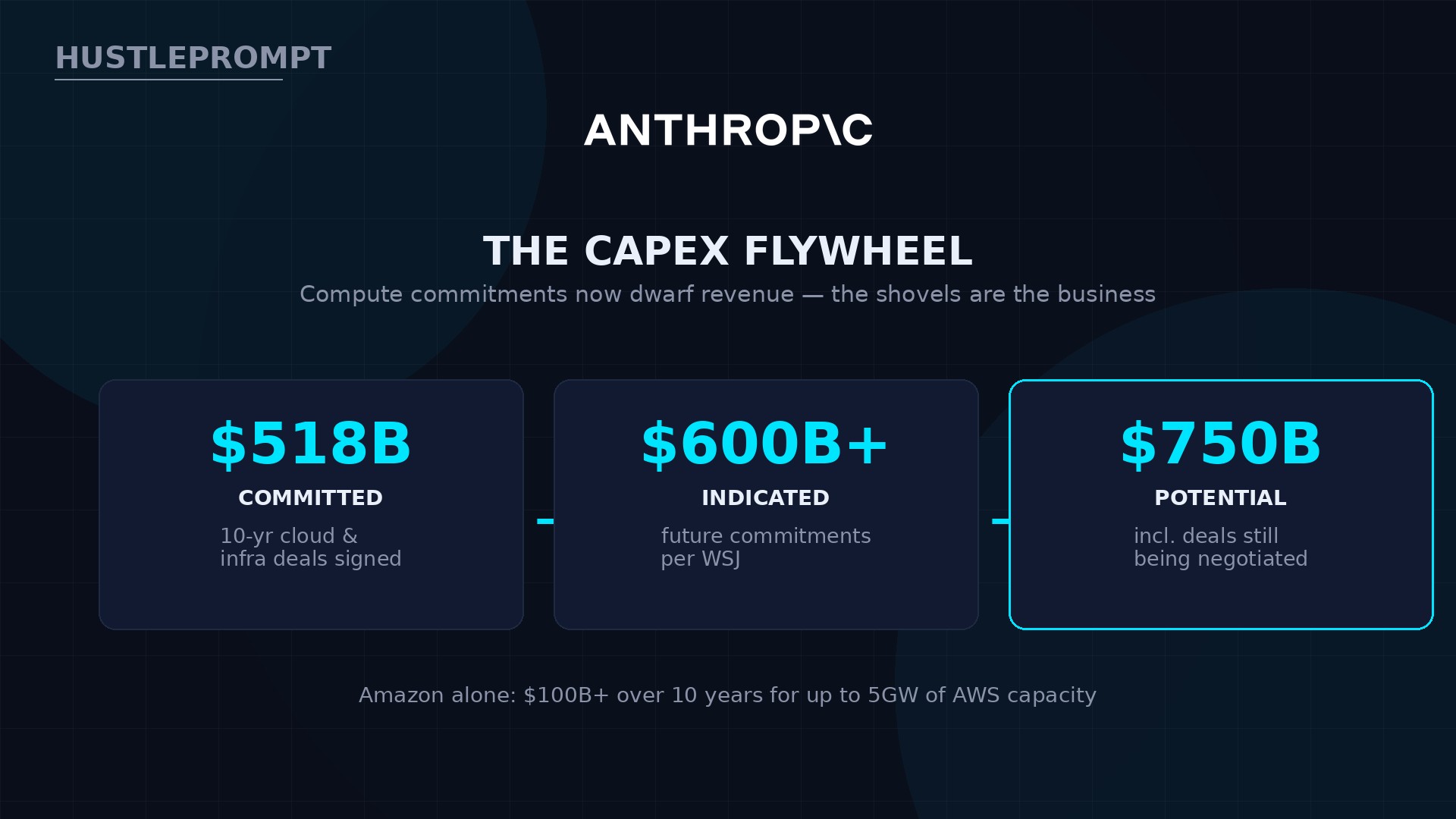
Anthropic has committed at least $518 billion over a decade on cloud, computing, and infrastructure, per Reuters — with the WSJ reporting future commitments could exceed $600 billion and potential spending reach $750 billion H1 compute spend alone was nearly $9 billion, up from $2.3 billion a year earlier. Profitable quarters don’t prove it can fund that bill.
The landlord-shareholder problem
The compute deals sit with Amazon, Google, and Microsoft — who are also shareholders. The April AWS agreement alone: $100 billion-plus over 10 years for up to 5GW. Suppliers and investors are the same companies.
How to profit: sell shovels, not models
Anthropic’s filing is a price list for where money flows in AI. The labs absorb the $518-billion commitments; everyone else gets paid on the margins.
FinOps-for-AI consulting: the $72B lesson, productized
Companies running on Claude, GPT, or Gemini have unaudited API bills nobody owns. Productize one offer: the “AI Spend Audit” — model choice, token waste, caching, batching, vendor mix — at $1,495 one-time plus a $595/month retainer.
The math (typical client): $20,000/month in API spend, 30% cut = $72,000/year saved — the audit pays for itself 48x over. Ten audits a month = $14,950 upfront; half on retainer = $2,975/month recurring.
Build model-agnostic products: the $1.70 arbitrage
A routing layer sends simple queries to cheap models, hard ones to frontier models — the trick behind Anthropic’s $1.70. The math (illustrative): 2M calls/month at $0.010 = $20,000/month; routing 60% to a $0.0025 model saves $9,000/month, $108,000/year. Ship it as a feature and pocket the spread.
Price your AI SaaS like someone who’s read the filing
| Rule | Anthropic evidence | Your move |
|---|---|---|
| Know your unit cost | Compute per revenue dollar: $0.71 → $0.56 | Price at ≥3x inference cost; re-price quarterly |
| Cap concentration | ~1/5 of revenue from 2 customers | No single client above 15% of revenue |
| Sell outcomes, not tokens | 80–85% enterprise mix wins on margin | Per-seat or per-outcome pricing; never pass raw API cost to users |
Position for the IPO window (not financial advice)
Anthropic is expected to debut in November — targeting $1.8–2 trillion after investors discussed ~$1.5 trillion, per Reuters. The play isn’t private shares; it’s the aftermath: the first audited frontier-lab financials reprice every AI-adjacent public stock. Watch the S-1’s compute footnotes.
What to do now
- Audit one AI bill. Export 30 days of API usage, sort by cost, find the top three waste lines.
- Benchmark unit cost. Compute cost per dollar of AI revenue. Above $0.60 is an Anthropic-Q1 problem — fix routing and caching first.
- Package the audit. One-page offer, $1,495 fixed, 5-day turnaround. Post in two founder communities today.
- Go model-agnostic + read the S-1. Abstract model calls behind one interface; when the audited filing drops, its compute footnotes matter more than the headline loss.
Three predictions
1. The IPO lands below $2 trillion. Investors already walked the number to ~$1.5 trillion, per Reuters — and the roadshow’s hardest question is reconciling the $80.7 billion GAAP loss with the operating profit story, on the record.
2. The public S-1 triggers a pricing war. Audited unit economics let rivals undercut — OpenAI is rushing a ~$30B raise ahead of the debut, per Reuters. Expect API price cuts through 2027.
3. The landlords consolidate power. With $518 billion-plus committed to Amazon, Google, and Microsoft — also shareholders — the compute suppliers end up owning the labs’ economics. Smaller model companies get acquired or die.
Watch: the S-1 numbers, explained
FAQ: Anthropic’s $80.7B loss and AI unit economics
What caused Anthropic’s $80.7 billion loss?
Mostly accounting. $72 billion was a non-cash charge from revaluing convertible notes as the valuation rose, per Reuters — alongside nearly $9 billion of compute spend and two straight quarters of adjusted operating profit.
Is Anthropic actually profitable?
On an adjusted operating basis, yes — Q2 and Q3 2026 were both positive, with an 11% Q3 margin per the FT. On a GAAP basis, no: the H1 net loss was $80.7 billion. Different measures, different periods.
What is a non-cash accounting charge?
A paper loss with no money changing hands. Convertible notes (bonds that can become shares) get revalued as the valuation climbs — they got more valuable, so the company books a loss. It signals dilution, not cash burned.
What is an S-1?
The registration statement a company files with the SEC to go public. Anthropic’s is still a confidential draft — no public S-1 had appeared on EDGAR as of October 20, and draft figures can change.
When is the Anthropic IPO?
Expected in November 2026, per Reuters and the WSJ — marketing could start the week of November 9. Valuations discussed: ~$1.5 trillion to over $2 trillion.
How can freelancers profit from this trend?
Sell the shovels: FinOps-for-AI audits, model-agnostic routing products, and pricing-discipline consulting for AI SaaS founders. The filing itself is your sales collateral.
- → Anthropic Wants AI Agents to Haggle Prices for You
Agents won’t just pick products — they’ll negotiate. What that means for your margins. - → The Agent App Store Gold Rush Is Starting
The distribution wave behind this story: who owns the agent shelf owns the economics. - → Enterprises Are Buying AI Agents, Not AI Tools
Where the big budgets are going — and why services beat software in the agent era.