
Foundations in the United States gave away an estimated $117.15 billion in 2025, according to Giving USA 2026. That money reaches nonprofits through written proposals — and most small nonprofits have nobody on staff who can write one. That gap is where AI grant writing services come in.
The honest version: AI does not write winning grants by itself. It compresses the slowest work — funder research, structuring arguments, first drafts — from weeks into days, while accuracy and judgment stay human. Combine both and you can offer small nonprofits an affordable service while building a freelance practice in one of the most defensible AI niches.
Video: Grant Writing for Beginners: Your First 30 Days — a practical guide to the grant-writing workflows that AI can accelerate. (The Grant Writers Collective)
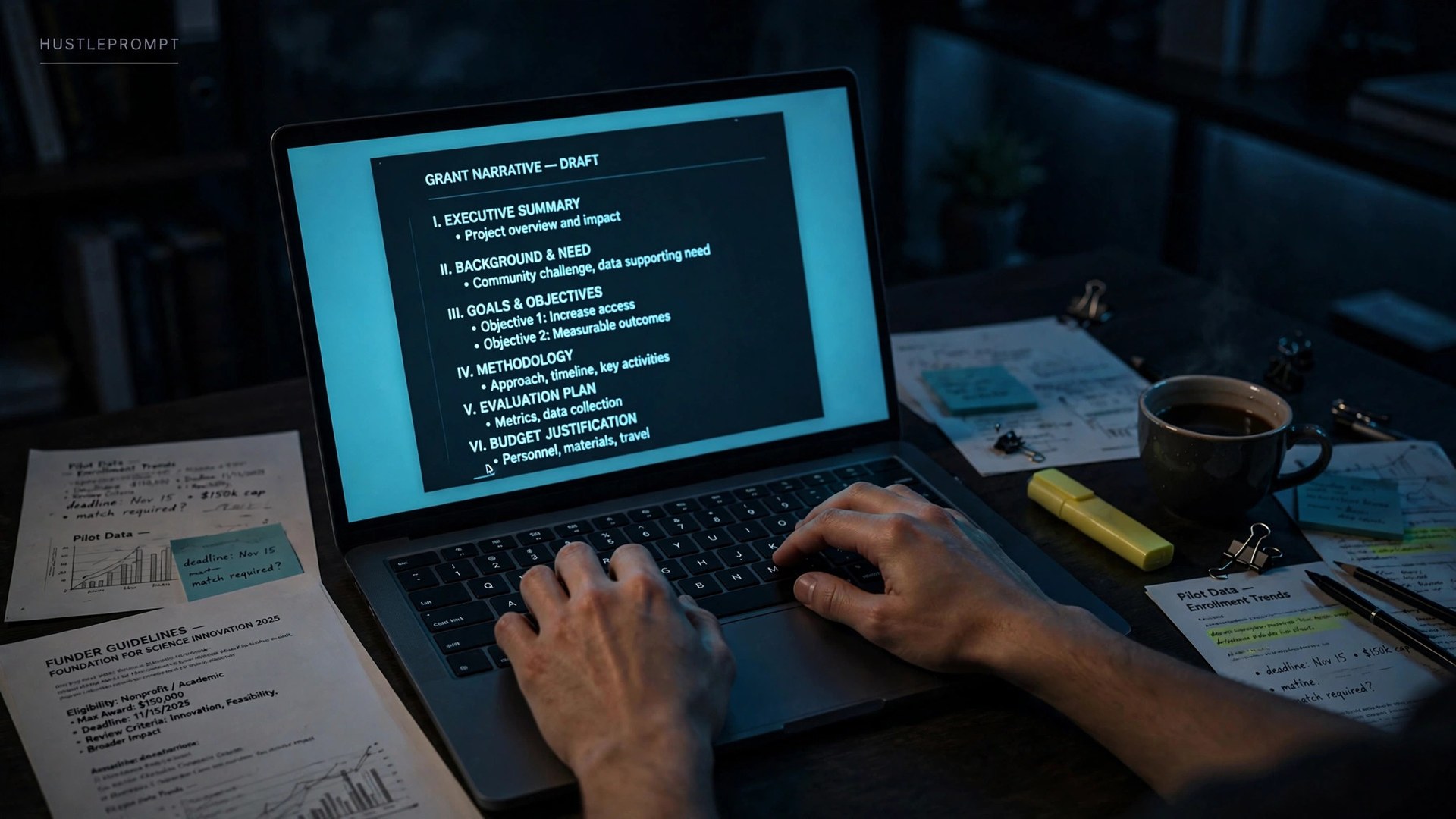
Step 1: Learn the Anatomy of a Grant Proposal
Before you touch AI tools, you need to understand what funders actually read. Nearly every foundation proposal follows the same core sections. A 2026 step-by-step guide from Grants.com breaks a winning proposal into these essential parts:
- Executive summary — the project and the ask in one page. Written last.
- Statement of need — the problem, backed by real local data.
- Project description — objectives, methods, timeline, outcomes.
- Organization background — mission, track record, capacity.
- Budget and budget narrative — every dollar justified.
- Evaluation plan — how results will be measured.
- Sustainability plan — what continues after funding ends.
- Appendices — letters of support, board list, financials.
Your job is to learn this structure cold, then use AI to execute it fast while the nonprofit’s own staff supplies the facts. Most small nonprofits know their mission intimately but have never assembled it into a funder-ready package.

Step 2: Understand the Market (It Is Enormous)
Grant writing is a measurable market with published numbers — an unusually defensible niche to sell into.
Stat highlights: the money behind the niche
- Total US charitable giving hit a record $617.2 billion in 2025, the first year ever above $600 billion (Giving USA 2026, reported by Give.org).
- Foundations alone gave $117.15 billion, up 5.7% year over year — and foundation giving has stayed above $100 billion every year since 2022 (NonProfit PRO).
- Corporate giving reached $43.7 billion in 2025 (Campbell Company summary).
On the freelancer side, a 2026 industry rate guide puts intermediate grant writers at $50–$75 per hour and seniors at $75–$150 per hour, while median posted rates on Upwork sit around $35–$60 per hour (Beancount 2026 guide; Upwork).
The mismatch is the opportunity: hundreds of billions in available grant money, and small nonprofits whose directors write proposals at midnight between everything else. They need a competent AI-assisted process that gets a clean proposal submitted on time.
Step 3: Run the AI-Accelerated Grant Workflow
Five stages, each with a clear AI role and a human checkpoint. AI accelerates; you verify.
The AI-accelerated grant workflow pipeline
1. Research
AI scans priorities and deadlines. Human confirms fit.
2. Outline
AI builds the section skeleton. Human signs it off.
3. Draft
AI drafts from verified fact sheets.
4. Budget
AI cross-checks numbers; human validates costs.
5. Review
Full human compliance check. Nothing ships AI-only.
Stage 1 — Research the funder
Feed the AI the funder’s guidelines and past grantee lists, and ask it to extract eligibility criteria, focus areas, and typical award sizes. Then verify every claim on the funder’s own website. This is where most bad proposals die — funders that were never a fit.
Stage 2 — Build the outline
Give the AI the funder’s exact section order and page limits, and have it generate a section-by-section skeleton. Get the nonprofit’s director to confirm the structure before drafting begins.
Stage 3 — Draft from verified facts
Never let AI invent program details. Build a fact sheet with the nonprofit — real statistics, staffing numbers, timelines — and draft one section at a time. Use a prompt rule like: “Do not invent statistics, names, dates, or results. If information is missing, ask me.”
Stage 4 — Write the budget narrative
Have AI cross-check every number against every sentence, then draft the written justification for each line item. You confirm costs against real quotes and the nonprofit’s actual rates.
Stage 5 — Human compliance review
Check the funder’s instructions off one by one: page limits, required attachments, submission portal rules. No AI review replaces this — one missing document can disqualify a proposal unread.
Step 4: Package and Price Your Services
A 2026 industry rate guide reports flat per-proposal fees from $500 to $5,000+, and monthly retainers of $1,500–$5,000 depending on volume (Beancount). Pick your lane from the table below.
| Model | Typical range | Best for | Watch out for |
|---|---|---|---|
| Per-proposal flat fee | $500–$5,000+ | Defined applications with known scope | Scope creep — define revisions in writing |
| Hourly | $50–$75/hr intermediate; $75–$150/hr senior | Research, prospecting, open-ended work | Clients fear open-ended bills — cap hours |
| Monthly retainer | $1,500–$5,000/month | Ongoing grant calendars and deadline management | Set a proposal quota so volume stays sane |
One hard rule: never take a percentage of the grant award. Auditors and many funders prohibit contingency fees, and such a structure can jeopardize the award itself (Beancount). Flat fees, hourly, and retainers are the compliant structures.
A simple arithmetic illustration
Illustration only — not a promise of earnings. At $1,500 per foundation proposal and two proposals a month, that is $3,000/month, or $36,000/year gross before taxes and expenses. Arithmetic example from published rate ranges, not typical results.
Step 5: Find Your First Nonprofit Clients
Small nonprofits rarely browse freelance marketplaces for grant writers. Go where they already are.
- Start local. Search your county’s nonprofit directory and community foundation grantee lists. Organizations with budgets under $2M almost never have grant staff.
- Offer a paid pilot. One letter of inquiry (LOI) or one funder research report for $300–$500 proves your process with minimal risk on both sides.
- Ask for the introduction, not the job. Email the executive director with one specific funder opportunity that fits their mission.
- Collect proof relentlessly. Every submitted proposal and on-time delivery becomes your portfolio. Keep funder names and award amounts confidential unless the client agrees otherwise.
- Network through infrastructure. Community foundations and nonprofit support centers run workshops and newsletters where service providers are welcome.

Honest Ground Rules Before You Sell This
This niche rewards trust, and trust is built on radical honesty. Keep these rules visible in your client agreements:
- AI accelerates; it does not win grants. Outcomes depend on the nonprofit’s programs, data quality, funder fit, and competition. Never promise a win rate.
- Disclose AI use in your service agreement, and ask the nonprofit to check each funder’s AI-use policies.
- Every fact gets a source. AI drafts, humans verify. A fabricated statistic can destroy a nonprofit’s credibility with a funder permanently.
- No contingency fees. Charge flat, hourly, or retainer — agreed before anyone knows the outcome.
- Check your state’s rules. Many states regulate professional fundraisers; flat-fee grant writing is generally treated differently, but verify before you scale.
Frequently Asked Questions
Can AI write a winning grant alone?
No. AI excels at research synthesis, outlining, and first drafts, but winning proposals require verified facts, accurate budgets, and a real understanding of the funder’s priorities. The winning model is AI speed plus human expertise, with a human reviewing every claim.
How do I find my first nonprofit clients?
Start with small local nonprofits (under $2M budgets) via community foundation grantee lists and county nonprofit directories, then pitch a small paid pilot — one letter of inquiry or a funder research report. One specific opportunity beats ten generic pitches.
Do I need a grant-writing certification to start?
No certification is legally required. What clients buy is a clear process and clean submissions. Study the standard proposal anatomy and a few real funder guidelines before you pitch, and you will be ahead of most competitors.
How long does it take to write a proposal with AI assistance?
A straightforward foundation proposal that might take 30–40 hours manually can often be drafted in 10–15 hours with an AI-accelerated workflow. Complex federal proposals still take substantially longer regardless of tools.
What should I charge as a beginner?
Published ranges put intermediate freelancers at $50–$75/hour and short foundation proposals at $500–$1,500 flat (Beancount 2026 guide). Starting at the lower end — or with a fixed-scope paid pilot — is a reasonable entry point.
Should I tell clients I use AI?
Yes. Disclose your AI-assisted workflow in your service agreement, describe what the AI does and what you verify personally, and ask clients to confirm each funder’s AI-use policies. Transparency is a competitive advantage in a trust-based niche.
What is the biggest mistake new grant-writing freelancers make?
Applying to the wrong funders. Most rejected proposals fail on fit, not prose. Spend disproportionate time on funder research and eligibility checks before drafting a word.