
Your $200-a-month AI subscription quietly became a $200-a-month API budget on October 7, 2026 — and unless you clicked one button, it’s been evaporating at the end of every billing cycle.
The announcement arrived tucked inside a model launch post, not a pricing email — and it marks the biggest shift in how AI is sold since flat-rate plans became the norm: the subscription is no longer just a chat window — it’s becoming a build budget.
Here’s what’s changing, why the vendors are doing it, and — the part that matters — how to turn the fine print into money.
What Changed on October 7: Credits Inside the Plan
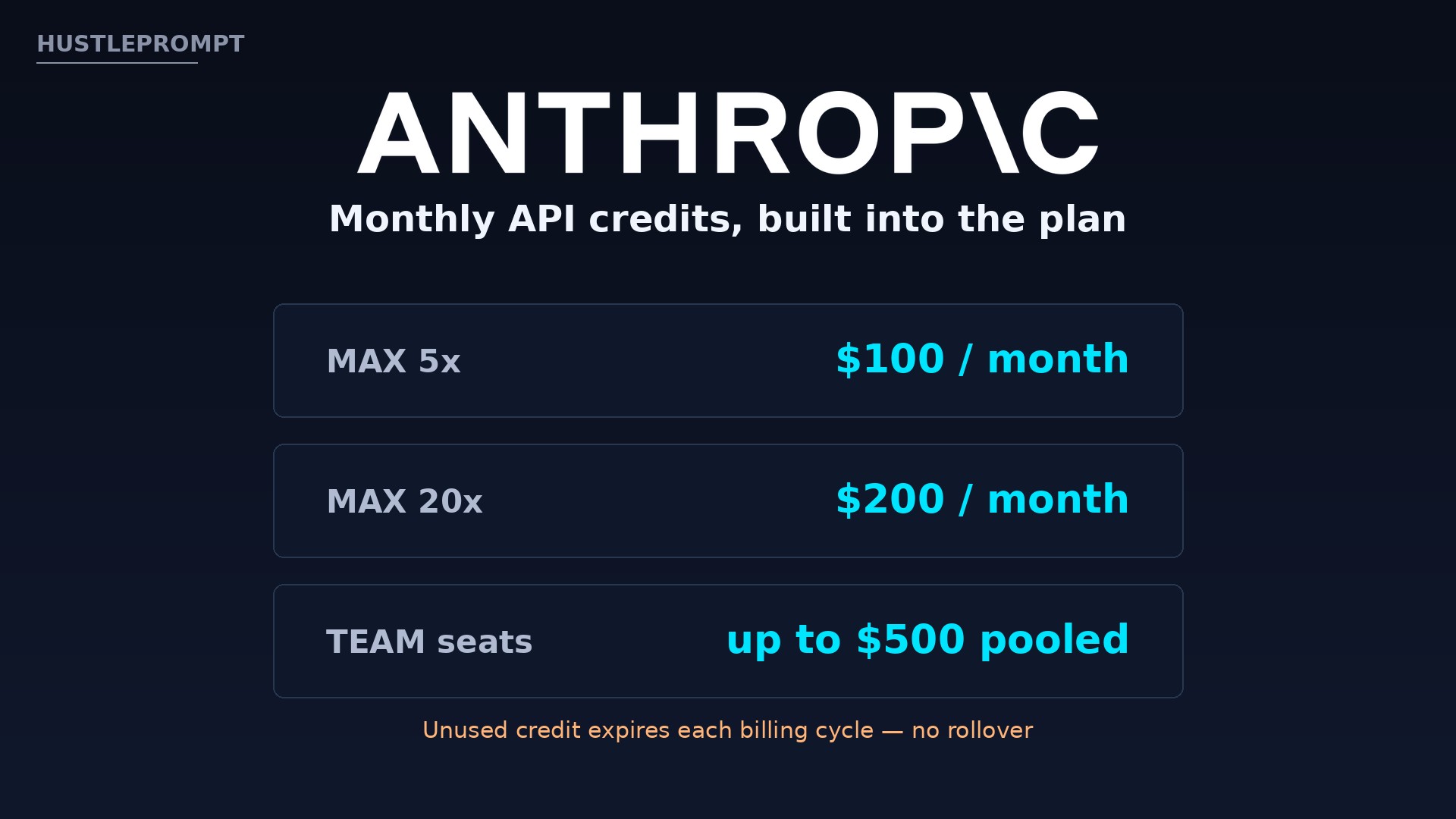
On October 7, 2026, alongside the launch of Claude Haiku 5.5, Anthropic began adding a monthly API credit to its Claude Max and Team plans. The numbers, from Anthropic’s own developer page (recapped by The Lab Notes):
| Plan | Monthly API credit | Catch |
|---|---|---|
| Max 5x | $100 | Claim after 7 days on plan |
| Max 20x | $200 | Claim after 7 days on plan |
| Team, Standard seat | $20 per seat, pooled | Pool capped at $500/mo |
| Team, Premium seat | $100 per seat, pooled | Pool capped at $500/mo |
Free, Pro, and Enterprise plans are not eligible. Three Standard seats plus two Premium seats pool to $260 a month — Anthropic’s own worked example (via Unite.AI).
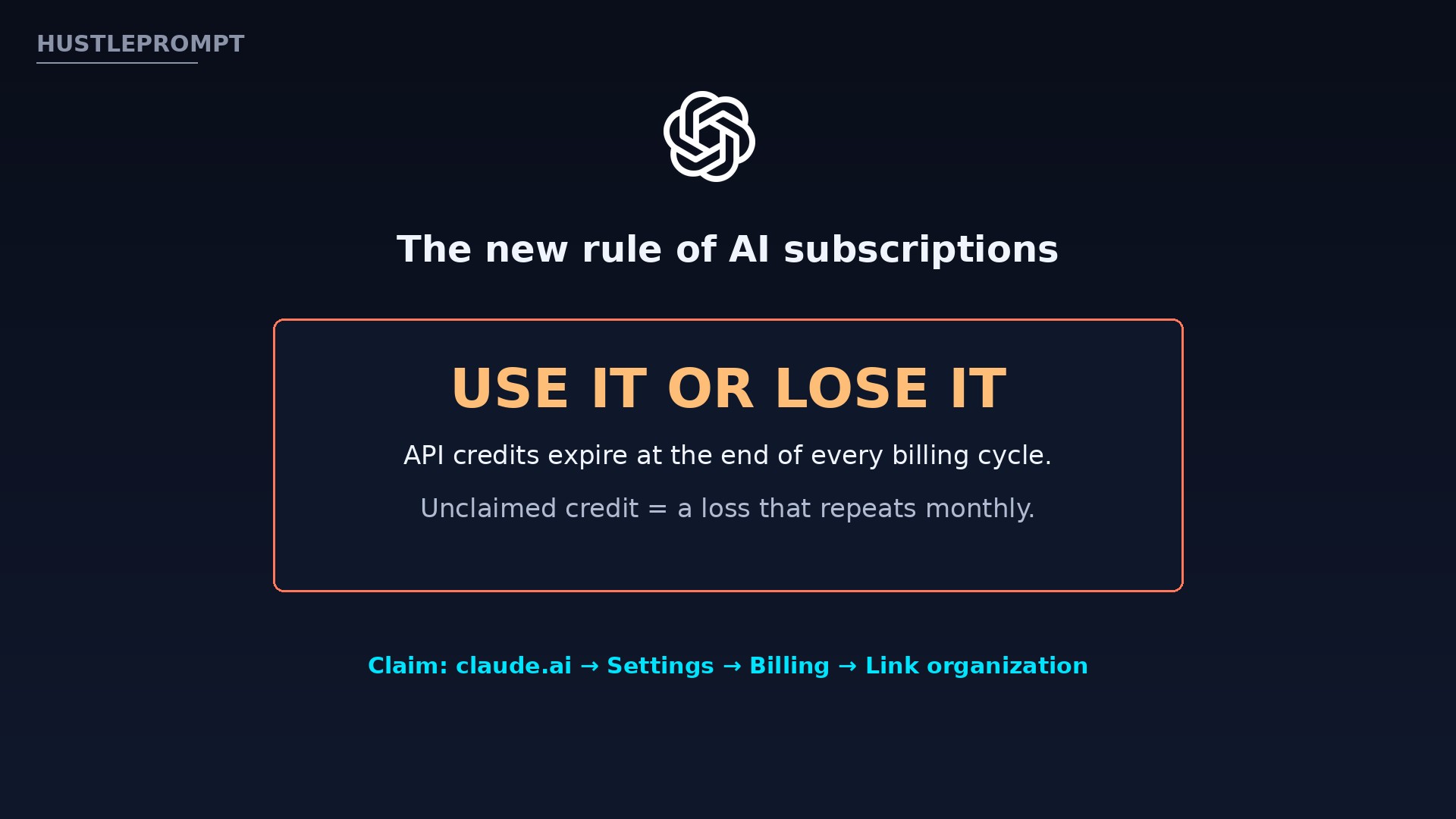
The credits pay for building, not chatting. They cover the Claude API, the Console Playground, Claude Managed Agents, and the Claude Agent SDK. They do not cover interactive Claude Code, and nothing rolls over — unused credit dies at the end of each billing cycle. Claiming takes one action: claude.ai → Settings → Billing → link a Console organization (step-by-step at madrobot.blog).
“For organizations already paying for Max or Team, an unclaimed credit is a loss that repeats every month.” — WBA Consulting, whose internal tooling measured a summarization request at under half a cent. At that rate, $100 covers nearly 15,000 full-article privacy screenings. (Source)
What $100–$200 Actually Buys: Run the Math
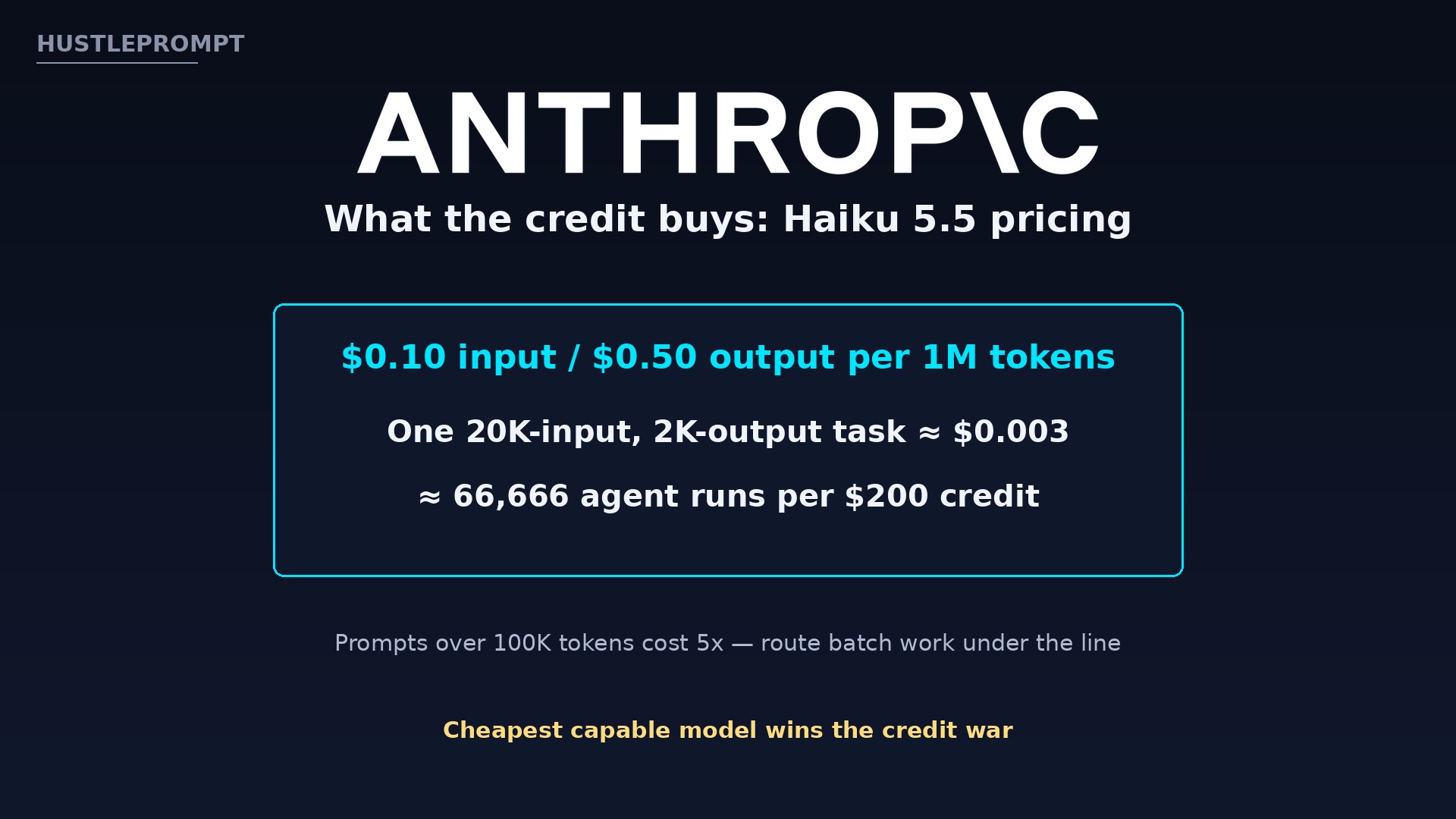
A credit number means nothing without prices. Haiku 5.5’s rates: $0.10 per million input tokens, $0.50 per million output — with a 5x multiplier for prompts over 100K tokens (dev.to):
| Cost of one 20K-input / 2K-output task | Runs a $200 credit buys |
|---|---|
| Haiku 5.5 — ≈ $0.003 | ≈ 66,666 |
| Sonnet 5.5 — ≈ $0.06 | ≈ 3,333 |
| Fable 5.1 — ≈ $0.30 | ≈ 667 |
That spread is the whole game. On flagship-class models, $200 is a few hundred heavy agent runs. On Haiku 5.5 — 66,666 tasks — it’s a small business’s entire monthly automation workload, free. The credit doesn’t just lower costs; it changes which model is rational. Route volume to the cheapest model that handles the task, and save the expensive brains for the 5% of work that needs them.
One trap inside the pricing: Haiku 5.5 charges 5x for prompts over 100K tokens. Chunk your inputs under that line or your “free” budget burns five times faster (dev.to).
Why Vendors Are Doing This: From Chat Window to API
The flat-rate subscription was built for people talking to AI. Vendors now want you building on it — and building means lock-in. A habit can switch vendors in a day; a workflow wired into an API cannot. (Secondhand SemiAnalysis estimates put Claude plans at 5x+ the value of OpenAI’s at heavy agent use — directional, not verified.)
Three forces drive the shift:
- API acquisition, cheap. Bundling metered credit turns millions of subscribers into API experimenters. The slice is big enough to build something real — and unclaimed credits are breakage: pure margin funding the program.
- Lock-in through infrastructure, not habit. One plan links to one Console organization (Anthropic says you can’t change it yourself). Your automations, keys, and spend history accumulate on their platform.
- Feeding the funnel from below. Claude for Startups — announced October 6, 2026 — offers a free year of Claude Team plus API credits to qualifying founders. Today’s free-tier startup is tomorrow’s pooled $500-a-month account.
The trend line is unmistakable: flat chat subscriptions → bundled metered credits. The chat window is the storefront; the API is the wallet.
The claim-to-save loop
1. CLAIM
claude.ai → Settings → Billing → link a Console org. Wait 7 days on plan. No card needed.
2. MEASURE
Log per-task cost in the Console. Find what each job costs — often under half a cent.
3. ROUTE
Move batch volume to Haiku 5.5 under the 100K-token line. Reserve premium models for hard tasks.
4. SAVE
Run monthly batch jobs inside the credit before it expires. Re-audit every cycle.
The Other Side: OpenAI Tightens While Anthropic Opens
Contrast sharpens the trend — but note everything in this section is reported, not verified in OpenAI’s docs:
- $200 Pro sign-ups were reportedly paused, and usage limits reportedly halved (Latent.Space, via Russ McGuire’s October 9 newsletter).
- DevDay materials reportedly point to a new $500/month Pro tier with “Ultrafast” speed (pandromeda.com — unverified).
One verified tidbit from OpenAI’s own copy (recapped by explainx.ai from the Dots announcement): conversations with a Dot don’t count toward ChatGPT usage limits.
Don’t read this as “Anthropic generous, OpenAI stingy.” Both are moving toward the same destination: the flat unlimited subscription is dying; bundled metered credits are the new battleground.
How to Profit: Sell the AI Cost Audit
Here’s the money angle, concrete enough to run this week. Small businesses pay for Max or Team plans and leave the credit unclaimed — a loss that repeats monthly. That sentence is a service offer.
Step 1: The free “unclaimed credit check” (foot in the door)
Offer a free 15-minute check: is the plan eligible? Is a Console org linked? Has the 7-day wait passed? The pitch: unclaimed credit is money you’re already paying to lose.
Step 2: Measure per-task cost
Connect their top 3 recurring tasks to the API on a trial key and log the real per-task cost in the Console. Typical findings: summarization, extraction, and drafting run under half a cent per task (WBA’s measured rate).
Step 3: Route batch work to Haiku 5.5
Move high-volume jobs to the cheapest capable model and keep prompts under 100K tokens to dodge the 5x multiplier.
Step 4: Build the “use-it-or-lose-it” calendar
Since credits expire monthly, schedule recurring batch jobs inside the credit window. Sell this as a $195/month “automation maintenance” retainer after a $495 setup audit.
The math that sells it
- A 5-person team on Standard seats pools $100/month (5 × $20).
- An agency running 30,000 summarization jobs/month at under $0.005 each spends under $150 — fully inside a Max 20x’s $200 credit.
- That’s effectively free automation the client already pays for. Your audit unlocks it.
Where This Is Heading: 4 Predictions
- Every major vendor copies the bundle within 12 months — the acquisition math is too good.
- Credit tiers become the new battleground. “$100 vs $200 vs $500 a month” replaces “which chatbot is smarter” as the comparison shoppers run.
- Rollover stays rare — on purpose. Expiry is the profit engine (breakage). “Use-it-or-lose-it” automation calendars become a standalone service.
- Model routing becomes a core consulting skill. Consultants who can prove per-task costs — with receipts, not vibes — will own the audit market.
FAQ: AI Subscription Credits
Do I get API credits on Claude Pro?
No — only Max 5x, Max 20x, and Team are eligible. Free, Pro, and Enterprise get nothing (justinmckelvey.com FAQ).
Do unused credits roll over to next month?
No. Unused credit expires at the end of each billing cycle — monthly even on annual plans. New credit arrives after the next plan payment (believemy.com FAQ).
Can I use the credits with Claude Code?
Not for interactive Claude Code sessions in the terminal, IDE, desktop, or web — those keep using your plan limits. The credits cover the API, Console Playground, Managed Agents, and the Agent SDK (madrobot.blog).
How do I claim the credits?
On claude.ai (in a browser, not the app), open Settings → Billing and link a Claude Console organization. You must have been on an eligible plan for 7 days. No payment method is required. Note: each plan links to one organization and you can’t change it yourself, so pick the org you’ll actually build in (7minai.com guide).
Is Max 20x’s $200 credit better value than OpenAI’s $200 Pro?
At heavy agent use, secondhand SemiAnalysis estimates put Claude plans at 5x+ the value (1.3x–2.9x after task-cost adjustment). OpenAI’s side is currently based on reported — not doc-verified — limit changes, so benchmark your own workloads.
Watch: Free Claude API Credits: Claim Up to $200/mo With Claude Max by Sumit Paul — who gets what, and how to claim.