
Your AI bill may have tripled overnight — and nobody told you. On the night of October 20, 2026, Alibaba quietly raised the hosted output price of DeepSeek V4 Flash 0731 from $0.40 to $1.32 per million tokens: a 230% spike. Price-tracking firm Stork AI caught it because it pings first-party list prices daily — and it found 16 more unannounced price hikes the same night.
If you built your product’s unit economics on the assumption that AI model prices only fall, this is your wake-up call. The labs are done subsidizing your tokens.
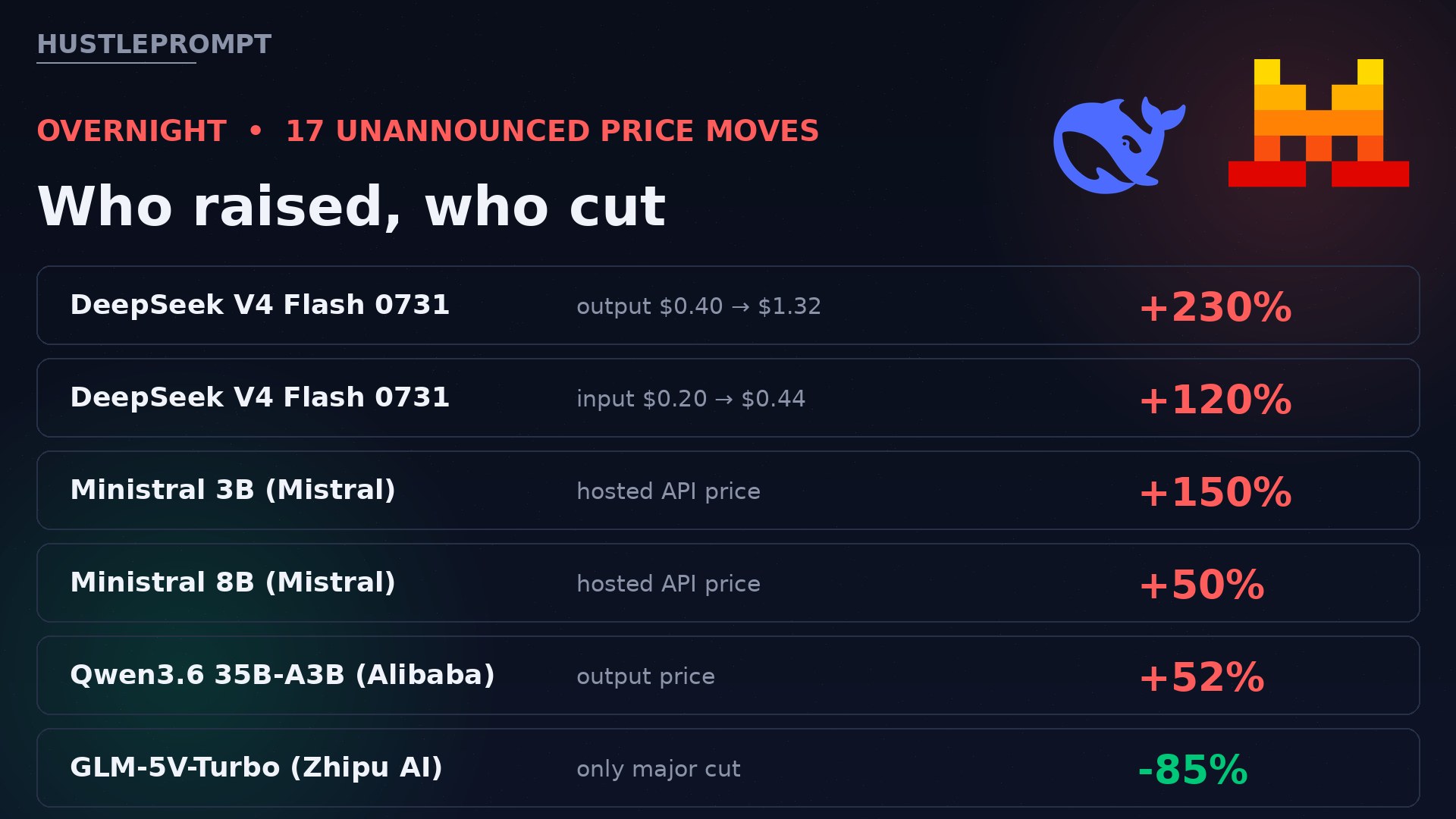
What Stork AI caught overnight
Stork runs its own LLM price catalog, scraping first-party list prices every day precisely because labs have a habit of staying silent when prices go up. Here is what its trackers found:
| Model (host) | Change | Move |
|---|---|---|
| DeepSeek V4 Flash 0731 (Alibaba) | Output: $0.40 → $1.32 / 1M tokens | +230% |
| DeepSeek V4 Flash 0731 (Alibaba) | Input: $0.20 → $0.44 / 1M tokens | +120% |
| Ministral 3B (Mistral) | Hosted API price | +150% |
| Ministral 8B (Mistral) | Hosted API price | +50% |
| Qwen3.6 35B-A3B (Alibaba) | Output price | +52% |
| GLM-5V-Turbo (Zhipu AI) | The only major cut | -85% |
Across the board, Stork caught 17 distinct price movements, with only Zhipu AI moving aggressively in the opposite direction. The hikes landed with no announcement, no changelog, no press release.
Important: DeepSeek’s own API did NOT raise prices
Here is the nuance that matters for your bill. The 230% spike applies to Alibaba Cloud’s hosted version of the older DeepSeek V4 Flash 0731 snapshot — not to DeepSeek’s own API.
DeepSeek’s official pricing for its current model, V4.1-Flash-1017, is unchanged: $0.15 per million input tokens and $0.60 per million output tokens off-peak, doubling at peak.
The lesson: the same model can cost wildly different amounts depending on whose cloud serves it. Alibaba’s hosted DeepSeek output now costs $1.32/M tokens versus $0.60/M off-peak direct from DeepSeek. Route your traffic accordingly.
Why prices are rising: the subsidy era is ending
Stork’s editor Wren Calloway put it bluntly: “The era of subsidized intelligence is quietly closing its doors.” The VC-subsidized compute that let builders throw million-token context windows at trivial problems is evaporating — inference costs real money, and labs are passing it down to you.
The infrastructure market backs this up. In the same newsletter, Stork reported that SF Compute executed a $245 million compute sale — nine-figure demand for raw programmable compute. When compute itself trades like a scarce asset class, cheap tokens were never going to last.
Meanwhile the competitive pressure runs both ways. MiniMax launched M3.1 Flash (the stealth “Space Bunny” model) claiming one-third the cost and 3x the speed of M3, and NVIDIA launched Nemotron 3.5 — a 120B-parameter model with only 12B active per token, engineered specifically to make inference cheaper. Stork’s bottom line: “Expect to see at least three more major AI labs quietly hike their API prices by the end of Q4.”
The 5-step margin defense playbook
- Audit your token spend today. Pull last month’s bill per model, per endpoint. You cannot defend what you do not measure.
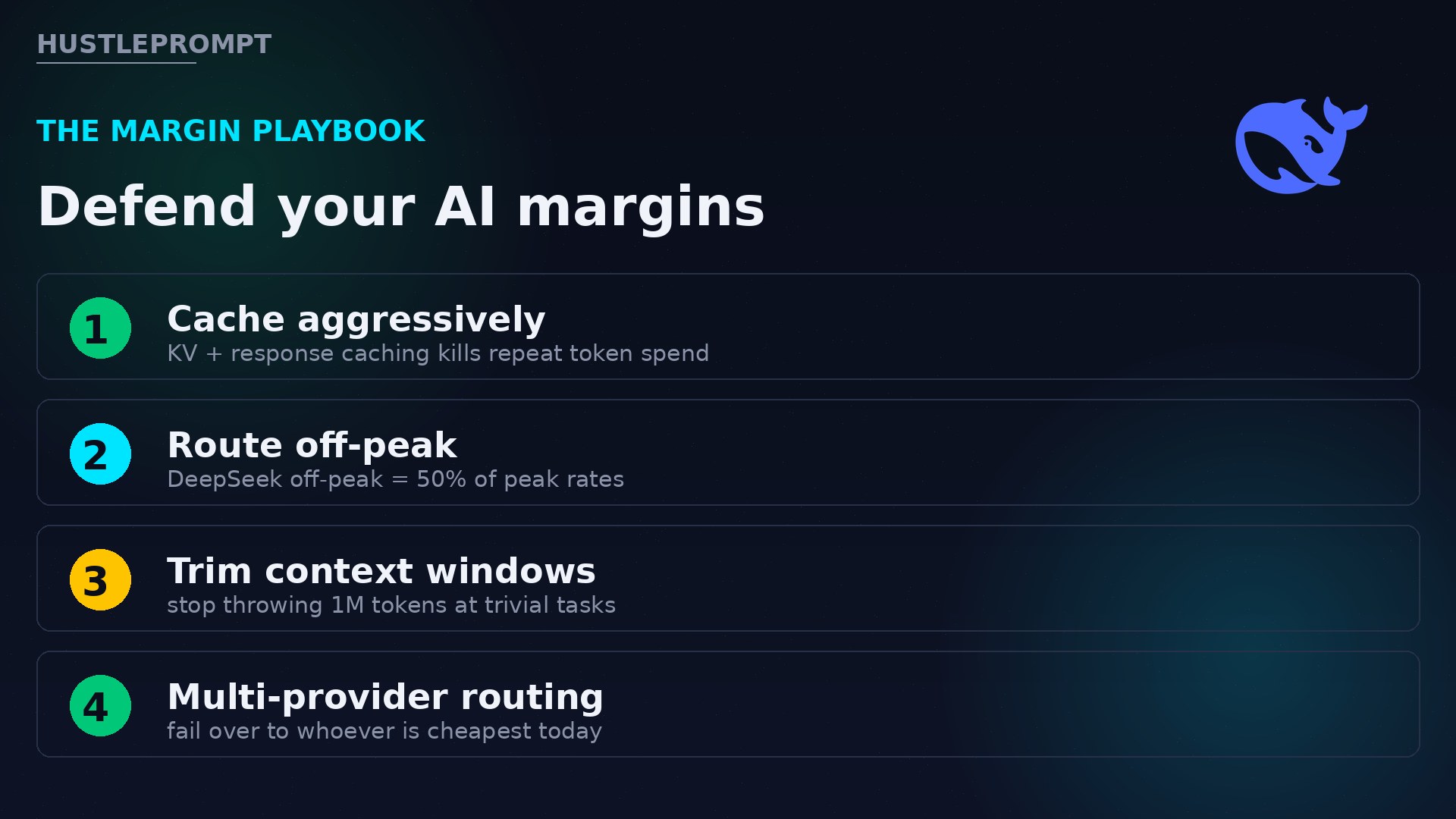
- Cache aggressively. KV-cache hits and response caching eliminate repeat spend. DeepSeek reports 96% cache-hit rates are achievable in production.
- Route off-peak. DeepSeek off-peak rates are 50% of peak. Schedule batch workloads for off-peak windows.
- Trim context ruthlessly. Stop sending 1M-token windows at trivial tasks. Retrieve, then reason over the retrieved slice.
- Multi-provider routing. The same model costs $1.32/M on Alibaba and $0.60/M direct. Fail over to whoever is cheapest today.
Token efficiency is now a core performance metric — treat it like uptime.
How to profit from the price shock
- Sell cost audits. Every AI startup with an agentic product just saw its margins move overnight. Offer a “token spend audit” service: find the waste, take a cut of the savings.
- Build the routing layer. Multi-provider failover that chases the cheapest endpoint per model is now a product, not a nice-to-have. LiteLLM-style gateways with price awareness will sell.
- Productize caching. Semantic cache setups for common agent workflows (support bots, research agents) can cut bills 50%+ — charge for the setup.
- Go where prices fell. Zhipu’s GLM-5V-Turbo just got 85% cheaper. Multimodal features that were uneconomical yesterday may pencil out today.
- Watch Q4. Stork expects at least three more labs to hike by year-end. Position yourself as the person who saw it coming — content, consulting, or tooling.
Frequently asked questions
Did DeepSeek raise its API prices?
No. DeepSeek’s own API pricing is unchanged ($0.15/M input, $0.60/M output off-peak). The 230% hike was on Alibaba Cloud’s hosted version of the older V4 Flash 0731 snapshot.
Which AI models got more expensive?
DeepSeek V4 Flash 0731 on Alibaba (+230% output, +120% input), Mistral’s Ministral 3B (+150%) and 8B (+50%), and Alibaba’s Qwen3.6 35B-A3B (+52%) — 17 unannounced moves total, per Stork AI.
Why are AI model prices rising?
Inference costs real money and the VC-subsidized era is ending. Labs are passing compute costs to users; SF Compute’s $245M compute sale shows how tight the underlying market is.
Will more price hikes come?
Stork AI expects at least three more major labs to quietly raise API prices by the end of Q4 2026.
How can I cut my AI API bill?
Cache aggressively, route workloads off-peak (50% cheaper on DeepSeek), trim context windows, and use multi-provider routing to always hit the cheapest endpoint.
Did any model get cheaper?
Yes — Zhipu AI slashed GLM-5V-Turbo by 85%, the only major downward move Stork caught.
Keep Reading
Sources: Stork AI Daily newsletter (Oct 21, 2026); DeepSeek official pricing docs; DeepSeek V4.1-Flash-1017 release notes.