
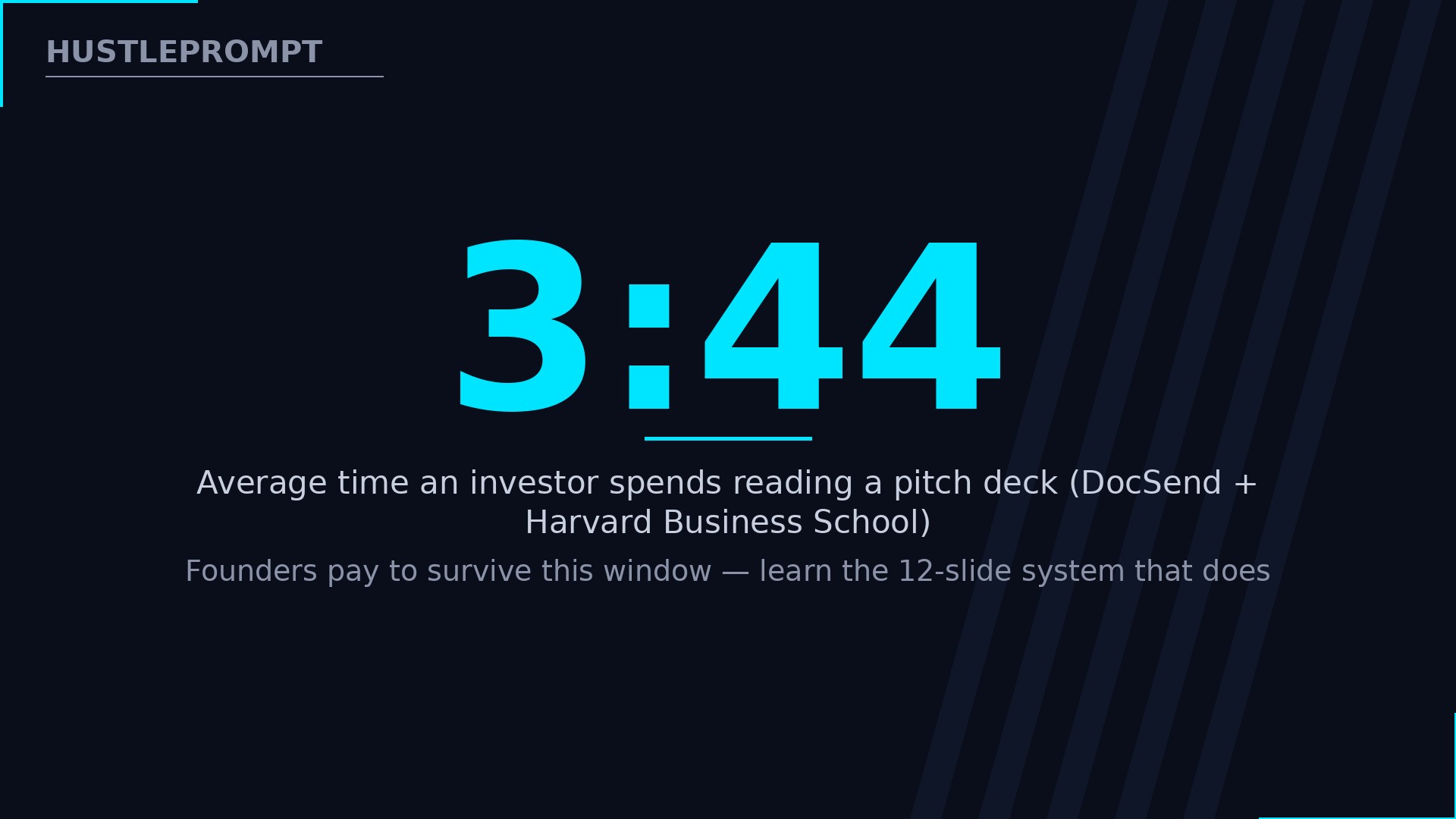
Investors spend an average of 3 minutes and 44 seconds reading a startup pitch deck — and 31% of readers leave within the first 10 seconds. That brutal window is exactly why founders pay real money for an AI pitch deck that survives it.
Most founders can build a product and close customers. Almost none can compress their company into 12 slides an investor actually finishes. With AI handling design and structure, closing that gap is a freelance service worth $500–$2,500 per deck. Here is the system.
Video: How To Perfectly Pitch Your Seed Stage Startup With Y Combinator’s Michael Seibel — Michael Seibel (Y Combinator) shares how seed-stage founders should pitch investors – the narrative principles behind the 12-slide blueprint in this tutorial. Verified live via YouTube oEmbed on 2026-10-22; ID not in used_youtube_ids.txt. (SaaStr AI (https://www.youtube.com/@Saastr))
Why founders happily pay for pitch decks
A pitch deck decides whether a startup gets a meeting. A 2015 DocSend study with Harvard — 200+ decks from companies that raised $360 million — found investors spend an average of 3 minutes and 44 seconds on a deck, via Twine.
A December 2025 Storydoc analysis of 1.3 million sessions found the window shrinking: 31% of readers leave within 10 seconds. The good news: 82% of investors who get past slide four read the whole deck — and investors spend 43% of their total reading time on the team slide. Your real product is narrative, not pixels.
The market backs it up. Waveup’s 2026 pitch deck cost guide puts freelancers at $35–$200 an hour and $500–$5,000 per deck on Upwork and Contra. Agencies charge $2,500–$15,000. An AI-powered freelancer sits in the sweet spot: faster than an agency, smarter than a $200 template gig.
The 12-slide blueprint investors expect
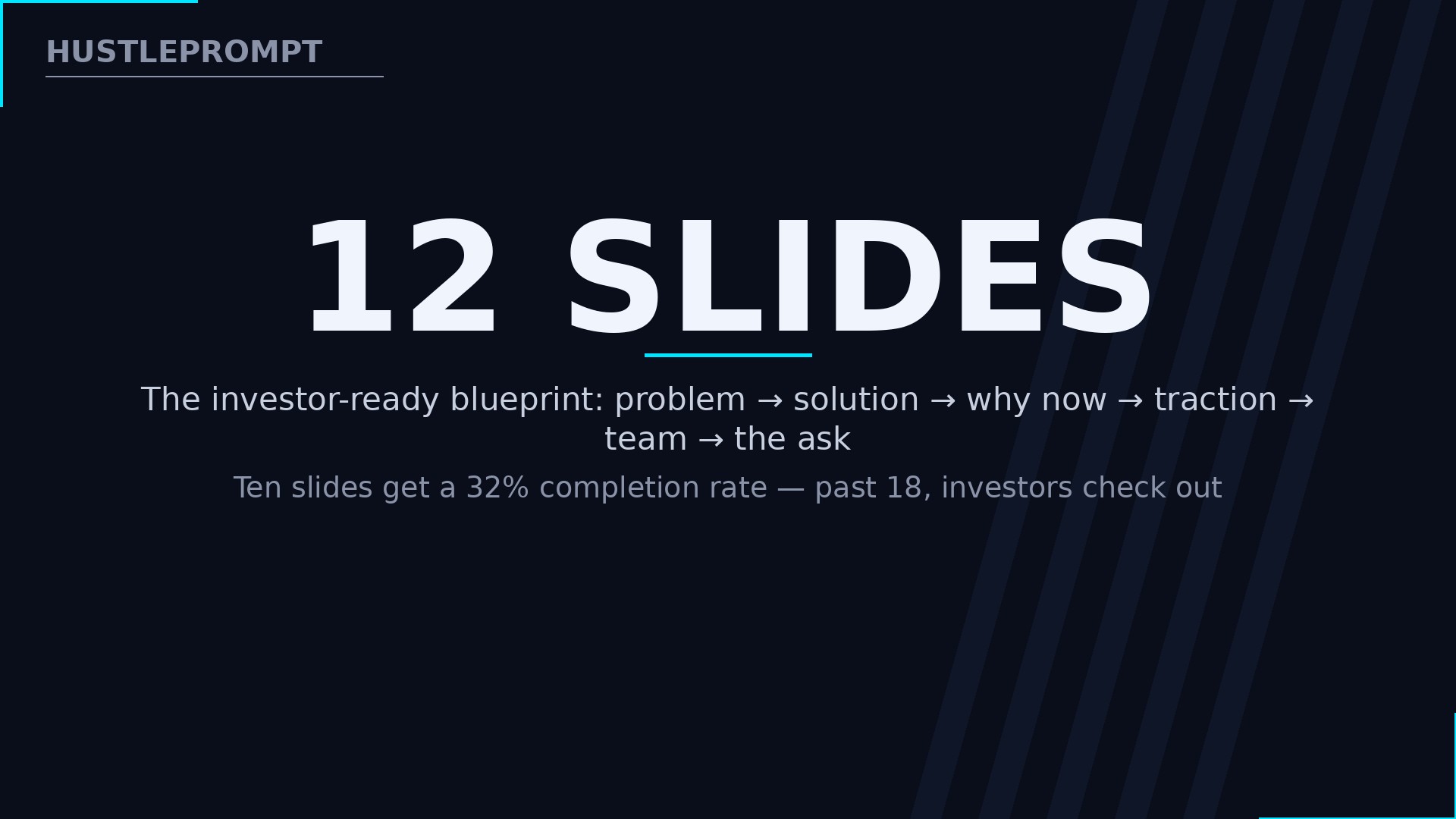
Every credible seed deck answers the same questions in the same order. Founders hire you to impose this structure on their chaos:
- Cover: name + one-sentence mission. Nothing else.
- Problem: a specific customer with a specific pain.
- Solution: the product doing the job. Show, don’t tell.
- Why now: the trigger — cheaper tech, regulation, behavior shift.
- Market: size + your wedge, with sourced numbers.
- Traction: users, revenue, pilots. Dates beat adjectives.
- Business model: how money flows, with unit economics.
- Go-to-market: the repeatable path to customers.
- Competition: an honest map, plus the moat.
- Team: relevant experience per person, tied to the problem.
- Financials: investors spend ~23s here — include a labeled forecast.
- The ask: how much, what it builds, one next step.
The Storydoc data sets a hard length rule: 10-slide decks had a 32% completion rate (vs. 22% average), and engagement dropped past 18 slides. So 10–12 slides is the sweet spot, with extras in an appendix. Three narrative rules hold it together: one headline, one visual per slide; specifics over superlatives (a named customer beats “massive opportunity”); and the first four slides must earn the rest.
Your AI tool stack for pitch decks
You need one lead tool per job, not design talent. Current published pricing, verified October 2026 — and one caution: Tome shut down its AI presentation product in April 2025, so never build a client workflow on it.
| Tool | Free tier | Paid plan | Best for pitch decks |
|---|---|---|---|
| Gamma | $0, 400 one-time credits | Plus $12/mo ($9/mo annual); Pro $25/mo ($18/mo annual) | Fastest draft from a prompt; PDF/PPTX/Google Slides export |
| Beautiful.ai | 14-day trial | Pro $14.50/mo billed annually ($174/yr); single deck $45 | Fully editable .pptx deliverable; on-brand smart slides |
| Canva | $0, 1.6M+ templates | Pro $18/mo ($144/yr); Business $25/mo | 141M+ assets, brand kits, Magic Design AI |
| Pitch | Free (limited) | Pro $10/user/mo; Business $25/user/mo | Live collaboration with the founder |
Sources: Gamma via ToolChase (verified on gamma.app, Oct 2026); Canva via AI Alleyway (Oct 2026); Beautiful.ai via LogicBalls (Oct 2026); Pitch via Digital Lab.
- Gamma for speed: founder notes in, 12-card draft out in minutes. Pick when the deadline is tight.
- Beautiful.ai for the final file: its .pptx export is genuinely editable, unlike most AI exports.
- Canva for visuals: headshots, icons, and brand kits for the whole deck.
- Claude or ChatGPT for narrative: every deck starts here, turning messy notes into a 12-slide outline before any design tool opens.
One warning from published testing: investors recognize an unedited AI draft on sight, and it reads as a deck the founder didn’t invest in. AI builds the first draft; you build the story.
The 5-step delivery workflow
Step 1 — Story extraction (Day 1)
Questionnaire first: description, customer, why now, proof, team, ask. Feed answers into Claude: “Turn these notes into a 12-slide outline — one headline and one visual per slide — and flag claims needing a source.” This interrogation is the service.
Step 2 — AI draft (Day 1–2)
Paste the outline into Gamma for a draft in minutes, or build in Beautiful.ai. Pick a restrained dark or editorial theme. Generate two theme variants — showing a choice makes you look like a studio.
Step 3 — Visual design (Day 2–4)
Replace every placeholder: real headshots, product screenshots, a cited market chart. Use Canva’s background remover. Turn bullet walls into comparisons or timelines. Check the deck on a phone — a third of sessions are mobile.
Step 4 — Investor polish (Day 4–5)
Read slides 1–4 cold, as an investor would. Fix those four before anything else. Cut to 10–12 slides; the rest is an appendix. Personalize the cover with the investor’s name — Storydoc shows that lifts engagement up to 47%.
Step 5 — Delivery and revisions (Day 5–7)
Deliver the editable file plus a locked PDF, with two revision rounds in the base price. Each round is an upsell: investor-specific versions, appendix build-out, a one-page teaser.
Pricing your pitch deck service
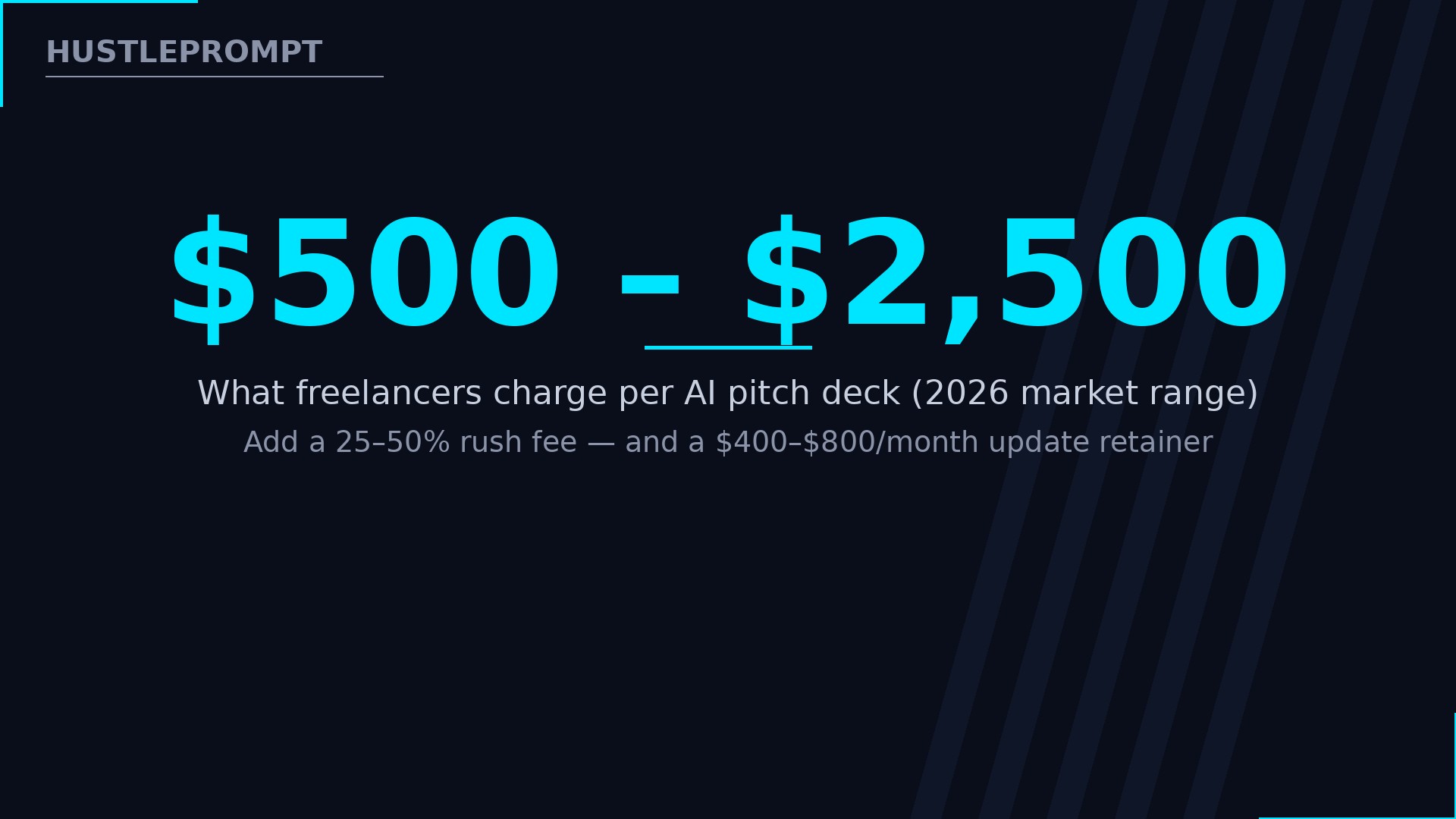
Price against the published market. Waveup’s 2026 data: freelancers charge $500–$5,000 per deck, $35–$200 an hour, roughly $100–$150 per slide.
- Starter — $500: AI-drafted 10-slide deck, one theme, one revision round. Pre-seed founders, 3–4 day turnaround.
- Standard — $1,200: 12-slide narrative build, two theme variants, real-asset swap, two revision rounds. The volume product.
- Premium — $2,500: strategy workshop included, editable .pptx, investor-personalized versions, appendix, pitch coaching notes.
- Rush fee — +50%: under-a-week delivery. Published 2026 research puts rush premiums at 25–50%.
- Retainer — $400–$800/month: investor updates and board slides after the raise.
Arithmetic illustration, not a promise: two Standard decks a month at $1,200 is $2,400 in revenue against roughly $25–$45 in tool subscriptions. Margins are high because the product is judgment. Never guarantee fundraising outcomes — you sell a better story, not a closed round.
Where to find startup clients
Founders hire people they trust — fish where fundraising happens:
- Accelerator networks: YC Startup School, Techstars alumni, local accelerators. Offer a free 15-minute deck teardown to get in the door.
- Founder communities: Indie Hackers, Product Hunt, founder Slack groups. Post before-and-after slide makeovers — they beat any sales copy.
- Wellfound (ex-AngelList): raising startups list publicly. Message CEOs with one concrete improvement to their public deck.
- Upwork and Contra: where founders already buy; top specialists charge up to $100/hr. Position on narrative plus AI speed, never cheapest price.
- LinkedIn and X: publish teardowns of famous public decks (Airbnb’s and Uber’s seed decks are public) — founders follow people who make their category legible.
Your portfolio is the pitch: build three sample decks for fictional startups (fintech, healthtech, AI dev tool) with the full 12-slide structure on a one-page site.
FAQ
How much can I charge for an AI pitch deck?
Published 2026 data: $500–$5,000 per deck, roughly $100–$150 per slide. A sensible ladder is $500 starter, $1,200 full build, $2,500 premium with strategy, plus a 25–50% rush fee. Market ranges, not promises.
Do I need design skills?
No — that is the point of the stack. Gamma and Beautiful.ai generate layouts; Canva supplies assets. Your billable skill is narrative: extracting the story, sequencing 12 slides, knowing what investors read first.
Which AI tool should I use?
Gamma for speed — a full draft in minutes. Beautiful.ai when the deliverable must be an editable .pptx. Canva for photos, icons, and brand kits. Most freelancers use two of the three per client.
How long does a deck take?
Market turnaround is a few days to two weeks. This workflow runs about 5–7 working days: story and draft on day one, design over two to three days, polish, then the two included revision rounds.
What if the founder’s numbers are weak?
Then you have your upsell: a narrative strategy add-on — story workshop, sourced market sizing, financial-slide build-out — at $800–$1,500 on top of the base deck.