
Perplexity just did something no other AI search company has done: it let developers stuff up to 50,000 AI search requests into a single file and have every one answered by a live browsing agent. The new Perplexity Batch API launched Thursday, announced by founder Aravind Srinivas on X, turns the company’s Agent API into a bulk-work machine — and it quietly opens a fresh revenue lane for anyone selling data, research, or enrichment services.
Here is what actually shipped, what it costs (and pointedly doesn’t), and exactly how to turn it into money.
What Perplexity Actually Shipped
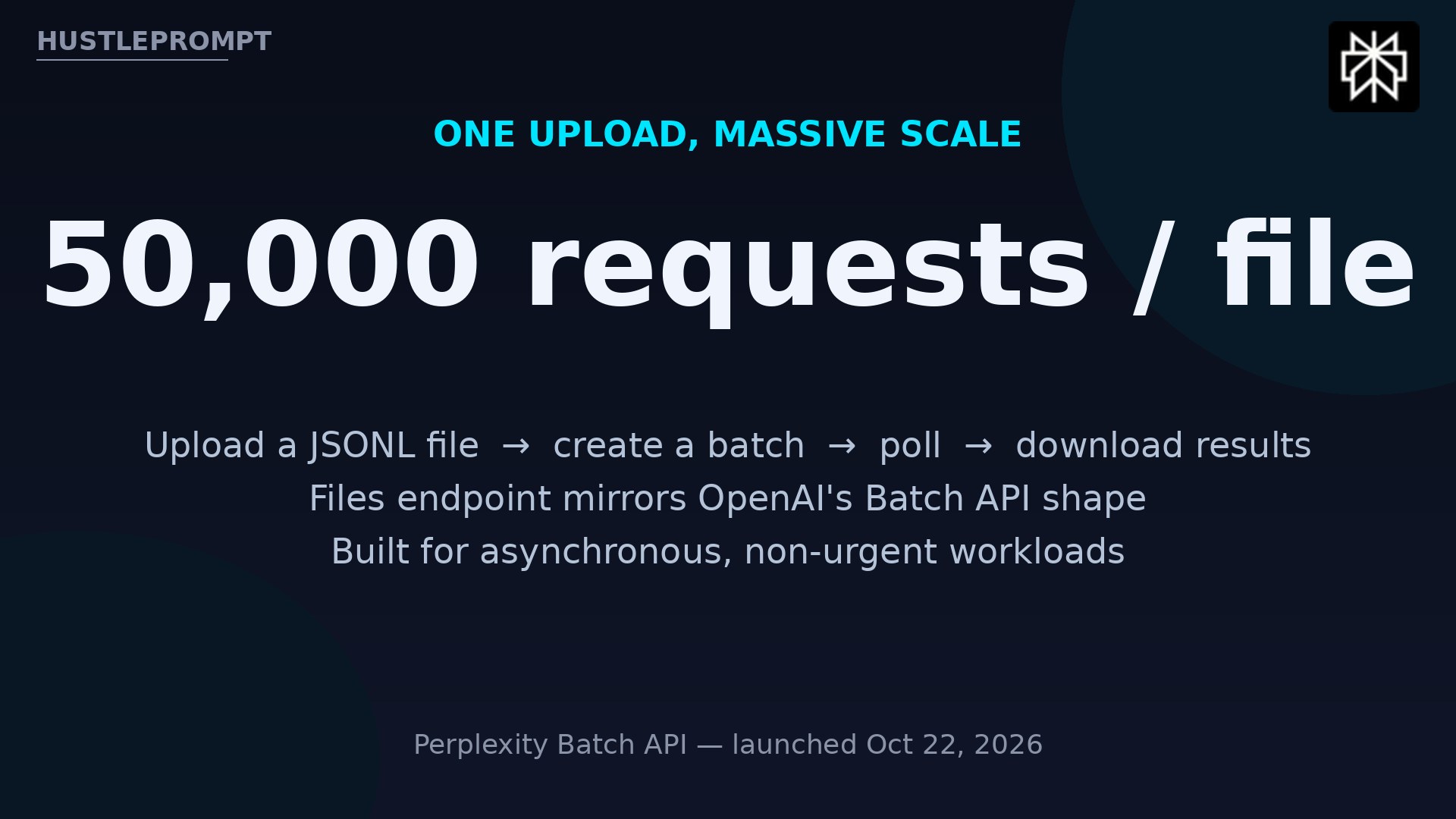
The Batch API extends the Agent API — Perplexity’s model-agnostic platform for building AI agents — into large asynchronous workloads. Instead of firing one live request at a time and waiting, you upload a JSONL file with up to 50,000 requests, create a batch, poll for status, and download a results file when the run finishes.
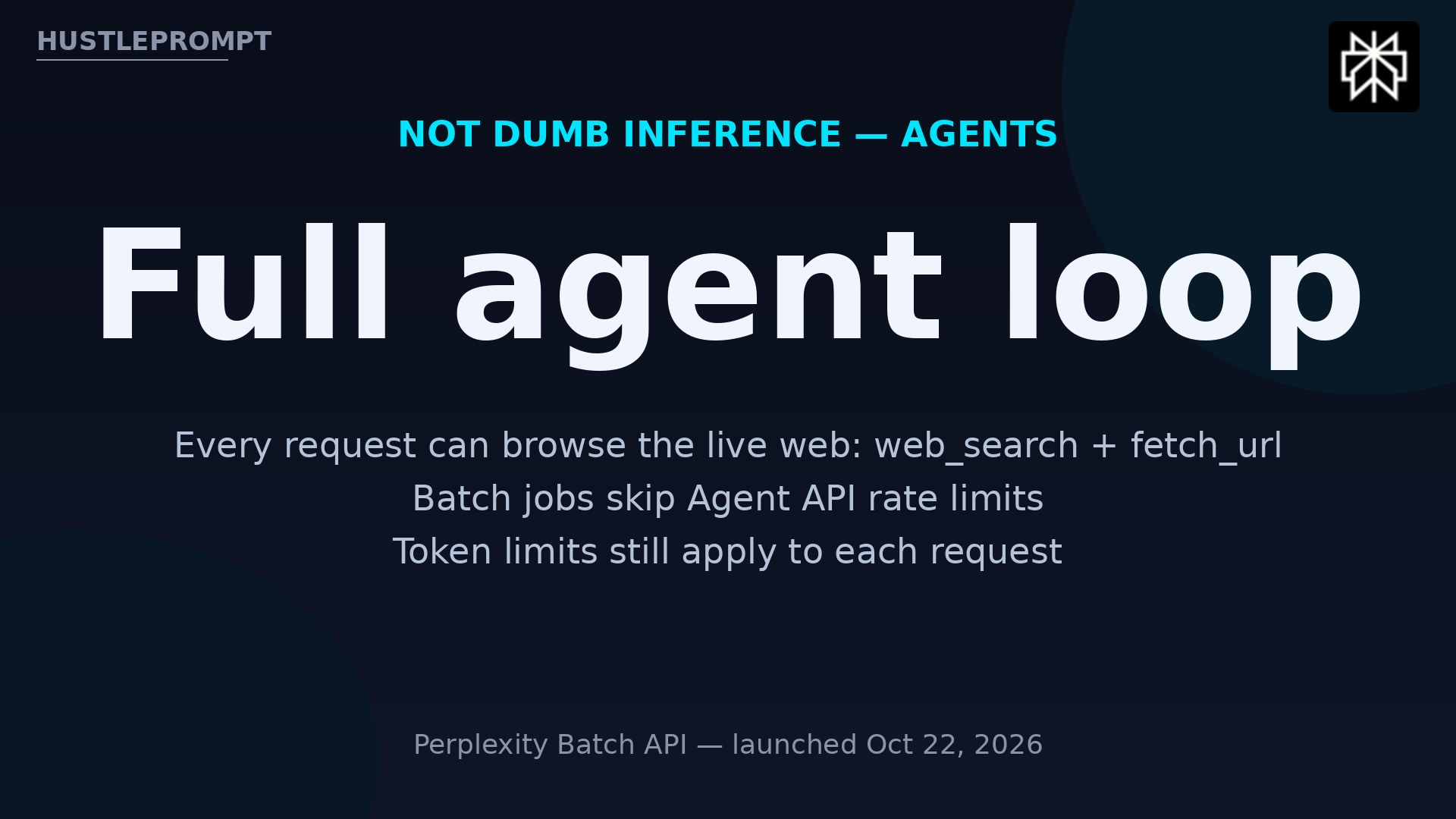
Two details matter most. First, each request is not dumb inference — it can run the same full agent loop as the live API, including live web search and URL fetching. Second, batch requests do not count against Agent API request rate limits, which removes the biggest ceiling on bulk work.
Batch API at a glance
| Spec | Detail | Source |
|---|---|---|
| Requests per file | Up to 50,000 | Fathom News (announcement) |
| Per-request capability | Full agent loop: web_search + fetch_url tools | Fathom News (announcement) |
| Rate limits | Exempt from Agent API request rate limits; token limits still apply | Fathom News (announcement) |
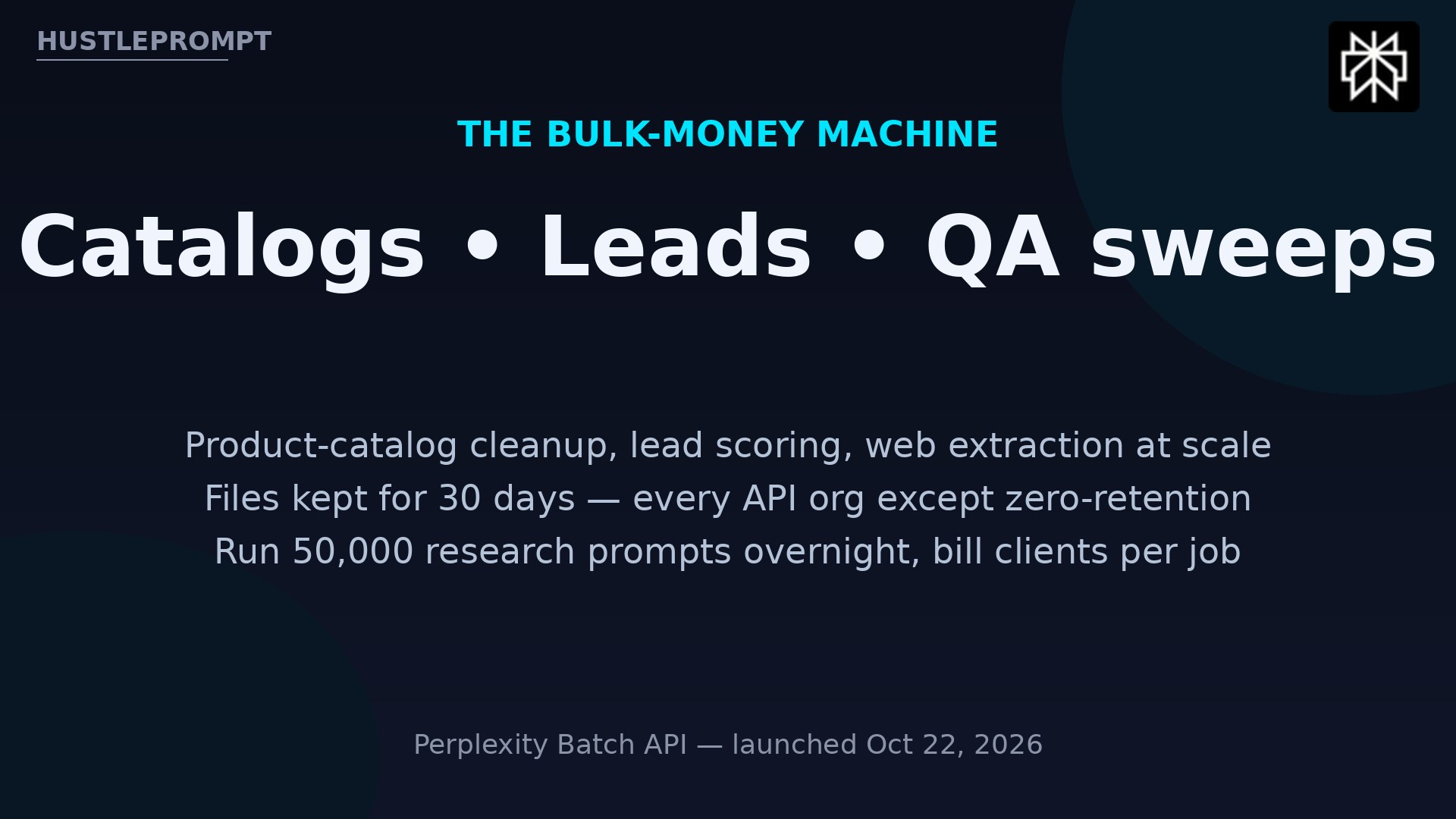
| File retention | 30 days | Fathom News (announcement) |
| Availability | Every API organization except zero-data-retention orgs | Fathom News (announcement) |
| Endpoint shape | Mirrors OpenAI’s Batch API (Files + Batches endpoints) | Fathom News (announcement) |
How the Batch API Works
The flow is deliberately familiar to anyone who has used OpenAI’s batch system — Perplexity says its Batch and Files endpoints follow the same shape, so existing JSONL tooling ports over with minimal changes.
The 4-step batch flow
Build the file
Pack up to 50,000 agent requests into one JSONL file — one line per job.
Upload it
Send the file through the Files endpoint. Perplexity validates it for you.
Create the batch
Point a batch job at the file ID, then poll for status while agents work.
Download results
Collect the finished result file. Files are kept for 30 days.
Packaging 50,000 agent calls into one file means no 50,000 live connections from your app server — and a concrete scale target instead of a vague enterprise promise.
Why “Agents in Bulk” Changes the Economics
Live agents are built for interaction — support chats, research copilots, anything where a human waits on the answer. Bulk work is a different animal: catalog cleanup, lead scoring, web extraction, QA sweeps, thousands of research prompts against the same internal process. Those jobs care about throughput, retries, and predictable billing far more than latency — exactly the gap this launch fills.
Batch vs. live, side by side
| Perplexity Batch API | Perplexity live Agent API | |
|---|---|---|
| Scale | Up to 50,000 requests per file | One request per call |
| Agent tools | Full loop: web_search + fetch_url | Full loop: web_search + fetch_url |
| Request rate limits | Exempt — batch jobs don’t count | Standard tier limits apply |
| Token limits | Still apply per request | Apply per request |
| Latency | Asynchronous — collect later | Real-time response |
| Best for | Bulk enrichment, evals, sweeps | Interactive copilots, support |
One honest caveat on price: Perplexity’s announcement mentions no batch-specific discount. Other providers’ batch offerings are typically discounted — industry comparisons put the norm around 50% off standard rates — but Perplexity framed this launch around throughput and operational simplicity, not a price cut. Token and tool metering from the Agent API still applies. Model your margins on that, not on a discount that was never announced.
How to Profit: 5 Concrete Ways to Productize It
- Sell bulk lead enrichment. Agencies pay per enriched lead. Feed 10,000 company URLs through one batch job that researches each — funding, headcount, tech stack — and charge per thousand records. One JSONL template, reused across clients.
- Offer catalog cleanup as a product. E-commerce sellers have messy product data. A batch job that fetches each product page, normalizes specs, and flags duplicates is a repeatable, fixed-price service.
- Run overnight competitive monitoring. 50,000 research prompts covers entire markets. Sell weekly “market brief” subscriptions: the batch runs overnight, the brief lands in the morning.
- Productize QA and content sweeps. Marketing teams need thousands of pages checked for broken claims or outdated pricing. Batch agents that actually fetch the pages beat regex scripts — and clients pay per sweep.
- Price per job, not per hour. The API’s predictable per-request shape makes unit economics easy to model: know your cost per 1,000 requests, add margin, quote flat fees. Async delivery lets you stack multiple client jobs per day on one pipeline.
The Fine Print
Three things to know before you build on it. First, it is open to every API organization except zero-data-retention ones — if a client’s compliance rules forbid 30-day file storage, this door is closed to them. Retention rules, not model quality, will decide adoption in regulated industries.
Second, there is no announced completion-time SLA — unlike OpenAI’s documented 24-hour window for its batch API, Perplexity has published no timing promise yet. Plan client timelines with buffer.
Third, per Fathom News, the announcement leaves open questions on license terms for tool usage at scale, the compute profile behind bulk runs, and protocol support details. Read the docs before shifting serious workloads.
FAQ
What is the Perplexity Batch API?
A new asynchronous API from Perplexity (launched Oct 22, 2026): submit up to 50,000 Agent API requests in one uploaded file, collect results later.
How many requests fit in one batch file?
Up to 50,000 per file, per Perplexity’s announcement.
Do batch requests get the full agent loop?
Yes — the same full agent loop as the live API, including web_search and fetch_url, so batch agents browse the live web.
Do batch requests count toward rate limits?
Batch requests do not count toward Agent API request rate limits, though token limits still apply to each request.
How long are batch files kept?
Uploaded files are kept for 30 days. The feature is available to every API organization except those on zero data retention.
Is there a batch discount on pricing?
No batch pricing was announced. Perplexity framed this around throughput, not a price cut — model costs on standard Agent API metering.
Keep Reading
Sources: launch details from Fathom News’ report on the Batch API launch (quoting founder Aravind Srinivas’ announcement post); Agent API mechanics from Perplexity’s official Agent API documentation.