
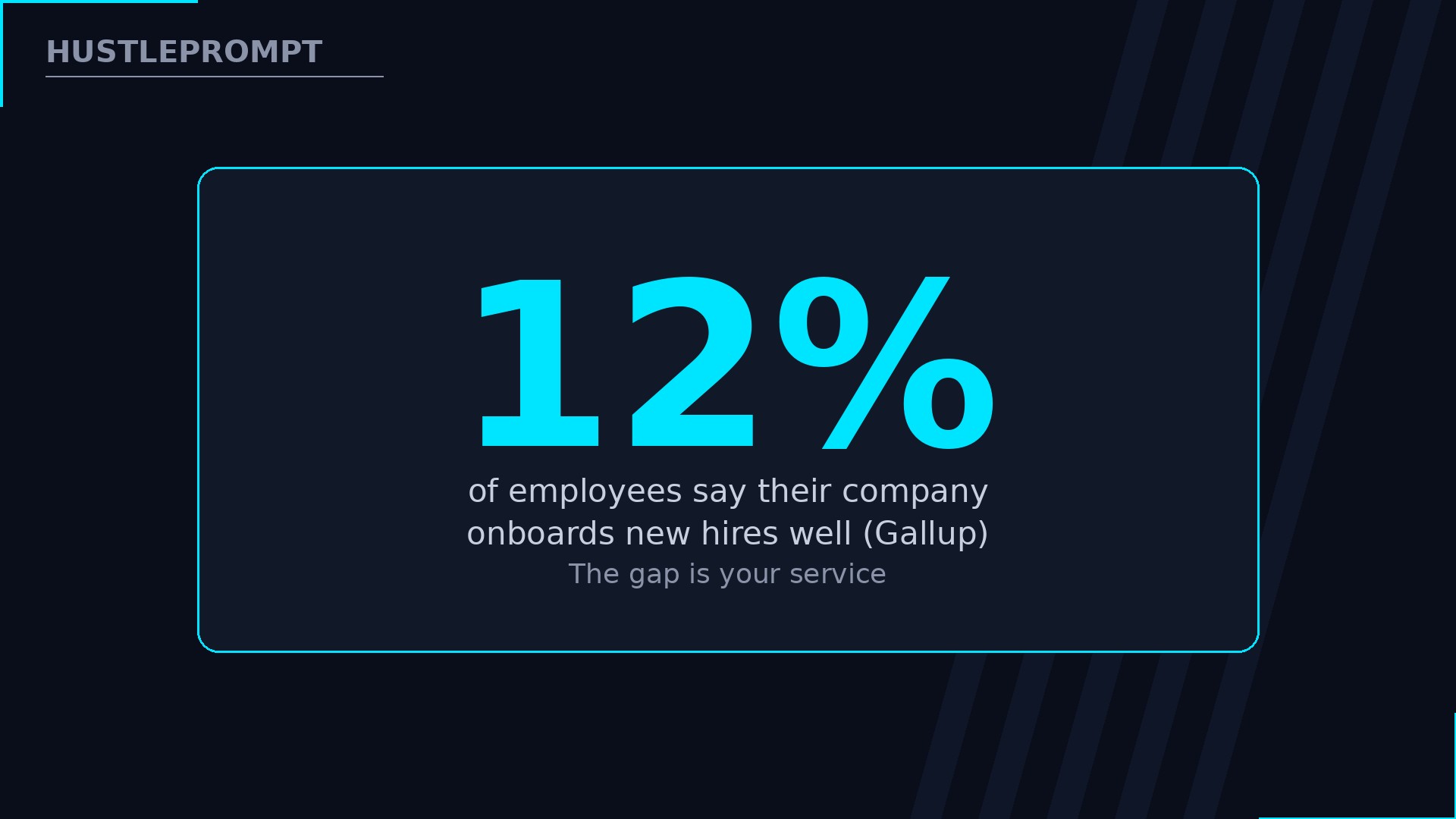
Only 12% of employees strongly agree their company does a great job onboarding new hires, according to Gallup. Meanwhile, McKinsey found knowledge workers spend 19% of their week — about 1.8 hours a day — just searching for information they need to do their jobs. That mess is your market: an AI SOP manual service that turns unwritten know-how into step-by-step manuals new hires can actually follow.
Video: How to Build SOPs Faster Using AI : Business Process Automation — systemHUB’s walkthrough of building SOPs faster with AI — it demonstrates the exact AI-assisted drafting workflow this service sells to small businesses. (systemHUB)
Why small businesses will pay for SOPs and training manuals
An SOP — a standard operating procedure — is a written, step-by-step description of how a routine job gets done, so it gets done the same way no matter who does it. A training manual packages the same idea for a new hire: role, tools, steps, and quality bar in one document. Most small businesses have none of this written down — the owner holds it in their head, the senior employee holds the rest, and new hires learn by interrupting both.
The pitch writes itself. Gallup cites SHRM estimates that replacing an employee can cost six to nine months of salary. A manual that keeps one hire from quitting in month two pays for itself.
Target businesses with 5 to 50 employees:
- Trades: HVAC, plumbing, landscaping, cleaning
- Clinics: dental, med spas, veterinary, gyms
- Food and retail: restaurants, cafés, shops
- Professional services: agencies, accounting, law, property
All of them train the same painful way: shadowing and hoping. You sell the fix.
What you actually sell: four service tiers
Do not sell “documentation.” Sell a finished product with a clear scope, priced per project — not hourly — so AI speed works in your favor.
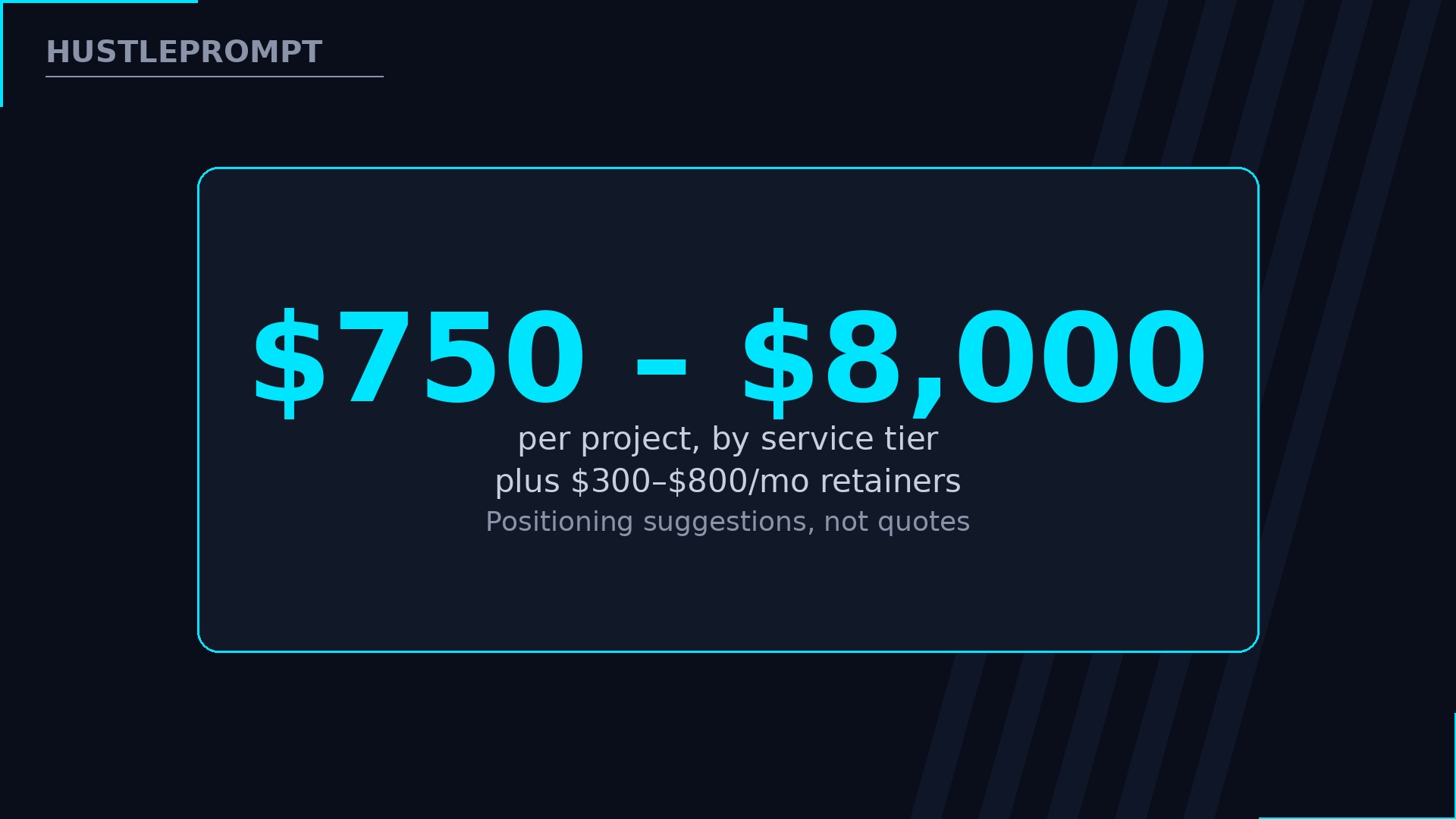
| Tier | What the client gets | Typical scope | Suggested project price* |
|---|---|---|---|
| Starter SOP Pack | 5 core procedures, written and formatted | 1 role, 1 week | $750–$1,500 |
| Role Training Manual | Full new-hire manual: role guide, SOPs, checklists | 1 role, 2–3 weeks | $1,500–$3,500 |
| Company Playbook | Every core role documented and searchable | 3–6 roles, 4–6 weeks | $3,500–$8,000 |
| Keep-It-Current Retainer | Monthly updates, quarterly audit | Ongoing | $300–$800/month |
*Prices are positioning suggestions for your own service, not vendor quotes. Set rates from your costs, speed, and local market.
Your AI tool stack for SOP and manual production
Four layers: capture, drafting, formatting, delivery. Keep your own costs low — this is the whole stack.
| Tool | Price (checked Oct 2026) | Your job for it |
|---|---|---|
| ChatGPT Plus | $20/month | Turn transcripts into structured SOP drafts |
| Claude Pro | $20/month | Long-document editing and consistency passes |
| Scribe | Free Basic; Pro Personal reported $25–$35/seat/mo — reports conflict, confirm at checkout | Auto-capture screen workflows into step-by-step guides |
| Trainual | No public list; reports from $249/mo plus a reported $1,000 setup fee — confirm at checkout | Optional delivery platform: training paths, tracking |
| Google Docs / Notion | Free plans available | Default delivery format |
Start with ChatGPT Plus, Scribe’s free tier, and Google Docs — about $20 a month. Add Claude Pro when editing becomes the bottleneck.
The 6-step delivery workflow
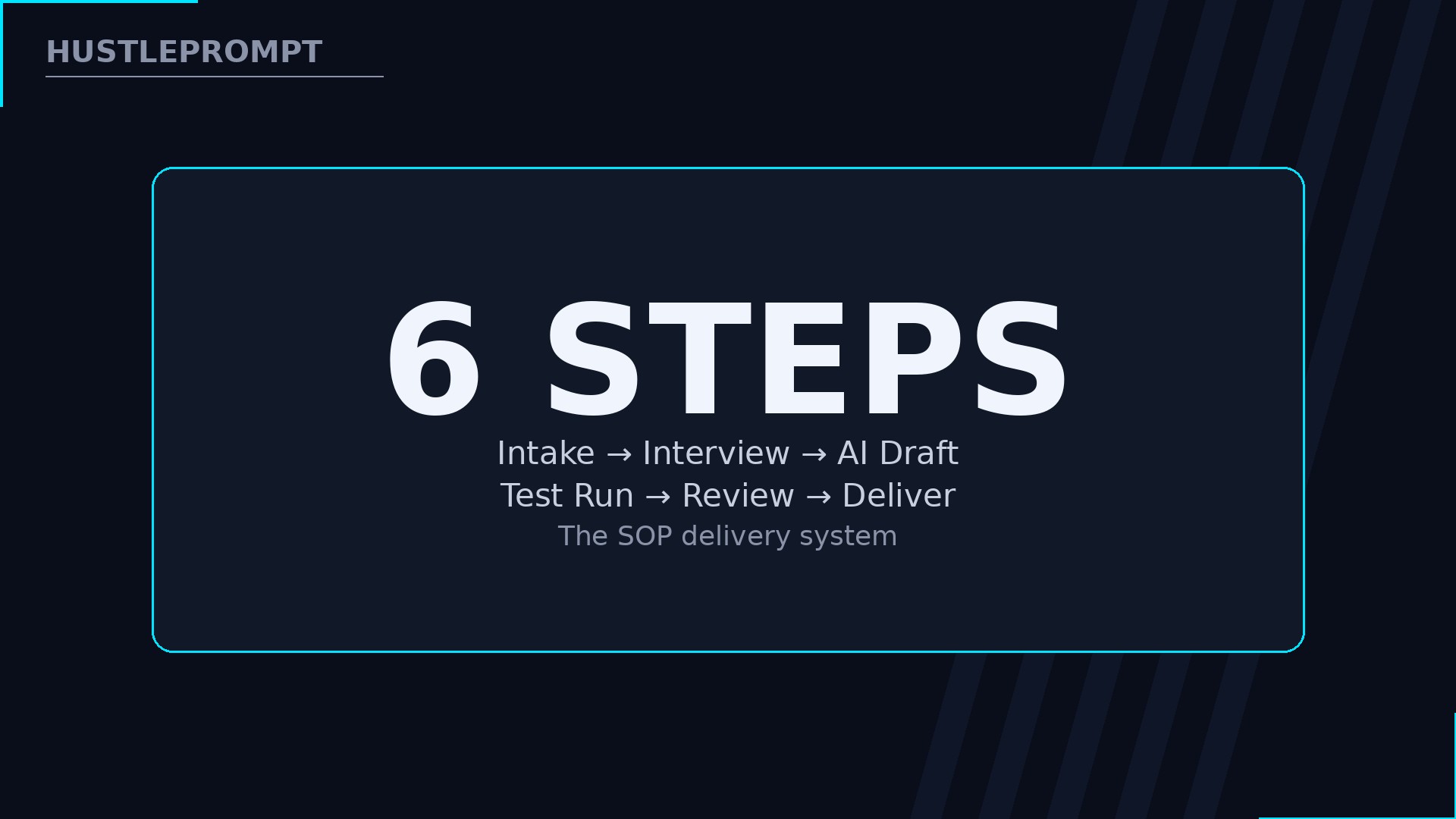
Run this system for every client, and a role manual that took a consultant a month ships in two to three weeks.
Step 1: Intake — find the bleeding processes first
Send a one-page intake form. Ask for:
- Daily, weekly, and monthly task lists
- Tools used (names only — never passwords)
- New hires’ three most common mistakes
- Questions the owner answers repeatedly
Rank processes by pain, not neatness. The procedure causing the most interruptions or errors goes first — quick wins in week one buy trust for the rest.
Step 2: Interview — capture, don’t invent
Book a 45-minute recorded call with the person who actually does the job — the knowledgeable worker, not necessarily the owner — and have them perform the task on screen while talking through it. For screen work, run Scribe to capture each click; for hands-on work, record phone video and transcribe it.
Step 3: Draft with AI — transcripts in, structured SOPs out
Feed the transcript and capture to ChatGPT or Claude with a tight brief:
“Turn the transcript below into a draft SOP for [task]. The reader is a [role] with [experience level]. Use numbered, actionable steps, including decision points, tools, and quality checks. If a step, tool, or expected result is unclear, mark it [CONFIRM] and list a question for me. Do not guess.”
The [CONFIRM] rule is the whole quality system: a guessed step in a safety or money procedure is a liability, not a shortcut.
Step 4: Test run — a newcomer reads it cold
Hand the draft to someone who has never done the job and watch them follow it without coaching. Each hesitation is a missing step or vague verb. Fix, then re-test only the rough spots.
Step 5: Client review — the owner signs off
Send the draft with a change log: what you wrote, what you marked [CONFIRM], and what the test run caught. The owner corrects facts, approves safety steps, and confirms policy. Get sign-off in writing — an “approved” email is enough.
Step 6: Deliver and train the trainer
Deliver the final manual as a searchable document plus a one-page checklist per procedure. Then run a 30-minute session showing the owner how to update it and when to review it (quarterly, or on any tool or policy change). That session is also your retainer pitch.
How the money works: an arithmetic illustration
Illustration only — arithmetic, not an income promise.
- One Role Training Manual at $2,500 = $2,500
- Two Starter SOP Packs at $1,000 each = $2,000
- Three retainers at $500/month = $1,500/month recurring
- Total: $6,000, of which $1,500 repeats
Costs stay tiny: roughly $20–$40 a month in AI subscriptions at the start, plus your time. AI drafting compresses writing into days of focused work — and ten retainers at $500 a month is $5,000 a month recurring. Again, an illustration, not a promise.
Getting clients: outreach that works
Your best prospects are actively hiring — a job post is a public confession that training is about to hurt. Check local job boards weekly.
Cold email script
Subject: Your new [role] hire’s first two weeks
Hi [Name] — I saw you’re hiring a [role]. Most owners spend the first two weeks re-explaining the same tasks, and Gallup found only 12% of employees say their company onboards well. I build step-by-step training manuals for [industry] businesses, so new hires learn from a document instead of interrupting you. Want me to draft one procedure free, so you can see the format first?
Follow-up script (day 4, if no reply)
Hi [Name] — quick bump. The free sample takes one afternoon plus a 20-minute call with whoever does the job best. If it doesn’t fit, keep it anyway. Worth a look?
The free sample is the closer. Pick their most-asked-about procedure, deliver it in 48 hours, and let the document sell the full manual. Cap free work at two samples a week.
Rules that keep you credible
- Never invent steps. If the expert didn’t say it, mark [CONFIRM].
- Never write regulated procedures cold. Safety, medical, food, and legal steps need qualified sign-off.
- Never collect passwords or sensitive data. Ask for tool names and redacted screenshots.
- Date and version every manual. No review date, no trust.
- Keep one master template. Same structure and headings for every client — your speed comes from the template.
Frequently asked questions
Do I need experience in the client’s industry?
No — you need a good interview method, not industry tenure. The knowledgeable worker supplies the expertise; you supply structure and speed.
How long does one training manual take?
Two to three weeks elapsed, mostly waiting on interviews and review.
Won’t AI just let businesses do this themselves?
In theory, yes — in practice, they don’t. Gallup’s 12% figure shows almost none onboard well. You sell finished work, not chatbot access.
Should I deliver in Trainual, Google Docs, or Notion?
Wherever the client already works; Google Docs is the safe default. Trainual only for tracking — its pricing is quote-based.
How do I price my first project?
Start at the low end of the Starter SOP Pack ($750–$1,500), deliver fast, and collect a testimonial. Then raise rates with proof.
Can this become recurring revenue?
Yes — that is the Keep-It-Current retainer. Offer it at delivery, when the value is obvious.