
What if your best sales forecast ran on the same server that hosts your website? Mistral Timestral makes that a real option.
Mistral released Timestral, its first family of time-series foundation models, in four sizes, 5 million to 209 million parameters. The largest runs on a server CPU, with no GPU needed.
Forecasting used to mean fitting a classic model per series, or training a deep model from scratch for every dataset. Timestral is pretrained, so it forecasts zero-shot on data it has never seen.
What Mistral actually shipped
A time-series foundation model learns patterns across many series, then transfers them to new ones. Think pretraining, but for numbers over time instead of text.
Timestral delivers probabilistic, multivariate forecasts. In plain English, it forecasts several related series together, and it returns a range of likely outcomes instead of a single number.
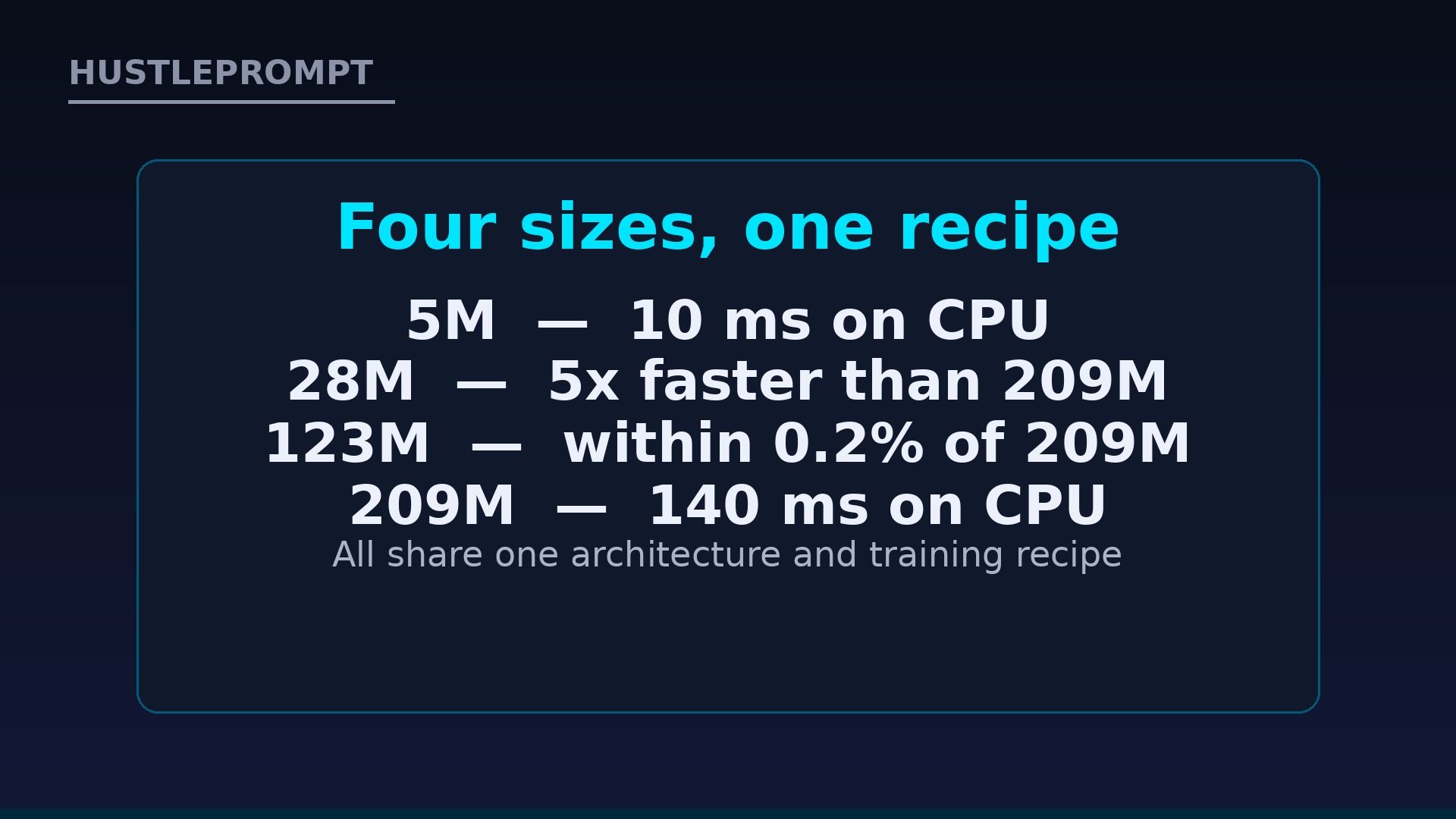
| Model | Parameters | Mistral-reported CPU speed* |
|---|---|---|
| Timestral-5M | 5 million | 10 ms |
| Timestral-28M | 28 million | 5x faster than the 209M |
| Timestral-123M | 123 million | Within 0.2% of the 209M score, at three quarters of its latency |
| Timestral-209M | 209 million | 140 ms |
*Speeds are Mistral-reported: forecasting one day ahead from three weeks of 15-minute history on a standard server CPU with 8 threads. Source: Mistral, “Timestral: Mistral’s time-series foundation models.”
Evidence, with the vendor label attached. Mistral reports the 209M model ranks first among pretrained, zero-shot models on all three main benchmarks: GIFT-Eval, TIME, and fev-bench, from a single checkpoint with no ensembling.
On the model card, Timestral-209M scores 0.658 MASE and 0.446 CRPS on GIFT-Eval (lower is better), and 50.39 on fev-bench SQL skill (higher is better). These are Mistral-reported results; the technical report is still to come.
Source: Mistral announcement and Hugging Face model card.
How it works, in four steps
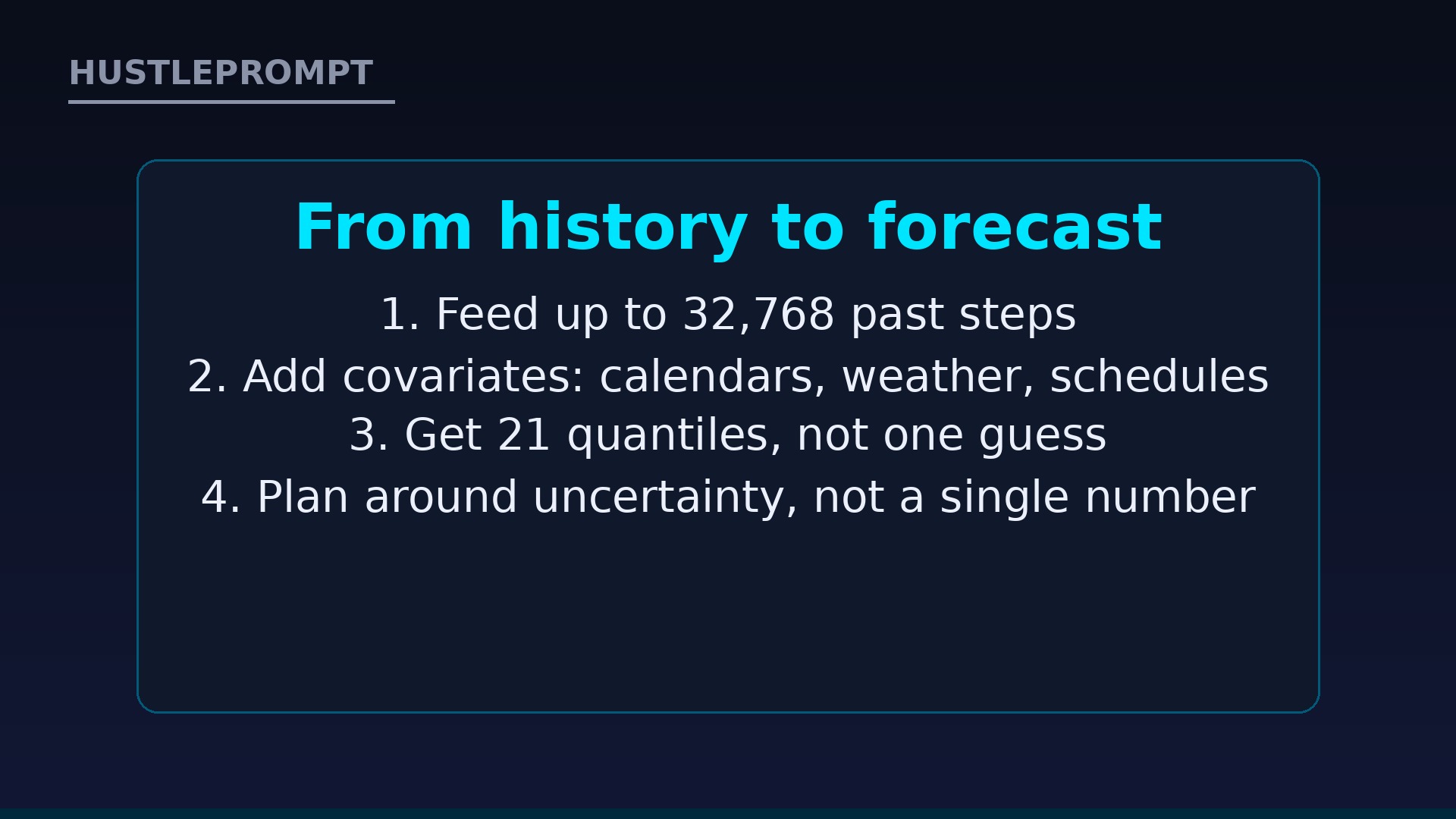
Up to 32,768 past steps: sales, sensor readings, traffic, or demand.
Past-only and known-future covariates, plus categorical inputs like day of week or machine state.
21 quantiles per step, so you see the range of outcomes, not just one guess.
Set stock, staffing, or maintenance plans around the likely range.
Covariates are extra inputs that help explain a series. A known-future covariate is known in advance, like a production schedule or a weather forecast.
Timestral also handles missing values and categorical inputs directly, removing much of the usual data-cleaning work.
How to profit from Timestral
Here is the practical play for freelancers and small agencies. Forecasting is a service businesses already pay for, and Timestral cuts compute cost to near zero.
- Pick one niche. E-commerce demand, restaurant staffing, energy use, or equipment maintenance. One niche beats ten vague offers.
- Run a shadow test. Forecast alongside the client’s current method for two to four weeks. Report accuracy in business terms: stockouts avoided, overtime saved, or waste reduced.
- Package the output. Sell a weekly forecast report, a dashboard, or an alert feed. Clients buy decisions, not models.
- Price on value. A monthly retainer tied to one clear metric, like forecast accuracy or inventory saved, is easier to sell than hourly work.
- Check the license first. See the license section below before you build a commercial product on the weights.
Start with the smallest model that passes your shadow test. The 5M model answers in 10 ms on CPU, per Mistral, so a cheap VPS can serve many clients.
The license catch you must read
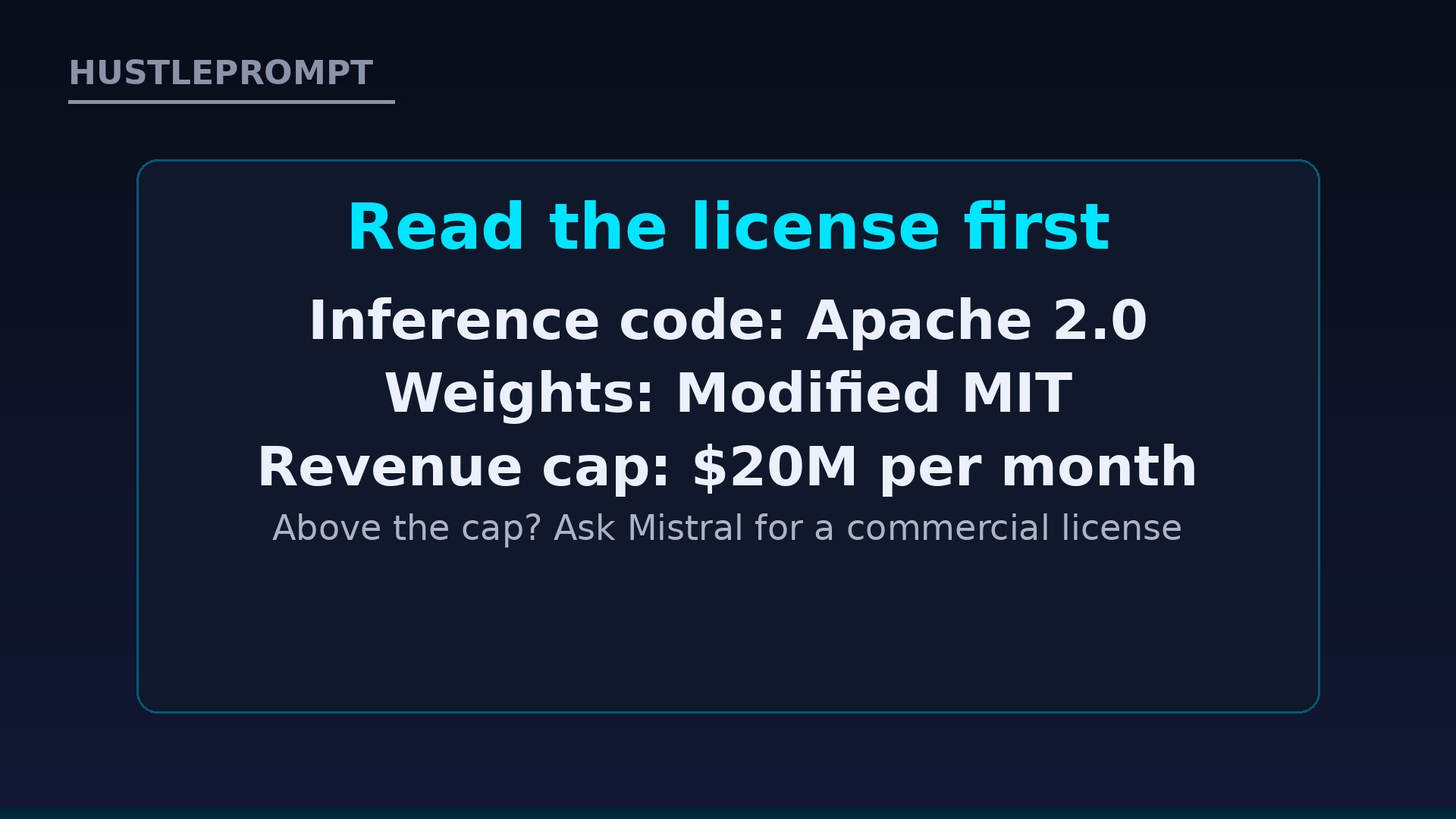
The inference code on GitHub is licensed under Apache 2.0. The model weights are not. They carry a Modified MIT license, per the Hugging Face model card and license file.
The modification is a revenue cap. The license does not authorize use by a company whose global consolidated monthly revenue exceeded $20 million in the preceding month. That restriction also covers derivatives and combined works.
Above the cap, Mistral says you can request a commercial license or use its hosted services. For freelancers and small businesses, that cap is far away, but read the license before you ship.
What to watch before you bet on it
- Benchmarks are vendor-reported. Mistral says results were submitted to the GIFT-Eval and TIME leaderboards, but the technical report has not landed yet.
- Zero-shot is not magic. Production data shifts over time, so re-test regularly.
- Fine-tuning costs extra effort. Mistral Forge offers fine-tuning on proprietary data, but that is a bigger project than zero-shot use.
The honest verdict: Timestral is a cheap, fast tool worth testing this week, not a proven replacement for every pipeline. Run your own shadow test, and let your client’s numbers decide.
Frequently asked questions
What is Mistral Timestral?
Timestral is Mistral’s first family of time-series foundation models. It forecasts numbers over time, such as sales, demand, or sensor readings, without training a new model per dataset.
Do I need a GPU to run Timestral?
No. Mistral reports 10 ms for the 5M model and 140 ms for the 209M model on a standard 8-thread server CPU for the test described above.
What does probabilistic forecasting mean?
Instead of one predicted value, you get a range of likely values, expressed as 21 quantiles per step. That lets you plan for best, expected, and worst cases.
How long a history can Timestral read?
Up to 32,768 time steps of context, with a single forward pass forecasting up to 1,024 steps, per the model card.
Is Timestral free for commercial use?
The code is Apache 2.0, but the weights carry a Modified MIT license with a $20 million monthly revenue cap. Read the license file on Hugging Face before commercial use.
Who should try Timestral first?
Freelancers and small teams selling demand, inventory, energy, or maintenance forecasting. CPU-only costs make small-client work profitable.
Where is the official source?
Mistral’s announcement at mistral.ai/news/timestral, the code at github.com/mistralai/timestral, and the weights on the Hugging Face Hub.