
On October 23, Moonshot AI put a number on the board that rewrites the economics of AI work: $2 in, $10 out per million tokens for Kimi K3.1 Pro — exactly half of Claude Opus 5.5’s list price — with the full open weights promised by November 4. Independent evaluator Artificial Analysis now puts the gap between the best open-weight model and the frontier at just 3 points, down from 12.
That is the real story of October’s releases: not a new capability, but a new price floor. The frontier is closing from below, as open-weight models get good enough and cheap enough to undercut the premium tier.
When the input cost of a service collapses, the margin moves to whoever sells the finished outcome. Here is that shift — and how freelancers can pocket the difference.
Four Releases in Eight Days
The collapse did not arrive as one announcement. It arrived as a volley:
- October 15 — NVIDIA Nemotron 3.5: three open models, including a 74-billion-parameter agent model that fits in 24GB of memory — one high-end graphics card.
- October 17 — DeepSeek V4.1-Flash-1017: an MIT-licensed update that DeepSeek says finishes tasks faster with shorter outputs, at the same $0.15/$0.60 rate card.
- October 19 — MiniMax M3.1 Flash: a fast agent model at $0.15/$0.60, with MiniMax claiming nearly 3x faster inference and 70% lower agent-task costs than its predecessor.
- October 23 — Moonshot Kimi K3.1 Pro: near-frontier scores at $2/$10, with open weights promised by November 4.
Four vendors, eight days, one direction: down. The pattern across all four is the trend.
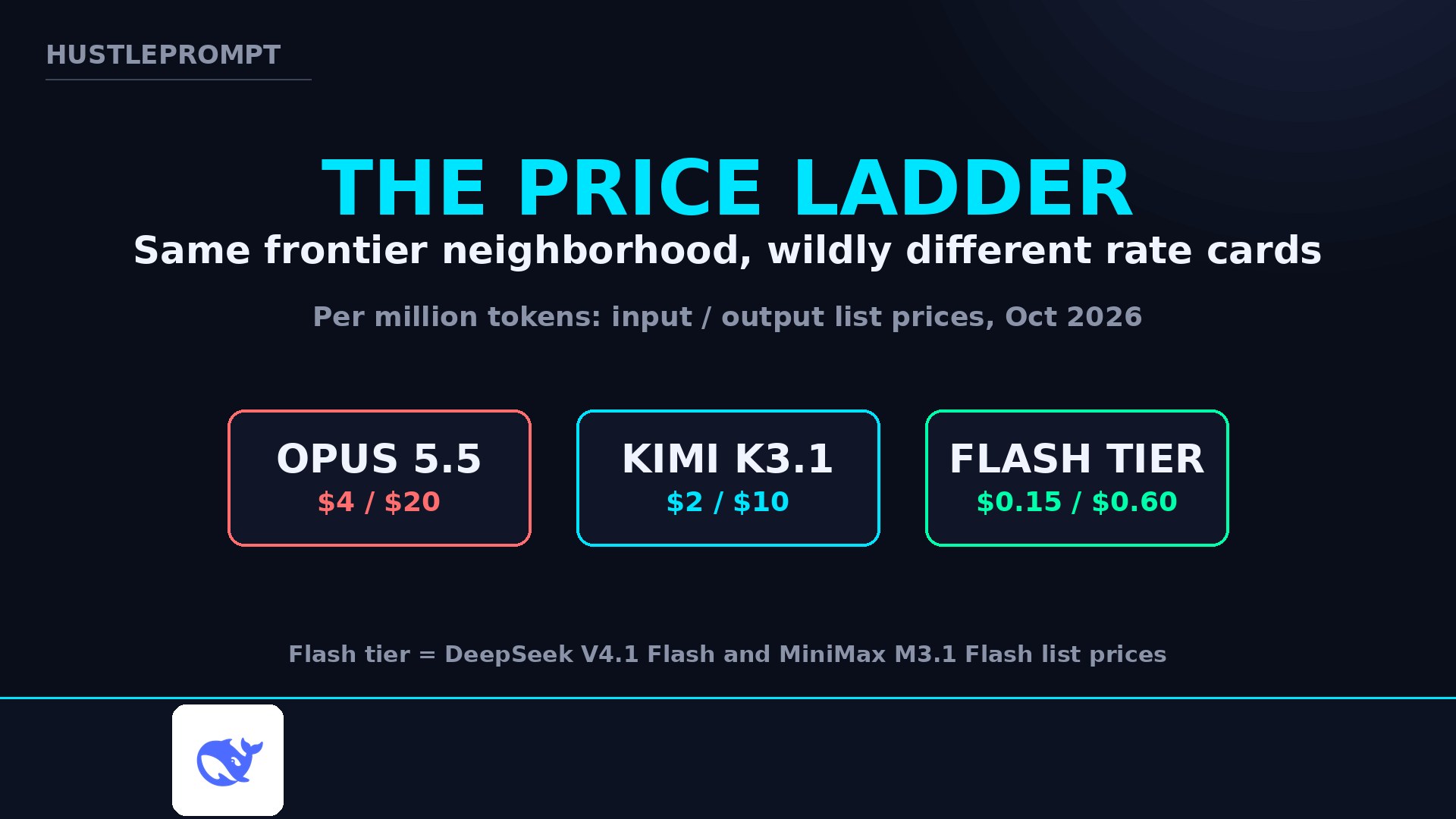
The Price Ladder, in Real Numbers
List prices per million tokens tell the story in one glance. These are published rate cards, not estimates:
Sources: Kimi and Opus pricing via FourWeekMBA (Opus $4/$20 is Anthropic’s list price, by its arithmetic); DeepSeek pricing via AI Weekly; MiniMax pricing via Open Loop News.
Read the benchmarks honestly
The price gap is real. The capability gap is now small — but not zero, and the fine print matters:
- Artificial Analysis Intelligence Index: Kimi K3.1 Pro scores 55, behind Claude Opus 5.5 at 58 — a 3-point gap, down from 12 for the previous best open model.
- Terminal-Bench 4.0 (Moonshot’s own numbers): Kimi K3.1 Pro at 65.7%, versus 66.4% for Opus 5.5 and 58.2% for GPT-6 Astra. Vendor-run, not independently verified.
- DeepSWE v1.1 (DeepSeek’s own numbers): DeepSeek V4.1-Flash-1017 at 77.0, ahead of the 74.0 DeepSeek reports for Opus 5 on the same test — but DeepSeek still trails Opus badly on broader reasoning (42.6 vs 56.3 on HLE).
- MiniMax’s claims: 73.7% on DeepSWE v1.1, 61.7 on OSWorld V2, output above 200 tokens per second — all MiniMax’s claims, with independent evaluator Artificial Analysis scoring M3.1 Flash 42 overall.
The honest read: cheap models now win specific jobs — coding, agent loops, long-context research — while the frontier still leads on hard reasoning. That is the split a freelancer needs. You do not sell “as smart as Opus.” You sell “good enough for this job at a fraction of the token price.”
Why Prices Are Collapsing
Three forces are compounding, and none of them is temporary:
1. Open weights kill the rent
A closed model charges rent forever: every token passes through the vendor’s meter. Open weights — the trained model files, published for anyone to download and run — break that meter. Even before you self-host, a downloadable alternative caps what closed vendors can charge. Moonshot’s November 4 weights promise is a price announcement disguised as a release note.
2. Inference got efficient, not just bigger
The October releases compete on engineering, not scale. DeepSeek’s companion paper is about KV-cache compression — shrinking the memory each conversation consumes. MiniMax frames its gains as efficiency rather than scaling. NVIDIA’s Bolt squeezes 74 billion parameters into 24GB with 2-bit quantization, trading a little precision for a much smaller footprint.
Less memory and fewer tokens per task mean cheaper serving — and that saving flows straight into the rate card.
3. Competition is now a price war
Four labs shipped in eight days, and two of them (DeepSeek, MiniMax) landed on the identical $0.15/$0.60 price point. That is a market clearing price for “good enough” intelligence. Kimi staked out the tier above at $2/$10. The tiers are now visible: premium frontier, mid-tier open, and a flash tier so cheap that token cost stops being the constraint.
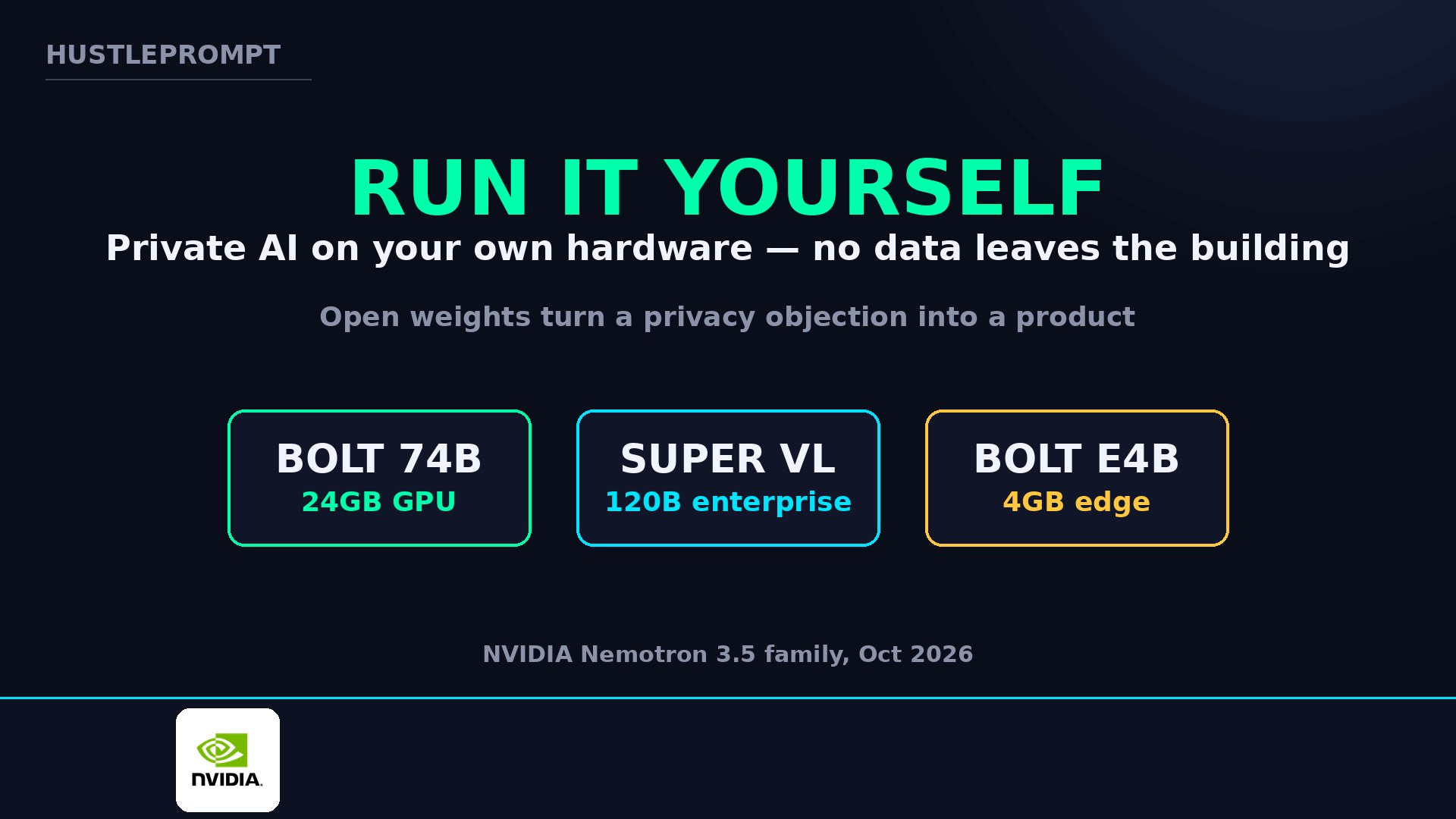
The Local Turn: the Second Price Cut
The API price war is only half the collapse. The other half runs on hardware you own.
NVIDIA’s Nemotron 3.5 family is built for this: Super VL, a 120-billion-parameter multimodal model for enterprise agents; Bolt 74B-A9B, activating 9 billion parameters per token and fitting in 24GB with 2-bit quantization; and Bolt E4B, a 4GB edge model. Weights, datasets, and training recipes ship openly, so a company can adapt the model to its own data and run it inside its own walls.
That changes who buys AI. Law firms, clinics, accountants, and manufacturers that would never send client data to a cloud API can now run a capable agent on an office workstation. Privacy stops being a reason to say no — and becomes a reason to pay a specialist to set it up.
The caveat is real: as Futurum analyst Mitch Ashley put it, “the inference bill shrinks, and the governance surface grows.” Local agents slip past the cloud dashboards IT uses to monitor AI use. A local install with no logging, access rules, or update plan is a liability, not a product.
How to Profit: Sell the Gap
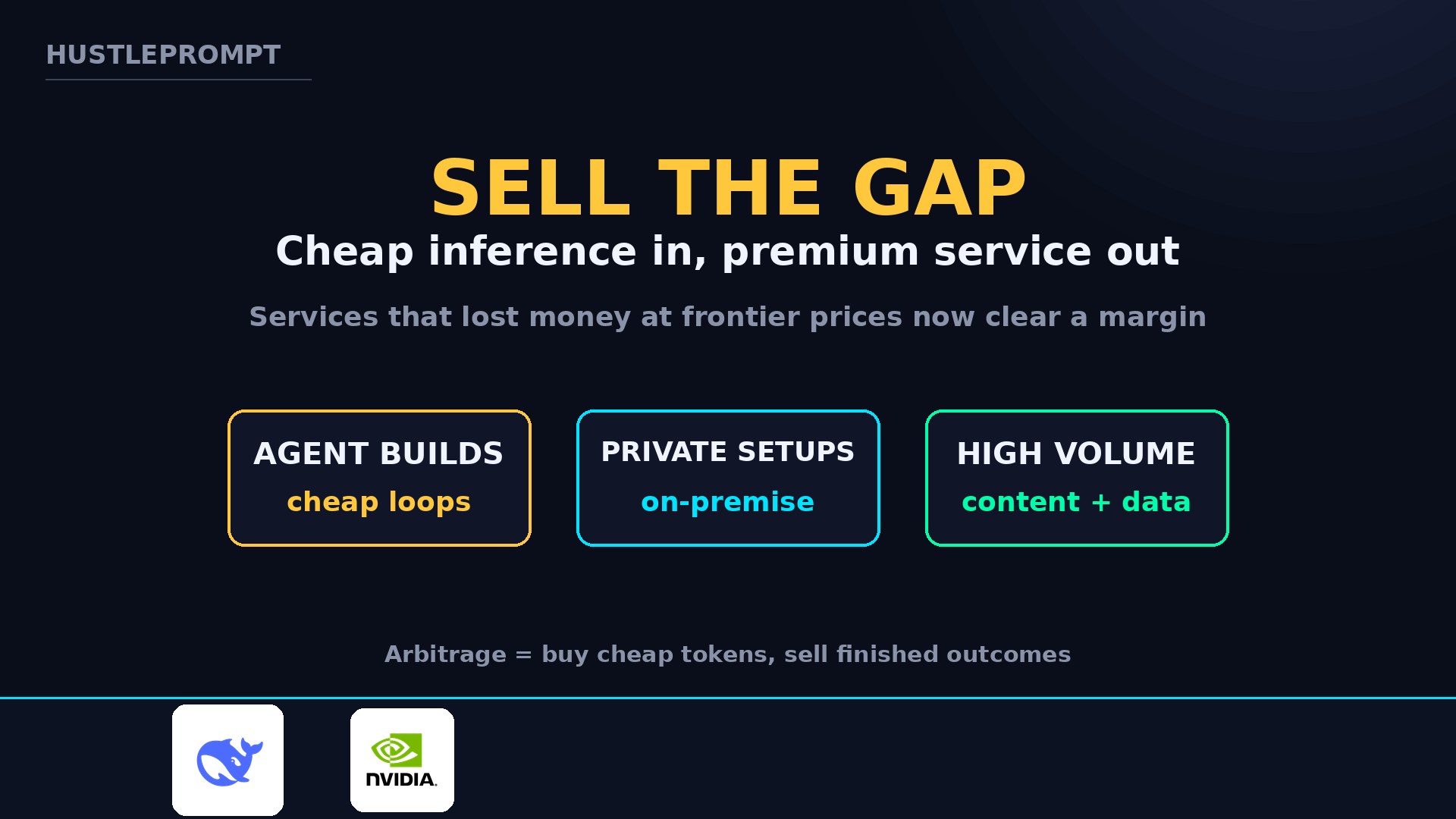
The arbitrage in one sentence: buy tokens at flash-tier prices, sell finished outcomes at human-service prices. The services below were marginal at frontier token prices. At $0.15/$0.60 — or zero marginal token cost locally — they clear a margin. All service prices below are my estimates based on comparable freelance AI service rates, not market data:
- Cheap agent builds ($600–$2,000, my estimate): inbox triage, lead research, quote drafting, and document processing agents built on flash-tier models. Agent loops burn tokens — loops that cost $40 a run on frontier models cost cents here, so you can finally sell them at small-business prices.
- Private AI setups ($1,500–$4,000 install + $300–$800/mo retainer, my estimate): install a Nemotron Bolt model on the client’s own hardware, wire it to their documents, add logging and access rules. Privacy-sensitive clients — lawyers, clinics, financial advisors — are the buyers.
- High-volume content and research ($400–$1,200/mo per client, my estimate): daily market briefs, competitor tracking, catalog enrichment, and SEO content at volumes that only work when tokens are nearly free. Sell the subscription, not the hour.
- Model-switching audits ($495, my estimate): take a client’s existing AI spend, re-route each workflow to the cheapest model that passes its quality bar, and keep the savings split. The audit sells itself the moment you show their current bill.
The Cost-Arbitrage Ladder
Four steps from cheap tokens to a sellable service.
Pick the floor
Flash-tier API at $0.15/$0.60, or a local model with zero token cost.
Test on real work
Run the client’s actual tasks. Keep frontier models only where cheap ones fail.
Sell the outcome
Price the finished report, agent, or setup — never the tokens inside it.
Retain the margin
Monthly retainers for monitoring, routing, and model swaps as prices keep falling.
What to Do This Week
- Benchmark one real workflow. Take a task you already sell — or want to — and run it on DeepSeek Flash and MiniMax Flash. Record quality and token cost. That comparison is your sales deck.
- Price three packages. Turn the list above into one page: agent build, private setup, monthly volume service. Lead with the outcome, not the model name.
- Find five privacy-stuck prospects. Local firms that handle sensitive data are the warmest leads for a local-model pitch. Offer the audit first.
- Watch November 4. If Kimi’s weights land on schedule and independent tests hold, the mid-tier price floor drops again — and every package you priced gets more profitable.
Where This Is Heading
The flash tier becomes the default. Within a year, “good enough” models at $0.15/$0.60 — or free, locally — handle most routine business work, and frontier models become a specialist tool you route to only for hard reasoning.
Local AI becomes a standard IT purchase. A workstation running a private agent joins the printer and the NAS as office infrastructure, installed and maintained by local specialists — not cloud vendors.
The margin moves up the stack. As tokens approach zero cost, nobody gets paid for access to intelligence. They get paid for judgment: which model, which workflow, which guardrails, and who is accountable when it goes wrong. That is a freelancer’s market, not a lab’s.
Watch: an expert first-impressions test of Kimi K3.1 Pro against Opus 5.5, Sonnet 5.5, and DeepSeek Flash — including the cost angle. Watch on YouTube.
Frequently Asked Questions
What is the open-weight price collapse?
The October 2026 drop in frontier-capable AI pricing driven by open-weight models: Kimi K3.1 Pro at half of Claude Opus 5.5’s price, DeepSeek and MiniMax flash models at $0.15/$0.60 per million tokens, and NVIDIA models runnable locally — closing the open-to-frontier gap to 3 points on Artificial Analysis.
What does “open-weight” mean?
The trained model files are published for anyone to download, inspect, adapt, and run on their own hardware — as opposed to closed models accessible only through a vendor’s API meter. Open weights cap vendor pricing even for buyers who never self-host.
Is Kimi K3.1 Pro really as good as Claude Opus 5.5?
Nearly, not quite. It scores 55 vs 58 on Artificial Analysis and 65.7% vs 66.4% on Terminal-Bench (Moonshot’s own numbers). For coding and agent work it is close; for hard reasoning, Opus still leads. Test on your own tasks before switching.
When do Kimi K3.1 Pro’s open weights arrive?
Moonshot has promised the full weights by November 4, 2026. Until then, the model runs only through Moonshot’s API, apps, and coding tools.
Can a small business really run AI locally?
Yes, for the right model: NVIDIA’s Nemotron Bolt 74B-A9B fits in 24GB of GPU memory, and Bolt E4B targets 4GB edge devices. Full frontier-scale models still need data-center hardware — the local opportunity is in capable mid-size models, not the biggest ones.
How do freelancers actually make money from cheaper AI?
By arbitraging the gap: buy inference at flash-tier or zero local cost, and sell finished outcomes — agent builds, private setups, volume content services, and cost audits — priced by value, not by token. My service-price estimates are in the “How to Profit” section above.
Will prices keep falling?
The forces behind the drop — open weights, inference efficiency, and multi-lab competition — are structural, not one-off. Expect the floor to keep dropping; the durable business is the service layer above it, not reselling tokens.