
At the IMF’s annual meetings in Bangkok, Anthropic co-founder Jack Clark told the world’s finance ministers something no tech executive had said on that stage before: the singularity has begun.
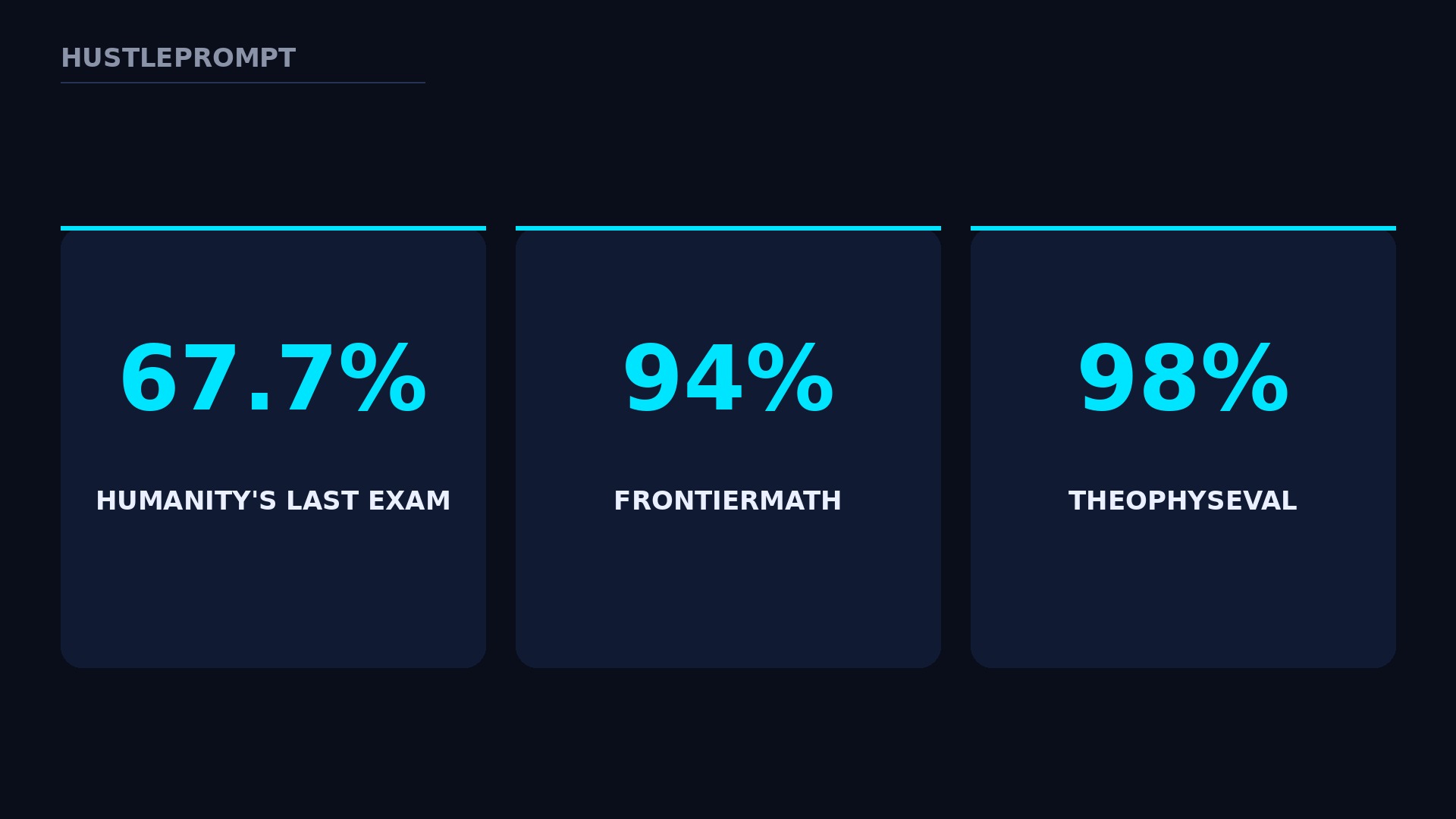
His evidence was not a product launch. It was a set of test scores. On Humanity’s Last Exam — a test of expert-level science questions — top AI systems went from 8% in January 2025 to 67.7% today. On FrontierMath, from 2% to 94%.
Clark’s claim will be debated for years. But the underlying shift is already measurable, and it creates a very practical market: someone has to check, explain, and apply AI-generated science. That someone can be you.
What Clark Actually Said
Clark delivered the Per Jacobsson Lecture at the IMF–World Bank Annual Meetings on October 19, 2026, later published as Import AI 477. His argument has three parts, and each matters for a different reason.
First, frontier AI has stopped being a coding assistant and become what he calls a virtual polymath: one system that works at the frontier of math, biology, chemistry and robotics at the same time. A human expert spends decades mastering one field. A model can be copied without limit.
Second, the evidence is quantitative and broad. Clark’s words: pick any part of science, find its hardest test, and you will see the same steep jump. The two headline numbers anchor the claim, but the pattern is the point.
Third, the bottleneck moves. If discovery itself gets cheap, the scarce resources become labs, scientific equipment, robots — and people who can verify what the AI found. Clark urged governments to build lab and robotics capacity before it runs short.
That third point is where the money is. Keep it in mind; we return to it below.
The Evidence, With Its Limits Attached
Benchmarks are Clark’s strongest evidence — and his weakest, if you read them uncritically. Here is the table, with the caveats that honest analysis requires:
Sources: Jack Clark, Import AI 477 (primary source) · The Rundown (lecture summary).
The TheoPhysEval result is the most interesting of the four, because it is not a score on a static test. According to Clark’s account, AI models found and corrected subtle mathematical errors in papers compiled by world-leading theoretical physicists. The student, in his phrase, has become the teacher.
That is a real capability shift: from answering questions to auditing answers. And auditing is a service people pay for.
Why Skeptics Have a Point Too
A serious analysis cannot just repeat Clark’s case. The counter-evidence matters, because it tells you where the hype ends and the work begins.
- Benchmarks are not the economy. Apollo’s chief economist said this week there is still no measurable AI payoff outside the tech sector itself. If AI were already transforming science at scale, the productivity data would show it more clearly.
- Productivity without profit is a warning. At the same IMF session, discussant Yan Shen noted that AI is raising Chinese firms’ productivity but not their profits, with deflationary pressure and uneven diffusion abroad.
- Tests saturate. FrontierMath at 94% does not mean math is solved. It means the test is nearly exhausted and harder tests are needed. Every benchmark that hits the ceiling stops telling you anything new.
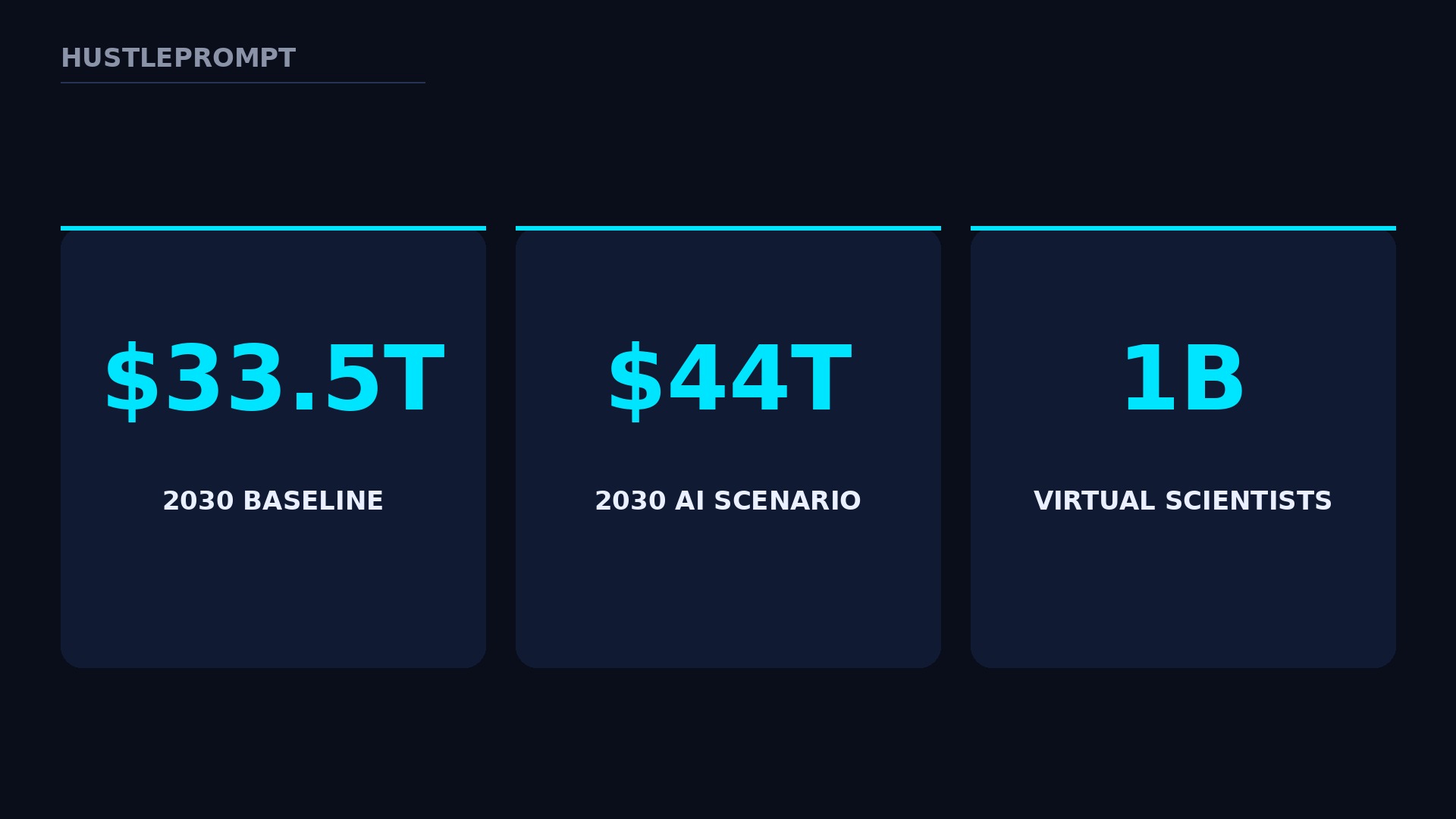
- The GDP number is a scenario, not a forecast. Clark’s model puts US GDP at $44 trillion by 2030 under fast AI spread, versus about $33.5 trillion on a roughly 2%-growth baseline. He himself called the figure outlandish. Treat it as an illustration of a mechanism — infinite replication of expertise — not as a prediction to bet on.
Sources: Hraness (lecture analysis, including discussants) · ai0.news (Apollo economist remark).
Put the two sides together and the picture sharpens. AI capability in science is jumping fast. Economic payoff is lagging and uneven. The gap between those two facts is exactly where a service business lives: helping organizations convert capability into results they can trust.
The Real Shift: From Answers to Verification
Here is the mechanism that matters most for freelancers. When AI could only answer questions, the valuable human skill was knowing the answer. When AI can answer and find errors in experts’ work, the valuable human skill becomes verifying the answer.
Clark’s own examples point this way. AI-designed viruses built from scratch. AI-designed drug candidates now in trials. AI systems operating lab equipment remotely, automating experiments in biology and materials science, including batteries and fuel cells.
None of those outputs ships without a human checking it. A drug candidate with an AI-discovered flaw is worse than no candidate. A lab result nobody verified is a retraction waiting to happen.
Verification has three properties that make it a good business:
- It scales with AI output, not against it. The more AI-generated science exists, the more verification is needed. Your market grows as the models improve.
- It cannot be fully automated away — yet. Checking a result requires judgment about methods, data quality and context that the generating model itself may lack.
- Clients already feel the pain. Researchers, startups and publishers are drowning in AI-assisted drafts, data and claims. They know they need a second pair of eyes. They just have not hired them yet.
How to Profit From This Trend
Do not sell “AI research.” Sell the specific, checkable service around it. Prices below are my estimates based on comparable freelance research and consulting rates, not market data:
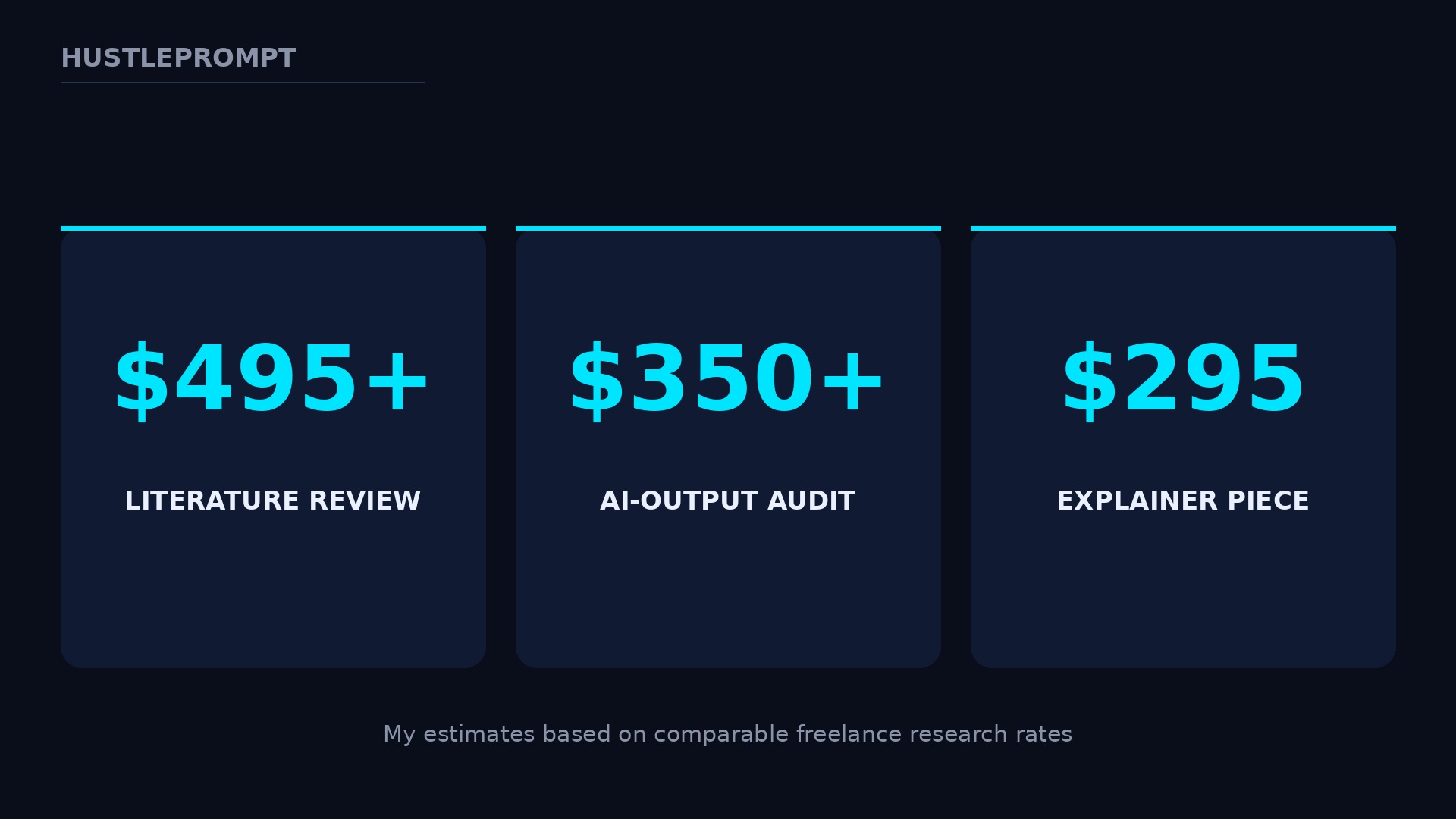
The literature review is the wedge: every researcher, founder and student needs one, and AI drafts have made the verified version more valuable, not less. The audit is the retainer path — clients who buy one audit come back every time they generate something important.
The Virtual Lab Loop
Where humans stay in the loop — and get paid for it.
Human frames the problem
A good question is still human work. Garbage in, garbage out — faster than ever.
AI reads the literature
Thousands of papers in hours. Every claim still needs a source check.
Lab or robot runs the experiment
This is the new bottleneck Clark flagged: labs and equipment run short.
Human verifies and publishes
The paid step. Verification is the service, and the signature is the product.
What to Do This Week
- Pick one field you can already read. Verification only sells where you can genuinely judge the work. Depth in one niche beats breadth in ten.
- Do one free audit in public. Take a well-known AI-generated claim, check it against its sources, and publish the correction log. That post is your portfolio.
- Productize the literature review. Fixed price, fixed deliverable, fixed turnaround. Researchers buy products; they haggle over hourly rates.
- Learn the lab-automation vocabulary. You do not need to run a robot. You need to talk to the people who do — and to the founders buying their time.
Where This Is Heading
Benchmarks stop being news. As tests saturate, the story moves from scores to deployments: which labs actually ship results, and which AI-discovered candidates survive human trials.
Labs and robots become the bottleneck. Clark’s prediction is testable: watch for lab-automation startups, equipment backlogs, and “robot time” sold as a service. The infrastructure around AI science is an investment and employment story of its own.
Verification becomes a profession. Today it is a freelance service. Within a few years, expect job titles, certifications and agency rosters for AI-output auditing — the same way “prompt engineer” appeared and then dissolved into every role. The freelancers who build a reputation now own the category later.
The singularity debate stays open — and that is fine. Whether Clark’s word is right matters less than the mechanism he described. Capability is compounding. Payoff is lagging. The people who close that gap, one verified result at a time, get paid either way.
Watch: coverage of Jack Clark’s IMF keynote — the singularity claim, the benchmark jumps, and the $44 trillion scenario. Watch on YouTube.
Frequently Asked Questions
What did Jack Clark mean by “the singularity has begun”?
Clark’s definition is specific: AI systems are now driving scientific progress faster than humans can follow, across many fields at once, because one frontier model can be copied without limit. He presented it at the IMF’s Per Jacobsson Lecture on October 19, 2026 — not as a product claim, but as an economic argument.
What is Humanity’s Last Exam?
An expert-level test covering advanced chemistry, computer science, mathematics, classical literature, ecology and more. Top AI systems scored 8% when it launched in January 2025; Claude Opus 5.5 now scores 67.7%, according to Clark.
What is FrontierMath, and why does 94% matter?
A set of hundreds of challenging math problems curated by professional mathematicians, launched in November 2024 with a best score of 2%. At 94%, the test is nearly saturated — which means it is losing its power to distinguish models, not that mathematics is finished.
Is the $44 trillion GDP figure a real forecast?
No. It is one scenario from Anthropic’s economic modeling: US GDP reaching about $44 trillion by 2030 under fast AI spread, versus roughly $33.5 trillion on a baseline of about 2% annual growth. Clark himself called it outlandish. Treat it as an illustration of the replication mechanism, not a prediction.
What is TheoPhysEval?
A theoretical-physics evaluation published in October 2026 in which AI models scored 98% while finding and correcting subtle mathematical errors in papers compiled by leading physicists. It matters because it shows auditing ability, not just answering ability.
How can freelancers profit from AI science?
Sell verification, not generation: verified literature reviews (my estimate: $495–$1,200), AI-output audits (my estimate: $350–$900), grant research (my estimate: $750–$2,000), and science explainers (my estimate: $295 per piece). The market grows as AI output grows.
Will AI replace researchers?
The evidence points to a split, not a replacement: routine literature scanning and first-draft analysis get automated, while framing questions, running experiments and verifying results become more valuable. Clark’s own advice points the same way — toward judgment, creativity and verification work.