
Ask a question in ChatGPT, and you are now part of a market OpenAI says is one-fifth the size of Google’s. That sentence should stop you — not because Google is finished, but because a second place where people ask questions has reached a scale where ignoring it costs real money.
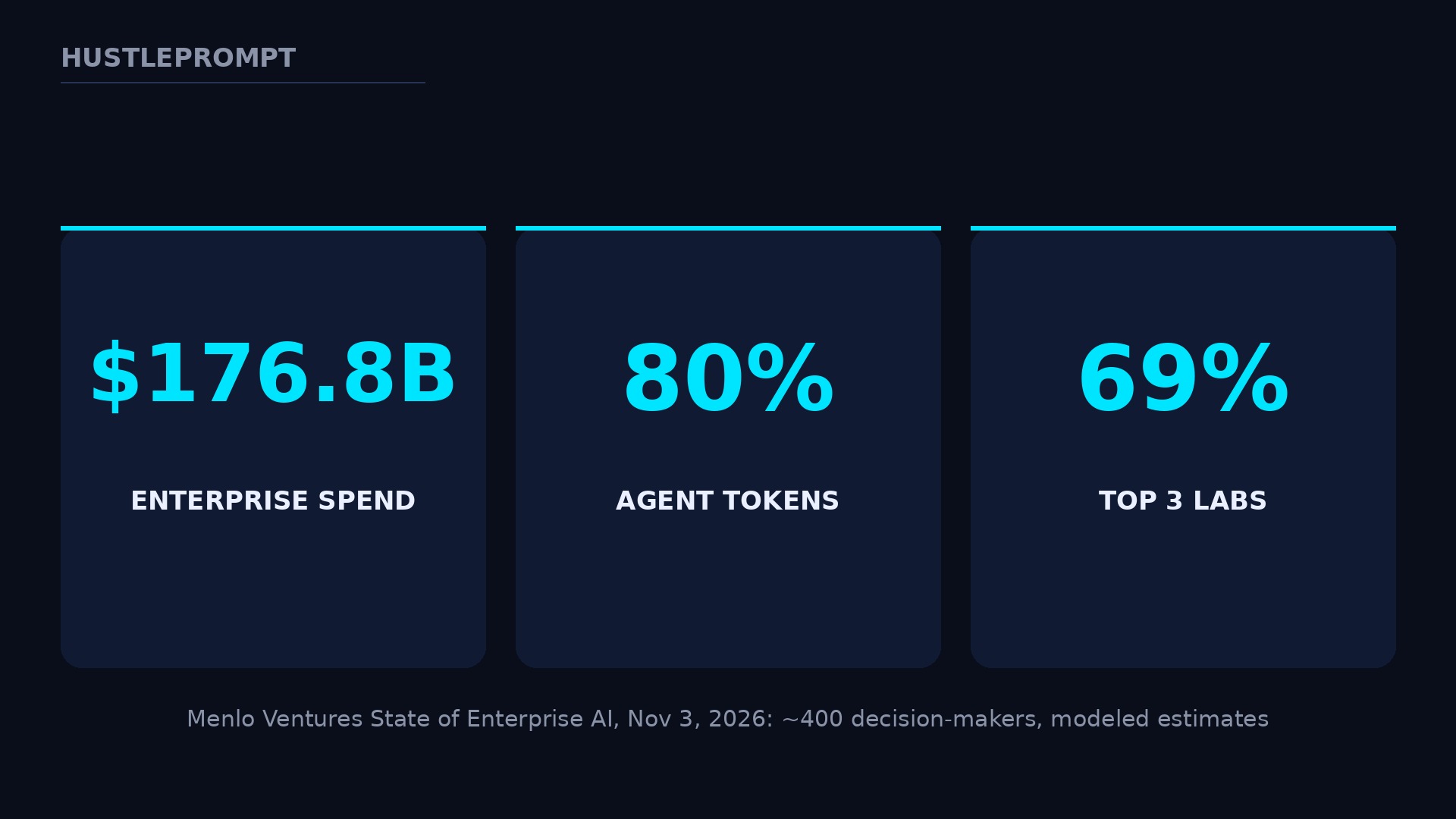
On November 2, 2026, OpenAI’s consumer product lead, Adam Fry, told an interviewer that ChatGPT’s volume of search-like queries is “roughly one-fifth the volume of queries of Google.” A day later, Menlo Ventures reported that enterprise AI deployment spending hit $176.8 billion by September 2026, up 5.4 times from $33 billion a year earlier, with agents generating 80% of tokens on one major routing platform.
Put those two numbers together and the trend is clear. People are asking machines questions, machines are asking models questions, and the money follows the questions — not the clicks that used to follow them.
What Is Actually Trending
A search-like query, in Fry’s definition, is any question that makes ChatGPT look something up on the web. He put it simply: “Every time you ask a question and go search the web, that’s a search.” Questions a model can answer from memory — a definition, a simple how-to — do not count. That definition matters, because it makes the 20% figure narrower than “all ChatGPT prompts” and broader than “visits to a search engine.”
The figure is also, by every account, OpenAI’s own. Fry did not disclose the Google baseline he divided into, and no independent firm has checked the comparison. The Verge reported the same figure, and multiple outlets flagged the same caveat: this is a company claim about query volume, not an audited market share, and it measures questions asked, not clicks delivered to websites.
Even with that caveat, the direction is hard to dismiss. Fry also put ChatGPT at 1.2 billion weekly users, 1.5 billion images created a week, and 250 million weekly voice users. One caution on the timeline: Fry described the jump from 1 billion to 1.2 billion users as happening over about sixty days, but The Verge had already reported the 1.2 billion figure on September 29. Treat the growth rate with care; treat the scale as real.
The Evidence: Questions Move, and Spending Moves Faster
The first evidence block is the query claim itself, cross-checked against traffic data that tells a different, useful story. A June 2026 study by OneLittleWeb, using Semrush and Ahrefs estimates, found search engines still drew 19.6 times more browser visits than all AI chatbots combined — 162.19 billion visits against 8.26 billion. Google alone drew 98.19 billion visits; ChatGPT drew 5.32 billion.
Those two pictures do not contradict each other. They measure different things. Browser visits count people landing on websites. Query volume counts questions asked inside an app, including questions that never produce a click at all. The gap between them is the whole point: a growing share of questions now ends in an answer, not a visit.
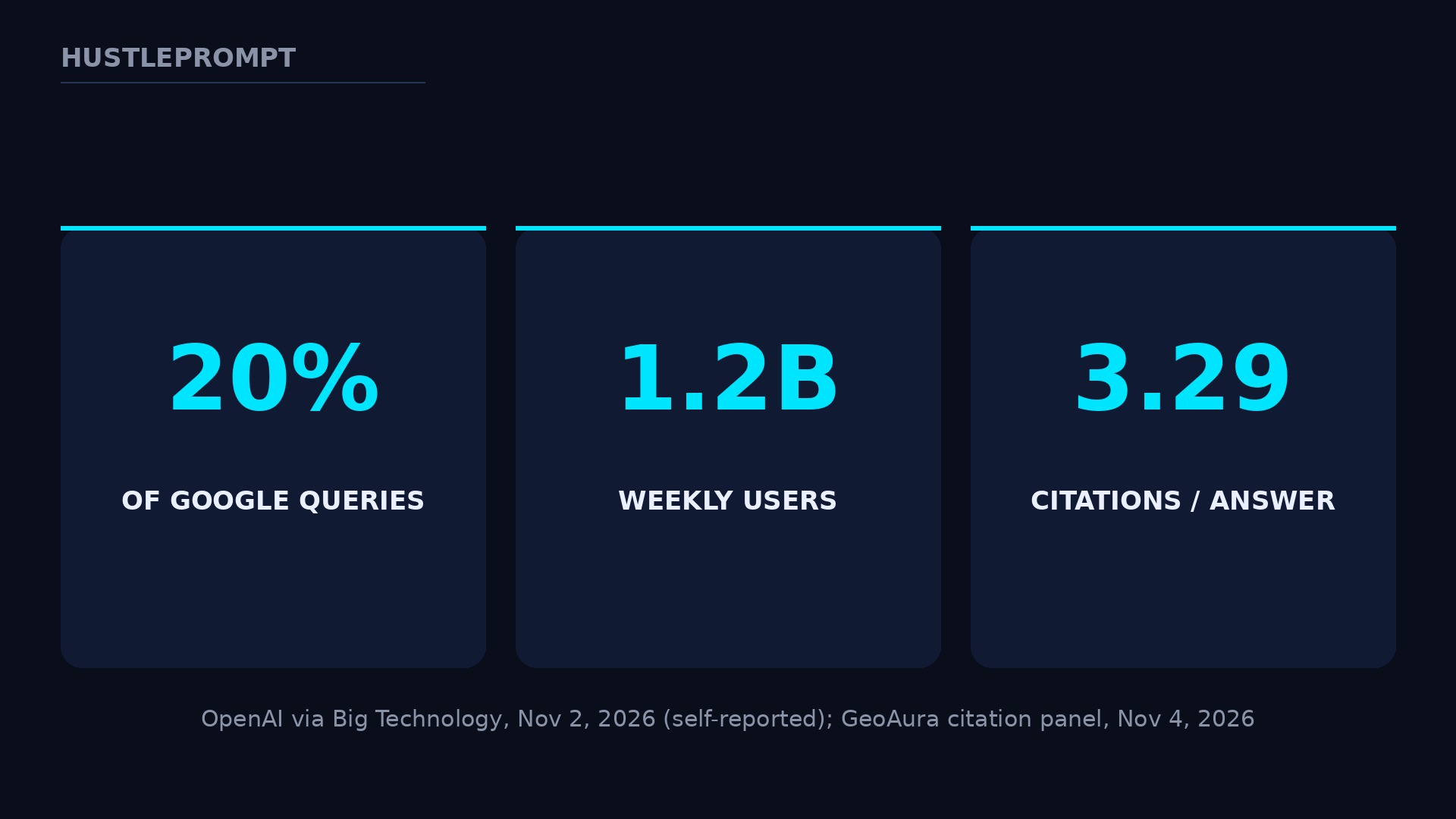
Sources: The Verge, “OpenAI says ChatGPT is catching up to Google in search” · Menlo Ventures, “2026: The State of Enterprise AI” (Nov 3, 2026) · GeoAura, “AI Search Market Share & Growth Trends (2026 Report)” · TechNext24, “Search engines still get 19x more web traffic than AI chatbots”.
The second evidence block is where the money went. Menlo’s report, based on a survey of nearly 400 U.S. enterprise decision-makers overseeing more than $4 billion in AI spending, plus a bottom-up market model, found deployment spending of $176.8 billion by September 2026. The share of companies using AI rose only from 55% to 65% — the surge came from existing buyers spending far more, at 2.5 times their planned budgets. Menlo discloses that it invests in Anthropic and OpenRouter, and its dollar totals are modeled estimates, not audited accounts.
Inside that spending, agents are the story. On OpenRouter, agents generate 80% of all tokens — about 130.9 trillion a week, roughly seven times human-driven usage. Agent traffic overtook human traffic in February 2026 and has grown 37 times since, against five times for human usage. Coding ($34.0 billion) and chatbots and assistants ($25.0 billion) make up 76% of the $77.3 billion application market. Anthropic, OpenAI, and Google together take 69% of deployment dollars, up from 50% a year earlier.
Why a Fifth Matters Even If the Number Is Wrong
Suppose OpenAI’s definition is generous and the true comparable figure is half what Fry claims — one-tenth, not one-fifth. That is still a second discovery market at a scale no business can treat as a rounding error. And the mechanics of that market punish exactly the habits that won on Google.
On Google, ten blue links meant ten chances. In ChatGPT, GeoAura’s panel puts the average answer at 3.29 citations. There are simply fewer seats at the table, and the table is chosen by a model, not by a ranked list a user scrolls. A business that ranks fifth on Google still gets seen. A business that is not among three cited sources in an answer does not exist in that conversation.
That is why the enterprise spending number belongs in the same article as the search number. The same agents that generate 80% of OpenRouter tokens are also the readers of those answers. A procurement agent does not scroll. It asks, it reads the cited sources, and it acts. The question “are we visible in ChatGPT” is becoming the same question as “are we visible to the machines that now do the buying.”
There is a second, quieter shift underneath. Menlo’s report notes that surveyed companies spent 2.5 times their AI budgets. That is not a sign of discipline. It is a sign that agent work expands to fill the budget, because every answered question creates the next question. The companies that win will not be the ones that spend least. They will be the ones that can prove what each dollar of agent work returned.
Be Citable: Claim, Evidence, Action, Proof
An answer engine cites pages it can quote, check, and trust. Build pages that way on purpose.
Answer in one sentence
Put the direct answer at the top of the page, in plain language, before any introduction.
Show the numbers
Tables, dates, and named sources give a model something quotable — and a reader something to trust.
Give the next step
A page that ends in a concrete step is more useful than a page that ends in a summary.
Prove it happened
Case results, before-and-after figures, and named clients turn a claim into a citation.
How to Profit From This Trend
Stop selling “SEO” as one thing and start selling visibility in two markets: the search list and the answer. The offer is a citation audit — test how a client’s brand shows up when real buyers ask ChatGPT the questions that used to go to Google — then rebuild the pages that should be cited but are not. This is distinct from classic SEO: the deliverable is not a ranking, it is a quoted answer.
Prices below are my estimates based on comparable freelance SEO and content service rates, not market data:
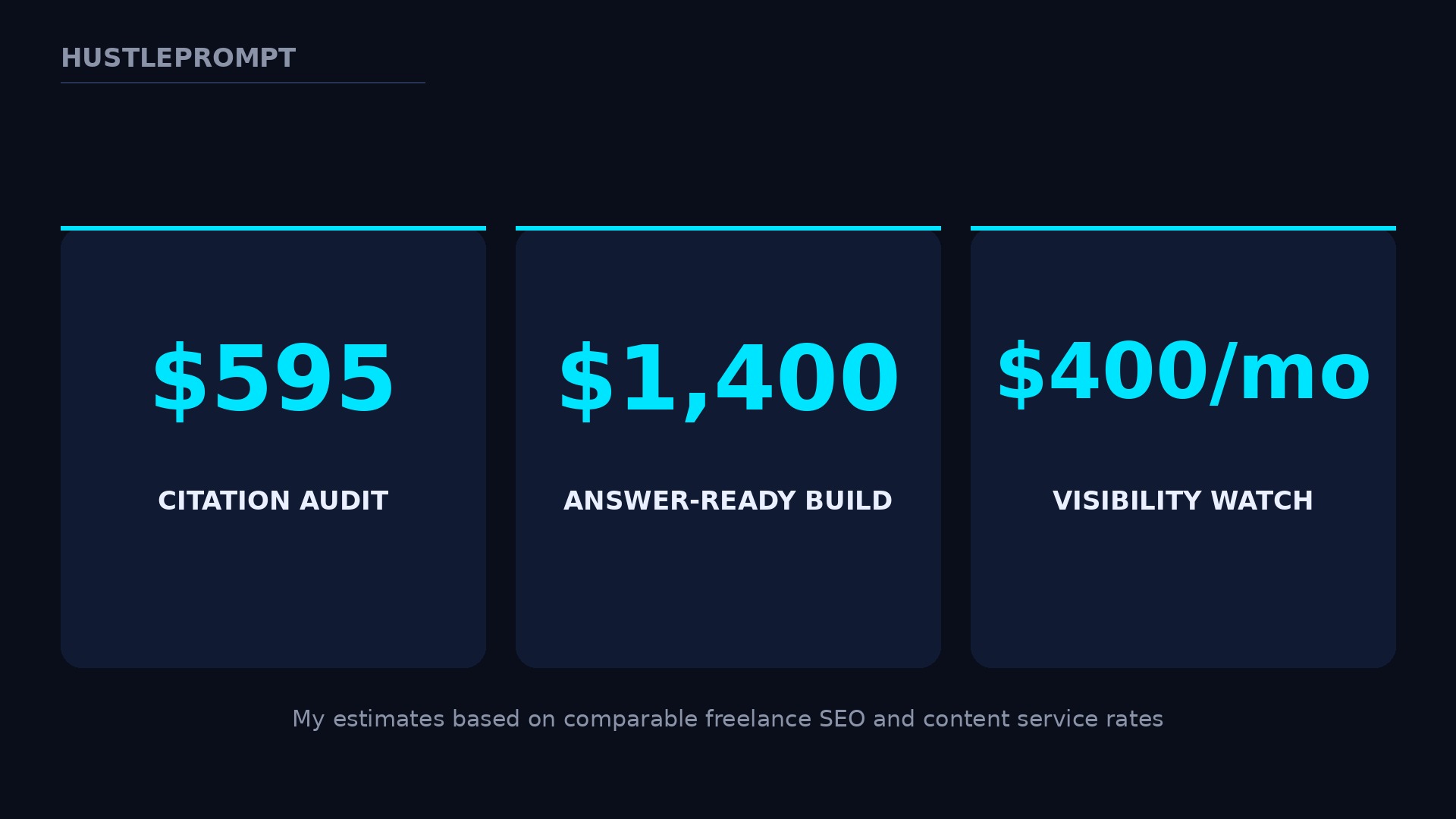
Lead with the client’s own questions, not with the 20% headline. Type their best customer’s question into ChatGPT, screenshot the answer, and show them who got cited. If they are not there, the sale is already made. If they are there, the watch plan sells itself — because citations, unlike rankings, can vanish with a single model update.
What to Do This Week
- Ask 10 buyer questions in ChatGPT. Use the exact words a customer would use. Note every source cited, and whether your site — or your client’s — appears.
- Rewrite one page as claim first. Move the direct answer to the top, add a table with real figures, and end with one concrete step.
- Add five honest FAQs. Answer the questions buyers actually ask, with dates and sources, not marketing copy a model cannot quote.
- Track answers, not just traffic. Start a simple sheet: question, date, cited sources, position. In six months, that sheet is your proof of value.
Watch: a third-party discussion of Menlo Ventures’ State of Enterprise AI report (SaaStr, not an official Menlo video). Watch on YouTube.
Where This Is Heading
Questions split, clicks shrink. Even if Google keeps most browser visits, the questions that matter most — comparisons, recommendations, “which one should I buy” — are the ones most likely to end inside an answer. Businesses that only measure clicks will miss the shift until it shows up in revenue.
Citation becomes a measurable channel. Expect tools and reports that track answer citations the way SEO tools track rankings, and expect clients to ask for citation share in the same breath as search share. The freelancers who already track it will look like they saw it coming.
Agents become the audience. With agents generating 80% of tokens on OpenRouter, the next buyer of your content may not be a person at all. Pages written for a human reader who skims will lose to pages written for a machine reader that quotes — clear claims, real numbers, and proof it can check.
Frequently Asked Questions
Is ChatGPT really 20% of Google search?
Not exactly. OpenAI says ChatGPT’s search-like queries run at roughly one-fifth of Google’s query volume, by its own count and definition, with no method or Google baseline disclosed. It is a claim about questions asked, not a verified share of the search market or of clicks.
What counts as a search-like query?
Any question that makes ChatGPT look something up on the web, in Adam Fry’s definition. Questions answered from memory, like a definition or a simple how-to, do not count.
Why do browser-visit studies show a much bigger gap?
Because they measure website visits, not questions. OneLittleWeb’s June 2026 study found search engines drew 19.6 times more browser visits than chatbots — but app questions that end in an answer, with no click, never appear in that count.
What did Menlo Ventures actually find?
Enterprise AI deployment spending reached $176.8 billion by September 2026, up 5.4 times from $33 billion, based on a survey of nearly 400 decision-makers plus a market model. Menlo discloses investments in Anthropic and OpenRouter, and its totals are modeled estimates.
Why do citations matter more than rankings now?
Because an answer cites only a few sources — about 3.29 on average for ChatGPT, per GeoAura — while a search page lists ten. Being fifth on Google still gets seen; being absent from an answer means not existing in that conversation.
How can a small business become citable?
Answer the buyer’s question in one sentence at the top of the page, back it with real figures and named sources, give a concrete next step, and show proof. Then test the same questions monthly, because citations change with every model update.