
Moonshot AI just handed developers the keys to one of the strongest open models on the planet. On November 4, 2026, the company published the full weights of Kimi K3.1 Pro on Hugging Face, keeping the promise it made at the model’s October 23 launch.
Why does a download matter? Because K3.1 Pro is a 2.8-trillion-parameter model that Moonshot says nearly matches Claude Opus 5.5 on a hard coding test, and it now runs on hardware you control.
Full details are in Moonshot’s official Kimi K3.1 Pro model card on Hugging Face. The repository is public, with no access request needed, and ships with vLLM and SGLang recipes.
What Moonshot released on November 4
The weights went public on Hugging Face on November 4, the exact deadline Moonshot set at launch, with Moonshot’s announcement following the same day.
The model card describes K3.1 Pro as an open-weight, natively multimodal agentic model, and Moonshot’s most capable 3T-class model to date. It takes text and images, and it keeps the 1-million-token context window from launch, enough to hold an entire codebase in a single prompt.
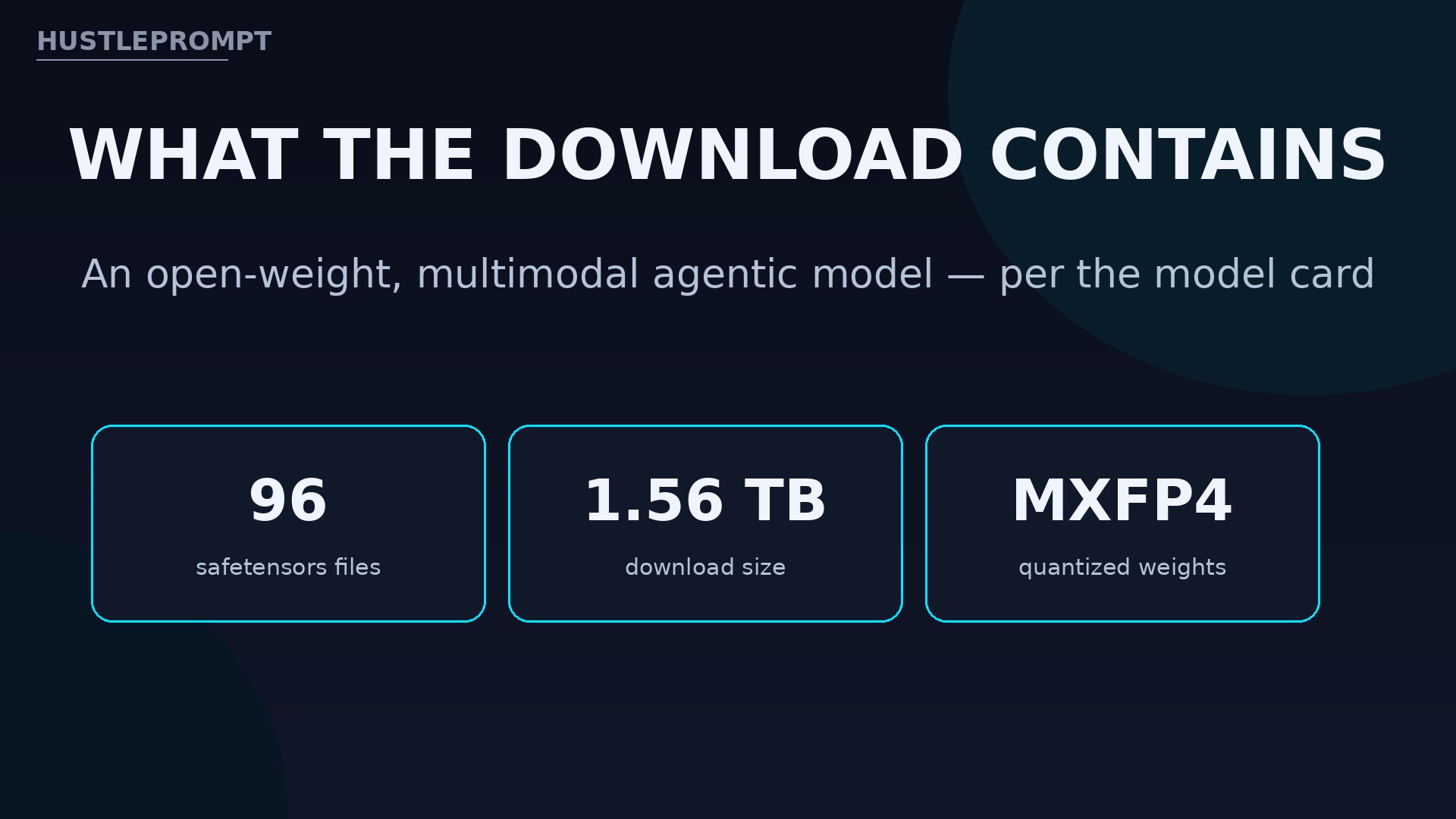
One honest warning: this is a heavyweight download. The checkpoint is 96 safetensors files totaling about 1.56 TB, stored as MXFP4 weights with MXFP8 activations.
The specs, in one table
| Spec | Kimi K3.1 Pro |
|---|---|
| Architecture | Mixture of experts, 93 layers |
| Parameters | 2.8 trillion total, 104 billion active per token |
| Experts | 896 experts, 16 selected per token |
| Context window | 1,048,576 tokens |
| Attention | 69 KDA layers + 24 Gated DSA sparse-attention layers |
| Weights | MXFP4, quantization-aware training; about 1.56 TB |
The architectural change worth knowing is Gated DSA, or DeepSeek Sparse Attention. In 24 of 93 layers, Moonshot replaced full attention with a sparse version, speeding up long-context work while keeping full attention elsewhere.
Benchmarks: strong, but read the label
Every score below is Moonshot’s own, not an independent result.
| Benchmark (Moonshot-reported) | Kimi K3.1 Pro | Comparison |
|---|---|---|
| Terminal-Bench 4.0 (coding agents) | 65.7% | Claude Opus 5.5: 66.4%; GPT-6 Astra: 58.2% |
| GPQA-Diamond (science questions) | 94.2 | Near-saturated |
| BrowseComp (web browsing) | 92.1 | Agentic research strength |
| OSWorld V2.1 (computer use) | 79.6 | Computer use |
| SWE Marathon v1.1 | 51.7 | Software engineering tasks |
| Artificial Analysis Intelligence Index | 55 (4th overall) | Independent index, pre-weights release |
The Terminal-Bench number is the headline: 65.7% puts K3.1 Pro within one point of Claude Opus 5.5, a closed flagship. For a model anyone can now download, that gap is the story.
The license: open, with a revenue gate
The weights ship under the custom Kimi K3.1 Pro License, not MIT or Apache 2.0. Read it before building on it.
For most developers, the terms are generous: use, modify, and sell are allowed. The catch targets only the biggest API businesses: model-access sellers above $20 million in revenue over 12 months need a separate Moonshot agreement.
There is also a deliberate safety trade-off baked into this release. Moonshot says it removed cybersecurity-related data from mid-training and reinforcement learning before opening the weights. On its internal xdev-bench-hard exploit benchmark, the unfiltered checkpoint scored 90.5%, while the released version scored 81.0%: capability given up on purpose.
How to profit from K3.1 Pro this week
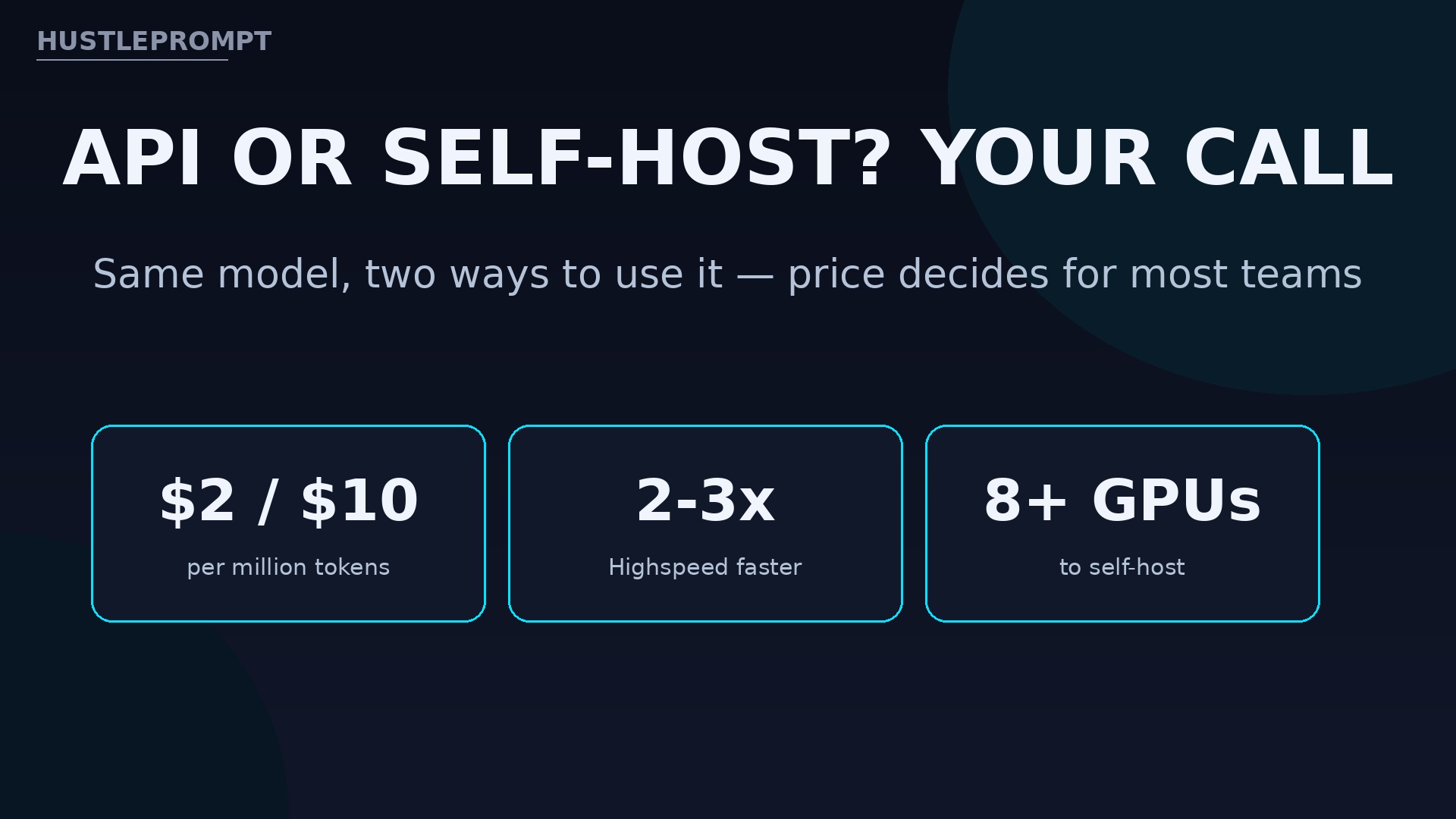
Self-hosting is not the starting point for most people. Reports on the release put the bar at a node with 8 or more B300 or GB300-class GPUs. The API is the fast path.
Use
kimi-k3.1-pro for real client tasks.$2 in / $10 out; Highspeed $4 / $20, 2-3x faster.
Self-host only when GPUs beat API spend.
Over $20M API revenue? Talk to Moonshot.
Here are concrete ways to turn it into income:
- Agentic coding services. Offer repo-wide refactors and bug hunts powered by the 1M-token context, and charge per project.
- Research packs. Use the browsing strength (BrowseComp 92.1, per Moonshot) to sell deep research reports to founders and investors.
- Hosted deployments. Run K3.1 Pro for companies that want their data on their own GPUs, for a monthly fee.
- Fine-tuned vertical models. Specialize the open weights for law, medicine, or finance workflows.
Pricing is on your side: $2 in and $10 out per million tokens, a third less than Kimi K3 at $3 and $15. Highspeed costs $4 and $20 for about 2 to 3 times the speed.
What to watch next
What decides its impact: independent confirmation of the 65.7% score, wider hosted access, and what the community builds on the weights.
Frequently asked questions
Where can I download Kimi K3.1 Pro?
From the public Hugging Face repository moonshotai/Kimi-K3.1-Pro. No access request is needed, but the download is about 1.56 TB.
Can I run Kimi K3.1 Pro on my own computer?
Not on a normal PC. Reports on the release put self-hosting at 8 or more B300 or GB300-class GPUs, so most users should start with the API.
How much does the Kimi K3.1 Pro API cost?
$2 per million input tokens and $10 per million output tokens. Highspeed costs $4 and $20, for about 2 to 3 times the speed.
Is Kimi K3.1 Pro really free for commercial use?
Mostly yes, under the custom Kimi K3.1 Pro License. The exception is large model-as-a-service businesses with more than $20 million in revenue over 12 months, which need a separate Moonshot agreement.
How good is K3.1 Pro at coding?
Moonshot reports 65.7% on Terminal-Bench 4.0, close to Claude Opus 5.5 at 66.4%. Those are vendor-reported scores, still awaiting independent reproduction on the open weights.
How is K3.1 Pro different from Kimi K3?
It is a heavily post-trained version of K3 with much more reinforcement-learning compute, the same 2.8T scale and 1M context, lower API prices, and now downloadable open weights.