
Saturday night, 22:51 UTC. If you ever saved an OpenAI, Anthropic or Google API key inside an OpenCode workspace, an email with the subject line “Action Required: Potential provider key breach” may already be sitting in your inbox — and if you ignored it, you are gambling with your own metered credits. The OpenCode API key breach disclosed this weekend hands whoever grabbed the keys a direct line to your billing account.
Anomaly Innovations — the company formerly known as SST that builds the open-source coding agent OpenCode — started emailing affected users late on October 17. A second email followed just before 01:00 UTC on October 18. The entry point: a legacy console system it was in the process of shutting down. The prize: third-party provider keys for OpenAI, Anthropic and Google saved in user workspaces.
What exactly was exposed
Not your password. Something worse in a metered world: the raw provider API keys your agent uses to call frontier models on your behalf.
| Fact | Detail |
|---|---|
| Company | Anomaly Innovations (formerly SST), builder of OpenCode |
| Entry point | A legacy console system the company was decommissioning |
| Keys at risk | Third-party provider API keys in user workspaces — OpenAI, Anthropic, Google |
| First warning | “Action Required: Potential provider key breach” — ~22:51 UTC, Oct 17 |
| Second warning | Follow-up email — just before 01:00 UTC, Oct 18 |
| Public advisory | None on the status page, changelog or website — email only, to accounts already flagged |
The timeline: 22 hours of silence
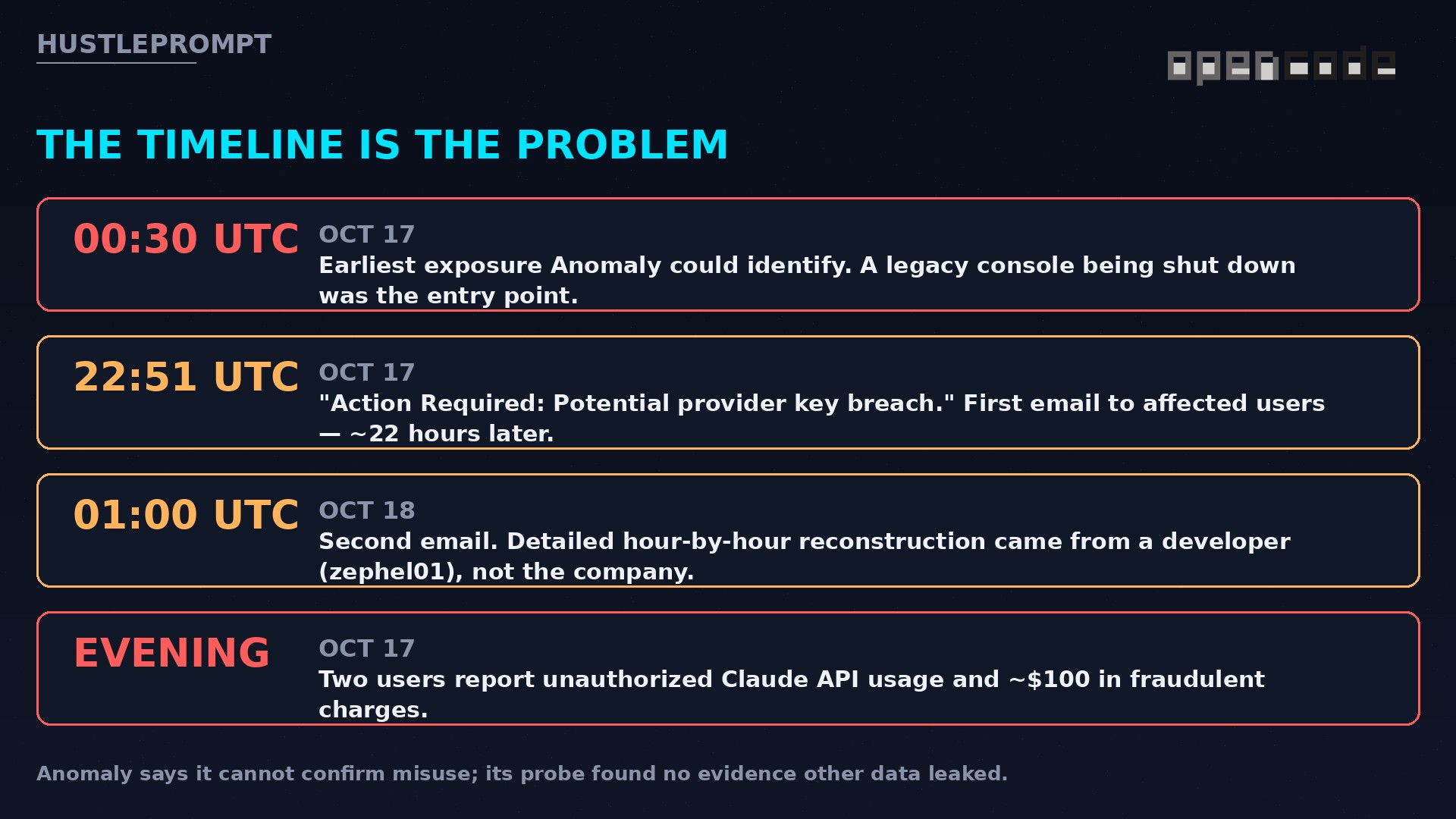
The earliest exposure the company could identify was approximately 00:30 UTC on October 17. The first notification went out about 22 hours later. Twenty-two hours is a long time to hold a live API key that someone else may already have — and the most detailed hour-by-hour reconstruction came not from the company but from a developer posting as zephel01.
As of the first reporting, OpenCode’s status page, changelog and the official OpenCode website carried no advisory at all. Silent channels plus a 22-hour lag: the combination that turns a contained incident into an open one.
Two fraud reports already
The company says it cannot confirm whether any keys were misused, and its probe found no evidence other data leaked. Two users have said otherwise: one reported unauthorized Claude API usage on the evening of October 17; another reported roughly $100 in fraudulent charges. That gap is why you don’t wait for a company’s investigation to finish before rotating — investigations take weeks, a leaked key can be drained in minutes.
Why a leaked key costs you real money
An API key is a metered payment instrument. Whoever holds yours can burn your credits on the most expensive endpoints, resell the key into shared proxy services, and abuse paid-tier quotas — with the bill landing on you. Some providers refund fraudulent usage on request; none promise it as policy. The $100 one user reported is the cheap version of this story. Users who had spending limits set turned a potential four-figure disaster into a hundred-dollar annoyance. The cap you set before the breach is the bill you pay after it.
Lock down your keys in 15 minutes
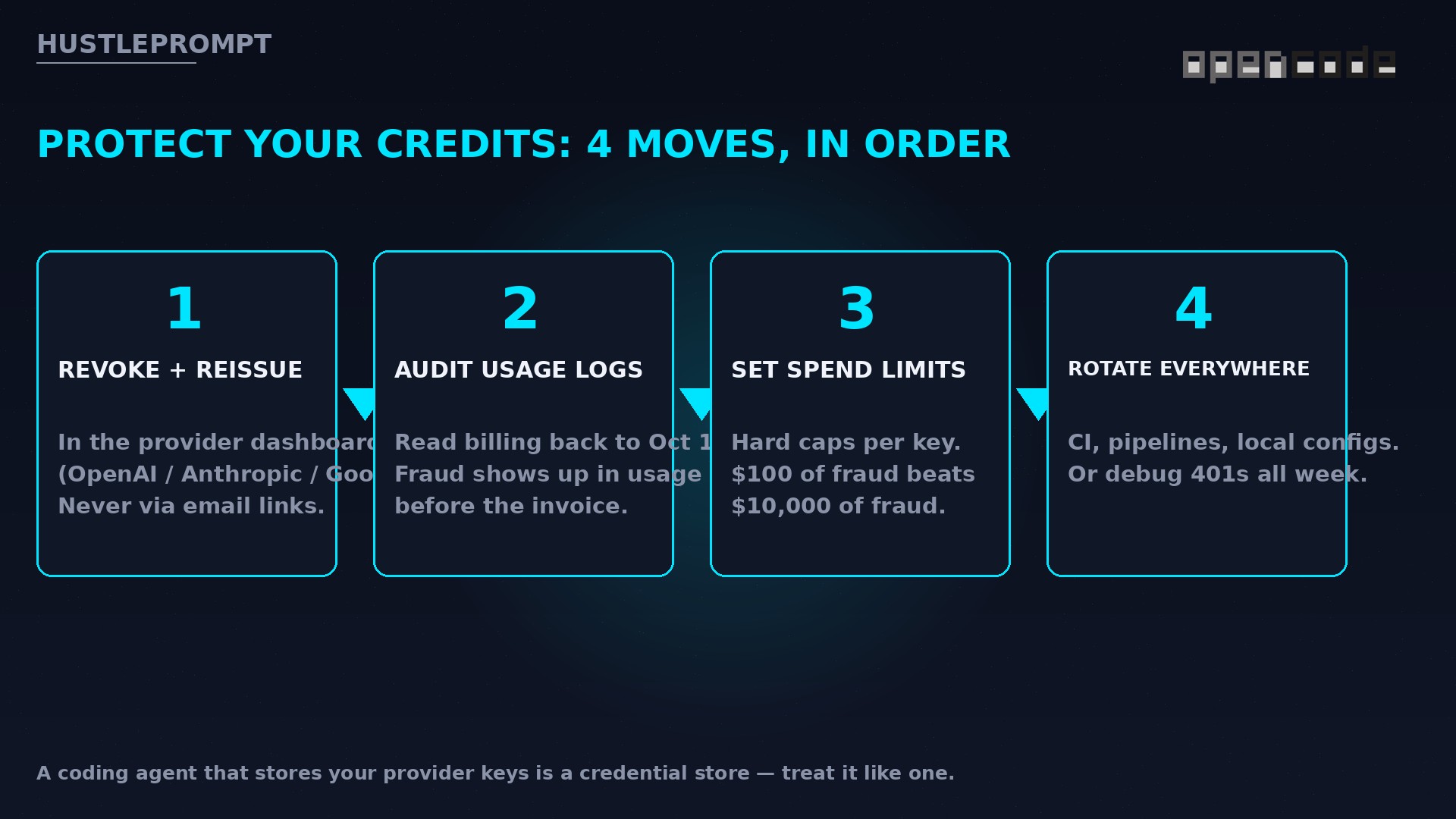
Directly in the OpenAI, Anthropic and Google dashboards. Never via email links — type the URL yourself.
Read billing back to October 17. Fraud shows in usage logs before it shows on an invoice.
Hard caps on every key. $100 of fraud beats $10,000 of fraud.
Update every pipeline, CI job and local config, or debug 401s for a week.
Do step 1 even if you never got the email. A rotated-unnecessarily key costs ten minutes; a live leaked key can cost your month’s API budget in an afternoon.
The pattern no one wants to name
A coding agent that stores your provider keys is a credential store, whether or not it’s marketed as one. OpenCode is a developer tool, not a bank vault — yet thousands of developers handed it the financial equivalent of a corporate card. Going forward: keep keys in a real secrets manager, scope them to minimum permissions, and treat any third-party tool that asks you to paste a key as a single point of failure — because it is.
Frequently asked questions
Was my OpenCode API key exposed?
If you ever saved an OpenAI, Anthropic or Google provider key in an OpenCode workspace, assume yes until you’ve rotated it. Rotate regardless of whether you received the email.
How do I revoke a compromised key?
Open each provider’s dashboard directly (type the URL yourself), delete the exposed key, generate a new one, update every pipeline and config, then set a spending limit on the new key.
What fraud was confirmed?
Two user reports: unauthorized Claude API usage on the evening of October 17, and roughly $100 in fraudulent charges. The company says it cannot confirm whether any keys were misused.
Did anything besides API keys leak?
Per Anomaly Innovations, its investigation found no evidence other data leaked. The at-risk assets are the third-party provider keys stored in user workspaces.
Why did notification take 22 hours?
Earliest identifiable exposure was ~00:30 UTC Oct 17; the first email went out ~22:51 UTC. No detailed public postmortem has been published, and the fullest public timeline came from an independent developer.
Will providers refund fraudulent charges?
Handled case by case — none of the three publishes a standing guarantee. Spending limits are what cap the worst case before you ever need a refund.
How do I protect keys used with coding agents?
Use a real secrets manager, scope each key to minimum permissions, set hard spending limits, rotate on a schedule, and monitor usage logs weekly.