
In May 2026, no AI model could fully rebuild a single program from scratch on the hardest coding test in the world. By October, the best model rebuilt 18.5% of them — whole programs, from a compiled binary and its documentation alone, with no source code, no internet, and no decompilation allowed.
That jump, from 0% to 18.5% in five months, is the most underrated shift in software this year. It does not mean programmers are finished. It means the thing programmers used to sell — the code itself — is getting cheaper by the month, while the things around the code are getting more valuable.
This is not a report of a benchmark score. It is an analysis of the rebuild economy: why whole-program rebuilding changes what software businesses are worth, why a viral reverse-engineering toolkit is accelerating it, and how freelancers can sell rebuilds legally, before their clients’ competitors do.
What ProgramBench Actually Tests
ProgramBench is deliberately brutal. It takes 200 real open-source programs — from small command-line utilities to widely used software like the SQLite database, the FFmpeg multimedia framework, and the PHP interpreter — and turns each one into a cleanroom reconstruction task.
The agent gets only two things: the compiled binary and the program’s user documentation. No source code. No internet. No decompilation. No skeleton code to fill in. It must choose the language, design the algorithms, define the data structures, and write a build script — then pass hidden behavioral tests generated by agent-driven fuzzing.
Most coding benchmarks test one skill: fix this bug, add this feature. ProgramBench tests the whole job: understand a program from the outside, then recreate it from nothing. That is why a score above zero matters, and why 18.5% matters more than it sounds. Thirty-seven whole programs, fully rebuilt, is not a demo. It is a capability crossing a threshold.
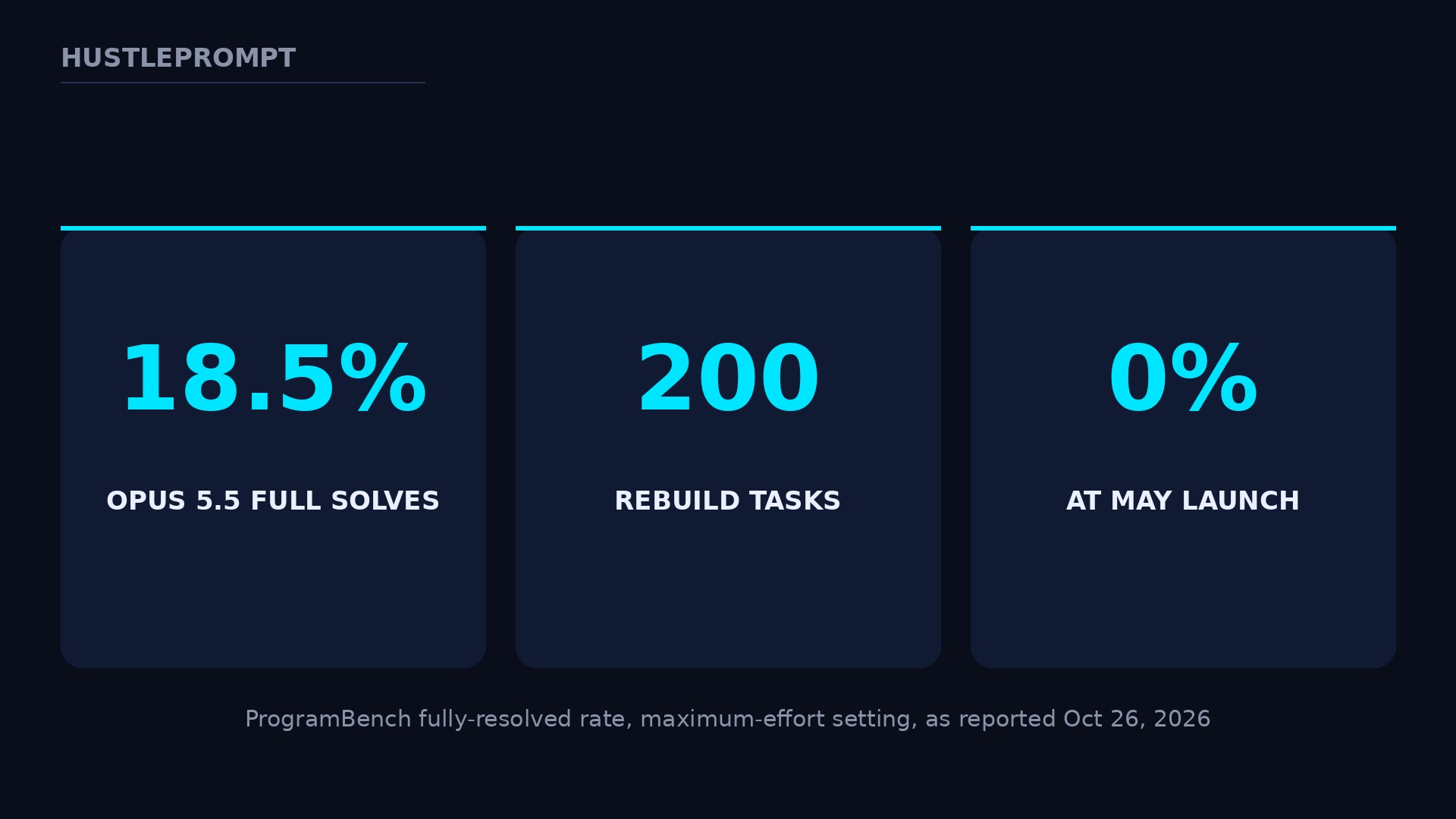
Two cautions keep this honest. First, 18.5% fully resolved is not 18.5% of all software — the “almost resolved” rate, where an agent passes at least 95% of hidden tests, is much higher, and different trackers report different headline numbers for that reason. Second, the benchmark’s own snapshot notes that the best fully-resolved rate across its display was 18.5%, with 200 tasks and nearly 249,000 behavioral tests. Compare fully-resolved to fully-resolved, or you will fool yourself.
Sources: BenchLM ProgramBench snapshot (Oct 22, 2026) · AI Data Insider, ProgramBench explainer (2026) · Vals cross-model table via PAS7 (Oct 2026).
Why Rebuilds Were Already Coming
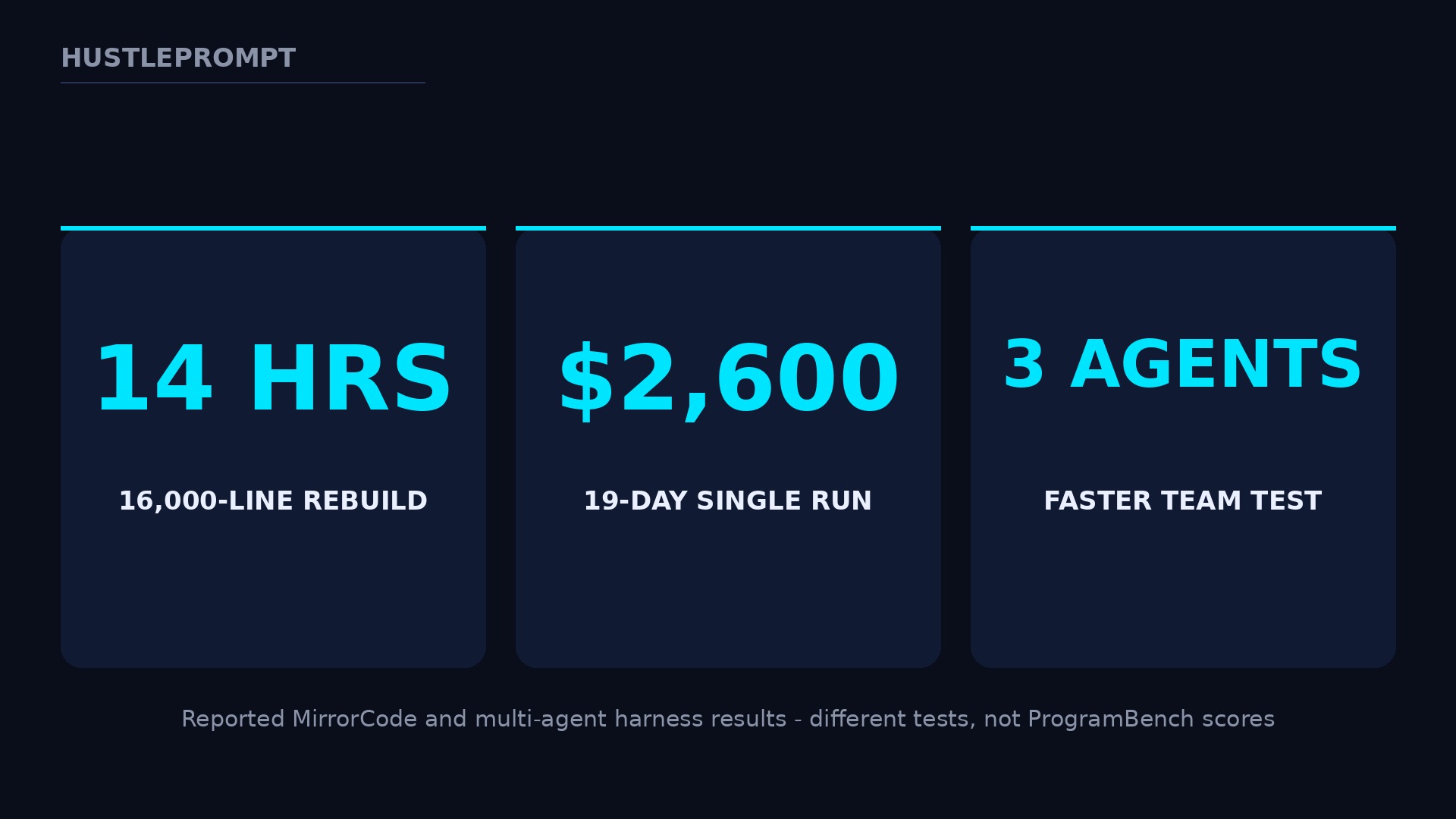
ProgramBench did not arrive out of nowhere. In June 2026, the MirrorCode benchmark — a related test of reconstructing complete programs from scratch, co-developed by Epoch AI and METR — showed Claude Opus 4.7 rebuilding a 16,000-line bioinformatics toolkit in just 14 hours.
That same coverage reported a single run lasting 19 days on one highly complex task, with a compute bill of $2,600. Those are not production economics yet. But they show the direction: a task that once took a team weeks can now be attempted by a model in hours, and the price of the attempt is falling toward the cost of a freelancer’s day rate.
Multi-agent teams push it further. Anthropic’s own Opus 4.8 evaluations, summarized by Faros, found a three-agent team reaching a 60% pass rate about 1.8x faster than a single agent on ProgramBench-style rebuilds — at the cost of higher token use. Note the metric: that 60% is a pass rate in that harness, not the 18.5% fully-resolved figure above. The point is the same in both: teams of agents beat single agents, and speed is now bought with tokens, not headcount.
Sources: AI Tech Suite, MirrorCode launch coverage (June 26, 2026) · Faros, Claude Opus 4.8 engineering guide (sourced from Anthropic system card).
The Viral Toolkit That Makes It Practical
Benchmarks prove capability. A viral open-source toolkit is making it usable. REA — Reverse Engineer Anything — is an MCP server that connects a coding agent like Claude Code to professional reverse-engineering tools, including Ghidra, Hopper, and IDA, so the agent can inspect an app’s binary, explain how it works, and rebuild a working version.
The demos circulating this month are deliberately ordinary, which is the point. One video walks through cloning the Windows Calculator — every mode, setting, and feature — with Claude Code on Opus 5.5, with and without REA, and compares both clones against the original. Another rebuilds a working notes app, with folders, pinned notes, and rich-text formatting, from a teardown of Apple’s Notes app. A third inspects a Three.js website and maps its 27-element DOM, scene, and animation setup in under a minute.
Treat those demos as demos, not benchmarks. They show what a skilled user can do with the tool, not what every user will get. But the pattern is real: the toolkit turns “rebuild this app” from a research prompt into a workflow with steps — pick a feature, route by build, summarize first, label every finding as seen, inferred, or unknown, then rebuild and test. That workflow is what freelancers can productize.
The Rebuild Workflow
Five steps, in order. Skip step one and the rebuild is guesswork.
Map what it does
Behavior first: screens, flows, inputs, outputs. Label seen vs inferred vs unknown.
Pick the rebuildable core
One workflow, not the whole app. The core that earns money gets rebuilt first.
Clean code, new design
Write fresh code from the behavior spec. Never copy assets, branding, or copied code.
Test against the original
Side-by-side behavioral tests. If it fails a real workflow, it is not done.
Beat, don’t just copy
Faster, cheaper, or better integrated than the original — or the rebuild has no reason to exist.
The Legal Line That Makes or Breaks This Business
Here is the part that separates a real service from a lawsuit. Rebuilding software you own, software you are authorized to examine, open-source software, or software for interoperability and preservation is legitimate work — and it is exactly what the REA creators say the tool is for.
Copying someone else’s copyrighted code, assets, branding, or trade secrets is not. Decompiling a competitor’s app to clone it feature-for-feature and sell it as your own is not a business model; it is a dispute waiting for a lawyer. The demos above work because they rebuild behavior with fresh code, and because the examples are either the builder’s own tools or widely used system apps shown for education.
The safe, profitable version of this business is almost entirely boring: a company owns an old internal tool nobody maintains, a vendor went out of business, or a workflow is trapped in a desktop app from 2012. Rebuilding that — with the owner’s permission, from their own binary, with a clean new codebase — is legal, valuable, and badly needed. Start there, and stay there.
How to Profit From This Trend
The money is not in cloning famous apps. It is in rescuing trapped software. Every mid-size company has at least one tool that everyone depends on and nobody dares to touch: an Access database, a VB6 utility, a Flash-era dashboard, a macro spreadsheet that runs the month-end close. Those tools are the rebuild market, and their owners will pay to modernize them before they break.
Prices below are my estimates based on comparable freelance development and migration rates, not market data:
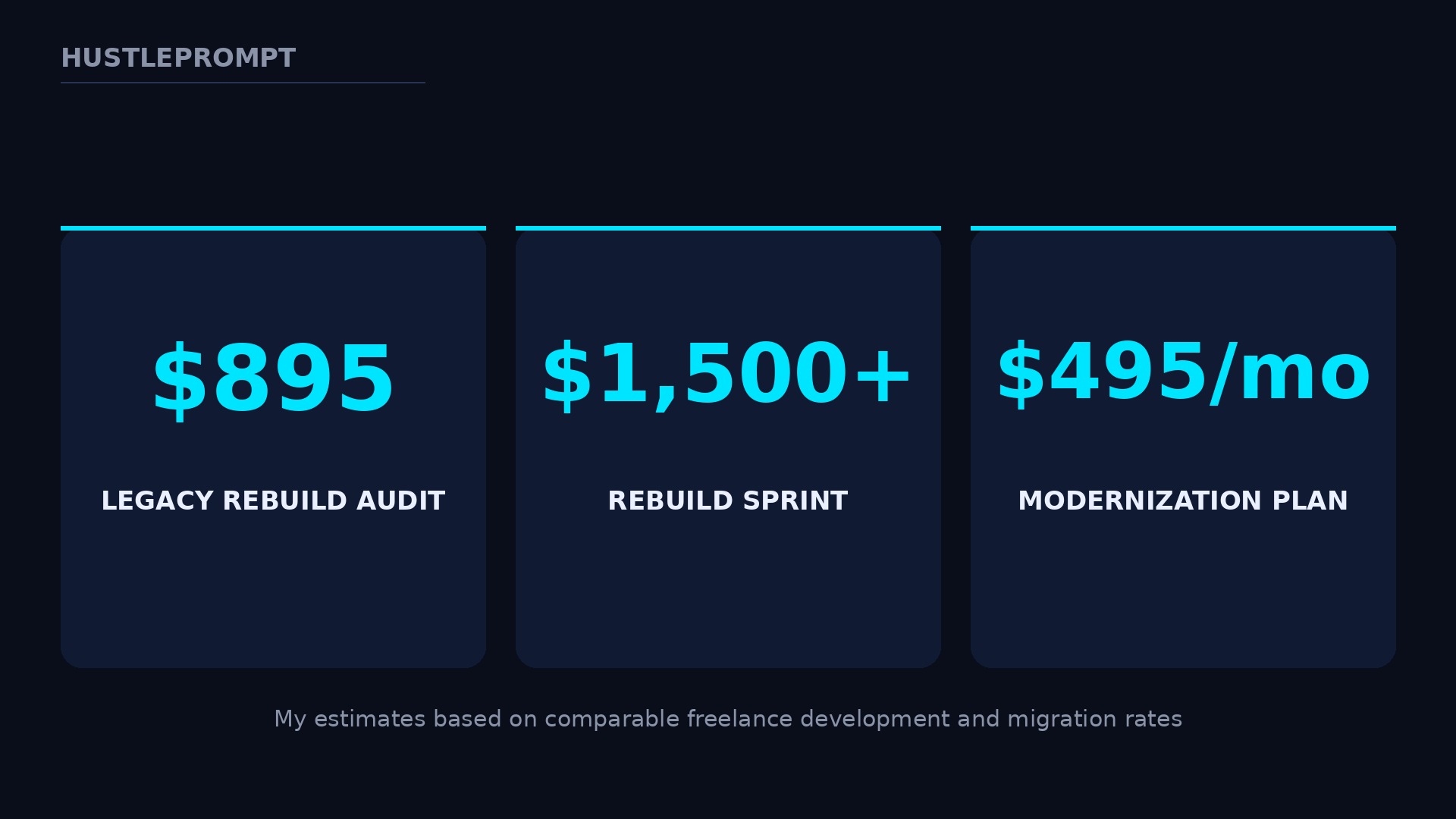
The audit is again the wedge. A company will not hand you its month-end close tool on day one, but it will pay $895 to learn what that tool actually does, what breaks if it dies, and what a rebuild would cost. The audit document becomes the sprint proposal, and the sprint becomes the retainer.
What to Do This Week
- Find one trapped tool. Ask three local businesses what software they are afraid to update. The answer that comes with a sigh is your first lead.
- Do one free teardown. Map one workflow, label seen vs inferred vs unknown, and show the owner the map. The map alone proves you understand their business.
- Rebuild one workflow, not the app. Pick the workflow that earns money or saves the most time, prove it side by side with the original, and ship that.
- Write the permission into the contract. The client confirms they own the software or are authorized to have it rebuilt, and that the new code is theirs. That clause protects both of you.
Watch: how REA connects Claude Code to reverse-engineering tools, the five-step workflow, and the responsible-use limits — lawful research, interoperability, and software you own or are authorized to examine. Watch on YouTube.
Where This Is Heading
Rebuilds become a line item. As fully-resolved rates climb past 18.5%, “rebuild it” will stop sounding exotic and start sounding like a quote request. The firms with a tested workflow and a permission clause will win those quotes; the firms with a demo and no process will not.
The moat moves to distribution and data. If code can be rebuilt, what cannot be rebuilt is the customer list, the distribution channel, the brand trust, and the proprietary data. Founders who invest there will survive the rebuild economy; founders who guard code alone will not.
Benchmarks will saturate, then change. Import AI’s Jack Clark expects ProgramBench to be saturated by the end of 2027 — that is his prediction, not a fact. When it saturates, the test will get harder, and the next capability jump will be about larger, messier, real-world systems. The rebuild business does not end at saturation; it moves upmarket.
Frequently Asked Questions
What is ProgramBench?
A benchmark of 200 cleanroom program-reconstruction tasks. An agent receives only a compiled binary and user documentation — no source code, internet, or decompilation — and must rebuild the program so it passes hidden behavioral tests.
Does 18.5% mean AI can rebuild any software?
No. It means Claude Opus 5.5 at maximum effort fully resolved 18.5% of those 200 tasks. Most real-world systems are larger, messier, and tied to live data and integrations the benchmark does not test. Treat 18.5% as a threshold crossed, not a job finished.
What is REA?
Reverse Engineer Anything: an open-source MCP server that gives a coding agent access to reverse-engineering tools such as Ghidra, Hopper, and IDA, so it can inspect a binary, explain how an app works, and help rebuild a working version from that analysis.
Is it legal to rebuild someone else’s app with AI?
Rebuilding software you own, are authorized to examine, or that is open source — for interoperability, preservation, or modernization — is legitimate work. Copying copyrighted code, assets, or branding, or cloning a competitor’s app to sell as your own, is not. Get written permission and write fresh code.
How much should a rebuild sprint cost?
By my estimate, $1,500 and up for one core workflow, depending on size and data complexity. Price the audit at $895 by my estimate first, so the sprint quote is based on a real teardown, not a guess.
Will rebuilds kill freelance developers?
No — they change what developers sell. Code gets cheaper, but judgment, integration, data migration, and trust get more valuable. The developer who can run a teardown, secure permission, rebuild a workflow, and prove it works is selling a service, not just code.