
On the same day, October 26, 2026, two numbers landed that tell one story. Anthropic filed its S-1 to go public, showing $16.3 billion in first-half revenue and its first profitable quarter. Meta announced plans to raise up to $95 billion to fund its AI buildout.
Read together, they describe a split, not a boom. At the top, capital is concentrating in a handful of companies that can raise tens of billions on demand. Everywhere else, the funding climate is tightening — and one prominent voice is now warning that smaller AI infrastructure firms may not survive it.
This is not a report of two filings. It is an analysis of what the split means, who gets squeezed, and where the paid work sits for freelancers, creators, and small businesses that will never raise $95 billion — but can sell to companies living through the consequences.
What Anthropic Actually Filed
Anthropic’s S-1, filed October 26, is the first time the public has seen audited-style numbers for the Claude maker. The headline figures are startling in both directions, which is exactly why they need reading carefully.
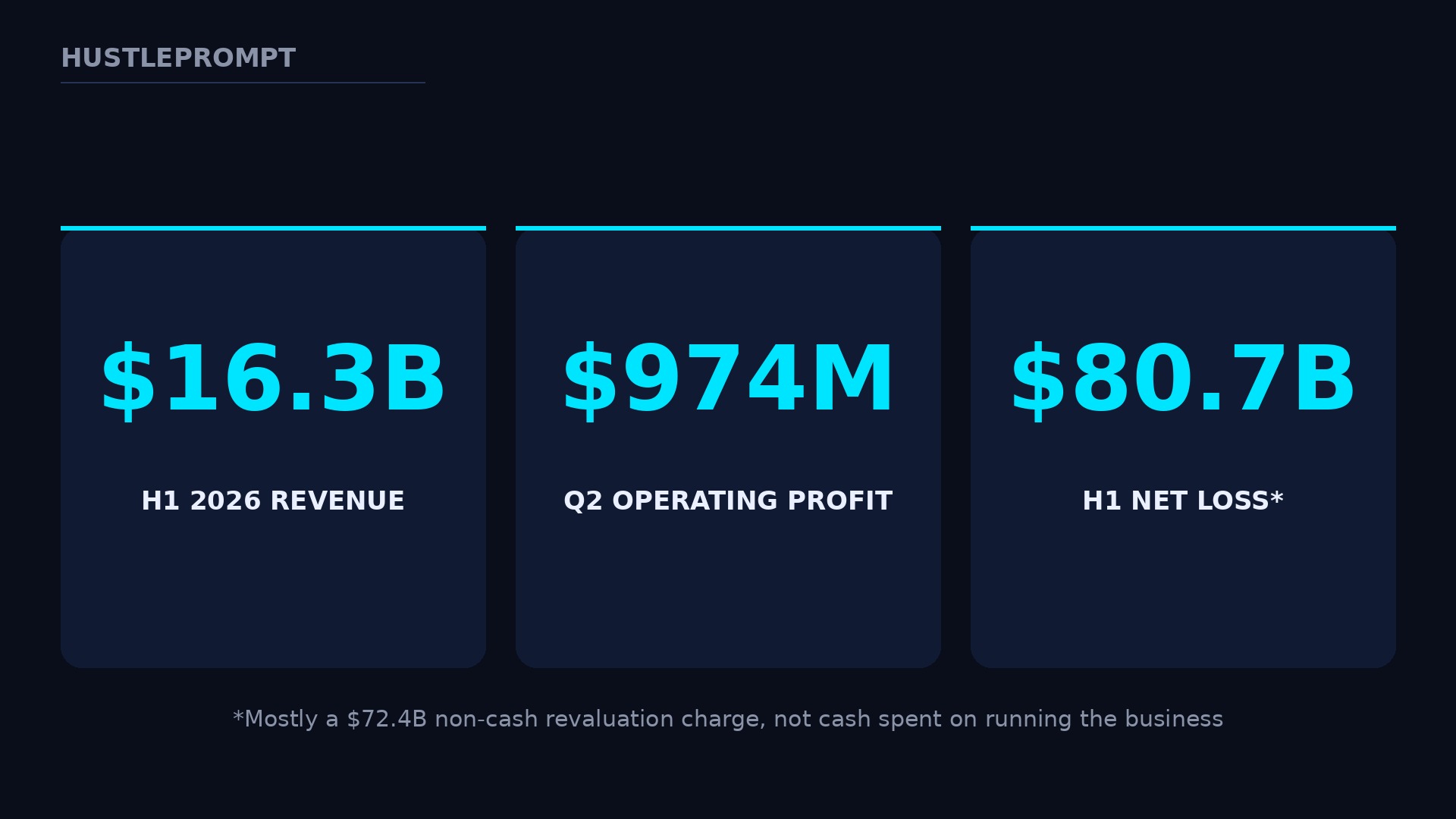
Revenue for the first half of 2026 was $16.286 billion, up from $1.163 billion in the same period a year earlier — a 14-fold jump. The second quarter alone produced $11.56 billion in revenue and $974 million in operating income, Anthropic’s first profitable quarter on that measure.
Then comes the number that will dominate headlines: a first-half net loss of $80.748 billion. That figure is real, but it is mostly not cash. About $72.4 billion of it is a non-cash charge from revaluing convertible notes, derivatives, and SAFEs — an accounting effect that grows as the company’s valuation rises. The operating loss for the half was far smaller, at $693 million, and operating cash flow was positive at $3.929 billion.
The filing leaves the share count and price range blank, so there is no official IPO date or valuation yet. It plans to list Class A shares on Nasdaq under the ticker ANT, with Goldman Sachs and Morgan Stanley among the lead bankers, according to coverage of the filing. Reported valuation talk of $1.5 trillion to $2 trillion is just that — reported talk, not a filed price.
Sources: Quant Data S-1 analysis (Oct 26, 2026, citing SEC S-1 pp. 147-170) · TradingView / Invezz, “Anthropic IPO prospectus released” (Oct 26, 2026) · DigitechBytes S-1 explainer (Oct 2026).
What Meta Actually Announced
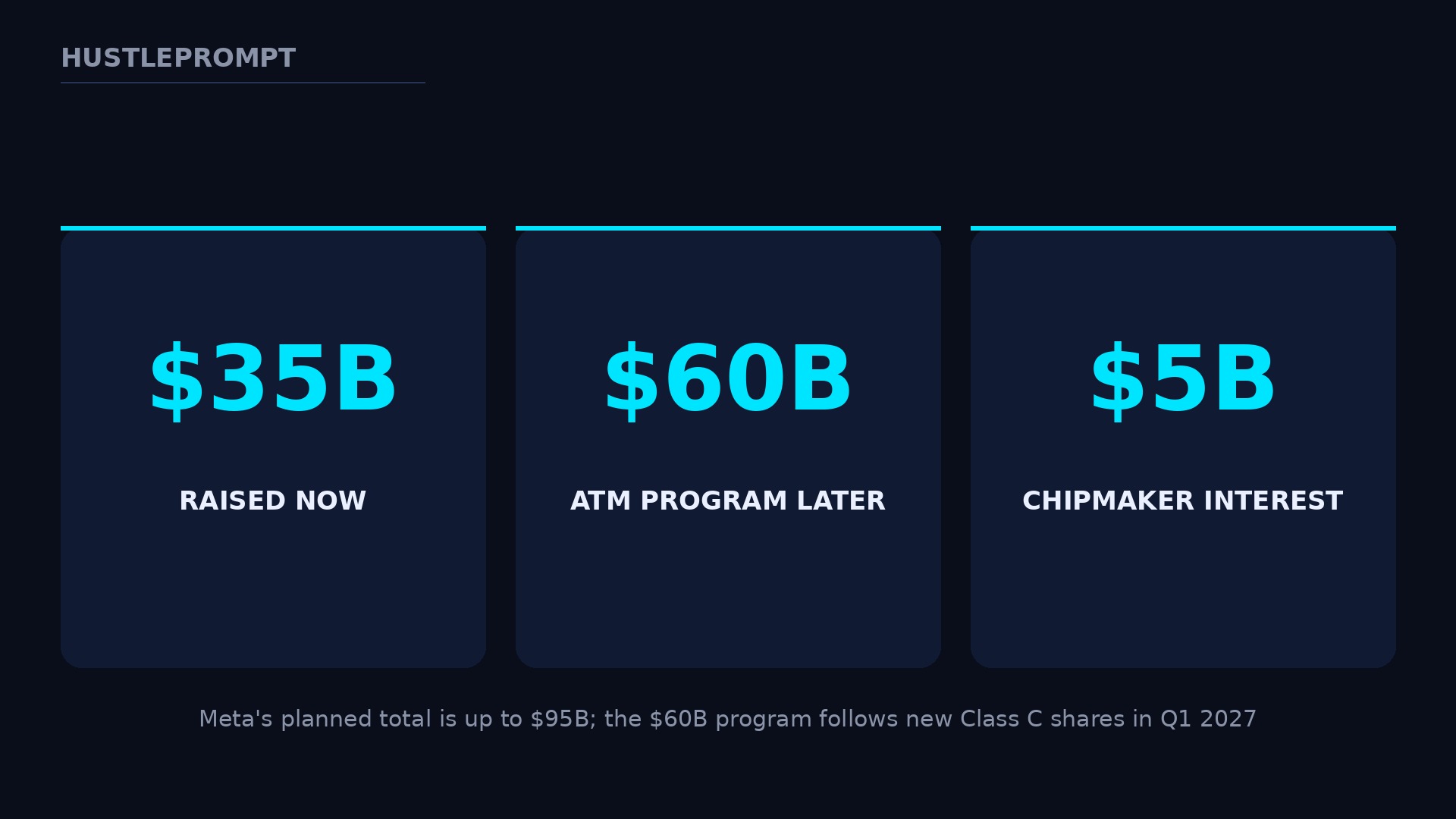
Meta’s plan, announced the same day, is its largest-ever equity fundraising. It launched public offerings worth about $35 billion in common and preferred stock, and plans a separate at-the-market sale program of up to $60 billion — for a planned total of up to $95 billion.
The second tranche is not immediate. It is expected to begin after Meta’s new non-voting Class C shares start trading, expected in the first quarter of 2027, with timing and terms not yet finalized. The money funds data centers, cloud capacity, and AI products including its apps and its Muse agent.
One detail matters more than the total. Nvidia, AMD, and Broadcom have expressed interest in buying up to $5 billion combined of Meta’s Class A shares. That means Meta’s chip suppliers may help finance one of their biggest customers — a circular flow that analysts flagged immediately. William Blair analysts said investors will keep questioning the financing and the potential for future raises, while noting the plan also shows Meta’s confidence in long-term AI returns.
Meta is not alone in turning to equity. Alphabet increased its equity offerings to $84.75 billion earlier this year, according to Reuters coverage. And Meta’s own 2026 capital expenditure forecast now sits at $135 billion to $145 billion, with third-quarter free cash flow turning negative at -$2.12 billion, against +$10.63 billion a year earlier.
Sources: Reuters via 98.5 The River, “Meta eyes record $95 billion equity raise” (Oct 26, 2026) · TradingView / dpa-AFX, “Meta plans to raise up to $95 bln” (Oct 26, 2026).
Why the Same-Day Timing Is the Story
Neither filing alone is the trend. The trend is the contrast between them, and what sits underneath both.
Anthropic’s filing shows a company whose revenue is growing faster than its compute bill — compute fell to 48% of revenue in Q2, from over 200% in early 2025 on one analysis of the filing. But it also shows a company with enormous future commitments: S-1 coverage puts non-cancelable purchase commitments at about $265.6 billion at June 30, up from $54.6 billion at the end of 2025. Other published totals for Anthropic’s infrastructure obligations are higher, but they use different definitions and may overlap — do not add them together into one scary number.
Meta’s raise shows the other side of the same coin: even a company with massive operating cash flow now funds AI expansion with equity, because the buildout is too big for cash flow alone. When giants fund themselves this way, the cost of capital for everyone else rises. Lenders and investors compare every AI infrastructure pitch against a world where Meta can raise $95 billion and Anthropic can file for a multi-trillion-dollar listing.
That is the context for the warning now circulating from Elon Musk: that the debt market has effectively closed for smaller companies relying on AI data centers, and that more than 200 smaller “NeoCloud” infrastructure firms face severe stress, consolidation, or failure. Treat that as Musk’s warning, not as a verified count of failures — no such wave has been documented yet. But the direction of travel is consistent with the filings: capital concentrates, and the middle gets squeezed.
The Split, in One Picture
Two funded cores, one exposed middle — and a service layer in between.
Giants that can raise billions
Meta’s $95B plan, Anthropic’s IPO path, Alphabet’s $84.75B in offerings. Their constraint is execution, not access to capital.
Small infra firms on debt
NeoCloud-style firms that borrowed to build capacity now face a debt market Musk says has closed to them.
The work everyone still needs
Migration plans, vendor audits, cost controls, and exit routes. This layer does not need to raise billions to get paid.
How to Profit From This Trend
Do not try to invest like a giant. Sell the survival skills the split creates. Every company that depends on a small AI vendor, a single cloud, or a rented GPU fleet now has a new board-level question: what happens if our provider is acquired, repriced, or shut down? Answering that question is a service, and it is priced by the fear, not by the hour.
Prices below are my estimates based on comparable freelance operations and advisory rates, not market data:
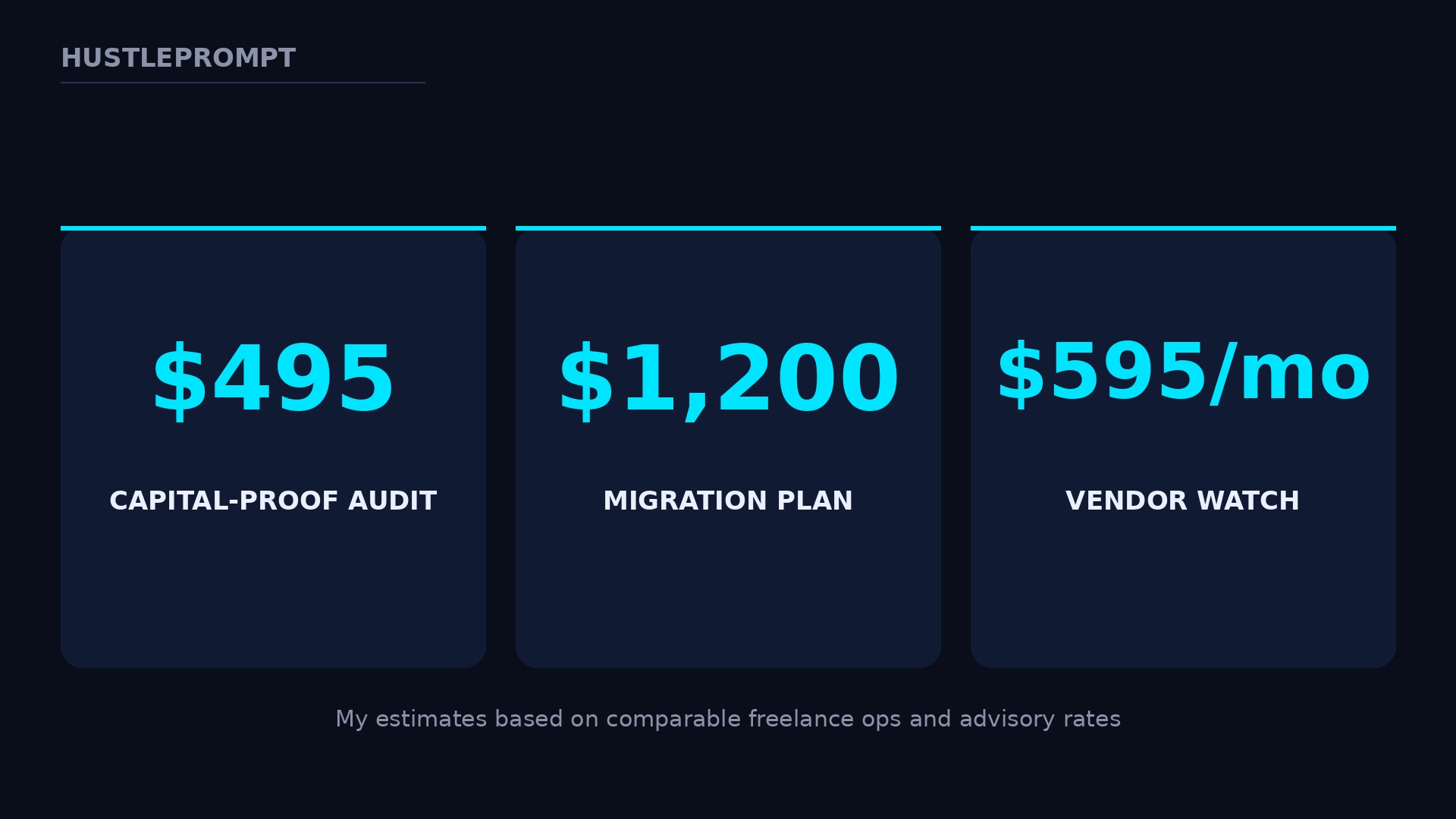
The audit is the wedge. It is cheap enough to sell in one call, it surfaces the migration work, and it gives the client a document their board can read. Lead with the question, not the service: “If your AI vendor doubled its price or shut down next quarter, how long would you be down?” Most clients cannot answer that in under a minute. That silence is the sale.
What to Do This Week
- Pick one exposed niche. Agencies, SaaS startups, and creator businesses built on a single small AI vendor are the best first clients — they feel the split first.
- Build the audit template once. Vendor list, contract terms, data-export test, fallback provider, and a one-page risk rating. Reuse it for every client.
- Run one migration drill. Move a non-critical workflow to a second provider and time it. A timed drill beats a slide deck when you pitch the full plan.
- Publish a monthly vendor watch. Even a short public note on funding and pricing changes builds the authority that sells the retainer.
Watch: the Anthropic S-1 explained — $16.3 billion in first-half revenue, an $80.7 billion net loss driven mostly by a non-cash charge, and why the reported $2 trillion valuation is talk, not a price. Watch on YouTube.
Where This Is Heading
Public-market scrutiny becomes a feature, not a bug. Once Anthropic trades, its quarterly numbers will set the benchmark every private AI company is judged against. Freelancers who can read a filing — revenue, operating income, commitments — will sound smarter than competitors who repeat headlines.
Circular capital gets questioned. Chip suppliers funding their biggest customer will draw attention from investors and regulators. Expect more disclosure, and more clients asking whether their vendor’s funding is real revenue or recycled capital.
The middle consolidates. If debt stays closed to small infrastructure firms, expect acquisitions, mergers, and quiet shutdowns through 2027. Each one creates a migration project for someone. Position yourself as the person companies call before the shutdown, not after.
Frequently Asked Questions
Is Anthropic profitable?
On a quarterly operating basis, yes in Q2 2026: $974 million in operating income on $11.56 billion in revenue. For the full first half, it still had a $693 million operating loss, and an $80.7 billion net loss driven mostly by a non-cash financing revaluation. Profitability depends on which measure you use — and the filing lets you check all three.
When will Anthropic stock trade?
No official date has been filed. The S-1 leaves the share count and price range blank, and trading can only begin after the SEC declares the registration effective and the IPO prices. Media reports point to mid-November 2026, but that is reported, not confirmed.
Is Meta’s $95 billion already raised?
No. About $35 billion was launched as public offerings, and up to $60 billion more is planned through an at-the-market program expected after new Class C shares begin trading in Q1 2027. The $95 billion is a planned total, not cash in hand.
What is a NeoCloud firm?
A smaller company that rents out AI compute capacity, typically built on borrowed money and leased chips, rather than owning a hyperscale cloud. The concern is that if debt funding dries up, these firms cannot refinance the hardware they bought to serve customers.
Should small businesses avoid small AI vendors?
No — but they should avoid depending on any single vendor without an exit plan. Use the small vendor for speed and price, keep a tested fallback, and export your data regularly. The risk is not smallness; it is having no second option.
How can freelancers sell a capital-proof audit?
Sell it as a fixed-price, one-week deliverable: a vendor map, a risk rating, and a tested export. Price it at $495 by my estimate, deliver it in a document the client can show their board, and let the migration work follow from what the audit finds.