
The most important number in AI training just got a new value — or so OpenAI claims. On November 24, it published nine new mathematics manuscripts, one titled the matrix multiplication exponent is nine fourths.
The claim: the matrix multiplication exponent, omega, is exactly 9/4 — 2.25. If it holds up, it ends a chase running since 1969, when Volker Strassen first showed matrices could be multiplied faster than the schoolbook method.
What OpenAI actually published
| Family | Manuscripts | Headline result |
|---|---|---|
| Euclidean tensor geometry (family 379) | 7 | The matrix multiplication exponent is nine fourths |
| Strongly polynomial linear programming (family 380) | 2 | A deterministic strongly polynomial algorithm |
The nine manuscripts arrived with Lean formalizations of selected results. OpenAI lists them in the history file of its public math repository on GitHub. The same drop also subsumes the November 23 result that VP and VNP are different, which we covered when Anthropic’s parallel claim landed.
These are preprints, not peer-reviewed papers. The history file records withdrawals and fixes from earlier drops, and the wider mathematical community is now examining the proofs. Treat 9/4 as a claim with strong early support — not settled fact.
What the exponent means, in plain words
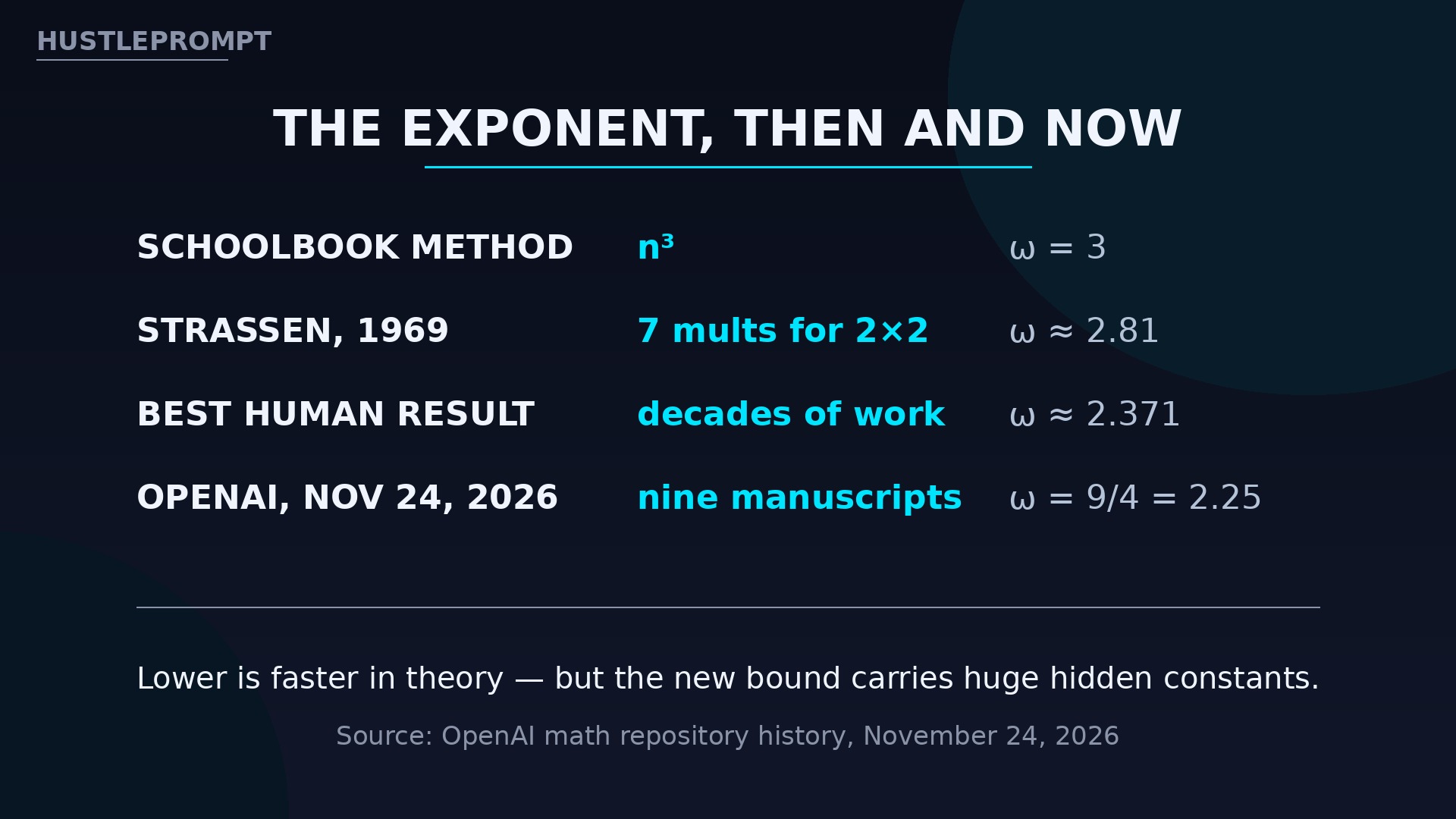
Multiplying two n-by-n matrices the schoolbook way takes about n cubed operations. Omega is the smallest number such that the job can be done in about n-to-the-omega operations — lower means fewer operations, in theory.
| Method | Year | Exponent |
|---|---|---|
| Schoolbook multiplication | — | 3 |
| Strassen (7 multiplications for 2-by-2) | 1969 | About 2.81 |
| Coppersmith–Winograd | 1990 | About 2.376 |
| Best human result before OpenAI | — | About 2.371 |
| OpenAI, November 24, 2026 | 2026 | 9/4 = 2.25 (claimed exact) |
The jump from about 2.371 to 2.25 is the biggest in decades. The previous bound had barely moved since 1990 — thirty-six years, roughly five thousandths — while OpenAI’s manuscripts claim to cut more than a tenth in one drop. Independent expositions on arXiv have since reproduced the 9/4 upper bound, and an October constructive proof gives an explicit algorithm reaching it.
What OpenAI’s repository says
The matrix multiplication exponent is nine fourths.
— Manuscript title, OpenAI math repository history, November 24, 2026
Strongly polynomial linear programming gives a deterministic strongly polynomial algorithm for linear programming, answering Smale’s ninth problem.
— OpenAI math repository history, November 24, 2026
An October preprint had already shown the exponent is at most 9/4 over the complex numbers. The November manuscript goes further, claiming the exact value over every field, with matching upper and lower bounds.
Two more famous problems in the same drop
The matrix result is the headline, but the second family may matter as much. Smale’s ninth problem asks whether linear programming — the math behind scheduling, logistics and portfolio optimization — can be solved in strongly polynomial time, depending only on the number of variables and constraints, not the size of the numbers. OpenAI says yes.
The companion manuscript disproves the polynomial Hirsch conjecture for bounded simple rational polytopes — the diameter can grow superpolynomially, not polynomially as claimed.
What it means for your money
If you invest in AI: do not trade on this. No GPU gets faster tomorrow — the new bound carries huge hidden constants — so it changes the theoretical floor of compute, not the next earnings call.
If you build AI systems: matrix multiplication is the core operation of training and inference, so a lower exponent lowers the long-run cost floor. That matters for five-to-ten-year infrastructure bets, not 2027 budgets.
If you run a business that buys compute: the takeaway is direction, not speed. AI’s core math keeps getting cheaper in theory, supporting the case that inference prices keep falling — one more reason not to lock in long, expensive compute contracts without an exit.
The caution: these are preprints, and the proofs are still being examined. The November 23 claim that VP and VNP are different is already under community review, and earlier manuscripts were withdrawn or fixed. A claim this large earns belief in stages: Lean formalization, independent reproduction, then peer review.
Frequently asked questions
What is the matrix multiplication exponent?
The smallest omega such that two n-by-n matrices can be multiplied in about n-to-the-omega operations. Schoolbook gives omega = 3; OpenAI claims the exact value is 9/4, or 2.25.
Did OpenAI prove the exponent is exactly 2.25?
OpenAI published manuscripts claiming exactly that, with matching upper and lower bounds over every field, plus Lean formalizations of selected results. They are preprints, now under examination by the wider mathematical community.
Will my computer or GPU get faster?
No — not from this. It concerns theoretical arithmetic complexity: it counts operations, not execution time, and carries huge hidden constants. It makes no existing matrix library or GPU faster.
What is Smale’s ninth problem?
It asks whether linear programming can be solved in strongly polynomial time — depending only on the number of variables and constraints, not the size of the numbers. OpenAI claims a deterministic strongly polynomial algorithm, answering it.
What is the Hirsch conjecture?
It claimed a polytope’s diameter is bounded by a polynomial in its facets and dimension. OpenAI disproves the polynomial version for bounded simple rational polytopes.
Where can I read the manuscripts?
In OpenAI’s public math repository on GitHub — the history file lists the November 24 drop: nine manuscripts across two families, with Lean formalizations of selected results.