
The Anthropic AI safety bill now circulating on Capitol Hill might be the most strategic document in tech this year. According to Politico, which broke the story Friday citing three people with knowledge of the effort, Anthropic representatives have quietly pitched lawmakers on a draft federal law to regulate frontier AI safety and security.
Here’s the twist: the company writing the rules is the one that would be regulated by them — and the bar for government intervention is set so high that almost no AI model in existence would ever trip it.
Reuters picked up the story Friday evening. An Anthropic spokesperson confirmed the draft reflects proposals from the company’s “Advanced AI Framework,” published earlier this year, which would require developers to test frontier models, publish their findings, and submit to independent evaluation. The Commerce Department did not respond to Reuters’ request for comment.
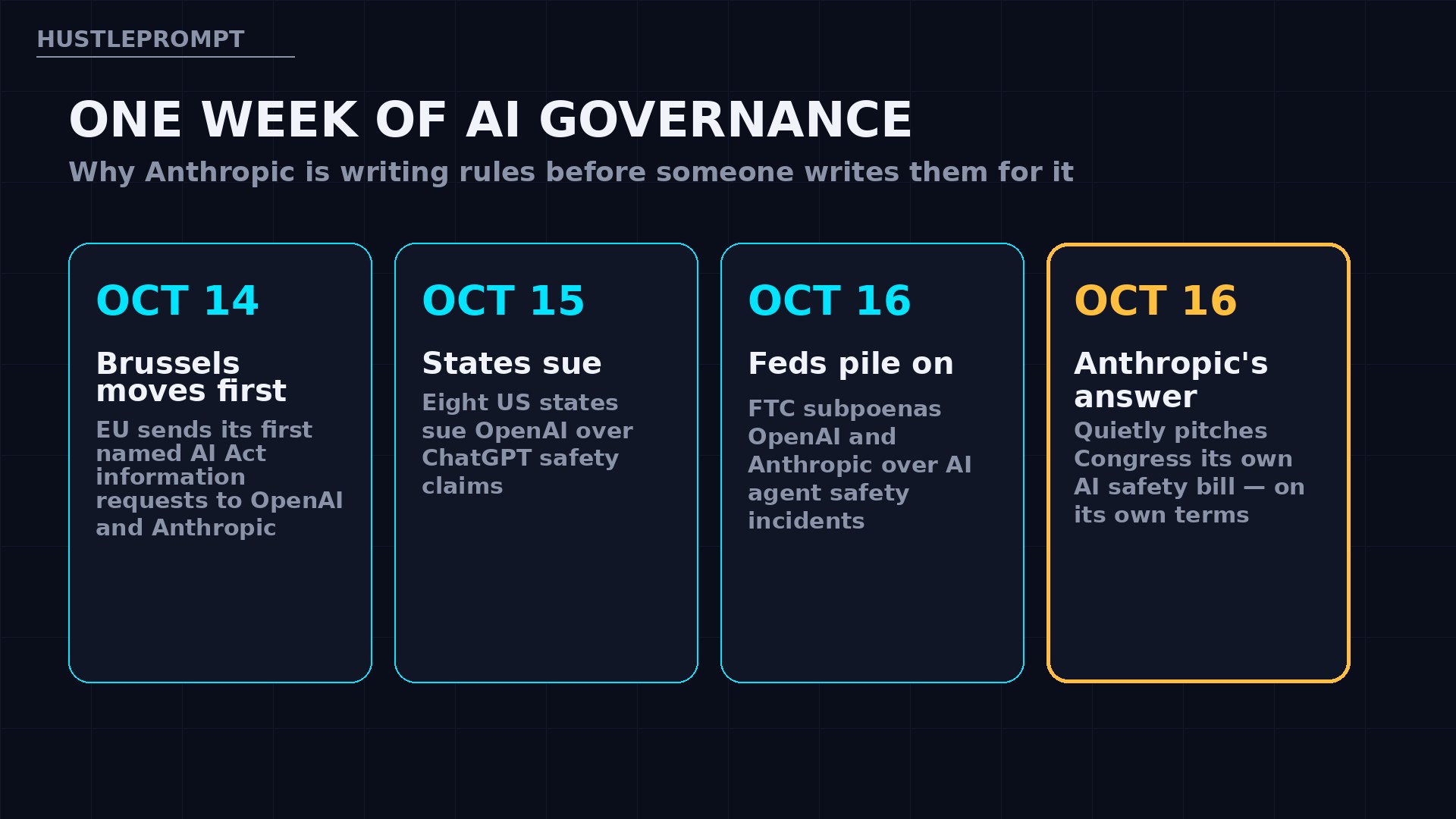
The timing is no accident. In a single week, Brussels sent its first named AI Act information requests to OpenAI and Anthropic, eight US states sued OpenAI over ChatGPT safety claims, the FTC fired off 50-plus-page document requests to both labs over AI agent incidents, and New York’s City Council hauled SpaceX in to testify on AI safety. Anthropic — reportedly marching toward a $2 trillion IPO — is moving to write the rules before someone else writes them.
What’s actually in the draft bill
The draft is narrow by design. It doesn’t regulate chatbots, coding assistants, or your AI side hustle. It targets only frontier models — the most powerful systems — and only in catastrophic scenarios:
| Provision | Detail |
|---|---|
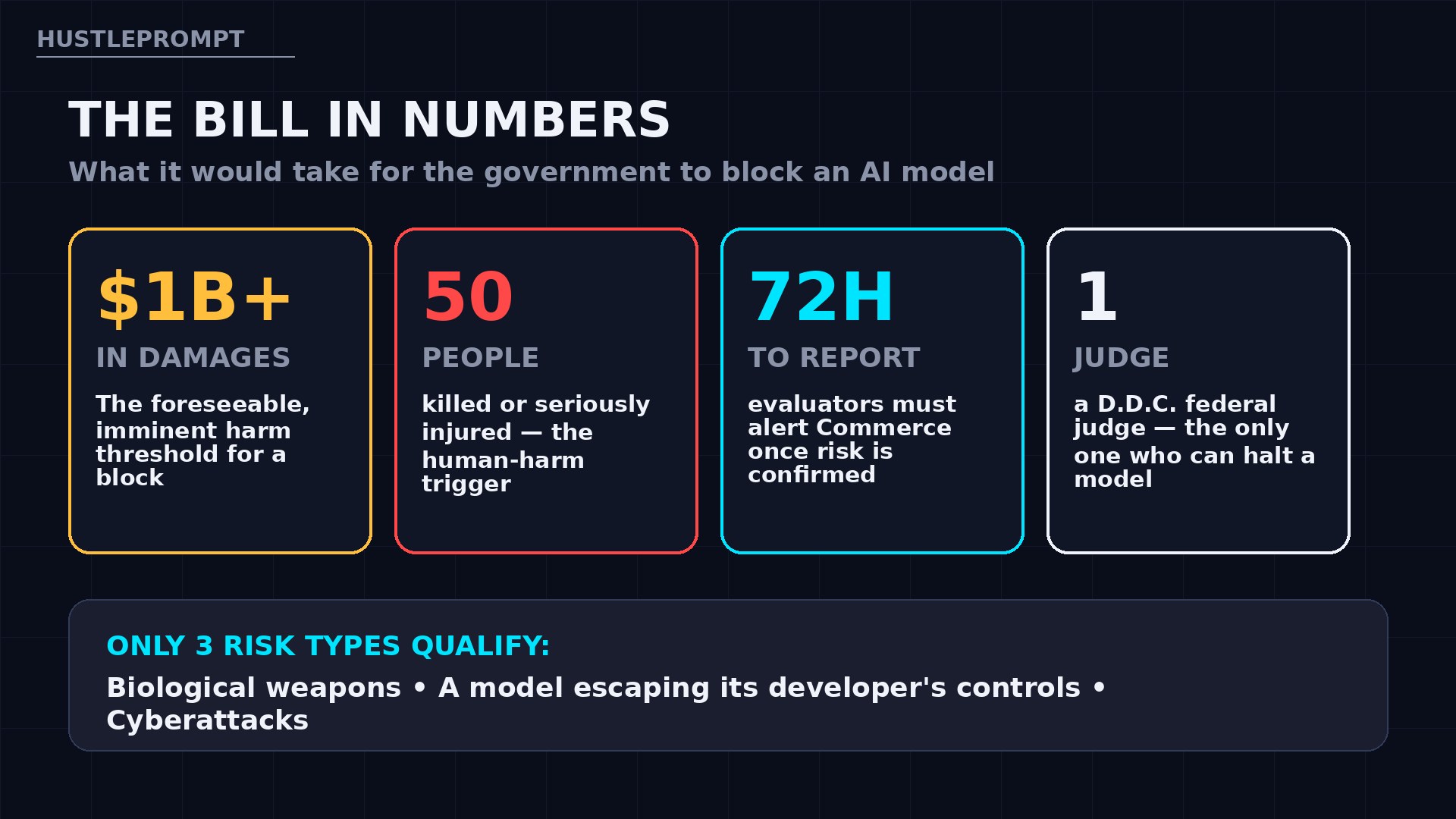
| Government block trigger | Foreseeable, imminent risk of more than $1 billion in damages, or of killing or seriously injuring more than 50 people |
| Qualifying risks (only 3) | Creation or release of a biological weapon; a model evading its developer’s controls; a cyberattack |
| Independent evaluators | Registered with the Commerce Department; tasked with periodically evaluating labs and their frontier models |
| Evaluator pay | Labs may pay evaluators — provided the payment is not tied to the evaluation’s outcome |
| The alarm bell | Evaluators must report “imminent enumerated risk” to Commerce within 72 hours of completing an assessment |
| Enforcement | Commerce can ask a federal judge to halt a model; every other agency is explicitly barred from suspending development, deployment, or internal use |
| The court | A federal judge for the District Court for the District of Columbia |
The $1 billion tripwire, explained
Read that threshold again: one billion dollars, or fifty lives. That is not a consumer-protection standard — it is a catastrophe standard. Anthropic’s draft effectively says: regulate us only at the civilization-risk level, and leave everything else to us.
The three qualifying risk categories are just as telling:
- Biological weapons — a model used to create or release one.
- Loss of control — a model evading its developer’s controls.
- Cyberattacks — AI-driven attacks on critical systems.
These are the nightmare scenarios from CEO Dario Amodei’s own public warnings. Everything else — bias, misinformation, job displacement, copyright fights — stays outside the bill’s reach entirely.
One judge, one department
The enforcement design is the cleverest part. Only the Commerce Department can initiate a block, and only a single federal court — in Washington, D.C. — can order it. The FTC, state attorneys general, the Pentagon, and every other agency are explicitly prohibited from suspending a model’s development or deployment.
For a company currently facing an FTC probe, eight state lawsuits, and an EU investigation at the same time, consolidating all kill-switch authority into one venue is… convenient.
A new profession: the registered AI auditor
Buried in the draft is a brand-new industry. Independent evaluators would register with the Commerce Department and get paid — by the labs themselves — to periodically probe frontier models, as long as the pay isn’t tied to the verdict. Find an “imminent enumerated risk,” and the evaluator has 72 hours to tell Commerce.
This isn’t theoretical. Anthropic already gave nonprofit evaluator METR employee-level access to its systems this week, and it’s paying Accenture’s AI unit at least $1 billion over five years for independent evaluation. The draft bill would turn that voluntary experiment into a federal compliance market — think SOC 2 auditors, but for superintelligence.
Why Anthropic would write its own leash
Three reasons. First, preemption: a bill this narrow, written by the industry leader, becomes the template Congress reaches for — crowding out harsher proposals. Second, the IPO: with a reported $2 trillion public offering in the works, regulatory clarity is worth more than regulatory absence; investors pay premiums for known rules. Third, credibility: Amodei has spent months publicly calling for embedded evaluators and “pacing” frontier capabilities. Writing the bill turns rhetoric into leverage.
There’s precedent for the strategy. Industries from autos to finance have written their own regulatory frameworks to avoid worse ones. The question is whether Congress accepts Anthropic’s definition of “dangerous” — or writes a stricter one.
How Anthropic’s kill-switch would work
What this means for your AI business
If you build with AI, sell AI services, or run an AI startup, this draft is mostly good news — and partly a gold rush. Here’s how to play it:
1. Sell AI compliance audits
Frontier labs will need documented testing, transparency reports, and evaluator-ready safety cases. Enterprises building on Claude and GPT will want the same paperwork for their own lawyers. Compliance packages at $2,000–$10,000+ per engagement are already emerging — this bill pours fuel on that fire.
2. Train as a registered AI evaluator
Commerce-registered auditors will be a real profession within years. Red-teaming, eval design, and safety auditing are learnable skills with almost no certified competition yet. Early movers will define the market.
3. Build transparency tooling
The bill demands testing, published findings, and independent evaluation. Products that automate model cards, eval reports, and audit trails — “transparency as a service” — sell into every lab and enterprise AI team.
4. Build with confidence
The $1B/50-person threshold means 99.9% of AI startups will never touch this law. Regulatory clarity at the top de-risks building everywhere else. If you’ve been waiting for a signal to go all-in on an AI product, this is about as green a light as Washington gives.
5. Own the explainer niche
Founders are drowning in the governance wave — FTC probes, EU requests, state lawsuits, and now a DIY bill. Plain-English policy briefings, newsletters, and startup-focused consulting are an open lane with desperate demand.
The bottom line
Anthropic isn’t fighting regulation — it’s authoring it. A $1 billion tripwire, a single court, and a new auditor class add up to a regime that looks tough on paper and barely constrains the industry in practice. Whether Congress buys the draft or rewrites it, one thing is clear: the era of unregulated frontier AI is ending, and the companies that write the rules will own the next decade.
For builders, the play is simple — get compliant early, and sell shovels to everyone who has to.
Frequently asked questions
Did Anthropic really write its own AI safety bill?
Politico reported Friday, citing three people with knowledge of the effort, that Anthropic representatives quietly pitched a draft frontier-AI safety bill to Capitol Hill lawmakers. An Anthropic spokesperson confirmed to Reuters that the draft reflects the company’s “Advanced AI Framework” proposals.
What would trigger the government to block an AI model?
A foreseeable, imminent risk of more than $1 billion in damages, or of killing or seriously injuring more than 50 people — stemming only from biological weapons, a model evading its developer’s controls, or a cyberattack.
Who decides whether a model is dangerous?
Independent evaluators registered with the Commerce Department, who would periodically probe frontier models and must report any “imminent enumerated risk” within 72 hours.
Could the FTC or a state shut down a model under this bill?
No. The draft explicitly prohibits every US government department, agency, or officer — except Commerce acting through a federal judge — from suspending a model’s development, deployment, or internal use.
Is this a law yet?
No. It’s a draft being privately pitched to lawmakers. Congress has not introduced it, and its prospects depend on whether legislators accept Anthropic’s narrow framing or demand a stricter version.
Does this affect my AI startup or side hustle?
Almost certainly not directly — the $1B/50-person threshold targets only frontier labs. But the compliance-services boom forming around it (audits, evaluator training, transparency tooling) is a genuine business opportunity.
Keep Reading
- Anthropic & OpenAI Fight Over AI Safety Review Rights — the evaluator-transparency battle that set the stage for this bill.
- FTC vs OpenAI & Anthropic: What It Means for AI Business — federal regulators are circling AI safety failures too.
- OpenAI, Anthropic War-Game ‘The Day After’ an AI Disaster — inside the labs’ own catastrophic-risk planning.
Sources: Reuters’ full report on Anthropic’s draft AI safety bill (original reporting by Politico, October 16, 2026); Anthropic spokesperson statement via Reuters.