
The biggest AI IPO in history is about to drop, and the Anthropic IPO $750B headline buried in its draft S-1 filing tells a wilder story than the $2 trillion valuation. Anthropic, the company behind Claude, lost $80.7 billion in the first half of 2026 — one of the largest half-year losses ever reported.
But the loss is only half the story. The filing also maps out as much as $750 billion in future computing spending, reframing the entire AI boom as a land grab for data centers, chips, and power. Here is what the numbers actually say, what the company wants you to see, and how to position yourself before the shares go public in November.
The Numbers: What the Draft S-1 Filing Actually Shows
The Wall Street Journal, which reviewed the draft prospectus, laid out numbers that read like a different company than the one reported a year ago. Reuters independently corroborated the key figures:
| Metric | H1 2026 | H1 2025 | Full-Year 2025 |
|---|---|---|---|
| Revenue | $16.3B | $1.1B | $4.6B |
| Net loss | $80.7B | $13B | ~$42B |
| Compute + infrastructure spend | ~$9B | $2.3B | $7.3B |
| Committed cloud deals (10 yrs) | ~$450B | — | — |
| Potential total infra spend | up to $750B | — | — |
Sources: The Wall Street Journal, Oct 20, 2026; Reuters, Oct 20, 2026.
Revenue grew nearly 15x year over year — from $1.1 billion to $16.3 billion in the first half. The company earned more in six months than in all of 2025 combined. That growth is real. Everything else in the filing is about what that growth costs.
The $72 Billion Catch: Why the Loss Isn’t What It Looks Like
Before you panic about an $80.7 billion loss, understand the accounting. About $72 billion of it is non-cash: paper charges tied to changes in the value of convertible notes and other instruments Anthropic issued to raise funding.
Convertible notes, in plain English: loans that can convert into company shares later. As Anthropic’s private valuation climbed — reaching $965 billion in May — the value of those notes’ conversion rights rose too, and accounting rules forced the company to book the difference as a loss. No cash left the building for most of it.
Strip that out and the underlying operating loss is about $8.7 billion for the half. Still brutal — more than the company’s entire 2025 operating loss. And the cash burn underneath is very real:
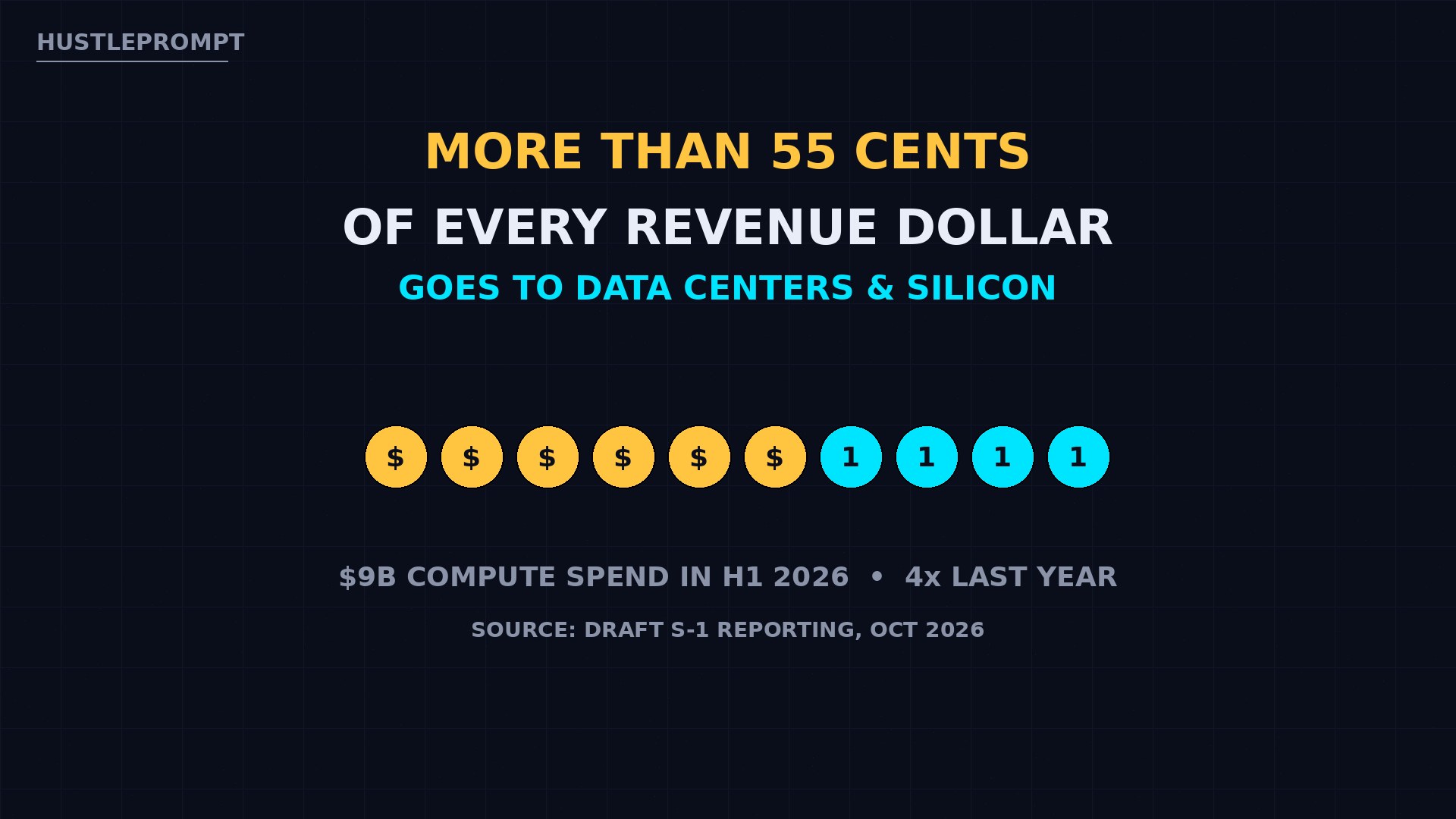
- $9 billion on compute and infrastructure in H1 2026 — more than all of 2025 ($7.3B) and nearly 4x H1 2025 ($2.3B).
- More than 55 cents of every revenue dollar goes to data centers and silicon, per the filing.
- The company says it was profitable on its own adjusted measure in Q2 and Q3 — a carefully chosen metric, but a signal nonetheless.
Where the $750 Billion Goes
This is the number that matters most for your money. Anthropic has signed roughly $450 billion in cloud deals over the next decade — and about 80% of that is non-cancellable, meaning the company owes the money whether it grows or not:
Anthropic’s $750B Compute Pipeline
→
→
→
→
$450B signed • ~80% non-cancellable • hyperscalers now seen as competitors, per the draft prospectus
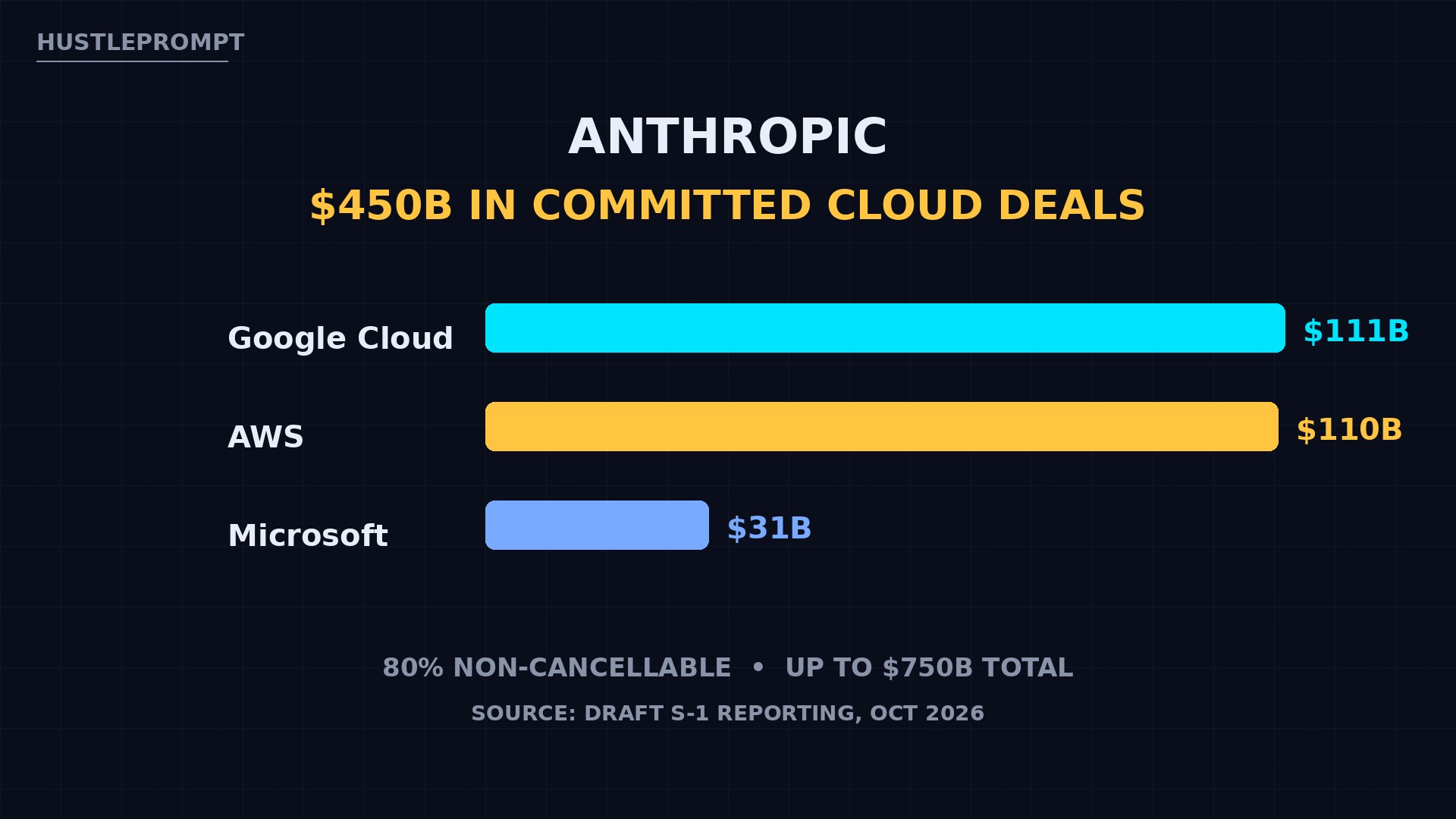
Here’s the twist the filing admits: Anthropic sought more capacity than the hyperscalers were willing to provide — and the cloud giants “increasingly see it as a competitor,” per the prospectus. So the company is turning to third-party data center developers, some of whom the filing admits have “limited operating history” and may run less reliable facilities.
Stat Highlights: What the Reporting Actually Says
A few numbers and quotes from the coverage that put the filing in context:
- “More than 55 cents of every revenue dollar” — the share of revenue Anthropic spends on data centers and silicon, per the draft prospectus reviewed by the Wall Street Journal.
- 20% of 2026 revenue comes from just 2 customers. Lose one, and the growth story cracks — a concentration risk most IPO investors will hate.
- ~80% of the $450 billion in commitments is non-cancellable. This is debt in everything but name.
- “Catastrophic incident” warning: the filing dedicates roughly a third of its pages to risk factors, warning that damages from a catastrophic AI-related incident could be so large the company “would be unable to obtain insurance to cover the potential damages.”
- Data center backlash is listed as a business risk — political resistance to new facilities is growing, and most of Anthropic’s capacity sits in the U.S.
- Up to $750 billion: with deals still being negotiated, total potential infrastructure spending could reach $750B, per the WSJ’s live market coverage.
What the AI Money Race Means for Your Money
Forget the $2 trillion valuation debate for a second. The filing is a business signal: the companies that win AI will be the ones that secure compute. Here’s how to act on it:
If you’re an investor
- Watch the picks-and-shovels, not just the miners. Anthropic’s $450B in non-cancellable commitments is guaranteed revenue for Google Cloud, AWS, Microsoft, and third-party data center developers — regardless of whether the IPO pops.
- Price the risk, not the hype. Customer concentration (2 customers = 20% of revenue) and uninsurable catastrophic risk are in the filing itself. If the IPO price assumes perfection, wait.
- Read the November S-1 final for the adjusted profitability claims — Q2 and Q3 “adjusted” profits need a footnote autopsy before you trust them.
If you build with AI
- Expect API pricing pressure. When 55 cents of every dollar goes to compute, providers must push volume or raise prices. Design your apps to be model-agnostic from day one.
- Lock in credits now. Buy discounted API credits and commit-tier pricing before demand (and prices) ratchet further.
- Benchmark cost per task, not per token. The winners of this compute war will be the builders who deliver results cheapest, not the ones using the flashiest model.
If you’re a freelancer or agency
- Sell “AI cost audits.” Businesses panicking about AI bills will pay for someone who can cut their token spend 30-50%. This filing is your sales deck.
- Learn multi-model routing. Clients need cheaper models for easy tasks and frontier models only where it counts — that’s a billable skill.
- Follow the data center money. Third-party developers building Anthropic’s overflow capacity need marketing, staffing, and local services. The land grab creates jobs beyond Silicon Valley.
FAQ
What did Anthropic’s draft S-1 filing reveal?
The filing, reported by the Wall Street Journal on October 20, 2026, shows $16.3 billion in H1 2026 revenue, an $80.7 billion net loss (mostly non-cash accounting charges), and roughly $450 billion in committed cloud deals — with total potential infrastructure spending up to $750 billion.
Why did Anthropic lose $80.7 billion in six months?
About $72 billion is non-cash: accounting charges from revaluing convertible notes as Anthropic’s private valuation rose to $965 billion in May. The underlying operating loss was roughly $8.7 billion — still larger than its entire 2025 operating loss.
What is the $750 billion AI spending number?
Anthropic has signed about $450 billion in cloud and data center commitments over the next decade (~80% non-cancellable). With additional deals still being negotiated, the company signaled total potential computing spend of up to $750 billion.
When is the Anthropic IPO?
The draft S-1 filing points to a planned November 2026 IPO at a roughly $2 trillion valuation, which would make it one of the largest public offerings in history.
Is Anthropic actually profitable?
Not on a GAAP basis. The company says it was profitable on its own adjusted measure in Q2 and Q3 of 2026 — an internally defined metric that excludes the big accounting charges. Treat that claim with caution until the final S-1 details the adjustments.
What does this mean for AI API prices?
Short term: pressure to raise prices or push volume, since compute eats 55+ cents of every revenue dollar. Long term: the $750B capacity buildout should eventually lower per-unit compute costs. Builders should design for multi-model flexibility now.