
What if the priciest step in your AI pipeline — where a frontier LLM reads messy documents and outputs structured data — got 49% cheaper and 3.2x faster overnight? On October 19, 2026, Cloudflare launched Clairic: it reads text, returns clean values, and writes zero output tokens. If you build or resell AI automations, pay attention.
Cloudflare Clairic is the first “System One extraction model”: send it text plus a map of typed fields, and it returns one value per field — in a single forward pass. No generated sentences, no token-by-token decoding. Just values (text, numbers, dates, durations, lists, estimates, forecasts) with confidence scores, plus “null” answers.
What Clairic Actually Is (And Why It’s Not Just Another LLM)
Borrowing from Kahneman’s Thinking, Fast and Slow: System One is fast and automatic, System Two is slow and deliberate — what LLMs do. Cloudflare’s bet: most structured-output calls ask predictable questions (totals, dates, delays, costs), so a model built only to return values wins on speed, cost, and auditability. It follows TypeSafe’s System One models and is the sibling of Clef, Cloudflare’s October-1 decision model. The name fuses [Cl]oudflare + [AI R]egression with “clerical clarity” and “clairvoyance.”
Per Cloudflare’s official Clairic announcement (Alex Reneau, Michelle Chen, Kevin Flansburg, October 19, 2026), the model:
- Extracts values stated in the input (names, order numbers, amounts).
- Computes values from input facts — e.g. a due date from an issue date plus “net 30”.
- Estimates values the input doesn’t fully determine (repair cost from a damage description).
- Forecasts series from data patterns.
The Evidence: 49% Cheaper, 3.2x Faster — With Receipts
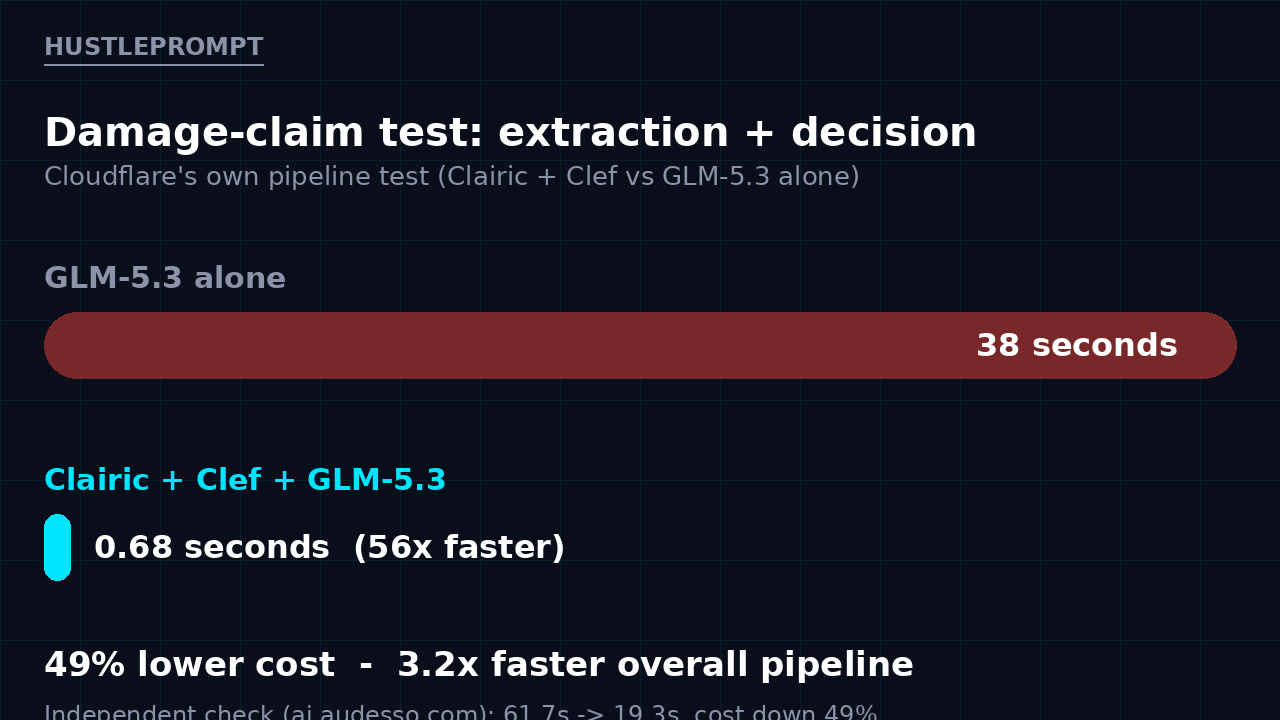
Cloudflare published the numbers: a claims pipeline using Clairic + Clef + GLM-5.3 cost 49% less and ran about 3.2x faster than GLM-5.3 alone. The standout: extraction plus the decision took 0.68 seconds versus 38 seconds. PPC Land’s breakdown of the 49% cost-cut test confirms the figures, and an independent benchmark (ai.audesso.com) measured 61.7s → 19.3s (69%) with cost down 49%.
Clairic specs at a glance
| Spec | Detail |
|---|---|
| Pricing | $0.10 / 1M input tokens — input billed only |
| Output tokens | None — no output price |
| Context window | 65,536 tokens |
| Per pass | 8,192 tokens of fields + input (overflow splits across parallel passes) |
| Images | Up to 4 embedded (PNG, JPEG, WebP — no remote URLs) |
| Availability | Preview on Workers AI: @cf/cloudflare/clairic |
| Open weights | “Soon” — no date; endpoint-only today |
How It Works: Code You Can Run Today
One function call from a Cloudflare Worker. The official example:
const facts = (await env.AI.run("@cf/cloudflare/clairic", {
  state: email,
  fields: {
    order_id:    { type: "text", instructions: "Order number" },
    amount_paid: { type: "number", decimals: 2, unit: "USD",
                   instructions: "Total paid including tax" },
    repair_cost: { type: "estimate", unit: "USD", min: 10, max: 5000,
                   instructions: "Cost to repair the damage" },
  },
})).answers;
You can also call it through the REST API. Every response carries confidence scores plus p_null — the odds the answer isn’t in the input — so weak fields go to human review. As this developer’s practical explainer of the API puts it: read the value, don’t guess it.
The Money Math: Why This Changes AI Economics
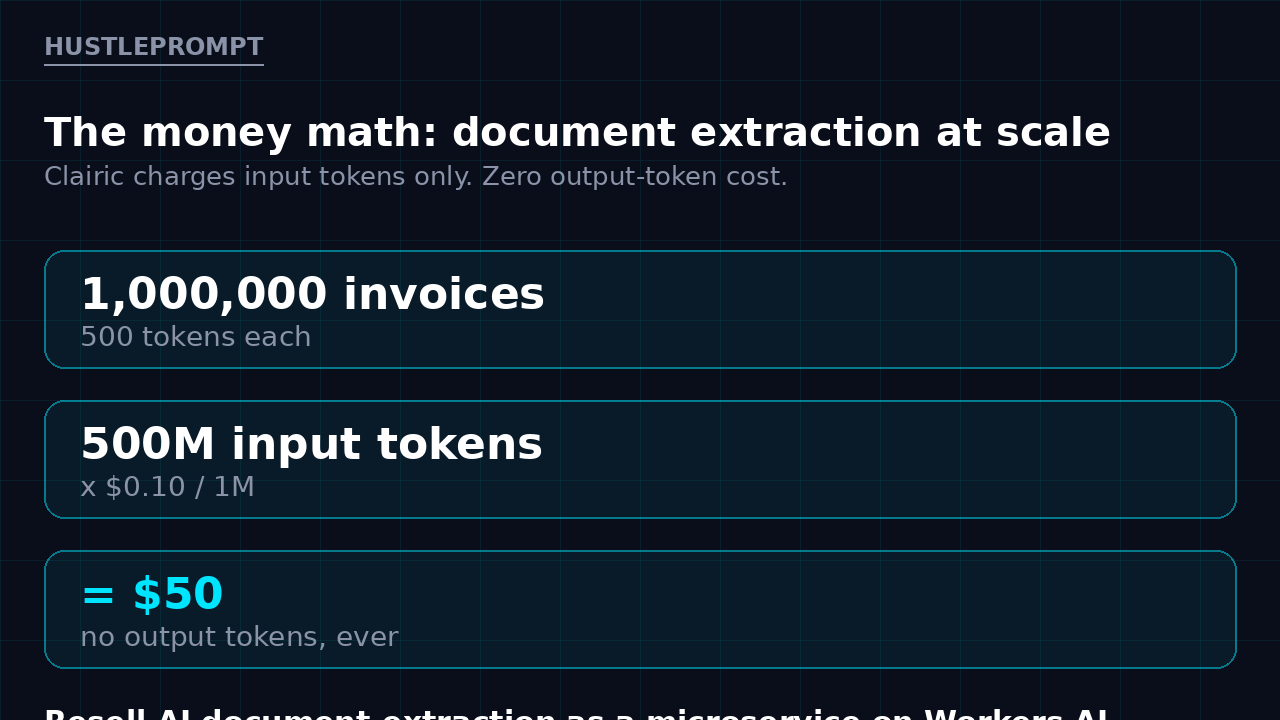
At $0.10 per million input tokens with zero output-token cost, extraction workloads — invoices, receipts, tickets, claim forms — become almost free:
How to profit: launch a document-extraction microservice in 4 steps
- Pick one painful document type. Invoices, receipts, damage-claim emails — messy, repetitive, everywhere.
- Define your field map. Vendor, invoice number, totals, due date — your fields are your product spec.
- Ship it on Workers AI. One Worker calling
@cf/cloudflare/clairicparses at ~$50 per million documents (~500 tokens each); route low-confidence values to review viap_null. - Resell the automation. Undercut legacy OCR-plus-LLM pricing and keep the margin.
The architectural play: route parsing to single-pass models, reserve frontier LLMs for reasoning. Every extraction call you move off a reasoning model is margin recovered.
The Honest Caveats
Clairic is a preview (“AS IS” / “AS AVAILABLE”) running only on Cloudflare’s endpoint — open weights intended “soon,” no date. Weak at multi-step arithmetic and calibration on unfamiliar data (do the math in code); forecasting is basic. Via Unite.AI’s report on the Clairic launch: well-formed answers are guaranteed, correct ones are not — use confidence scores and null answers to pick what to automate.
FAQ
What is Cloudflare Clairic?
Cloudflare’s first “System One extraction model” (Oct 19, 2026). Send text plus typed fields; get one value per field in a single pass — no generated text, no output tokens.
How much does Clairic cost?
$0.10 per million input tokens, input only. no output-token price exists.
How fast is Clairic vs a regular LLM?
In Cloudflare’s damage-claim test, extraction + decision took 0.68s with Clairic + Clef vs 38s with GLM-5.3 alone — 49% cheaper, ~3.2x faster overall.
How do I use Clairic?
From a Worker: env.AI.run("@cf/cloudflare/clairic", { state, fields }), or via REST API. Returns typed answers with confidence scores.
Is Clairic open source?
Not yet — open weights are intended “soon” (no date); today it runs only on Cloudflare’s endpoint.
What are Clairic’s limitations?
Preview: weak at multi-step arithmetic and calibration on unfamiliar data, basic forecasting, “AS IS.” Well-formed ≠ correct — use confidence scores and p_null to route uncertain fields to review.