
Devin Bots give the AI software engineer something it never had: a manager. Cognition launched them on November 17, 2026. A Devin Bot is a persistent agent with its own memory and tools that owns a goal end to end and leads teams of Devin coding agents to deliver it — for days or weeks, while you answer only the decisions that need a human.
Until now, working with a coding agent meant delegating specific tasks. The agent wrote the code, but you stayed responsible for the project: noticing the next problem, choosing an approach, writing the task, checking the result and deciding what comes next. A Bot takes on that coordination job. You give it a responsibility — “keep Android at parity with iOS” — instead of a ticket, and it figures out how to get there.
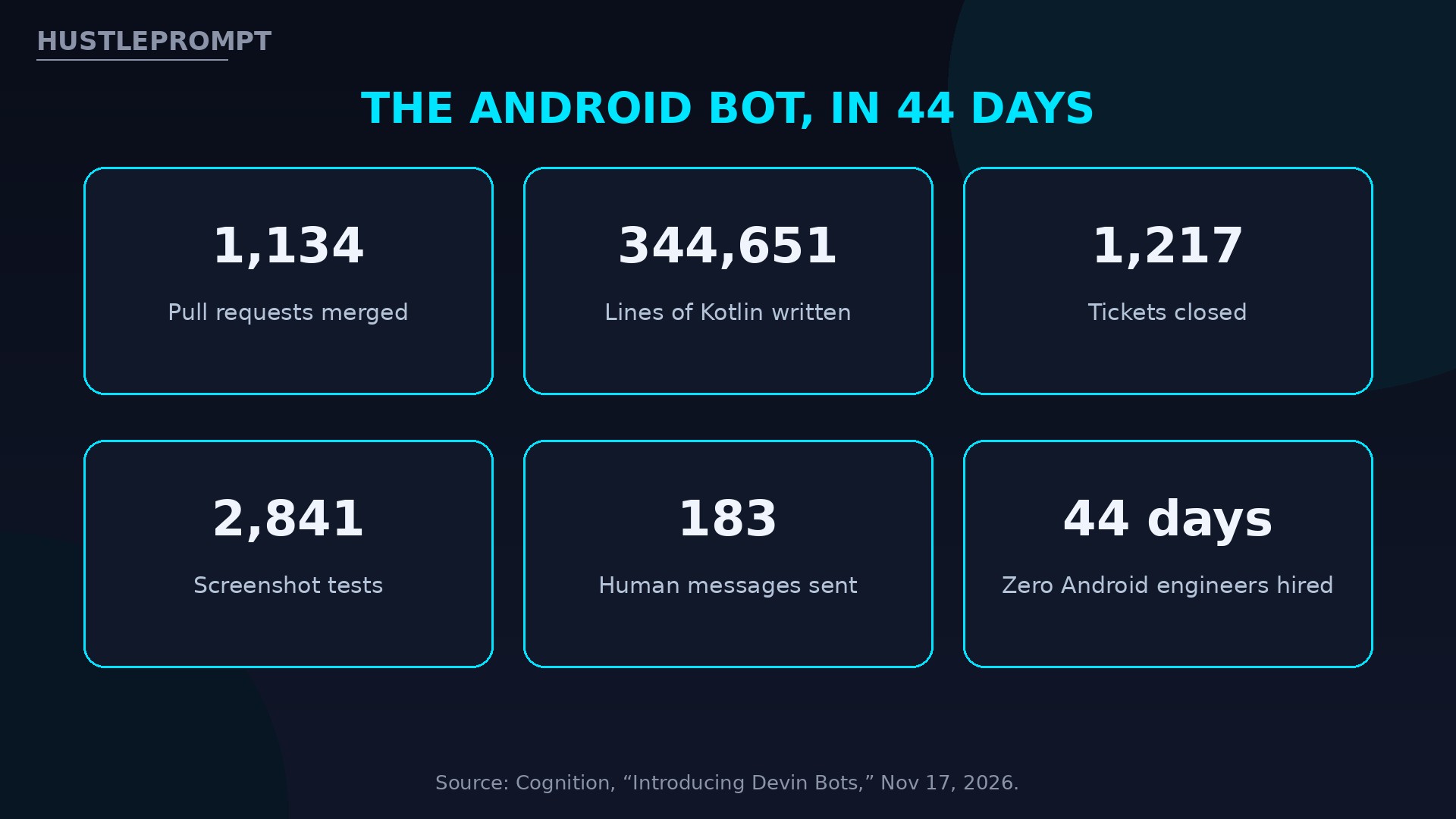
The proof is Cognition’s own dogfood. One Bot built Devin’s entire Android app in 44 days: 1,134 pull requests merged, 344,651 lines of Kotlin written and 1,217 tickets closed, from just 183 human messages. A one-person game studio now ships a release every week with about 20 Bots. This is what Devin Bots are, what they actually did, what they cost — and how a freelancer or small team can profit from them.
What a Devin Bot actually does
A coding agent can finish every task you give it while still leaving you responsible for moving the project forward. Someone has to identify the next problem, investigate possible solutions and check whether the changes actually helped. Cognition built Devin Bots to take on that responsibility.
A Bot investigates, delegates work to teams of Devin sessions running in parallel, evaluates the results and decides what to pursue next. It retains context across sessions, so it does not need to be re-briefed every morning. It brings you only the decisions that need your judgment — and those land in a Needs You inbox, instead of interrupting you all day.
| A task to complete | A responsibility to own |
|---|---|
| Port this feature to Android. | Keep Android at parity with iOS. |
| Fix the layout shift. | Keep the web app smooth as it changes. |
| Fix this onboarding error. | Get new users through setup successfully. |
A task describes the change you want. A responsibility describes the outcome and leaves the Bot to figure out how to achieve it. A Bot can also find work you would never have assigned — an agent that owns the goal watches everything that affects it, including the parts nobody is looking at.
The Android Bot: 44 days, 1,134 PRs, 183 messages
The headline case study is the one Cognition ran on itself. Devin had an iOS app and a team of iOS engineers behind it. It had no Android engineers and no plan for Android. On September 28, 2026, Samyok, an engineer on the Bots team, created “Android Bot” and sent it one message: its job was to product-manage the Android app — to autonomously create the entire thing, starting by figuring out the blockers.
“Your job is to product manage the android app. Basically, you’re going to autonomously create the entire thing, but we need to figure out what the blockers are for you doing that first.”
— Samyok’s first message to the Android Bot, September 28, 2026, quoted by Cognition
44 days later, Devin had an Android app. The Bot surfaced blockers first — where the code would live, how to test an Android build, how changes would merge — then filed tickets, started a Devin session for each one, and merged the pull requests that passed CI and Devin Review. Each day it posted a report in Slack with a screen recording of what had changed.
| Android Bot, 44 days | Result |
|---|---|
| Pull requests merged | 1,134 |
| Lines of Kotlin written | 344,651 |
| Screenshot tests | 2,841 |
| Tickets closed | 1,217 |
| Human messages from Samyok | 183 — about 1 for every 6 PRs merged; on 22 of the 44 days he sent none |
| Where the app is now | In open testing on Google Play; the Bot owns development end to end and updates it whenever iOS changes |
The message count is the number that matters most. Most of Samyok’s 183 messages addressed something the Bot needed a human decision on, like a pull request that needed a security review. Others simply encouraged it or set direction, like “be more ambitious.” That is roughly one human message per six merged pull requests — and 22 silent days. The Bot did not just write code fast. It decided what to build next, mostly alone.
Two more Bots, already working at Cognition
The Android app was not a one-off demo. Cognition put Bots on two more ongoing responsibilities, and both show what “owning a goal” looks like in practice.
The Layout Bot owns keeping the Devin web app from jumping. The app loads page parts through separate requests, and late content can shift elements on screen — hard to catch in review, because it depends on timing and connection speed. Every three hours, the Layout Bot builds the production version of the latest code and simulates first visits, repeat visits and delayed loads. When a check fails, it reruns it to rule out timing noise, traces the regression to the pull request that introduced it, and opens a fix with before-and-after recordings. In three weeks it merged 159 pull requests and cut lag by 70%. One evening it traced a new shift to a PR merged two hours earlier and was already fixing it before anyone asked — answering, when asked who requested the fix: “Nobody asked. My scheduled layout check flagged main’s tall grey block on first visit.”
The game studio Bot team is the most extreme case. Cognition colleague Jenny Xu runs a mobile game studio as its only human employee, with about 20 Bots — each owning one job end to end: development, Unity, releases, UI, iOS, Android, testing on real devices and more. Above them sits the Super Jenny Bot, the only one she talks to. Four times a day, Super Jenny collects the decisions the other Bots need into one Slack thread, and she answers with emoji. The studio went from about 50 pull requests a week to 1,900, and ships a release every week.
Early customers report the same pattern at smaller scale. Bilt’s Bots merged about 1,600 pull requests in one week. A Fireworks AI engineer says Bots “tripled my productivity overnight.” Reducto’s CTO calls it “by far the most effective persistent agent I’ve used,” and Decagon says using a Bot “feels like having my own technical lead.” These are customer quotes selected by Cognition, not independent measurements — but they all point the same way: the value is continuity, not speed.
Watch: Cognition introduces Devin, the first AI software engineer, on its official YouTube channel.
GOAL → BOT → TEAM → DECISION
1. GOAL
Give the Bot a responsibility and define what success means — tests, benchmarks, user flows, production behavior.
2. BOT
The persistent manager keeps memory across sessions, investigates, and decides what to pursue next.
3. TEAM
It delegates to teams of Devin sessions in parallel, each in its own session, and evaluates the results.
4. DECISION
Only the calls that need you land in the Needs You inbox, on Slack, iMessage or in the Devin app.
What Devin Bots cost: no separate price published
Here is the honest gap in the launch: Cognition has not published separate pricing for Devin Bots. The announcement says Bots are available today at devin.ai/bots and that they run on Devin — but it states no per-Bot price, no plan tier and no usage rate.
What is published is the company around the product. Fortune reports Cognition was valued at $48 billion after a $2 billion funding round in September 2026, and passed a $1 billion annualized revenue run rate that same month. Bot usage among early customers — Decagon, Fireworks AI and Reducto — grew tenfold in two weeks, according to the company. And Citigroup’s CEO said on the bank’s October 13 earnings call that Devin is used by 14,000 engineers at Citi, with a 30% year-over-year vendor-spend reduction. Treat the valuation and revenue figures as Fortune-reported, and the usage and Citi figures as company-reported — impressive, but not independently audited.
How to profit from Devin Bots: 5 moves
Bots are built for teams that already ship software. For a freelancer or a small dev shop, that is the opening: sell the ongoing ownership that clients can never staff, not another one-off build.
- Sell a maintained app, not a built app. Offer a monthly retainer: “I keep your Android app at parity with iOS, forever.” The Android Bot case is your sales deck — 44 days from zero to a shipped app, then owned end to end. You are the human who answers the Needs You inbox; the Bot does the grinding.
- Offer overnight QA and incident triage. A Layout Bot that checks production every three hours and opens fixes with before-and-after recordings is a service small SaaS teams cannot hire for. Sell it as a weekly report plus fixes, priced per app.
- Take the maintenance clients hate paying for. Open-source maintenance, release management, dependency updates, regression fixes — the work that loses priority between urgent projects. A Bot keeps it moving without an engineer reconstructing context every time.
- Start with one responsibility, measured. Give your first Bot a narrow scope with clear success criteria: tests green, CI passing, a named metric. Cognition’s own guidance is that engineers must build the feedback — tests, benchmarks, user flows, production behavior — and define what the Bot may change and when spending or releases need approval.
- Price the judgment, not the keystrokes. Your billable value is deciding what is worth owning, setting the bar and building the systems that measure it. The code is the cheap part now. Charge for the outcome and the review, and let the Bot absorb the volume.

What to watch before you trust it
Three honest limits belong in any article about Devin Bots, because the announcement leaves them open.
- No independent quality data. 1,134 merged pull requests is a volume number, not a quality number. Cognition does not publish defect rates, revert rates or review time for Bot-written code. Volume without quality data is a claim, not a proof.
- Humans still own the hard calls. The Android Bot came back for security reviews and tricky merges, and Cognition says engineers define what a Bot may access, change and spend. The “self-driving” framing has a human steering wheel — budget for your own review time.
- Availability and pricing are unclear. Bots are available at devin.ai/bots, but Cognition has not said what a Bot costs or whether access is open to everyone or still limited to early customers. Confirm both before you build a business on them.
The competitive context is moving fast. OpenAI shipped Dots, its always-on agent inside Codex, around September 29, 2026, and Anthropic shipped Duet, tied to Claude Code, in the weeks before the Bots launch. Cognition’s counterargument is focus: Dots and Duet are general-purpose agents that happen to handle code, while Devin Bots are built around a coding agent from the ground up. The next year will show whether focus beats generality.
What to watch next
- Bot pricing. The first published price list will decide who can actually use Bots — indie developers or only funded teams. Until then, every business case is an estimate.
- Quality metrics. The first independent look at revert rates and bug counts in Bot-merged code will matter more than the next PR total.
- The 1,900-PRs-a-week studio. If Jenny Xu’s game studio keeps shipping weekly releases with one human, the model is proven at small scale. If it quietly adds humans, the limit is found.
The bottom line: Devin Bots do not sell you a faster coder. They sell you a manager that never sleeps, never forgets context and only bothers you when a decision genuinely needs you — as long as you keep the judgment, the review and the pricing honest.
Frequently asked questions
What are Devin Bots?
Devin Bots, launched by Cognition on November 17, 2026, are persistent AI manager agents. Each Bot has its own memory and tools, owns a goal or responsibility end to end, and leads teams of Devin coding agents in parallel — investigating problems, delegating work, evaluating results and deciding what to pursue next. They are available at devin.ai/bots.
How much do Devin Bots cost?
Cognition has not published separate pricing for Devin Bots. The launch announcement states no per-Bot price or plan tier. Do not trust third-party price claims that do not come from Cognition. Until official pricing appears, budget for Devin usage and confirm the cost directly with Cognition.
What did the Android Bot actually build?
In 44 days, from September 28, 2026, the Android Bot built Devin’s Android app from scratch: 1,134 pull requests merged, 344,651 lines of Kotlin written, 2,841 screenshot tests and 1,217 tickets closed, from 183 human messages. The app is now in open testing on Google Play, and the Bot keeps it at parity with the iOS app.
How do I talk to a Devin Bot?
On Slack, iMessage or right in the Devin app. Bots share reports and test recordings proactively, use memory to adapt to how you prefer to review their work, and send decisions that need your input to the Needs You inbox. You can open individual Devin sessions any time to dig into a specific workstream.
What is the difference between Devin and a Devin Bot?
Devin is the coding agent that completes tasks — write the code, fix the bug, open the pull request. A Devin Bot is the manager above it: a persistent agent that owns a responsibility, breaks it into pieces, hands those pieces to teams of Devin sessions, and keeps the work moving for days or weeks. You give Devin a task; you give a Bot a goal.
Who is already using Devin Bots?
Early customers named by Cognition include Decagon, Fireworks AI and Reducto, plus Bilt and OpenRouter. Cognition says Bot usage among early customers grew tenfold in two weeks. Citigroup uses the original Devin with 14,000 engineers, according to its CEO on the October 13 earnings call.
Are Devin Bots better than OpenAI Dots or Anthropic Duet?
They solve a different-shaped problem. Dots and Duet are always-on, general-purpose agents that handle code among other work. Devin Bots are built around a coding agent from the ground up and coordinate Devin instances specifically. There are no published head-to-head benchmarks yet.
Keep Reading
Sources: Cognition, “Introducing Devin Bots: from tasks to outcomes” (Nov 17, 2026); Devin Bots product page; AI Weekly on the Fortune report (Nov 18, 2026).