
Until today, the DeepSeek API gave you a brain and left you to build the body. If you wanted your app to search the web, read a PDF, open a link, or talk out loud, you wired up a search engine, a file parser, a scraper, and a voice service yourself — then fed the results back to the model. On November 13, 2026, DeepSeek deleted that whole job. Its API change log announces the full suite of application APIs: the same web search, file input, URL reading, voice interaction, and safety checks that power the DeepSeek app are now switches inside the API, running on the deepseek-flash model.
The timing is deliberate. DeepSeek spent October opening pieces of this — an in-house search API on October 17, then the V4.1-Flash-1017 model upgrade the same day — and charging for search and fetch from November 1 at $0.75 per 1,000 calls. Today it puts the pieces together: one model call can now search, read, and speak, with DeepSeek handling the tool calls and the context assembly on its own servers. For anyone selling AI apps, the moat just moved. The hard part is no longer building a chatbot that can search — it is finding a customer whose problem is worth solving.
DeepSeek’s full app API, at a glance
| Announced | November 13, 2026, in the DeepSeek API change log |
| Model | deepseek-flash (DeepSeek-V4.1-Flash-1017), 1M-token context, 384K max output |
| Works through | Messages, Responses, and Chat Completions APIs — enable a parameter, no new endpoint to learn |
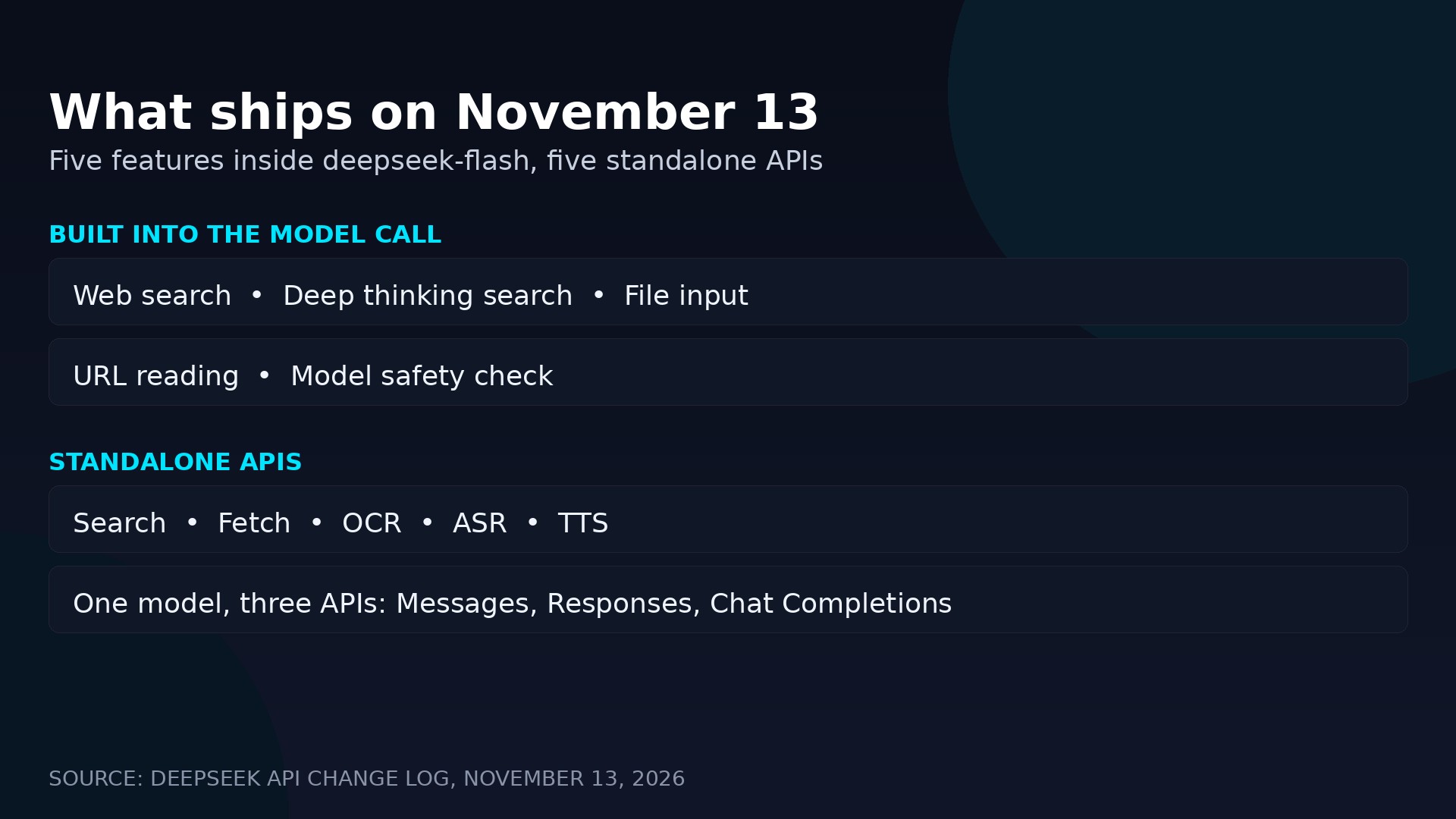
| Built-in features | Web search, deep thinking search, file input, URL reading, model safety |
| Standalone APIs | Search, Fetch, OCR, ASR (speech to text), TTS (text to speech) |
| Starter kit | Open-source demo chat client that can import your DeepSeek chat history |
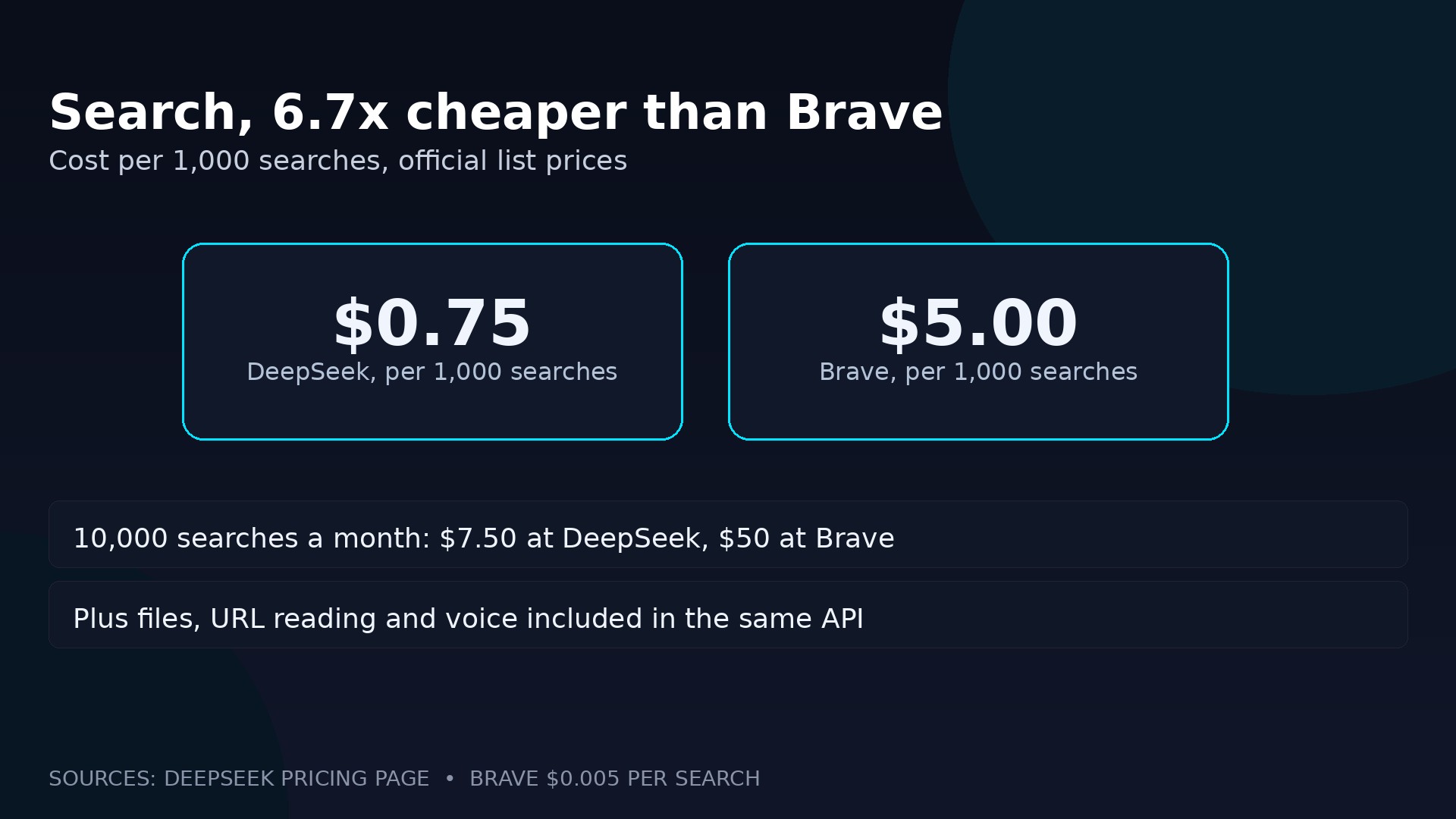
| Search price | $0.75 per 1,000 searches — 6.7x cheaper than Brave’s $5 per 1,000 |
Source: DeepSeek API Docs — Change Log, November 13, 2026 and DeepSeek API Docs — Models & Pricing.
What you can switch on
Five features now live inside the model call, each turned on with a parameter. None of them needs a second vendor:
- Web search. With thinking off and the
deepseek_web_searchtool on, the model runs web or image searches as the question requires and answers with citations. Your app stops hallucinating prices and dates it never looked up. - Deep thinking search. With thinking on and the same tool enabled, the model searches the web and reads links on its own over multiple reasoning steps — the research-assistant pattern, without you writing the loop.
- File input. Users upload PDFs, Office files, and images. DeepSeek extracts plain text or parses the rich layout, then adds it to the conversation context so the model answers from the document, not from memory.
- URL reading. With the
deepseek_read_urltool on, the model spots links in the user message, fetches the pages, and answers with them in context. Paste a link, get an answer grounded in that page. - Model safety. With the safety check parameter on, DeepSeek reviews model input and output and returns a refusal marker when it finds a risk. Public-facing services are told to enable it — and the docs name the obligations that come with it, including content safety review, large model registration, and AI labeling.
Behind those switches sit five standalone APIs for builders who want direct control instead of letting the model drive: Search, Fetch, OCR, ASR, and TTS. Search returns results for your own retrieval and ranking. Fetch pulls and parses a specific URL. OCR turns images of text — a scanned receipt, a photo of a whiteboard — into machine-readable text. ASR converts recorded speech into words. TTS reads answers aloud. The split is the point: let the model orchestrate when speed matters, call the pieces directly when control matters.
The price list
Cheap is DeepSeek’s brand, and this release keeps it. Token prices for deepseek-flash are $0.30 per million input tokens at peak and $0.15 off-peak on a cache miss, $0.006 peak and $0.003 off-peak on a cache hit, and $1.20 peak and $0.60 off-peak per million output tokens. Off-peak is half of peak, and peak hours are narrow — 01:00 to 04:00 and 06:00 to 10:00 UTC, Monday through Friday, excluding Chinese public holidays. Everything else, including weekends, is off-peak. Run your batch jobs on Saturday and you pay half price by the clock alone.
What each piece costs (official DeepSeek pricing)
| Input tokens, cache miss | $0.30 / 1M peak, $0.15 / 1M off-peak |
| Input tokens, cache hit | $0.006 / 1M peak, $0.003 / 1M off-peak |
| Output tokens | $1.20 / 1M peak, $0.60 / 1M off-peak |
| Web search | $0.75 per 1,000 searches |
| Web fetch | $0.75 per 1,000 fetches |
| File parsing and OCR | $0.225 per 1,000 pages |
| Text to speech | $0.45 per 10,000 characters list, $0.225 limited-time (50% off) |
| Speech to text | $0.116 per hour of audio list, $0.058 limited-time (50% off) |
Source: DeepSeek API Docs — Models & Pricing, read November 13, 2026. DeepSeek notes prices may change and recommends checking the page before budgeting.
Put the numbers next to the competition and the gap is blunt. Brave charges $0.005 per search — $5 per 1,000 — for the same job DeepSeek sells at $0.75 per 1,000. That is 6.7 times cheaper per search, before you count that DeepSeek needs no second vendor for files or voice. A support bot doing 10,000 searches a month pays $7.50 for search at DeepSeek against $50 at Brave. A research tool parsing 1,000 document pages pays $0.225. These are per-use prices, not subscriptions, so a side project with ten users costs almost nothing — and a product with ten thousand users still has a bill you can forecast to the cent.

How to profit: sell the chatbot DeepSeek just made easy
Every time a model vendor absorbs a hard integration, a service business opens underneath it. This release is that moment for document-grounded chatbots. Here is the play, step by step:
- Pick a niche with documents. Real estate agents with listing PDFs, accountants with tax forms, clinics with intake paperwork, contractors with spec sheets. The niche matters more than the tech now — the tech is a parameter.
- Build one demo on the open-source starter. DeepSeek open-sourced a demo chat client on these APIs that imports chat history. Fork it, load a prospect’s own documents, and show them their files answering questions in their own words. The demo does the selling.
- Charge a setup fee plus a monthly retainer. A realistic package: $500 to $1,500 to set up, then $99 to $299 a month for hosting, updates, and monitoring. Your cost per client stays tiny — at these prices, even a chatty client burns a few dollars a month in tokens and searches.
- Schedule the heavy work off-peak. Bulk document ingestion and overnight report generation run outside the 01:00–04:00 and 06:00–10:00 UTC peak windows, cutting token costs in half. Tell the client the system is “optimized for cost” — because it literally is, by the clock.
- Turn on the safety check and say so. Public-facing services must enable it, and the compliance duties behind it — content review, registration, labeling — are a selling point, not a burden. Clients pay for handled compliance.
The arithmetic is what makes this a business instead of a hobby. A client paying $199 a month while your DeepSeek bill runs $8 to $15 leaves a margin no SaaS subscription can touch — because you are reselling pennies of compute as a finished workflow. The risk is the same as with any vendor-priced input: DeepSeek can change prices, and it says so on the pricing page. Price your retainer with room to absorb a move, and re-check the pricing page monthly.
The honest limits
Three things to keep straight before you build on this:
- Safety is a requirement, not a feature. If your service faces the public, DeepSeek says to enable the safety check and meet obligations such as content safety review, large model registration, and AI labeling. Budget the compliance work into your setup fee.
- The benchmarks are DeepSeek’s own. For the V4.1-Flash-1017 model behind deepseek-flash, DeepSeek reports HLE 42.6, Terminal-Bench 4.0 at 42.3, and DeepSWE v1.1 at 77.0. Those are vendor-reported scores from its October 17 changelog entry, not independent tests. Test the model on your client’s actual documents before you promise accuracy.
- Prices are official — and movable. The token and tool prices above come from DeepSeek’s own pricing page, and DeepSeek says the V4.1-Flash-1017 upgrade left API pricing unchanged. Ignore third-party marketplace prices quoted as DeepSeek prices: aggregators recently showed a much higher figure that traces to OpenRouter, not to DeepSeek’s list. Quote the list, link the page, re-check it monthly.
From a user question to a cited answer
Flow per the DeepSeek API change log, November 13, 2026.
Frequently asked questions
What did DeepSeek announce on November 13, 2026?
DeepSeek opened the full suite of application APIs. The web search, file input, URL reading, voice interaction, and safety checks from the DeepSeek app are now available to developers through the API, powered by the deepseek-flash model across the Messages, Responses, and Chat Completions APIs.
What is deepseek-flash?
It is the API name for DeepSeek-V4.1-Flash-1017, the current Flash model. It has a 1-million-token context window, a 384,000-token maximum output, and supports thinking and non-thinking modes. Older model names still route to it at the Flash price.
How much does DeepSeek search cost?
$0.75 per 1,000 searches, and the same $0.75 per 1,000 web fetches, whether you call the standalone APIs or the model uses them through its tools. File parsing and OCR cost $0.225 per 1,000 pages.
Do I still need an API key?
Yes. Unlike Brave’s x402 search proxy, which takes a crypto payment instead of a credential, DeepSeek’s API still uses API keys and a topped-up balance. Fees are deducted from your balance, granted balance first.
What are the standalone Search, Fetch, OCR, ASR, and TTS APIs for?
They let you call each capability directly instead of letting the model drive it. Use them when you need control over retrieval, ranking, or media processing — for example, building your own search pipeline or transcribing audio without a chat model in the loop.
Is the safety check optional?
Technically it is a parameter you enable. In practice, DeepSeek says public-facing services should enable it and meet the duties behind it, including content safety review, large model registration, and AI labeling. Treat it as required for anything customers touch.
How cheap is deepseek-flash, really?
Off-peak, $0.15 per million input tokens on a cache miss and $0.60 per million output tokens — half the peak rates. Peak hours are 01:00–04:00 and 06:00–10:00 UTC on weekdays. Cache hits cost almost nothing: $0.003 per million input tokens off-peak. Weekends are off-peak all day.
Keep Reading
- DeepSeek Opens $0.75 Search API: 6.7x Cheaper Than Brave — The search tool alone, priced in October. Now it comes with files, voice, and safety attached.
- Brave Lets AI Agents Pay for Search With Crypto — The other way agents buy search: half a cent per query, no account, paid in crypto.
- DeepSeek V4 Pro Lands on AWS SageMaker JumpStart — The bigger sibling, deepseek-v4-pro, now runs on AWS — for workloads Flash cannot carry.
Sources: DeepSeek — API Change Log, November 13, 2026; DeepSeek — Models & Pricing; Crypto Briefing — DeepSeek opens its full app toolkit to developers through its API (November 13, 2026). Benchmark figures are DeepSeek’s own, from its October 17, 2026 changelog entry. The price comparison with Brave uses Brave’s published $0.005-per-search rate.