
AMD just threw its hardest punch yet at Nvidia’s grip on AI chips. On November 12, 2026, AMD announced the Instinct MI450X, a new data-center GPU with 288 GB of HBM4 memory — and, in the same breath, published test results claiming its flagship MI455X beats Nvidia’s latest Vera Rubin platform by up to 30% on AI inference. The market noticed instantly: AMD shares rose 5.38% on Thursday after the announcement. For anyone building or buying AI infrastructure, the message is that the two-horse race for inference — the work of actually running AI models, which now eats most of the world’s AI computing — finally has a challenger with numbers.
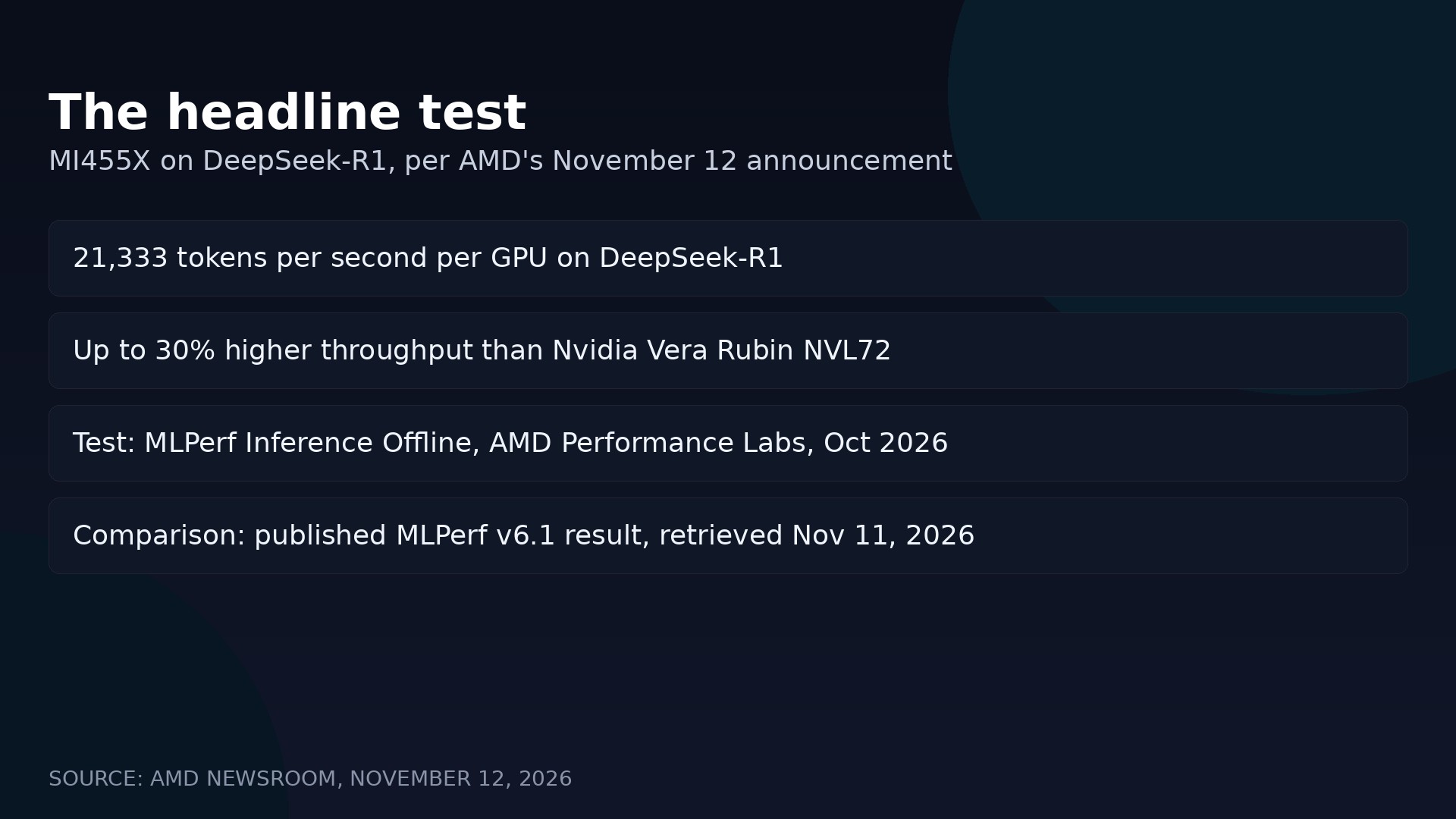
The headline number is 21,333 tokens per second per GPU. That is what AMD says the MI455X, running inside its Helios rack system, processed on DeepSeek-R1, the popular open model, in an MLPerf Inference Offline configuration. AMD’s claim is that this is up to 30% higher throughput than the latest published MLPerf result for Nvidia’s Vera Rubin NVL72. Read that sentence carefully, because the qualifiers matter as much as the number — and this article will take them apart before it tells you what to do with them.
AMD’s MI400 update, at a glance
| Announced | November 12, 2026, on the AMD newsroom |
| New chip | Instinct MI450X — 288 GB HBM4 per GPU, for Helios racks |
| Headline test | MI455X: 21,333 tokens/sec per GPU on DeepSeek-R1 (MLPerf Inference Offline) |
| The claim | Up to 30% higher throughput than Nvidia Vera Rubin NVL72’s published MLPerf v6.1 result |
| Helios edge | Up to 20% higher HBM bandwidth and higher scale-up bandwidth than Vera Rubin (AMD calculations) |
| Market reaction | AMD shares up 5.38% on Thursday, November 12 |
| Price / ship date | None announced for MI450X |
Source: AMD Newsroom — AMD Advances the Instinct MI400 Series for AI, November 12, 2026.
What AMD actually announced
The announcement has two parts, and they solve different problems. The first is the benchmark. AMD’s labs ran the MI455X on DeepSeek-R1 in October 2026 and recorded 21,333 tokens per second per GPU. The comparison point is the published MLPerf Inference v6.1 result for Nvidia’s Vera Rubin NVL72 in the Closed Division, retrieved from MLCommons on November 11, 2026. Same benchmark family, same model — and, AMD says, up to 30% more throughput. AMD also credits the Helios rack itself: up to 20% higher HBM bandwidth and higher scale-up bandwidth than Vera Rubin, by AMD’s November 2026 calculations.
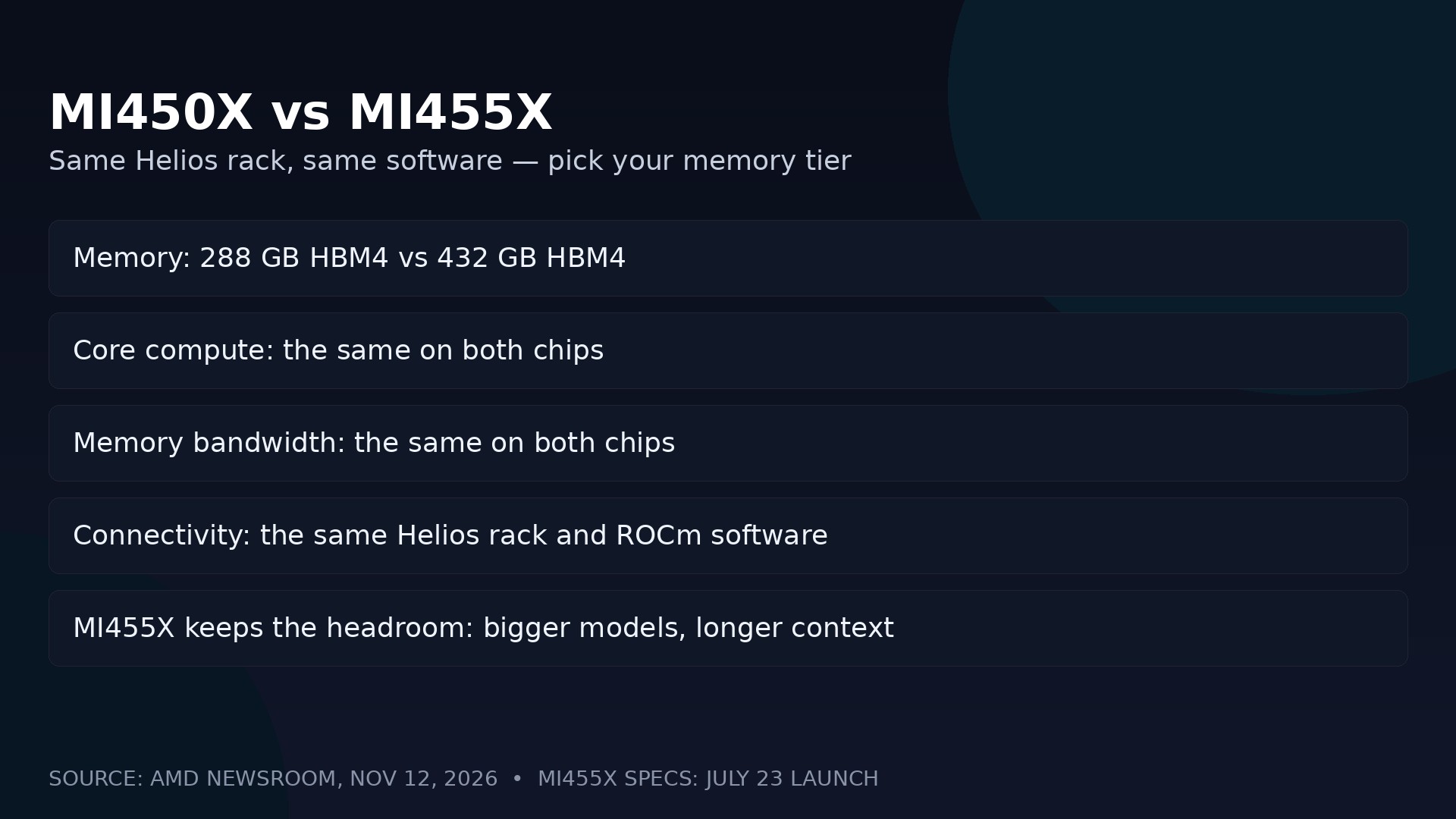
The second part is the more practical one. The MI450X is a second GPU option for the same Helios racks, with 288 GB of HBM4 memory per GPU and — in AMD’s words — the same core compute, memory bandwidth, and scale-up and scale-out connectivity as the MI455X. The MI455X keeps the memory headroom for larger models, longer contexts, or heavier concurrency; the MI450X exists for customers whose workloads do not need the biggest memory configuration. Both run on the same open rack-scale architecture and the same ROCm software foundation, so a customer picks memory capacity the way you pick a storage tier — without re-platforming.
MI450X vs MI455X: the choice in one table
Helios is AMD’s rack-scale system: dozens of GPUs linked in a single rack, built to run very large AI models. Until now, the MI455X was the GPU at its heart. Here is how the two options compare:
MI450X vs MI455X
| Memory | 288 GB HBM4 | 432 GB HBM4 (July launch spec) |
| Core compute | Same as MI455X | Up to 40 PFLOPS FP4, 20 PFLOPS FP8 (July launch spec) |
| Memory bandwidth | Same as MI455X | Up to 23.3 TB/s (July launch spec) |
| Connectivity | Same scale-up and scale-out as MI455X | Helios rack-scale, 72 GPUs per rack |
| Best for | Workloads that do not need maximum memory | Larger models, longer contexts, higher concurrency |
| Price / availability | Not announced | Launched July 23, 2026; volume deployments expected in the second half of 2026 |
Sources: AMD Newsroom, November 12, 2026; MI455X launch specs per AMD’s July 23, 2026 launch coverage.
Notice what is missing from that table: a price for either chip, and a ship date for the MI450X. AMD sells these GPUs inside Helios systems to cloud providers and enterprises, not on store shelves, so list prices rarely appear — but the absence still matters. You cannot buy a MI450X today, and no one outside AMD can independently verify the 30% figure until systems reach customers.
How to profit: three ways this announcement pays
Most readers will never touch a Helios rack. The money in this story sits one level up, in what cheaper inference does to everyone else’s costs:
- The stock already moved — watch the follow-through. AMD shares rose 5.38% on the day of the announcement. The trade now is not the announcement, it is the confirmation: Nvidia reports earnings on November 17, and its numbers and guidance are the rebuttal. If Nvidia’s data-center growth still dwarfs AMD’s, the 30% claim gets priced as marketing. If Nvidia guides soft, AMD’s claim gets priced as a real share shift.
- Cheaper inference means cheaper AI products. Inference is now roughly two-thirds of all AI computing, per Deloitte, and every token your app serves has a hardware cost behind it. A 30% throughput gain per GPU, if it holds, pushes token prices down — which is margin for anyone selling chatbots, agents, or AI search. Builders should re-price their unit economics every time a chip like this lands, because their competitors will.
- Sell the migration, not the chip. Cloud buyers now have a credible second source for inference racks, and second sources create consulting work: benchmarking a workload on MI400 vs Vera Rubin, re-tuning models for ROCm, and re-architecting deployments across vendors. The skill that pays here is honest measurement — the same skill this article applies to AMD’s own claim.

The honest limits
The 30% figure is the part of this announcement that will travel furthest, so it deserves the closest look:
- AMD tested it, not MLPerf. The test was conducted by AMD Performance Labs in October 2026, in an AMD-tested MLPerf Inference Offline configuration. It is not an independent MLPerf-certified AMD submission, and it is not a head-to-head run of both systems on identical terms. The comparison is legitimate in one sense — same benchmark family, same model — but AMD’s own footnote says results may vary by model, configuration, software, and other factors.
- One model, one configuration. The claim covers DeepSeek-R1 inference in the Offline configuration. It says nothing about training, about other models, or about the interactive serving pattern most apps actually use. A chip can win Offline and lose everywhere else.
- No price, no date. AMD announced no price and no ship date for the MI450X, and the MI455X’s volume deployments are still ramping through the second half of 2026. A benchmark lead you cannot buy is a press release, not a product advantage — yet.
- Nvidia answers on November 17. The incumbent’s earnings land five days after this announcement, and Nvidia’s data-center numbers will frame whether AMD’s claim reads as a turning point or a footnote. Treat this story as the opening of an argument, not its conclusion.
How AMD’s 30% claim was measured
Method per the AMD newsroom footnotes, November 12, 2026.
Frequently asked questions
What is the AMD Instinct MI450X?
A new data-center GPU in AMD’s Instinct MI400 Series, announced November 12, 2026. It offers 288 GB of HBM4 memory per GPU with the same core compute, memory bandwidth, and connectivity as the flagship MI455X, giving Helios rack customers a lower-memory option for workloads that do not need the maximum configuration.
How fast is the MI455X, really?
AMD says 21,333 tokens per second per GPU on DeepSeek-R1 in an MLPerf Inference Offline configuration — up to 30% higher throughput than the published MLPerf v6.1 result for Nvidia’s Vera Rubin NVL72. The test was run by AMD Performance Labs, not independently, so treat it as a vendor claim until independent results appear.
What is Helios?
AMD’s rack-scale AI system: 72 MI455X or MI450X GPUs, EPYC CPUs, and networking in a single rack, designed to run very large AI models. It is AMD’s answer to Nvidia’s NVL72 racks, and both chips share the same Helios architecture and ROCm software foundation.
How much does the MI450X cost, and when can I buy one?
AMD announced no price and no ship date. These GPUs sell inside Helios systems to cloud providers and enterprises, not to consumers, and the MI455X’s volume deployments are still ramping through the second half of 2026.
Why did AMD shares rise on the announcement?
AMD stock rose 5.38% on Thursday, November 12, after the announcement. Investors read the MI455X benchmark and the new MI450X option as evidence AMD can compete with Nvidia on inference — the largest and fastest-growing slice of AI computing — rather than only on price.
Does this mean AMD beats Nvidia?
Not yet. One vendor-tested benchmark on one model is a claim, not a verdict. Nvidia reports earnings on November 17, and independent MLPerf results plus real customer deployments will decide whether the 30% lead is real, and whether it matters outside the Offline configuration.
Keep Reading
- Nvidia, AMD, Google, Meta Back Open-Source AI Inference — The same companies just joined forces on open inference software. AMD’s chip is the hardware side of that story.
- Azure Leads DeepSeek-R1 Speed in MLPerf v6.1 — The same benchmark, the same model — and the result AMD is now measuring itself against.
- Jensen Huang Resigns as Nvidia CEO — Nvidia’s leadership changed this week too. AMD’s challenge lands while its rival is in transition.
Sources: AMD Newsroom — AMD Advances the Instinct MI400 Series for AI (November 12, 2026); Longbridge — AMD Stock Soars over 5% After Introducing a New AI Data Center GPU (November 12, 2026); DaySec — AMD Adds MI450X to Helios, Reports New MI455X Inference Results (November 13, 2026). MI455X launch specs are AMD’s July 23, 2026 figures. The 30% comparison is AMD’s own test, and the article states that wherever the figure appears.