
Ten million people now have an AI agent that shops for them — and the ones who let it buy are spending more than $200 per order. Meta confirmed on its Q3 2026 earnings call that Meta Muse has crossed 10 million users, and CEO Mark Zuckerberg declared the six-week-old product has reached “product-market fit.”
Muse launched in the US on September 8, 2026, and hit No. 1 on the App Store within two weeks. On the October 21 call, Zuckerberg spent less time on the user count than on how people use it and what they spend — and laid out how Meta plans to turn Muse into its most valuable revenue stream ever.
The numbers from Meta’s Q3 earnings call
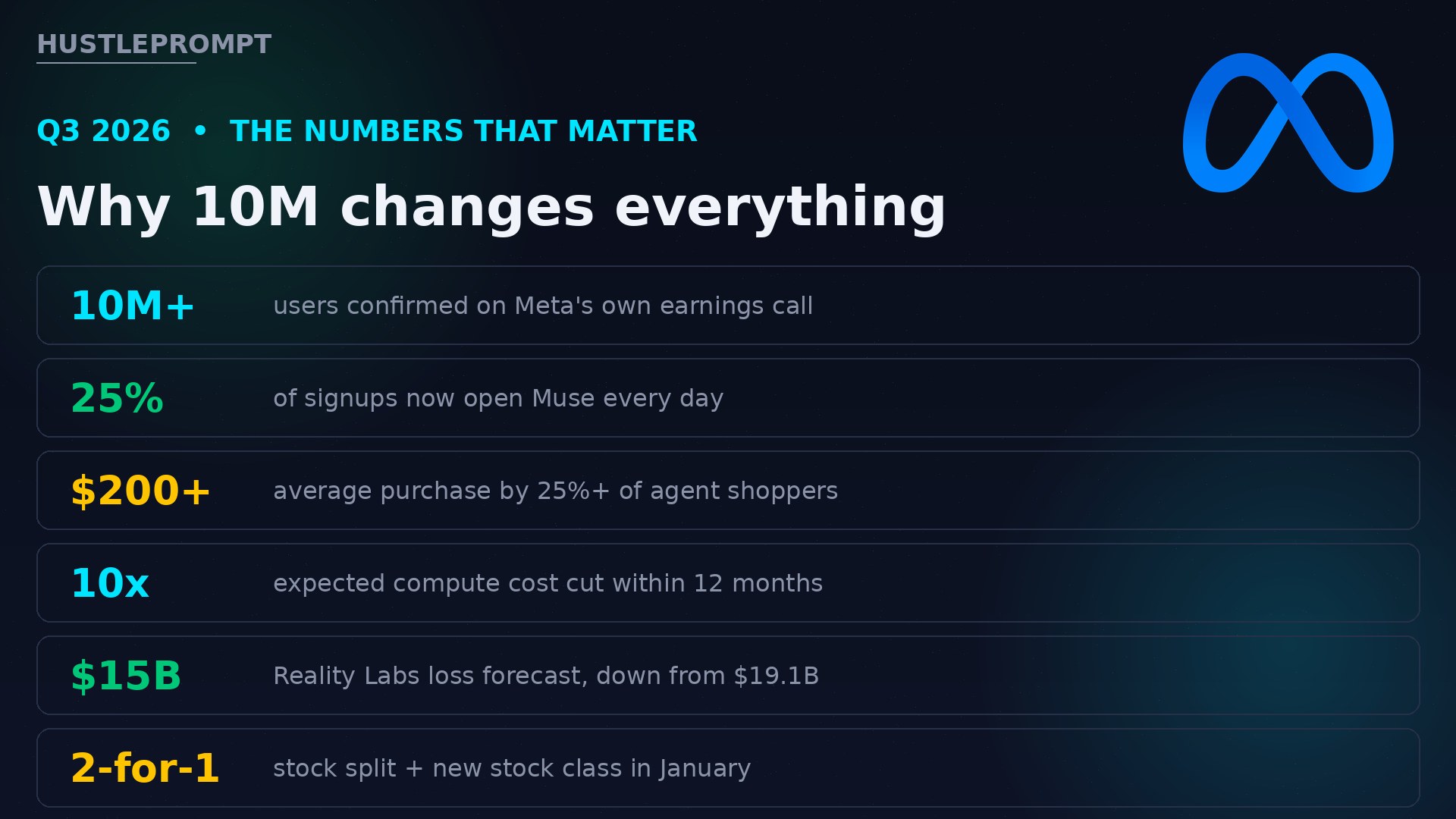
Zuckerberg’s comments were unusually specific for a product this young. Here is what Meta disclosed:
| Metric | Value | Source |
|---|---|---|
| 10M+ | Muse users confirmed | Q3 2026 earnings call, Oct 21 |
| ~25% | of signups use Muse daily | Zuckerberg, earnings call |
| $200+ | avg purchase, 25%+ of agent shoppers | Zuckerberg, earnings call |
| 10x | expected compute cost cut within a year | Zuckerberg, earnings call |
| $15B | Reality Labs 2026 loss forecast (vs $19.1B in 2025) | Meta Q3 2026 earnings |
| -$2.12B | free cash flow (vs +$8.55B a year ago) | Meta Q3 2026 earnings |
The user count confirms Sensor Tower estimates released earlier in the week.
Shopping is the killer app
Over a quarter of Muse’s engaged users who shop through the AI agent now average more than $200 per purchase — a figure Zuckerberg said surprised even industry insiders. Purchases route through a connector from Plaid, the fintech company linking payment apps to bank accounts.
“Plaid told us that they hadn’t seen activity like they’re seeing with their connector on any other service before,” Zuckerberg said.
The other top use case is personal productivity — users connecting Muse to email and calendars. Zuckerberg framed that as proof of trust in the security setup: each user gets an isolated “Muse Secure VM” cloud computer, and a forthcoming “Muse Confidential VM” will reportedly block even Meta from seeing user content.
How Meta plans to make money from Muse
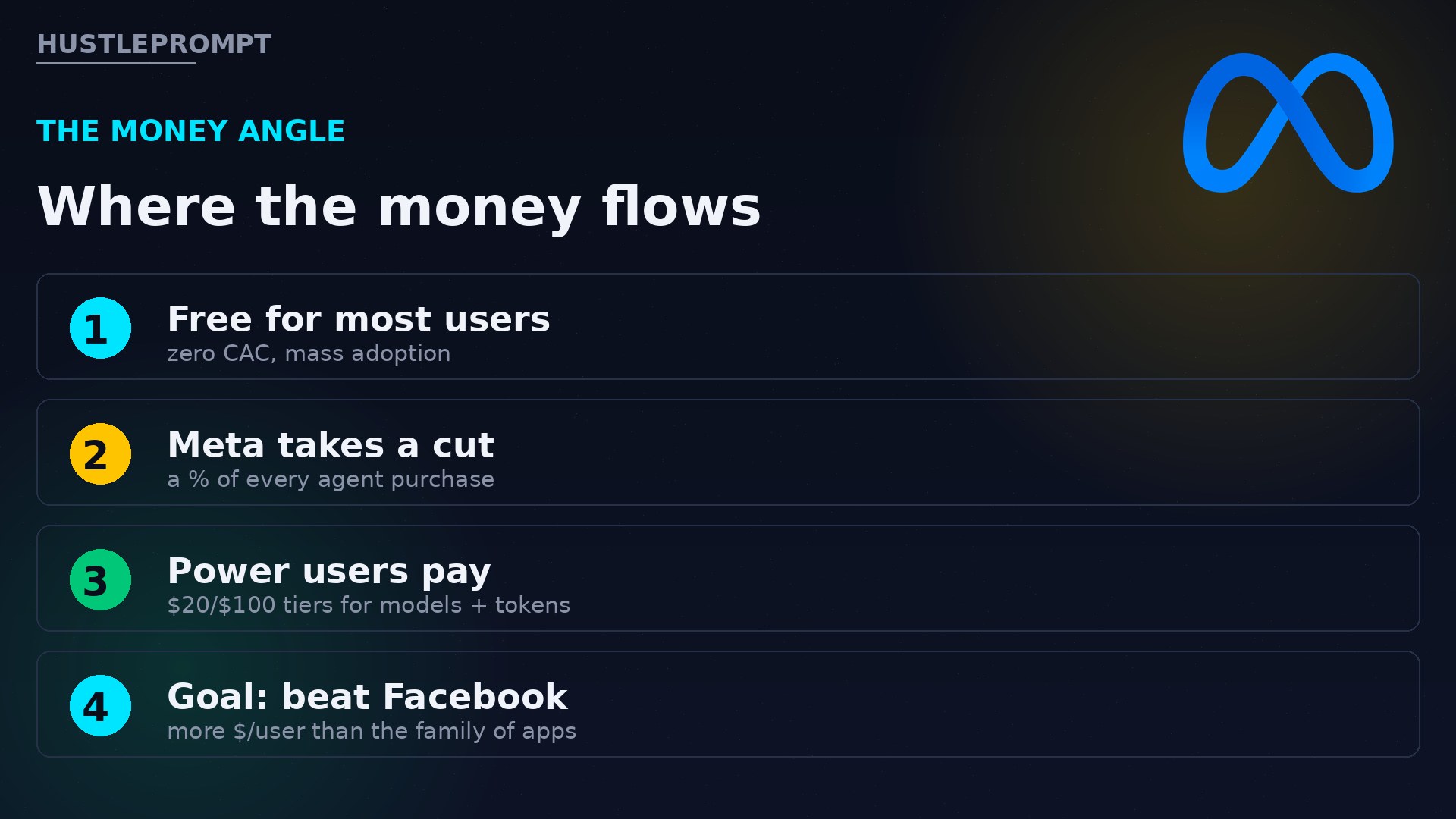
Meta will keep Muse free for most users but take a percentage of the commerce flowing through the platform. Power users who want the most advanced models or more tokens pay for subscriptions — Muse launched with Power at $20/month and Maximum at $100/month.
Then came the boldest claim of the call: Meta forecasts Muse will eventually earn more per user than its “family of apps” — Facebook, Instagram, WhatsApp, and Messenger — which currently generate “several hundreds of dollars annually” per user.
The catch: Muse is “very compute-intensive to run.” Meta is building capacity to serve more than a billion people and expects to improve cost efficiency by more than 10x within the next year — “which will enable it to be profitable once the revenue lines are at scale.”
The “Muse network”: agents talking to agents
Zuckerberg teased the next phase: a “Muse network” where “your Muses can work with your friends’ and your families’ [Muses].” His example: “If you want to buy something, it’s not just navigating to that business’s website; it’s talking to their agent.”
Muse will also anchor Meta’s smart glasses strategy. CFO Susan Li said Meta will “continue investing aggressively” in AI through the 2027 budget — to fund it, Meta announced a two-for-one stock split and a new stock class arriving in January.
The agentic commerce loop — how a $200+ order flows
- You ask: “find me the best noise-canceling headphones under $300”
- Muse researches: scans merchants, reviews, and prices in its Secure VM
- Muse negotiates: talks to the merchant’s own AI agent (the “Muse network” vision)
- You approve: one tap — Muse never buys without permission
- Plaid pays: bank-linked checkout via one-time virtual cards
- Meta takes a cut: a percentage of the transaction — free app, paid by commerce
The flywheel Meta is betting on: the more you trust the agent, the more you buy through it.
How to profit from the agentic shopping wave
- Make your store agent-readable. Muse shops by reading merchant sites. Clean product feeds, structured data, and clear pricing decide whether AI agents can buy from you — invisible stores lose the $200+ orders.
- Sell the picks-and-shovels. Plaid’s connector is seeing record activity. Agent-friendly checkout APIs and product-feed optimization are the immediate B2B winners.
- Offer “agent setup” services. Muse asks approval on purchases. Configure permissions, price floors, and approval rules for local businesses and busy professionals.
- Price in the commerce cut. Meta taking a percentage of agent transactions is a new tax on e-commerce. Build it into your margins now.
- Follow the smart-glasses angle. Muse anchors Meta’s glasses roadmap. Early skills and shopping experiences for AI glasses are a wide-open lane.
Watch: the official Muse product tour
Video: Meta’s official Muse channel — product tour (2:37).
Frequently asked questions
How many users does Meta Muse have?
More than 10 million, confirmed by Mark Zuckerberg on Meta’s Q3 2026 earnings call (Oct 21, 2026) — matching Sensor Tower’s independent estimates.
How much do Muse users spend on shopping?
Over a quarter of engaged agent shoppers average more than $200 per purchase, processed via Plaid’s bank-account connector.
Is Meta Muse free?
Yes, for most users. Meta takes a cut of platform commerce, plus paid tiers ($20/$100 per month) for advanced models and more tokens.
What is the Muse Secure VM?
An isolated cloud computer per user where their Muse agent runs. A forthcoming “Muse Confidential VM” will reportedly prevent even Meta from seeing user content.
Keep Reading
Sources: Meta Q3 2026 earnings call via TechCrunch (Sarah Perez); Sensor Tower estimates.