
ElevenLabs buys Kotoba to own Japanese voice AI. On November 16, 2026, the voice AI company announced it is acquiring Kotoba, the Tokyo lab behind the Koto voice model, in a deal Nikkei Asia reports at more than $100 million. The companies themselves disclosed no price. What they did disclose is the reason: Japan is the world’s fourth-largest economy, and its language breaks voice models built for English.
Kotoba’s Koto already handles Japanese text-to-speech, speech-to-text, and speech-to-speech for simultaneous interpretation. And it is not a lab demo: Salesforce already uses Koto for Japanese-language conversations in Agentforce Voice. ElevenLabs is buying a team, a model, and a customer that proves the model works in production.
This is what ElevenLabs actually announced, what the reported price means, why Japanese is the hardest test in voice AI, and how a small builder can turn the deal into paid work.
What ElevenLabs announced on November 16
Both companies published announcement posts on November 16, 2026, and Kotoba confirmed the deal in a Japanese release on November 17. ElevenLabs is acquiring Kotoba Technologies, founded in July 2023 by AI researchers Noriyuki Kojima and Jungo Kasai. The deal is expected to close later in the fourth quarter of 2026, subject to customary regulatory approvals and closing conditions.
Two facts from the Japanese release matter for the size of the deal. Fifteen employees transfer to ElevenLabs, and this is ElevenLabs’ first acquisition in Japan. A 15-person team at a reported price above $100 million is not a headcount buy. It is a research buy: ElevenLabs is paying for people who solved a problem it has not solved itself.
ElevenLabs’ own post states the goal plainly. “To bring the value of AI to every person, it needs to be natural and intuitive to interact with,” said Mati Staniszewski, co-founder and CEO of ElevenLabs. “The language people speak and the social norms they follow need to be reflected in the technology’s architecture from the very start. Kotoba has done exactly that for Japan.”

The deal in numbers. Sources: ElevenLabs blog (Nov 16, 2026); Nikkei Asia (reported price); Kotoba PR Times release (Nov 17, 2026).
The deal at a glance
| Item | Detail |
|---|---|
| Buyer | ElevenLabs — voice AI company, founded 2022, valued at $22 billion (Sep 2026) |
| Target | Kotoba Technologies — Japanese voice AI lab, founded July 2023, Tokyo and San Francisco |
| Reported price | More than $100 million (Nikkei Asia; the companies disclosed no price) |
| Structure | ElevenLabs buys all of Kotoba’s shares; wholly owned subsidiary (Nikkei Asia) |
| Team | 15 employees transfer to ElevenLabs (Kotoba PR Times release) |
| First | ElevenLabs’ first acquisition in Japan (PR Times) |
| Expected close | Later in Q4 2026, subject to regulatory approvals |
| Flagship product | Koto — Japanese text-to-speech, speech-to-text, and speech-to-speech |
Sources: ElevenLabs — Kotoba is joining ElevenLabs (Nov 16, 2026); Kotoba — Kotoba Is Joining ElevenLabs (Nov 16, 2026). Price reported by Nikkei Asia; not confirmed by either company.
Read the structure carefully. A 100%-share purchase with a named closing window is a clean acquisition, not a partnership dressed up as one. The open question is integration: neither post says how Koto folds into ElevenLabs’ ElevenAgents platform, or when Japanese voice agents built on Koto ship inside it.
Why Japanese breaks English-first voice models
ElevenLabs’ post spends more time on Japanese social norms than on the deal terms. That is the point. Voice AI fails in Japan for reasons that have nothing to do with audio quality.
- Sentences drop the subject and the object. A model trained on English expects both. Japanese often supplies neither, and the meaning lives in context.
- Vocabulary changes with the listener. Who you are speaking to changes the words you use. One register does not fit every conversation.
- Apologies carry little liability. They are common, and a model that treats every apology as an admission misunderstands the speaker.
- Pauses signal thought, not awkwardness. A voice agent that jumps in to fill silence interrupts the conversation it is supposed to serve.
- Praise is deflected, and “no” is avoided. A model that takes polite deflection literally will misread agreement, refusal, and satisfaction alike.
- Kuki o yomu — “reading the air.” People are expected to pick up what is not said. That is the hardest requirement in the list, and the one no English-first model was built for.
The two founders are the reason ElevenLabs believes Kotoba cracked it. Kojima holds a PhD in computer science from Cornell, worked as a research scientist at Hugging Face, and co-built Japan’s Fugaku-LLM, an open-source model trained from scratch on the RIKEN Fugaku supercomputer. Kasai holds a PhD in computer science and engineering from the University of Washington, was an assistant professor at Toyota Technological Institute at the University of Chicago, and is one of Japan’s most-cited researchers.
“Kotoba’s team has done exceptional research on the Japanese language,” said Piotr Dabkowski, co-founder and CTO of ElevenLabs. “It is an incredibly intricate language that poses a whole range of technical challenges when building voice models. Bringing their research together with ours will improve Japanese across the entire stack ElevenLabs builds.”
1 • FOUNDED
July 2023 — Kojima and Kasai found Kotoba to build a frontier AI lab from Japan.
2 • FUNDED
$23 million raised in total, including a $10 million round led by Kindred Ventures.
3 • ANNOUNCED
November 16, 2026 — ElevenLabs announces it is acquiring Kotoba; Nikkei reports over $100 million.
4 • CLOSE
Later in Q4 2026 — expected close, subject to regulatory approvals and closing conditions.
Three years from founding to a nine-figure exit — the timeline of a research team that solved a local problem the giants had not.
Sources: ElevenLabs and Kotoba blogs (Nov 16, 2026); Nikkei Asia (reported price).
What Koto actually does
Koto is not one model doing one job. It covers the full voice stack in Japanese: text-to-speech, speech-to-text, and speech-to-speech for simultaneous interpretation. Kotoba’s models also cover Korean and Chinese, and run on servers or on devices.
The proof point ElevenLabs leads with is Salesforce. Koto powers Japanese-language conversations in Agentforce Voice, Salesforce’s voice agent product. That is an enterprise deployment, not a benchmark: real customers, real conversations, in a language where a wrong register can end a business relationship.
Kotoba’s technology also reaches beyond call centers. Its interpretation work supports artists such as YOASOBI, and the company ships a simultaneous interpretation app called Kotoba. ElevenLabs says it plans to build out local sales leaders and keep investing in infrastructure in Japan — the commercial follow-through after the research deal.
“Voice is emerging as a powerful new interface for AI, with potential to transform how people interact with technology,” said Nowi Kallen, a partner at Salesforce Ventures, which backed both companies. “We’ve been proud to back both ElevenLabs and Kotoba, and together, they’re uniquely positioned to bring more natural, intuitive AI experiences to businesses and consumers worldwide.”
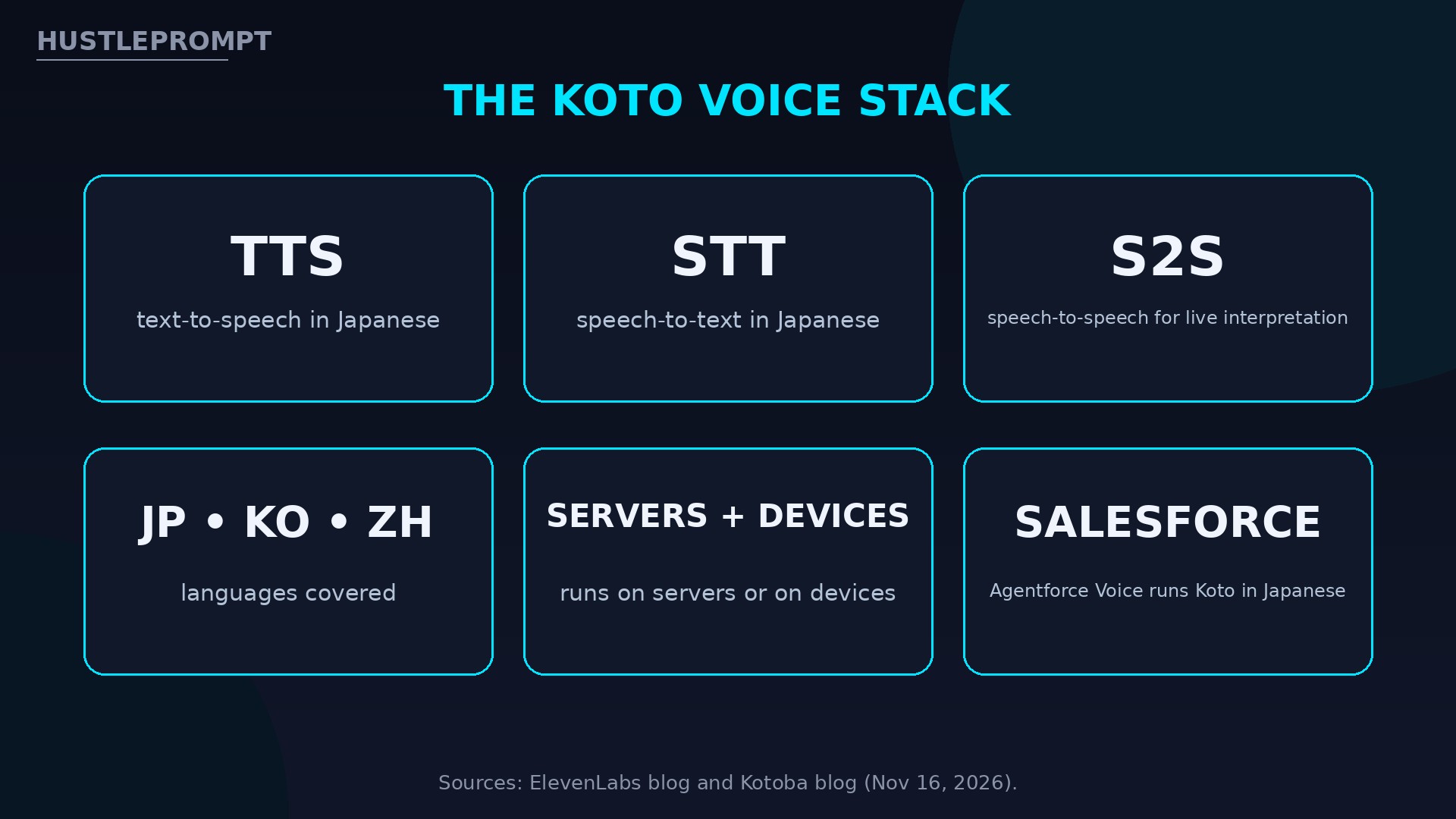
The Koto stack. Sources: ElevenLabs blog and Kotoba blog (Nov 16, 2026).
The money behind the deal
Voice AI is consolidating fast, and this deal shows what the consolidators are paying for: native-language research teams, not headcount.
| Number | Figure | What it means |
|---|---|---|
| Reported price | More than $100 million | Nikkei Asia’s report; neither company confirmed a price |
| Kotoba total raised | $23 million | Including a $10 million round in June led by Kindred Ventures, with Salesforce Ventures and Sony Innovation Fund |
| Price vs. money raised | More than 4x | The reported price is over four times everything Kotoba raised — arithmetic on the reported figures |
| ElevenLabs valuation | $22 billion | September 2026, on enterprise demand for conversational agents |
| Team joining | 15 people | The whole Kotoba team transfers, per its PR Times release |
| Earlier funding | $11.83 million seed | June 2025 round led by Globis Capital Partners (reported) |
Sources: ElevenLabs blog (Nov 16, 2026); Nikkei Asia via MLQ and Dealroom (reported price); Kotoba funding via MLQ and WOWTALE (reported).
The ratio is the story. A team of 15 that raised $23 million is reportedly selling for more than $100 million — over four times its total funding — because it owns the Japanese voice stack outright. ElevenLabs, valued at $22 billion in September on enterprise demand for conversational agents, is buying the one capability its platform could not credibly claim: voice AI that understands Japan.
The timing fits a pattern. ElevenLabs set up a Japanese subsidiary in 2025 and has been building distribution and enterprise partnerships in the market. The acquisition turns that beachhead into a research base: “a frontier AI research lab from Japan,” in Kojima’s words, now inside a $22 billion company.
How to profit: sell Japanese voice agents
The deal hands small builders a market map. Japanese voice AI is now a funded priority inside the biggest voice company in the world — and the customers are already named.
- Sell interpretation first. Meetings, events, and customer support are Koto’s proven jobs. Offer real-time interpretation for companies doing business with Japan, and let the model — not a phrasebook — carry the conversation.
- Target exporters and tourism. Nikkei’s own angle is that the deal could speed the overseas spread of Japanese content such as anime. Sell voice localization to game studios, media companies, and tourism operators with Japanese customers.
- Bundle with Salesforce. Koto already runs inside Agentforce Voice. If you implement Salesforce for clients, add Japanese voice agents as a paid add-on — the reference customer is built in.
- Price per minute of conversation, not per seat. Voice agents are consumed in minutes. Quote a per-minute or per-conversation price and show the client the math against a human interpreter’s hourly rate.
- Sell the etiquette layer, not the transcript. Kuki o yomu is the product insight: a voice agent that reads the room is worth more than one that transcribes it. Make cultural fit the headline of every proposal.
The wedge is narrow and real. You do not need to build a voice model. You need one Japanese-speaking client, one workflow Koto already handles, and a price that undercuts a human interpreter by an order of magnitude.
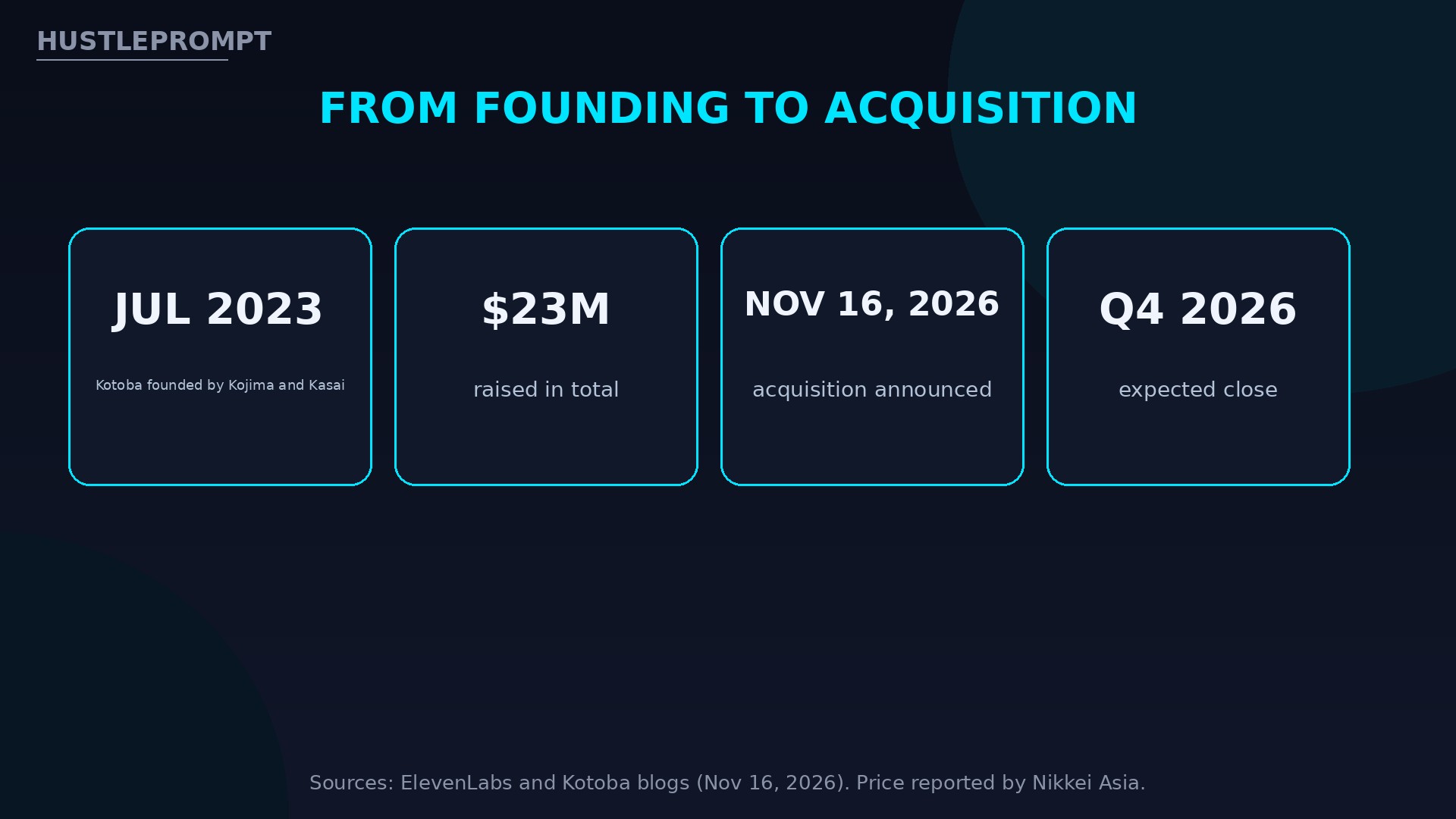
From founding to acquisition in just over three years. Sources: ElevenLabs and Kotoba blogs.
What is still missing
Four gaps are worth naming before anyone treats the reported price as fact.
First, the price is unconfirmed. Only Nikkei Asia reports more than $100 million. Neither company disclosed terms, and no filing confirms the figure. Treat it as reported until a disclosure says otherwise.
Second, there are no integration details. Neither post says how Koto folds into ElevenAgents, when Japanese voice agents built on Koto ship inside ElevenLabs’ platform, or what happens to Kotoba’s standalone products.
Third, the deal has not closed. It is expected to close later in Q4 2026, subject to customary regulatory approvals and closing conditions. Until then, it is an agreement, not a completed acquisition.
Fourth, there is no official launch video yet. No video on ElevenLabs’ official YouTube channel covers this acquisition. When one appears, it belongs in this article — until then, the two companies’ posts are the source.
Frequently asked questions
What did ElevenLabs announce on November 16, 2026?
ElevenLabs announced it is acquiring Kotoba Technologies, the Japanese voice AI lab behind the Koto model. Kotoba confirmed the deal the same day on its own blog. Closing is expected later in Q4 2026, subject to regulatory approvals.
How much is ElevenLabs paying for Kotoba?
The companies disclosed no price. Nikkei Asia reported more than $100 million, with ElevenLabs buying all of Kotoba’s shares and making it a wholly owned subsidiary. Treat the figure as reported, not confirmed.
What is Koto?
Koto is Kotoba’s voice model family. It handles Japanese text-to-speech, speech-to-text, and speech-to-speech for simultaneous interpretation, and also covers Korean and Chinese. It runs on servers or on devices.
Who uses Koto today?
Salesforce uses Koto for Japanese-language conversations in Agentforce Voice. Kotoba’s interpretation technology also supports artists such as YOASOBI, and the company ships a simultaneous interpretation app called Kotoba.
Who founded Kotoba?
Noriyuki Kojima and Jungo Kasai founded Kotoba in July 2023. Kojima holds a PhD from Cornell and worked at Hugging Face; Kasai holds a PhD from the University of Washington and was an assistant professor at Toyota Technological Institute at the University of Chicago.
When does the ElevenLabs-Kotoba deal close?
Later in the fourth quarter of 2026, subject to customary regulatory approvals and closing conditions, according to both companies’ announcement posts.
What does this mean for voice AI builders?
Japanese, Korean, and Chinese voice agents get a native research stack inside ElevenLabs, the voice company valued at $22 billion in September 2026. Builders can sell interpretation, localization, and Agentforce Voice work on top of it — without building a voice model themselves.
Keep Reading
Sources: ElevenLabs — Kotoba is joining ElevenLabs (Nov 16, 2026); Kotoba — Kotoba Is Joining ElevenLabs (Nov 16, 2026); Nikkei Asia reporting on the price, via MLQ and Dealroom (Nov 16–17, 2026).