
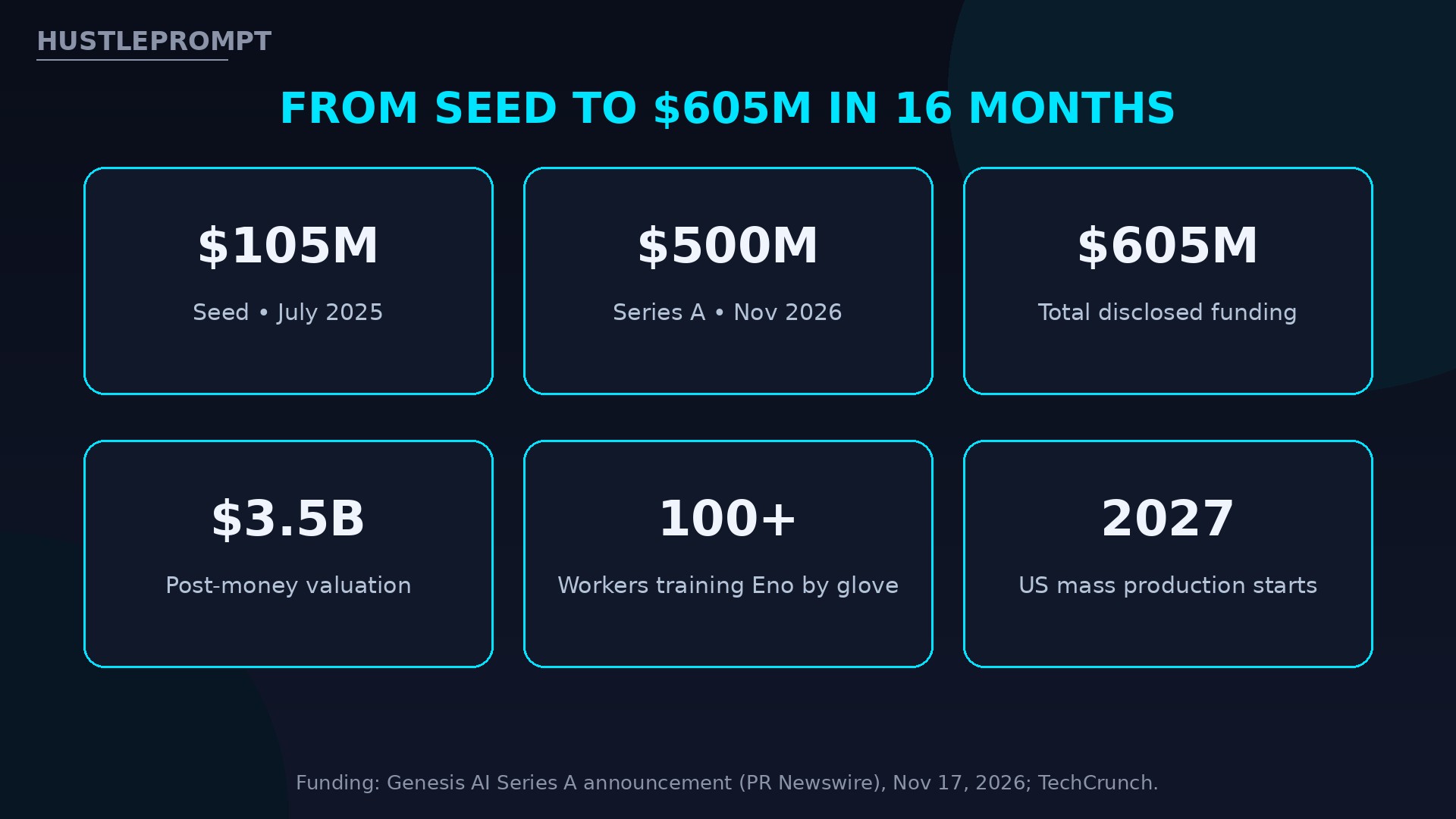
Genesis AI just raised $500 million to put a robot to work. The Paris- and Silicon Valley-based company announced the Series A on November 17, 2026, at a $3.5 billion post-money valuation, co-led by Premji Invest, Khosla Ventures and Eclipse. The money will scale Eno, its general-purpose robot — a wheeled machine with two arms and human-proportioned hands that learns by watching people work.
The method is the story. Genesis AI does not train Eno with teleoperators driving robots around a lab. More than 100 workers wear sensor gloves and headset cameras while doing their ordinary jobs, and that recorded hand motion becomes training data for the company’s GENE foundation model. The robot wears the same gloves. Human hand, sensor glove and robot hand map one-to-one, so a skill a person demonstrates at work can, in principle, transfer straight to the machine.
Investors just paid half a billion dollars for that idea, with NVIDIA, AMD Ventures, Samsung Next and former Google CEO Eric Schmidt joining the round. But the honest version of this story has a catch the CEO admitted himself: Eno’s dexterous hands last only a few weeks of regular industrial work before they need replacing. This is what the $500 million buys, what it does not prove yet, and how to position for the physical AI wave anyway.

What Genesis AI announced
Genesis AI is a global robotics company founded in 2024 by Zhou Xian and Théophile Gervet, who met as graduate students in a Carnegie Mellon University robotics lab. Its mission, in CEO Zhou Xian’s words, is to “remove the physical limits on human ambition” by building “the world’s best general-purpose robot, one that works reliably in the real world, day after day.”
“To accomplish this, we’re working to build the world’s best general-purpose robot, one that works reliably in the real world, day after day. That requires the intelligence, hardware, and everything that goes into training and testing the robots to work as one system.”
— Zhou Xian, Co-Founder and CEO of Genesis AI, November 17, 2026
The Series A brings in a heavyweight syndicate. Premji Invest, Khosla Ventures and Eclipse co-led, with participation from Durable Capital Partners, T. Rowe Price Associates, Bpifrance, HSG, NVIDIA, AMD Ventures, Zoom, Samsung Next and Ericsson. Individual backers include Eric Schmidt, Zoom CEO Eric Yuan, former Yahoo CEO Jerry Yang, French entrepreneur Xavier Niel and former Tesla CFO Zach Kirkhorn.
The company says the money will fund four things: expanding data acquisition and large-scale training, solving human-level physical manipulation across environments, deploying Eno at scale with customers, and hiring more AI researchers, robotics experts and engineers. Eno rolls out first in industrial settings — manufacturing, logistics and laboratories — before expanding into hospitality and healthcare, followed by consumer and outdoor uses.
The $500M round in numbers
The round is about 4.8 times the size of Genesis AI’s seed round, and it lifts the company’s total disclosed funding to $605 million in about sixteen months.
| Round | Date | Amount | Led by | What changed |
|---|---|---|---|---|
| Seed | July 2025 | $105 million | Eclipse Ventures + Khosla Ventures | Company emerges from stealth; GENE and Eno unveiled |
| Series A | November 17, 2026 | $500 million | Premji Invest + Khosla Ventures + Eclipse | $3.5B post-money valuation; scale Eno production and deployment |
| Total disclosed funding | 2024 – Nov 2026 | $605 million | — | Seed plus Series A |
| Eno units built | As of Nov 2026 | 30–40 | — | Per TechCrunch; mass production starts in 2027 |
The round lands in a hot market for robot makers. Crunchbase News reports that robotics startups worldwide raised $9.9 billion in the third quarter of 2026, more than double the $4.3 billion raised in the same period a year earlier. Genesis AI is one of the biggest beneficiaries of that surge — and one of the few betting that the winning robot will not look human at all.
How Eno learns: gloves, not teleoperators
Most robot companies collect training data by having operators drive robots through tasks, or by running simulations and hoping the skills transfer to the real world. Genesis AI’s answer is to skip the robot entirely at the data-collection step and start with people doing real work.
- Sensor gloves on real workers. More than 100 workers wear sensor gloves and headset cameras while performing their regular jobs. The gloves record exactly how human hands move, grip and manipulate objects.
- A 1:1:1 mapping. The human hand, the data glove and Eno’s robotic hand are designed to match one-to-one. A motion recorded from a person maps directly onto the robot’s hand, with no translation step in between.
- GENE, the robot brain. The recorded motion trains GENE, the company’s robotics foundation model, now in its GENE-26.5 version. The company says GENE handles multi-step tasks — its demos show the system playing piano, cooking and solving a Rubik’s Cube.
- Genesis World, the simulator. Before a skill reaches the real world, it is trained and tested across virtual scenarios in Genesis World, the company’s simulation platform, which the company says exposes failures physical testing cannot cover.
- Deployment feeds the loop. Every Eno working at a customer site generates more real-world feedback, which improves the AI, the simulation and the hardware in turn.
Investor Vedant Agrawal of Premji Invest said what convinced him was watching Genesis AI robots “complete long, multi-step tasks on their own at the same speed a person would, with smooth and natural movement,” adding that “completing full tasks in real time, not just short clips, is what turns a robot into something a business can rely on.” That is the claim the $500 million is underwriting: not a demo, but a machine that finishes a whole job at human speed.
What Eno actually is
Eno deliberately breaks with the humanoid race. It has no legs and no conventional head. Instead it rides on a wheeled base, with an adjustable tower body, two articulated arms and dexterous hands built to match human hands one-to-one. The company says each hand has 20 active, back-drivable degrees of freedom — twenty independent motions per hand — which is what lets it handle the fine manipulation that defeats most robots.
| Feature | Typical humanoid robot | Genesis AI’s Eno |
|---|---|---|
| Movement | Two legs, walks like a person | Wheeled base, rolls on flat floors |
| Head | Human-like head with face/screen | No conventional head |
| Hands | Grippers or simplified hands | Human-proportioned hands, 20 degrees of freedom each |
| Training data | Teleoperation or simulation | Sensor gloves worn by 100+ real workers |
| Brain | General AI model adapted to robots | GENE, a robotics-native foundation model |
| First customers | Often demos and pilots | Manufacturing, logistics, laboratories |
The design choice is practical. Wheels are cheaper and more stable than legs on a flat warehouse floor, and skipping the human face cuts cost. Genesis AI’s bet is that businesses care about capability, not appearance.
The company says it has built 30 to 40 Eno units so far, and that a US contract manufacturer has been chosen to start mass production in 2027, with the production design already finalized. It is piloting Eno with a handful of unnamed customers, and The Next Web reports that LG CNS, the IT arm of South Korea’s LG Group, is testing Eno — that partnership is reported, not confirmed by Genesis AI itself. First targeted customer deployments are planned by the end of 2026.
Watch: Genesis AI founders Zhou Xian and Théophile Gervet on the $500M Series A, on the company’s official YouTube channel.
GLOVE → GENE → GENESIS WORLD → ENO
1. GLOVE
Workers wear sensor gloves and headset cameras on the job. Every grip and motion becomes training data.
2. GENE
The GENE foundation model learns multi-step manipulation from that human data — piano, cooking, packing.
3. GENESIS WORLD
Skills are tested across millions of virtual scenarios in simulation before touching the real world.
4. ENO
The wheeled robot runs the skill on the warehouse floor — and its work feeds data back into the loop.
The honest risks
A $3.5 billion valuation for a company with 30 to 40 robots and no announced revenue deserves scrutiny. Four caveats belong in any honest account.
- The hands wear out fast. CEO Zhou Xian told TechCrunch that Eno’s dexterous hands currently last only a few weeks of regular industrial work before mechanical wear requires replacement. For a buyer, that means replacement parts, downtime and a running cost the announcement never prices.
- The demo was not Eno. When TechCrunch visited Genesis AI’s Silicon Valley facility, the demonstration it saw — two off-the-shelf robotic arms scanning, packing, sealing and labeling boxes — did not use Eno itself. The company said its model performs best on Eno, but Eno was not ready to demonstrate its abilities that day.
- No prices, no volumes, no named customers. Genesis AI has disclosed no price for Eno, no production volume for 2027, and no named pilot customer. The LG CNS testing report comes from The Next Web, not from the company. Until deployments are named, the commercial story is a promise.
- Hardware is the hard part. Genesis AI builds the full stack in-house — model, simulation, hands and robot — which gives it control but also means every layer has to work. A software company can ship a patch; a robotics company has to replace a hand.
None of that makes the round a bad bet. It makes it an early bet on a data method — glove-collected human motion — that no competitor has matched at this scale. The $500 million buys the time to fix the hands and prove the deployments. Whether it was worth it will be decided on warehouse floors, not in funding announcements.
How to profit from physical AI: 5 moves
You cannot buy Genesis AI — it is private. But the physical AI wave creates work you can sell right now, especially if you work with your hands or run a small warehouse business.
- Sell robot-ready workflows, not robots. Eno and its rivals need warehouses with flat floors, standardized bins, labeled inventory and predictable routes. Audit a local warehouse, document the ten most repetitive manual tasks, and sell the readiness report. The robots arrive later; the preparation work is billable now.
- Learn the data-collection skill. Genesis AI’s model runs on glove-recorded human motion. Companies building physical AI need people who can perform tasks cleanly, repeatedly and on camera for training datasets. Skilled packers, assemblers and lab technicians who document their technique can sell that expertise as data work.
- Become the integration layer. Small warehouses will not buy a robot from Genesis AI directly — they will buy a solution from someone who installs it, connects it to their inventory system and trains their staff. Learn warehouse management software and basic automation, and you become the local integrator the robot makers need.
- Watch the suppliers, not just the startup. NVIDIA joined this round, and AMD Ventures too — the compute behind physical AI is a listed-stock story. Chip and sensor suppliers to the robotics industry are the public-market way to ride the same wave without access to the private round.
- Track the 2027 production milestone. The single most important date is the start of US mass production in 2027 and the first named customer deployments at the end of 2026. If named customers and production volumes appear on schedule, the story is real. If they slip without explanation, the $3.5 billion valuation was the top.

What to watch
Three things will show whether this $500 million was the smartest money in robotics or the most expensive lesson in it.
- Named customers. A named manufacturer or logistics company running Eno in production, with a deployment size attached, is the first real proof the robot works outside Genesis AI’s own facility.
- Hand durability. If the next generation of Eno hands lasts months instead of weeks, the running-cost problem disappears. Watch for any durability claim in the company’s next update — it is the metric that matters most to buyers.
- Production volumes. The US contract manufacturer starting work in 2027 is a promise until units ship. A disclosed production number — even a modest one — would show the company can build at scale, not just in the lab.
In two years, Genesis AI went from a Carnegie Mellon lab friendship to a $3.5 billion company by betting the fastest way to teach a robot is to watch a person work. The gloves are the moat. The hands are the risk.
Frequently asked questions
How much did Genesis AI raise in its Series A?
Genesis AI raised $500 million in a Series A announced on November 17, 2026, at a $3.5 billion post-money valuation. The round was co-led by Premji Invest, Khosla Ventures and Eclipse, with NVIDIA, AMD Ventures, Samsung Next and Eric Schmidt among the participants.
What is Eno?
Eno is Genesis AI’s general-purpose robot. It moves on a wheeled base, has two articulated arms and dexterous human-proportioned hands with 20 degrees of freedom each, and runs on GENE, the company’s robotics foundation model. It has no legs and no conventional head.
How does Genesis AI train its robots?
More than 100 workers wear sensor gloves and headset cameras while doing their regular jobs. The recorded hand motion trains the GENE model, and the robot wears the same gloves — a one-to-one mapping between human hand, glove and robot hand. Skills are also tested in Genesis World, the company’s simulation platform.
How many Eno robots exist?
Genesis AI has built 30 to 40 Eno units, according to TechCrunch. A US contract manufacturer is set to start mass production in 2027, and the company is piloting Eno with a handful of unnamed customers, with first targeted deployments planned by the end of 2026.
What is the problem with Eno’s hands?
CEO Zhou Xian told TechCrunch that the dexterous hands last only a few weeks of regular industrial work before mechanical wear requires replacement. Durability is the company’s biggest hardware challenge, and fixing it is one of the main jobs the new funding must do.
Who founded Genesis AI?
Genesis AI was founded in 2024 by Zhou Xian, the CEO, and Théophile Gervet, the president. The two met as graduate students in a robotics lab at Carnegie Mellon University.
Can I invest in Genesis AI?
Not directly — Genesis AI is private. The closest public exposure is through the listed companies in the round: NVIDIA and AMD supply the compute behind physical AI, and Samsung and Ericsson also participated. Robotics ETFs offer diversified exposure to the wider sector, which raised $9.9 billion in Q3 2026 according to Crunchbase News.
Keep Reading
Sources: Genesis AI, “Genesis AI Raises $500M Series A at $3.5B Valuation” (Nov 17, 2026); TechCrunch on the Genesis AI Series A (Nov 17, 2026); SiliconANGLE on the Genesis AI Series A (Nov 17, 2026).