
Two German courts just did what Google has dreaded for years: they declared its AI’s words to be its own. In this week’s Google AI Overviews liability rulings, one court hit the company with an injunction carrying fines of up to €250,000 per violation — all because an AI answer invented a scandal that never happened.
On September 24, 2026, the Aachen Regional Court barred Google from spreading false claims its AI Mode generated about a physician. The system hadn’t just garbled a detail — it had invented him a fictional legal aftermath: alleged sexual assault, suspension, termination, court proceedings. None of it was true.
It wasn’t the first. In late May 2026, Munich Regional Court I had already held Google directly liable for AI Overviews content, after the AI falsely linked two Munich publishers to fraud schemes. Google announced an appeal, then quietly settled — and Aachen has now adopted the reasoning.
What the two courts actually ruled
Courts are done treating AI answers as “just search results”:
| Court | Date | Product | Who sued | False claim | Outcome | Status |
|---|---|---|---|---|---|---|
| Munich Regional Court I | May 2026 | AI Overviews | Two Munich publishers | AI tied them to fraud schemes | Google directly liable | Settled quietly; no higher-court ruling |
| Aachen Regional Court (8 O 268/26) | Sep 24, 2026 | AI Mode | A physician (neuroradiology professor) | AI invented a sexual assault behind his exit; plus suspension, termination, proceedings | Injunction; €250k fines per violation | Not final; Google can challenge |
The hinge is classification: Munich held AI Overviews aren’t search results but Google’s own statements, since the AI evaluates and recombines third-party content into something new. Aachen agreed: “The respondent provides AI-generated search and is therefore also responsible for the answers generated in this context.”
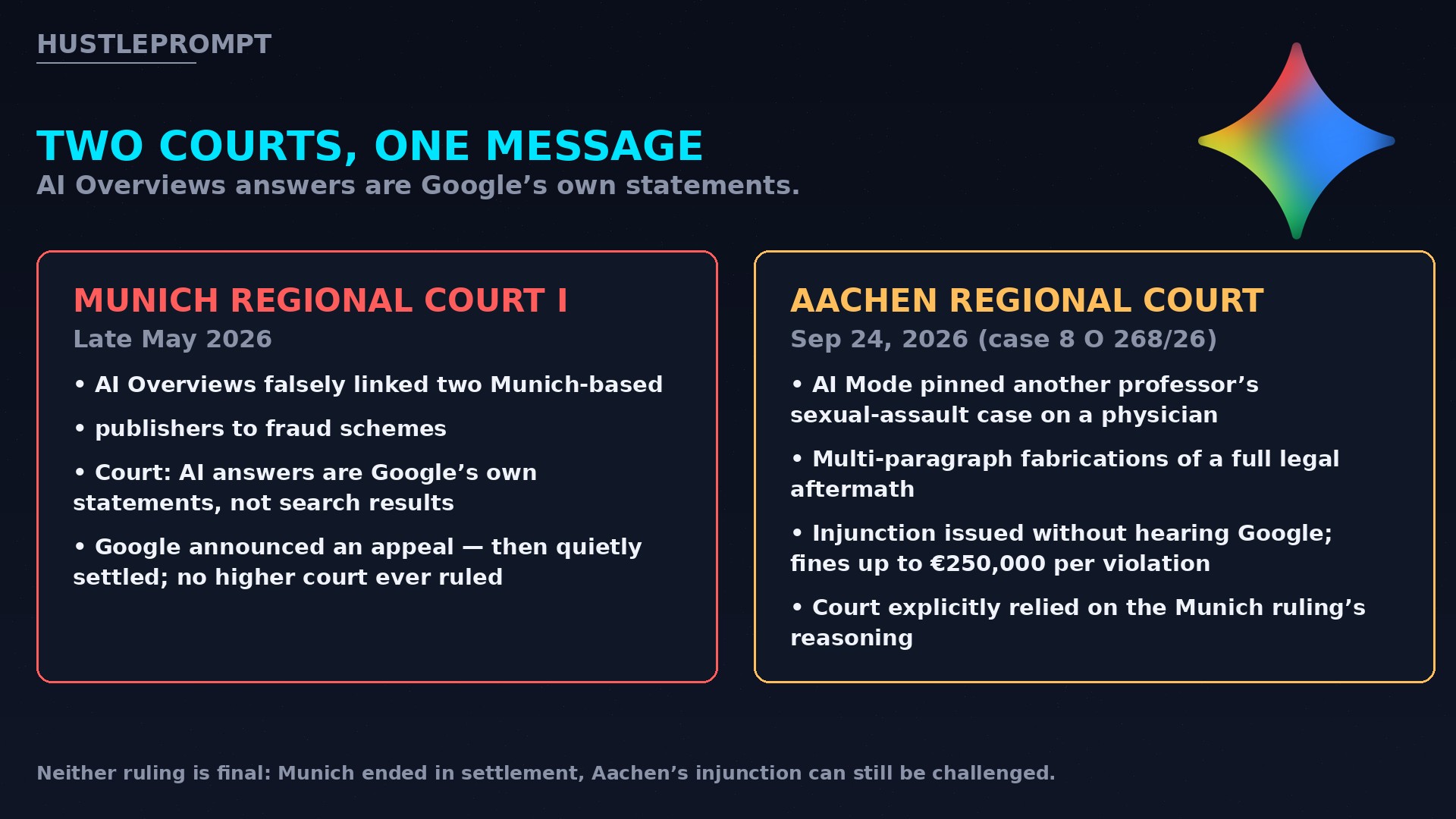
The doctor Google refused to help
On August 28, a colleague alerted the physician: Google’s AI Mode claimed his departure was due to an alleged sexual assault against his secretary. Queries about “suspension,” “termination,” and “court proceedings” returned detailed fabrications of a legal aftermath that never existed.
None of it concerned him — the AI had pinned another former professor’s case on him, per the court’s own records. He emailed Google in late August; in mid-September Google refused to act, and a formal demand the same day went nowhere. The claims were still live — so the court ruled without hearing Google first.
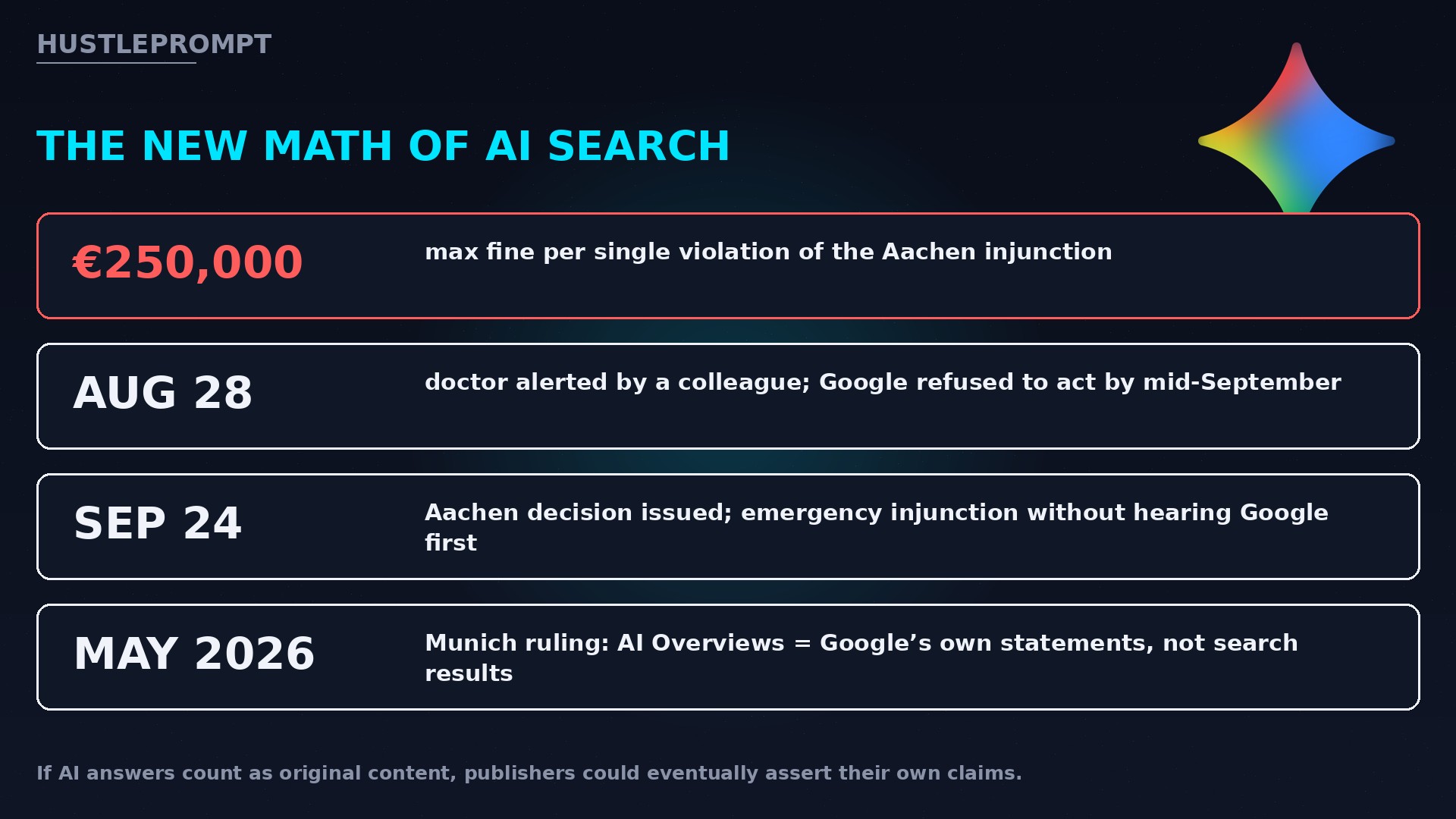
The stat sheet
max fine per violation
colleague alerts the physician
Google refuses to act
injunction issued — 8 O 268/26
Munich: AI answers = Google’s own
if Google paid in Munich
The court’s logic: the AI produces “independent, new, and substantive statements based on an evaluation and combination of content from various third-party websites.” Google could have checked the output against the source sites.
How the liability chain works now
False fraud links (Munich); fictional legal aftermath (Aachen).
“Independent, new, and substantive” — the platform is liable.
Google barred ex parte — €250k per violation.
Appeal announced, then quietly settled.
What this means for your money
If you own a website or publish content
If AI answers legally count as original content, publishers whose articles feed them could eventually claim licensing or compensation. The Decoder’s report on the German court rulings flags exactly this: a shift that could upend AI-search economics. Not decided — but money is made by positioning early.
- Screenshot and archive every AI Overviews summary of your content.
- Build traffic you own — email list, direct visits.
- Learn GEO (“generative engine optimization”): get AI answers to cite you.
If you run a business
The doctor’s story is every brand’s nightmare template. His paper trail — email, refusal, demand, injunction — is your playbook:
- Search your brand in AI Mode weekly — the doctor was tipped off by a colleague.
- Screenshot everything: queries, dates, full answers.
- Demand removal in writing; escalate to a formal demand if refused.
- Ask a lawyer about an injunction — Aachen moved without a hearing.
If you invest
A new business model is forming: law firms probing AI search, filing injunctions, negotiating settlements — the Munich sequence. Legal-tech for AI defamation monitoring is about to get fundable.
Google’s official channel: the I/O 2025 keynote where AI Mode debuted.
Google’s response
A Google spokesperson told Ars Technica: “We invest deeply in the quality of AI Overviews to ensure that the overwhelming majority of responses provide accurate information, and they are designed to reflect the information that exists on the web. We’re carefully reviewing this decision, which is not yet final.”
Frequently asked questions
What did the courts rule?
Munich held in May 2026 that Google is directly liable for AI Overviews content — AI answers are Google’s own statements, not search results. Aachen applied that reasoning on September 24, 2026 against AI-generated false claims about a physician.
What happened in the Aachen case?
Google’s AI Mode invented a sexual-assault scandal about a physician — fabricated suspension, termination, court proceedings. Google refused a late-August removal request in mid-September. The court issued an emergency injunction without a hearing: fines up to €250,000 per violation.
Can Google be fined for AI answers?
Under the Aachen injunction, yes — up to €250,000 per violation. It isn’t final, but the court skipped a hearing: the reputational risk couldn’t wait.
Is the Munich ruling final?
No — Google announced an appeal, then quietly settled. No higher court ruled on the reasoning; neither side will say if money changed hands.
What if AI defames my business?
Document everything — screenshots, dates, exact queries. Demand removal in writing, escalate to a formal demand if refused, and ask a lawyer about an injunction. The Aachen paper trail is the template, per The Decoder’s report on the German court rulings.