
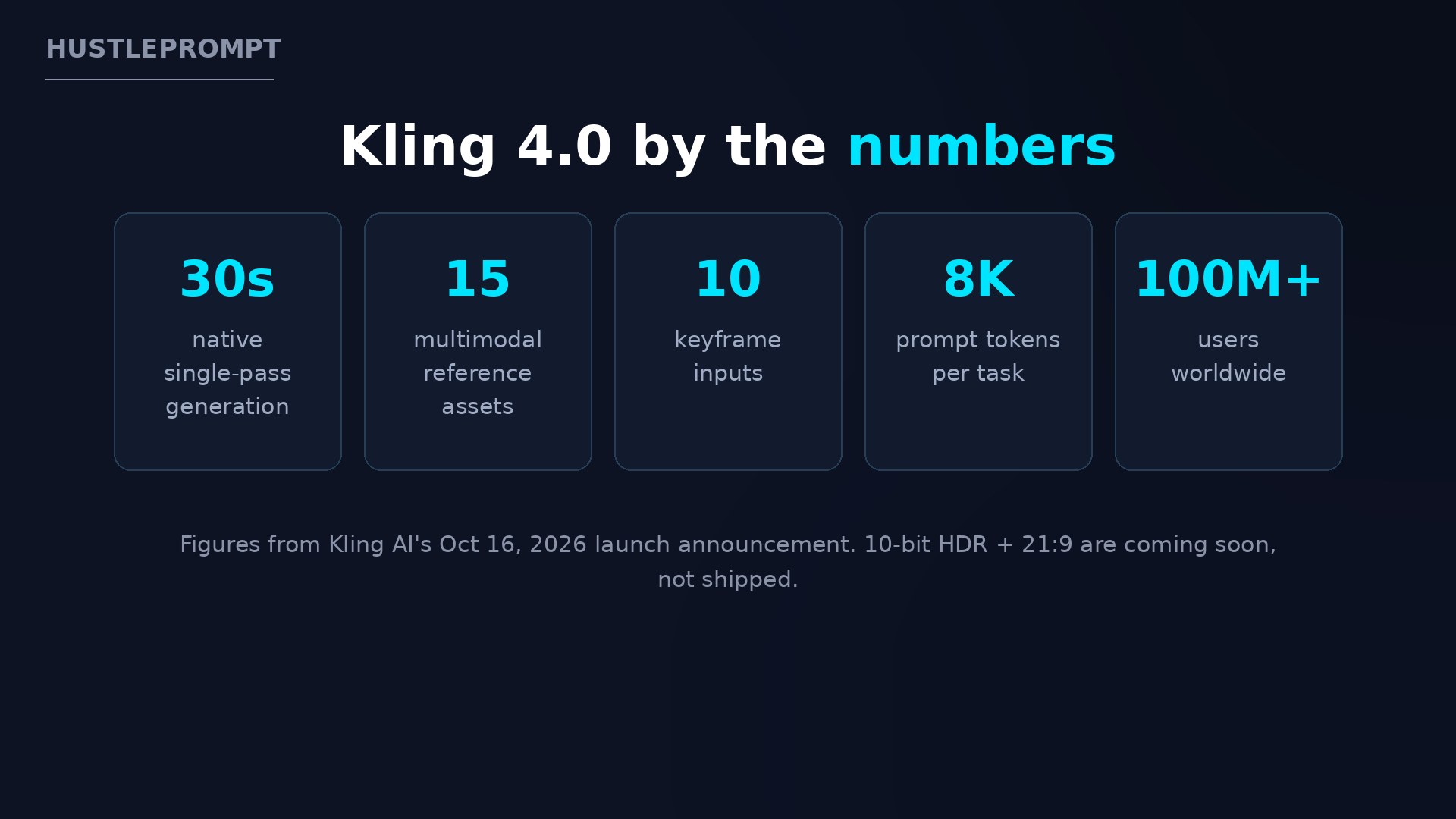
Kling 4.0 can now generate a full 30 seconds of pro-grade video in a single pass — and Kuaishou’s Kling AI just launched it globally. Announced on October 16, 2026, the rollout doubles the maximum clip length of Kling 3.0, adds up to 15 multimodal reference assets and 10 keyframes, and pushes Kling from “clip generator” into something closer to a real directing tool.
For video creators, freelancers, and agencies, this is the first AI video model whose headline feature maps directly onto a billable unit: the 30-second spot. Here is what shipped and how to turn it into revenue.
What Kling 4.0 actually delivers
Kling AI framed the launch around three upgrades: steadier large-scale motion (tracking shots, orbit shots, and high-speed action stay more coherent), native 30-second generation, and Omni Reference — up to 15 combined reference assets plus 10 keyframes for frame-level control of characters, scenes, and story progression.
The reference system is the real unlock. A single task can combine images, video, voice, and subject references — and reference videos, including white-model and depth-map footage, can guide performance, camera movement, and pacing. Characters stay consistent across shots and episodes instead of re-rolling the dice every clip.
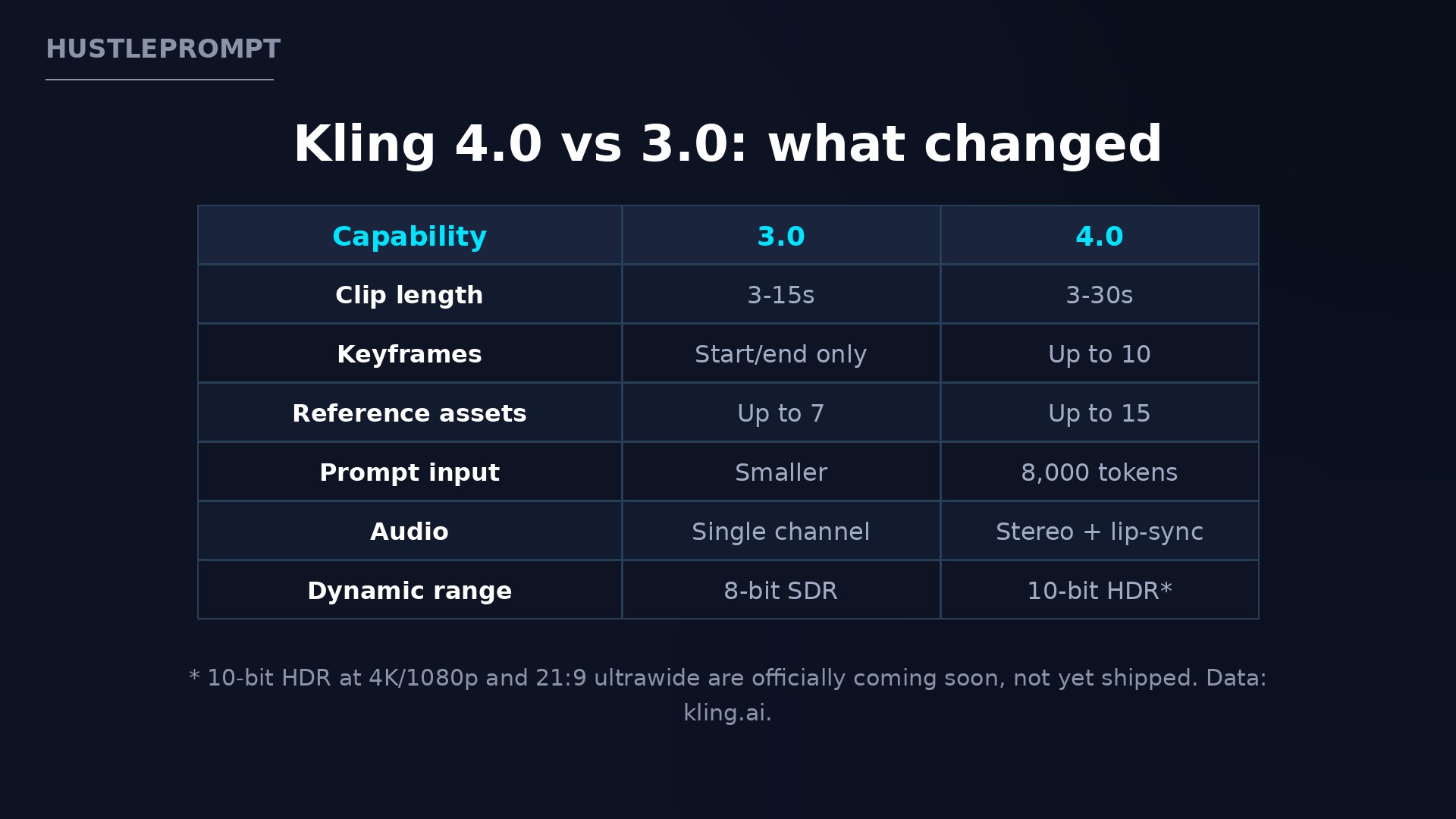
| Capability | Kling 3.0 | Kling 4.0 |
|---|---|---|
| Clip length | 3–15 sec | 3–30 sec native |
| Keyframes | Start & end frames only | Up to 10 |
| Reference assets | Up to 7 combined | Up to 15 combined |
| Prompt input | Smaller limits | Up to 8,000 tokens |
| Audio | Single channel | Two-channel stereo + stronger lip-sync |
| Video extension | — | Extend clips up to 2 minutes |
Data: Kling’s official 4.0 vs 3.0 comparison and the October 16, 2026 launch announcement.
How it works
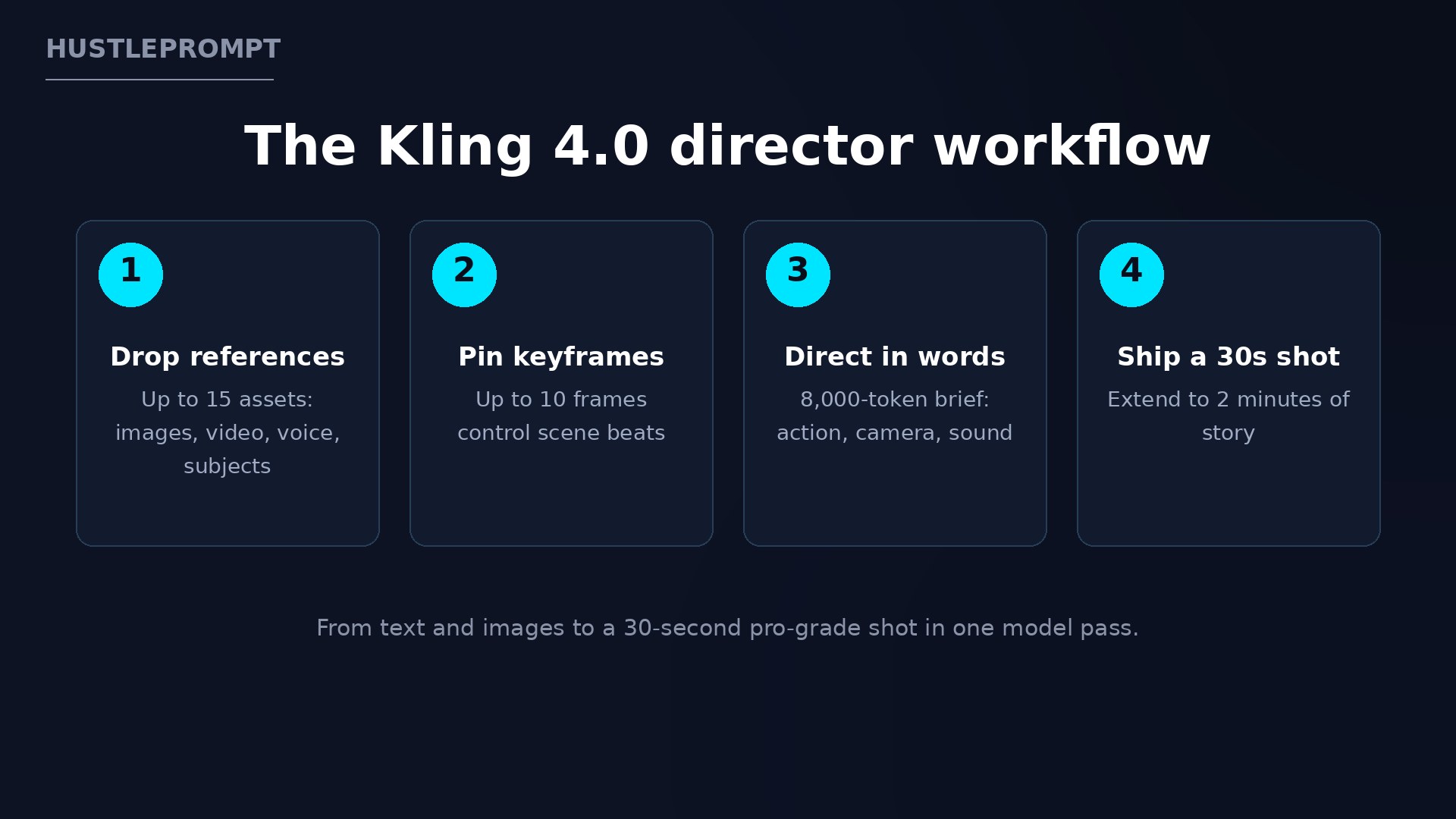
The 4.0 workflow is built for longer, more directed sequences:
- Drop in references. Upload up to 15 assets: up to 10 images, up to 5 videos (30 seconds combined), up to 7 subjects, plus voice references.
- Pin up to 10 keyframes. Set visual milestones along the timeline — character enters at 0s, product appears at 6s, camera pushes in at 12s.
- Direct in words. Write up to an 8,000-token brief covering action, dialogue, camera direction, sound, and pacing — or start simple and let the model expand it.
- Generate and extend. Render a 30-second shot in one pass, then upload it and extend the story up to two minutes for multi-part narratives.
How to profit with Kling 4.0
The money angle is simple: 30 seconds is the standard ad unit, and character consistency is what turns one-off clips into sellable series.
- Sell 30-second client spots. Local businesses, DTC brands, and creators pay for finished video ads. Build a package: concept, references, keyframes, two revision rounds. The keyframe system lets you revise a single beat without regenerating the whole spot.
- Launch a character-driven series. Omni Reference keeps the same character on-model across episodes. A consistent character becomes ownable IP — monetize through sponsorships, merch, or licensing.
- Run a TikTok/Reels pipeline. Use Kling 4.0 Flash — the lighter tier, in early access since September 28 for Ultra Yearly subscribers per launch coverage — for high-volume short-form, and reserve the full 4.0 model for hero content.
- Offer Creative Recreation for e-commerce. Kling’s dedicated workflow lets brands borrow the pacing and structure of a trending video and rebuild it around their own product — a repeatable agency service: “we turn viral formats into your brand’s ads.”
The 30-second client-spot money pipeline
What is live now vs. coming soon
Live: the full Kling 4.0 model is broadly available on the Kling AI website since October 15, with MCP and CLI access live per Kling’s community announcement. Stereo audio, improved lip-sync, and expanded language support are in.
Coming soon: 10-bit HDR output at 4K and 1080p, plus a 21:9 ultrawide format — the launch announcement says Kling 4.0 will soon support these, so don’t sell HDR delivery yet. Enterprise and developer API access is also slated to open soon, and Kling 4.0 is coming to Adobe Firefly.
FAQ
When did Kling 4.0 launch?
Kuaishou announced the global launch on October 16, 2026, with broad availability on the Kling AI website starting October 15.
How long can Kling 4.0 videos be?
Native generation runs 3 to 30 seconds in a single pass. You can also upload an existing video and extend it up to two minutes for longer storylines.
What are the Omni Reference limits?
Up to 15 combined reference assets per task — up to 10 images, up to 5 videos totaling 30 seconds combined, up to 7 subjects, plus voice references — alongside up to 10 keyframe inputs.
Is 10-bit HDR available in Kling 4.0 now?
Not yet. Kling’s launch announcement says 10-bit HDR at 4K and 1080p, plus 21:9 ultrawide output, are coming soon. Treat them as roadmap, not shipped features.
What is Kling 4.0 Flash?
A lighter, faster tier in the 4.0 lineup. It opened in early access on September 28, 2026 for Ultra Yearly subscribers — roughly 20-second, 720p output aimed at high-volume everyday content.
How much does Kling 4.0 cost?
The launch announcement doesn’t publish pricing — Kling runs on a credit/subscription model on kling.ai, so check current plans on the official site before budgeting client work.
Keep Reading
- AI Video Tools Creators Are Actually Switching To in 2026
Where Kling 4.0 lands in the real creator stack. - The Best AI Video Tools for Faceless YouTube Channels
Faceless channels are the natural home for 30-second AI spots. - HeyGen Review 2026: Worth $29/Month for AI Videos?
Avatar video vs. cinematic video — pick the right tool.