
A credit line in Google’s official Chrome release notes now reads “assisted by Claude.” On October 15, 2026, Google shipped Chrome 155 with 10 security fixes — and for one high-severity flaw, tracked as CVE-2026-110913, the credited finder was an Anthropic researcher working with Anthropic’s AI model. The Claude Chrome vulnerability find is the clearest signal yet that AI-assisted bug hunting has gone mainstream — and the people doing it are getting paid.
Here is what happened, what Google actually said, and how to turn the skill into income.
What just happened
Google published its Chrome Stable Channel update on October 15, 2026:
- 10 security fixes in total — 1 rated Critical, 6 High, 3 Medium
- Chrome moves to 155.0.8059.84/.85 on Windows and Mac, 155.0.8059.84 on Linux, rolling out over the coming days and weeks
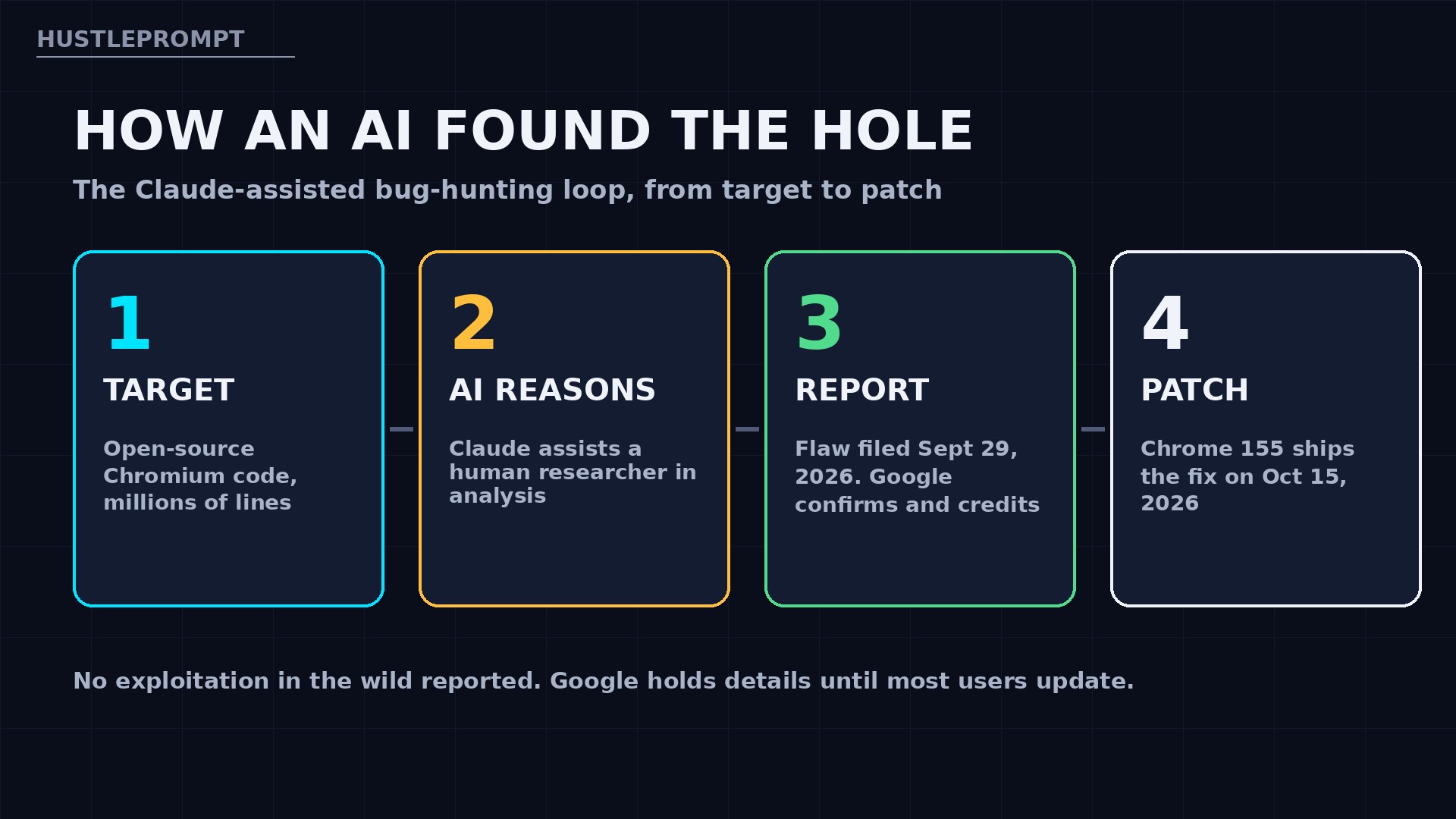
- No exploitation in the wild reported; Google keeps technical details restricted until most users have the fix
The most severe entry is CVE-2026-110922, a Critical use-after-free in Prerender, reported by Xinyang Ge on October 2. But the entry everyone is talking about is one line down the list.
The official record: all 10 fixes
From Google’s advisory, via security press:
| CVE | Severity | Component | Type | Reporter |
|---|---|---|---|---|
| CVE-2026-110922 | Critical | Prerender | Use after free | Xinyang Ge |
| CVE-2026-110913 | High | DOM | Memory corruption | Xinyang Ge (Anthropic), assisted by Claude |
| CVE-2026-110919 | High | V8 | Use after free | Xinyang Ge |
| CVE-2026-110918 | High | Core | Memory corruption | |
| CVE-2026-110917 | High | SVG | Memory corruption | C0rk1 |
| CVE-2026-110921 | High | V8 | Use after free | Xinyang Ge |
| CVE-2026-110920 | High | V8 | Memory corruption | Xinyang Ge |
| CVE-2026-110916 | Medium | Desktop | Improper input validation | |
| CVE-2026-110915 | Medium | Compositing | Use after free | |
| CVE-2026-110914 | Medium | Workers | Memory corruption |
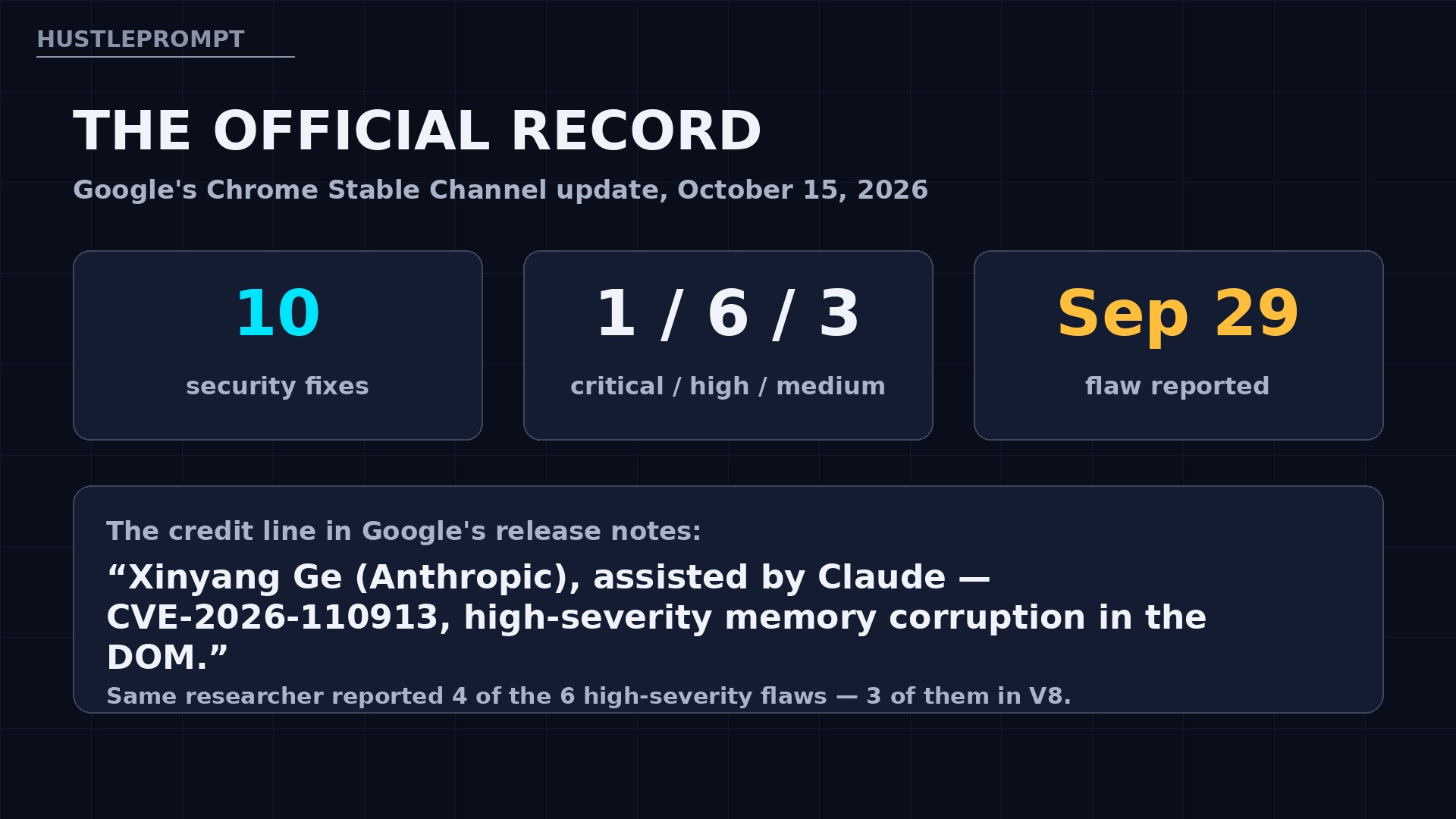
The credit line that matters
Unpacking that: CVE-2026-110913 is a high-severity memory corruption flaw in the DOM — the browser’s model of a web page’s structure. Corrupted memory can crash the tab — or let an attacker run code inside it.
The flaw was reported on September 29, 2026 — and the credit names not just the researcher, but the AI. Trade-press reporting notes the October 13 update carried a similar credit for CVE-2026-110169: the second week running an AI model appears by name in Google’s security credits.
Ge also had an outsized week overall: he reported 4 of the 6 high-severity flaws, three of them in V8.
How Claude-assisted bug hunting actually works
Google catches many bugs with automated tooling — AddressSanitizer, MemorySanitizer, libFuzzer and AFL. What’s new here is the reasoning layer: an AI that reads code like a senior security engineer and points a human at the suspicious parts.
From target to patch: the Claude-assisted loop
How to profit: the AI bug-bounty playbook
Bug hunting used to demand years of C++ experience. AI doesn’t replace the expertise — but it slashes the reading cost. The playbook:
- Pick an open target. Chromium, Firefox, Linux and thousands of smaller projects are open source — you can read the exact code professionals audit.
- Let the AI do the reading. Feed Claude suspicious components — DOM memory handling, parsers, media codecs — and ask it to reason about unsafe patterns.
- Reproduce before you report. A credit needs a real, reproducible flaw: build a proof of concept and document the trigger precisely.
- Submit to the vendor’s reward program. Google’s Chrome Vulnerability Reward Program pays by severity — full exploit chains have paid up to $250,000, as in the $250K Chrome payout we covered this week.
- Productize the skill. Beyond bounties, companies pay for AI-assisted security audits. One CVE credit in Google’s release notes beats any certification.
Honest caveat: a skill, not a lottery ticket. The AI accelerates a competent analyst — but the barrier has never been lower.
FAQ
What exactly did Google say?
Google’s October 15 update lists CVE-2026-110913, a high-severity DOM flaw, credited to “Xinyang Ge (Anthropic), assisted by Claude” (Chrome Releases blog).
Did Claude find the bug on its own?
No — the credit says assisted by Claude. Xinyang Ge did the work with the AI as a reasoning partner. Google is crediting the human-AI team, not an autonomous agent.
Is this the first time an AI got a Chrome CVE credit?
Not quite. Trade-press coverage reports the October 13 update carried a similar credit for CVE-2026-110169. Second week running — that’s why it’s a pattern, not a fluke.
Should I update Chrome right now?
Yes. Open Chrome’s About page to trigger the update check, then relaunch. Edge, Brave and Opera users should check their vendor’s patched release — they inherit these fixes.
How much do Chrome bug bounties pay?
Payouts scale with severity. Google’s Chrome Vulnerability Reward Program has paid up to $250,000 for full exploit chains; single high-severity flaws pay less, but they add up.
Can I really make money finding bugs with AI?
Yes: vendor bug-bounty programs (Google, Microsoft, Apple all run them) and paid security audits. The AI compresses the hardest part — reading millions of lines — but you still verify, reproduce and report like a professional.
Keep Reading
Keep Reading
- AI Bug Bounty: Google Paid $250K for Chrome Hack — the full exploit-chain payout story.
- Claude Cracked a 25-Year Crypto Mystery in 30 Minutes — Anthropic’s red team solved a 25-year cryptographic puzzle.
- Anthropic Wrote Its Own AI Safety Bill — Here’s the Catch — the draft law deciding which models get blocked.
Sources: Google Chrome Releases — Stable Channel Update for Desktop (Oct 15, 2026); GBHackers CVE breakdown; Cyber Security News coverage.