
Rivals do not usually share a roadmap. On November 12, 2026, eight of them did. The SGLang Consortium brings together Nvidia, AMD, Intel, Google, Meta, Cloudflare, Modal, and RadixArk behind SGLang, the open-source engine that runs a huge share of the world’s AI models. The reason is simple, and it is about money: inference — actually running the models — is about to become two-thirds of all AI computing. Whoever makes inference cheaper wins the next decade.
LMSYS Org, the nonprofit behind SGLang, launched the consortium in the opening keynote of the first SGLang Summit in San Francisco. The summit runs November 12–13 at the Fort Mason Center, with more than 100 speakers and over 2,000 attendees. The message from the stage was blunt: building new data centers is hard, so software that squeezes more work out of the hardware we already have is “incredibly important,” in the words of Ying Sheng, co-author of the original SGLang paper and co-founder and CEO of RadixArk.
The SGLang Consortium, at a glance
| Announced | November 12, 2026, 19:00 UTC, at the first SGLang Summit, San Francisco |
| Organizer | LMSYS Org — the nonprofit behind SGLang, FastChat, Vicuna, and Chatbot Arena |
| Founding members | NVIDIA, AMD, Intel, Google, Meta, Cloudflare, Modal, RadixArk |
| What SGLang is | Open-source, full-stack inference engine for frontier AI, part of the PyTorch ecosystem |
| Scale today | Runs on hundreds of thousands of GPUs; powers some of the largest production inference deployments |
| Big users | Meta, Microsoft, Google, Amazon, Thinking Machines Lab, Cloudflare, Reflection, Modal |
| How it works | Each member names a technical representative and joins two roadmap meetings a year; maintainers keep code control |
| Focus areas | Frontier model support, reasoning and multimodal workloads, distributed inference, hardware optimization |
Source: LMSYS Org via BusinessWire — LMSYS Org Launches SGLang Consortium, November 12, 2026, and SGLang Summit 2026 (sglang.io).
Why inference is the money story
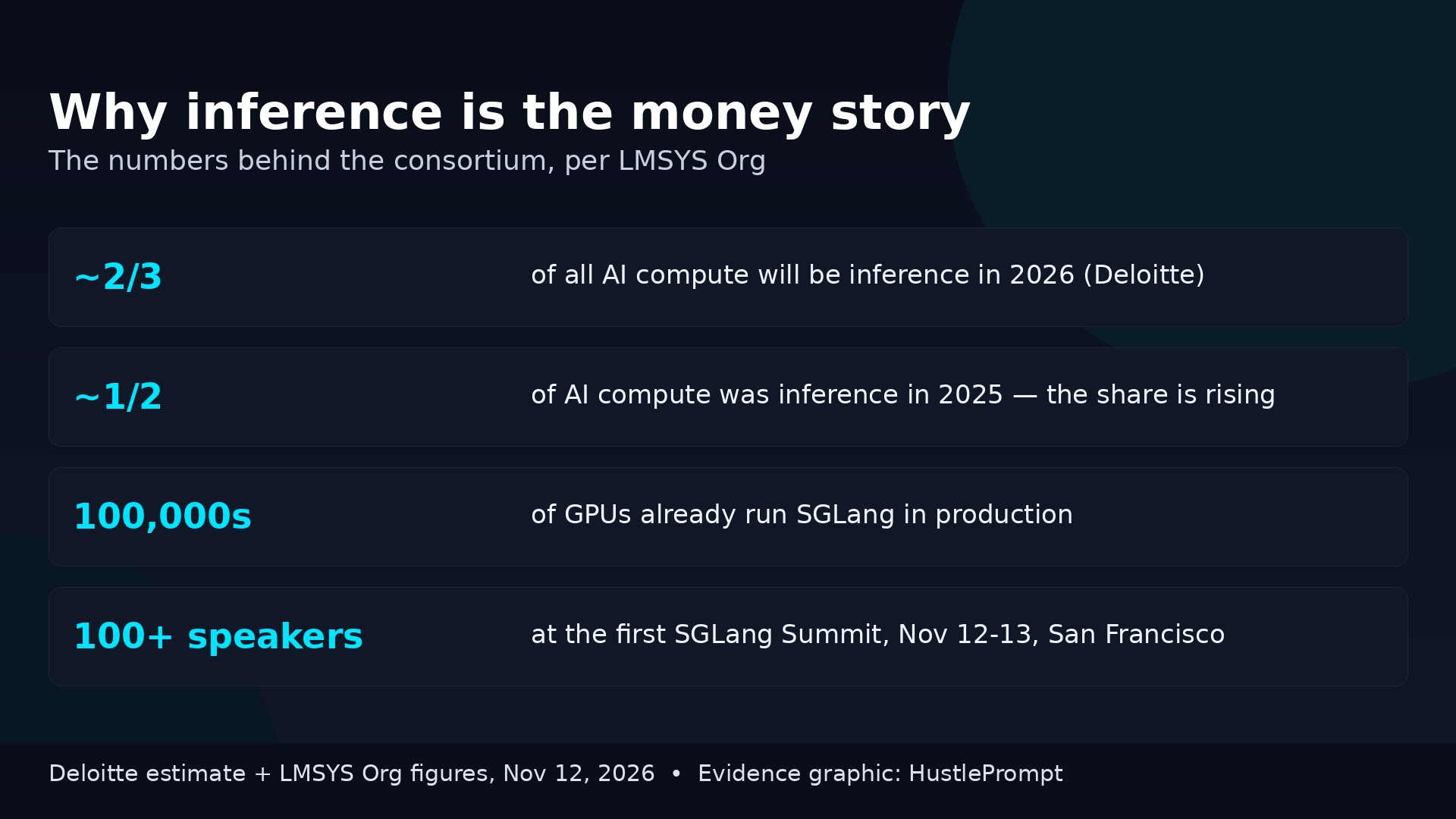
Training a model gets the headlines. Running it pays the bills. Every ChatGPT answer, every Claude reply, every image and video a model generates is inference — and inference is eating the AI budget. Deloitte estimates it will account for roughly two-thirds of all AI compute in 2026, up from about half in 2025. That is the number behind this consortium: the companies that sell the chips and rent the clouds all need the same engine to run faster and cheaper.
SGLang is that engine for a large part of the industry. It is the software that decides how a model answers thousands of requests at once: scheduling, memory, and batching on the hardware underneath. It runs on hundreds of thousands of GPUs and powers some of the largest production inference deployments in the world. Its users include Meta, Microsoft, Google, Amazon, and Thinking Machines Lab. The project carries about 38,800 GitHub stars, according to LMSYS Org’s projects page, and it grew out of a 2024 research paper from UC Berkeley, Stanford, and Carnegie Mellon — the same team that built Chatbot Arena.
Here is why that matters for your wallet. Inference cost is token cost. Every time an AI app answers you, somebody pays for the compute behind that answer — and the price per million tokens is set by how efficiently the inference engine uses the hardware. Better software means the same GPU answers more requests, which means cheaper tokens, which means AI products that can afford to exist at lower prices. The consortium is, at its core, a cost-cutting pact dressed as an engineering alliance.
Chip rivals, one engine
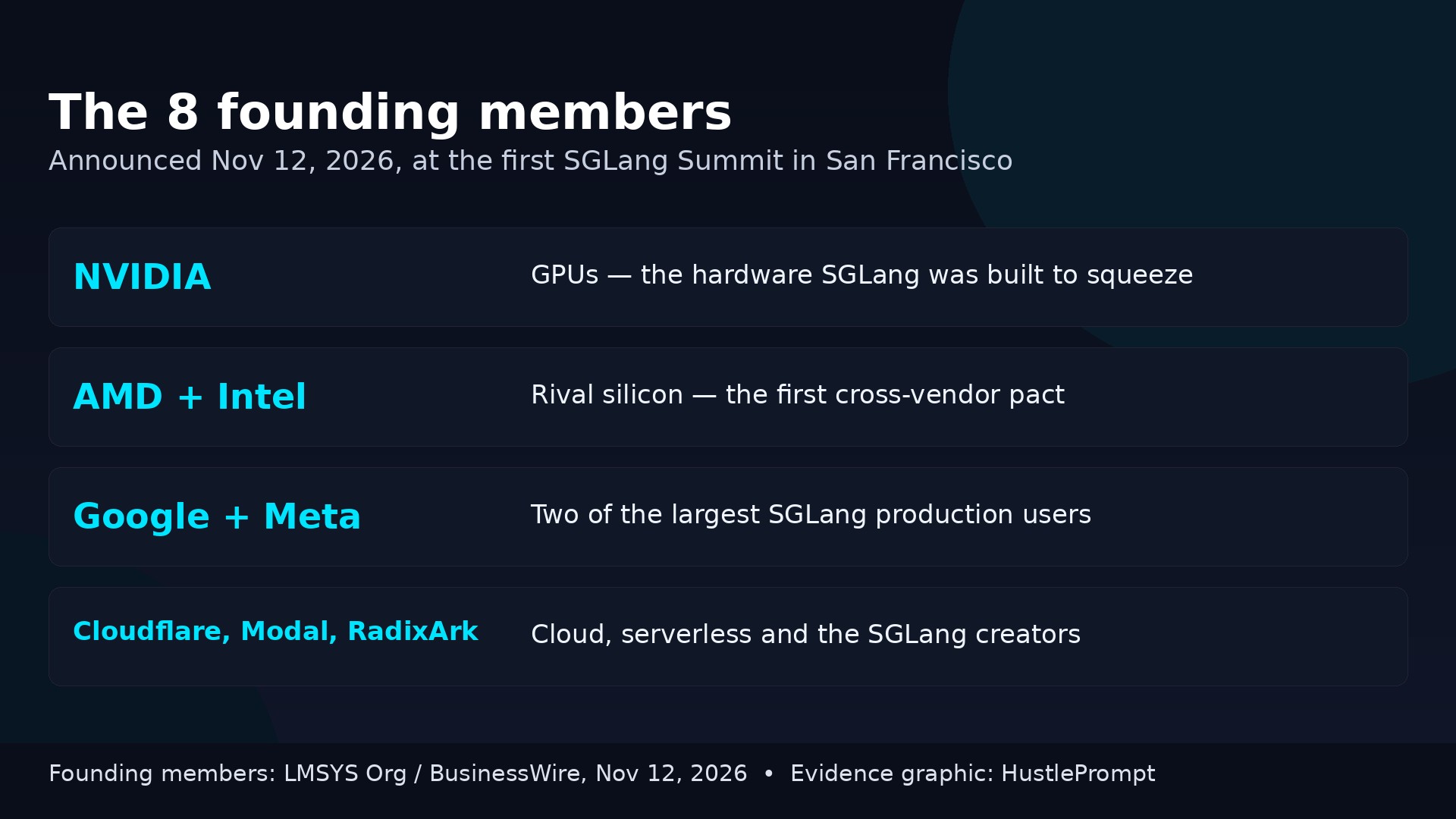
The member list is the story. Nvidia and AMD are direct competitors. Intel is fighting to stay relevant in AI. Google builds its own TPUs. Meta runs one of the largest AI fleets on earth. They have never agreed on hardware — and now they have agreed on software.
That agreement has a clear shape. Each founding member designates a technical representative and joins two roadmap meetings a year, contributing engineering expertise, deployment feedback, testing resources, or joint development. Working groups can collaborate between meetings, with public updates on roadmap direction and progress. But the SGLang maintainers keep responsibility for technical decisions and code acceptance, and the project stays open to the entire community. Members advise. They do not own the code.
The governance matters because it answers the obvious suspicion: is this Nvidia buying influence over the open stack? The announcement says no — twice, in different words. Maintainers keep control, and the project stays open. For developers and small AI businesses, that is the guarantee that matters: the engine your product depends on will not quietly become a single vendor’s product.
Nvidia’s own quote gives away its interest. “Better software helps developers get more performance from NVIDIA compute,” said Ian Buck, vice president of hyperscale and high-performance computing at Nvidia. “Open models enable them to build new applications and businesses. And lower inference costs make AI more accessible to organizations everywhere.” Translation: Nvidia sells more GPUs when the software makes those GPUs cheaper to run. AMD and Intel want the same engine to run fast on their silicon too — that is why they joined.
The numbers that matter
| Metric | Figure |
|---|---|
| Inference share of AI compute, 2026 | Roughly two-thirds (Deloitte estimate, cited by LMSYS Org) |
| Inference share, 2025 | About half — the share is rising fast |
| GPUs running SGLang | Hundreds of thousands, in production deployments |
| Founding members | 8 — NVIDIA, AMD, Intel, Google, Meta, Cloudflare, Modal, RadixArk |
| Summit scale | 100+ speakers, 2,000+ attendees, Nov 12–13, Fort Mason, San Francisco |
| GitHub stars | About 38,800 (LMSYS Org projects page) |
| Roadmap meetings | Two per year, one technical representative per member |
“The teams running SGLang at the largest scale see what inference needs next before anyone else does. With the challenges in building new data centers, software approaches to improve AI efficiency will be incredibly important.” — Ying Sheng, co-author of the original SGLang paper and co-founder and CEO of RadixArk, November 12, 2026. “Better software helps developers get more performance from NVIDIA compute.” — Ian Buck, vice president of hyperscale and high-performance computing, NVIDIA.
What the consortium will actually do
Announcements are cheap. Workstreams are the test. The consortium named four: supporting frontier models as they arrive, improving reasoning and multimodal workloads (agents and video, not just chat), scaling distributed inference across many machines, and optimizing performance across hardware platforms. In plain terms: keep the engine fast on the newest models, on the hardest jobs, at the largest scale, on every chip.
That last item — “on every chip” — is the one that changes the market. Today, most production AI runs on Nvidia hardware, partly because the software is best there. A shared engine tuned for AMD, Intel, and Google TPUs as well as Nvidia GPUs lowers the cost of switching. For a startup renting compute, that means real competition between hardware vendors for the first time in years — and competition means lower prices.
How your request becomes a cheap answer
1. You ask
A prompt hits an AI app — a chatbot, an agent, a video tool. Somebody pays per token for the answer.
2. SGLang schedules it
The engine batches your request with thousands of others and reuses cached work (RadixAttention) instead of recomputing it.
3. Hardware runs it
The work lands on a GPU or TPU. The consortium’s job is to make that step fast on every vendor’s chip, not just Nvidia’s.
4. You pay less
More answers per GPU means a lower cost per token — and cheaper AI products, or fatter margins for the people who sell them.
SGLang is the middle layer. The consortium is eight giants agreeing to improve it together instead of forking it apart.
How to profit from cheaper inference
This is infrastructure news, but it lands directly in the wallet of anyone building with AI. Here is what to do with it:
- Build on open weights now. SGLang serves open models — Llama, DeepSeek, Qwen, Gemma — and the consortium makes that stack faster and cheaper. An app that runs on open weights plus SGLang has no per-token bill from a closed provider. That is the zero-marginal-cost stack.
- Price your product for the cost curve, not today’s cost. If inference keeps getting cheaper, a service that is barely profitable at today’s token prices becomes comfortably profitable in a year. Lock in customers now with pricing that assumes falling costs — your margin grows as the engine improves.
- Learn the engine, not just the API. The SGLang Cookbook — one-click model deployment — is the skill that turns a developer into the person companies hire to run their inference. The official tutorial below is the fastest way in.
- Watch the hardware race. If AMD and Intel silicon get meaningfully faster at inference through this consortium, cloud GPU prices will face real competition. Renting compute is most startups’ biggest bill; a price war there is a gift.
- Sell the migration. Companies running expensive closed-model APIs are the customers for a “move to open weights on SGLang” service. The pitch writes itself: same answers, a fraction of the token bill, and no vendor lock-in. The consortium’s launch is the credibility — eight giants just bet on this stack.

Watch it in action
SGLang is a developer tool, and the fastest way to understand it is to see it deploy a model. LMSYS Org’s official Cookbook tutorial walks through one-click deployment — the same workflow the consortium is now investing in together:
Watch: the official SGLang Cookbook tutorial from LMSYS Org — one-click model deployment on the engine eight giants just united behind. Video: LMSYS Org Official (YouTube).
Frequently asked questions
What is SGLang?
SGLang is an open-source, full-stack inference engine for large language models and multimodal models, developed by LMSYS Org — the nonprofit behind Chatbot Arena. It handles the serving layer: scheduling requests, managing memory, and batching work so a model answers thousands of users efficiently. It is part of the PyTorch ecosystem and grew out of a 2024 research paper from UC Berkeley, Stanford, and Carnegie Mellon.
Who joined the SGLang Consortium?
Eight founding members: NVIDIA, AMD, Intel, Google, Meta, Cloudflare, Modal, and RadixArk. They were announced on November 12, 2026, in the opening keynote of the first SGLang Summit in San Francisco. LMSYS Org runs the consortium; each member names a technical representative and joins two roadmap meetings a year.
What does the consortium actually change?
It gives the biggest SGLang users a standing forum with the maintainers to set roadmap priorities — frontier model support, reasoning and multimodal workloads, distributed inference, and hardware optimization. The maintainers keep control of technical decisions and code acceptance, and the project stays open to the whole community. In practice, expect SGLang to get faster on more kinds of hardware, sooner.
Does this threaten Nvidia’s dominance?
It loosens it. Most production AI runs on Nvidia hardware, partly because the software is best there. A shared engine tuned for AMD, Intel, and Google TPUs as well as Nvidia GPUs makes switching cheaper — which pressures prices across the board. Nvidia joined anyway, because faster inference software also sells more Nvidia GPUs.
How does cheaper inference help me make money?
Every AI product pays per token, and the token price is set by inference efficiency. Cheaper inference means higher margins on AI apps, or lower prices that win more customers. If you build on open weights served by SGLang, you skip the closed-provider token bill entirely — and the consortium is making that stack better.
Is SGLang free to use?
Yes. SGLang is free and open-source, distributed under the Apache 2.0 license, and developed under the sgl-project open-source organization. Anyone can download it, run it on their own hardware, or deploy it in the cloud. The consortium does not change that — the project stays open to the entire community.
What is RadixArk?
RadixArk is an AI infrastructure company founded by Ying Sheng and Banghua Zhu, whose team includes creators and core maintainers of SGLang. It builds managed infrastructure and tooling for inference and training. Ying Sheng co-authored the original SGLang paper and invented RadixAttention, the caching mechanism at the heart of the engine.
Keep Reading
- Google TPU 8tx and 8i Max: 4 New AI Chips in 2026 — Google’s answer to the hardware race: four new AI chips, including the ones SGLang will now be tuned for.
- Edge0-145B: 145B AI Model Runs on a Laptop — Inference is getting so efficient that a 145-billion-parameter model runs on a laptop. Here is how.
- MiniMax H3-Image: 4K AI Images for 7 Cents — Cheap inference is already here for image generation: 4K images for seven cents, benchmarked on SGLang’s own stack.
Sources: LMSYS Org via BusinessWire — LMSYS Org Launches SGLang Consortium; SGLang Summit 2026 (sglang.io); NVIDIA at SGLang Summit; LMSYS Org — Projects. The Deloitte inference-share estimate is cited by LMSYS Org in its announcement; member list, focus areas, governance, and quotes are from the announcement. The summit runs November 12–13, 2026, at the Fort Mason Center in San Francisco.