
Meta just blinked. Three days after legal experts torched its new Meta AI training terms as “absurdly broad,” the company pulled the clause critics read as a license to scrape business websites and train AI on their content.
The Verge reported on October 17 that the passage no longer appears on Meta’s Commercial Terms page; TechCrunch confirmed it the same day. Meta’s message: “We’ve heard you.” Read TechCrunch’s report on Meta removing the controversial language for the breaking account.
What Meta actually changed
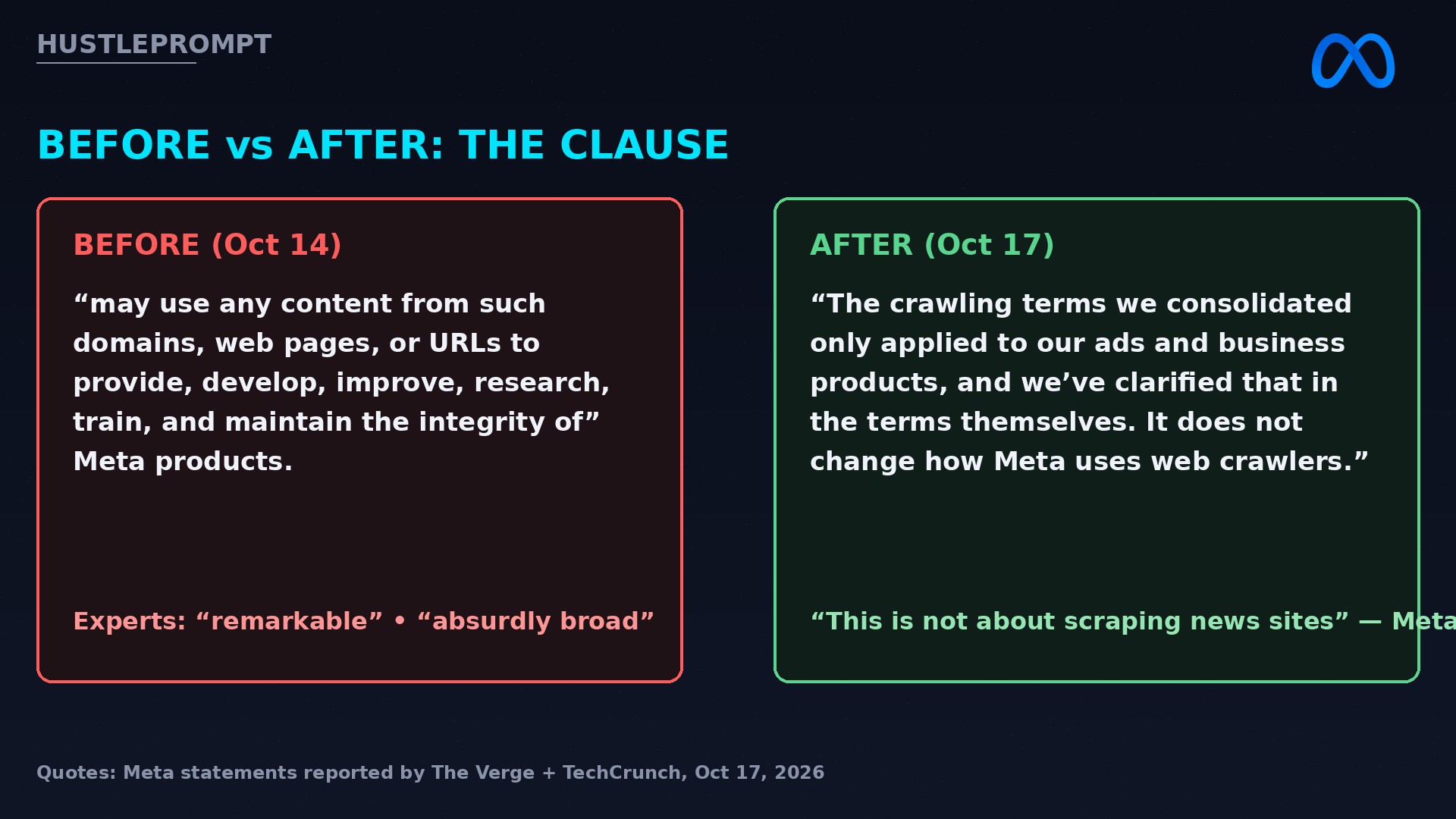
The original update, posted October 14, declared that Meta could “use any content from [a business account’s] domains, web pages, or URLs to provide, develop, improve, research, train, and maintain the integrity of” Meta products and services.
That word — train — is what set off the alarm. Legal experts told Nieman Lab a “remarkable provision” that could let Meta scrape any publisher’s site holding a Meta business account and use the content to train AI models.
The revised terms do two things:
- The word “train” is gone. The revised text drops the training reference entirely.
- Crawling is narrowed. Meta says the terms “only applied to our ads and business products” — and now say so explicitly.
The money story: your content has a price tag
Theo Bamber, CEO of a UK news media trade group, said the data at stake was worth “millions, or billions” in a licensing market. Training data is now an asset class.
The scope was the quiet bombshell. Per The Register’s reporting, “business customers” covered ads, marketing messages, product catalogs, Pages, Groups used for business purposes, Ads Manager, and Meta Business Suite. Millions of small businesses were swept in — and the only opt-out was quitting Meta’s products for business.
| What happened | The number | Why it matters for you |
|---|---|---|
| Backlash to reversal | 3 days | Publisher pressure moved a trillion-dollar company in 3 days |
| Licensing market value | “Millions, or billions” | Your archive may be a licensable asset, not just traffic inventory |
| Who the terms covered | Ads, Pages, Business Suite, catalogs, Ads Manager | If you advertise on Meta, you were inside the blast radius |
| Original effective date | October 30, 2026 | Reporting has not confirmed whether that date still holds for the revised text |
What Meta says vs. what changed
Meta insists nothing about its actual crawling changed. Spokesman Andy Stone said robots.txt preferences are still honored: “This is not about scraping news sites.” Spokesperson Daniel Roberts added: “These updates don’t give us new rights that supersede those preferences.”
No company rewrites its terms in three days over a misunderstanding. Meta beat a major copyright suit last year, but other AI-training cases — including against Meta — continue. The training-data fight is the industry’s defining battle, and this episode shows the front line runs through your terms of service. See the full timeline of Meta’s statement and the backlash for every quote.
The 3-day reversal, step by step
Oct 14 — Meta ships the terms
New terms claim the right to use “any content” from business domains to train Meta products.
Oct 15-16 — The backlash
Legal experts call it “remarkable” and “absurdly broad.” Publishers warn of scraping news sites for AI training.
Oct 17 — Meta folds
“We’ve heard you.” The word “train” is pulled; crawling is limited to ads and business products.
Now — Your move
Audit robots.txt, read the revised terms, price your content — licensing is a real market.
How to protect — and profit from — your content
Treat this as a drill:
- Audit your robots.txt this week. Decide explicitly which AI crawlers may touch your pages. Meta says it honors robots.txt — make yours say what you mean.
- Read the revised Commercial Terms and confirm the current effective date on Meta’s terms page.
- Watch your server logs. Unknown bots hitting your site are an early warning. Log the user agents, then block or allow deliberately.
- Price your content. If AI labs are buying licenses, your archive has a price. Talk to a lawyer about how platform terms affect your rights.
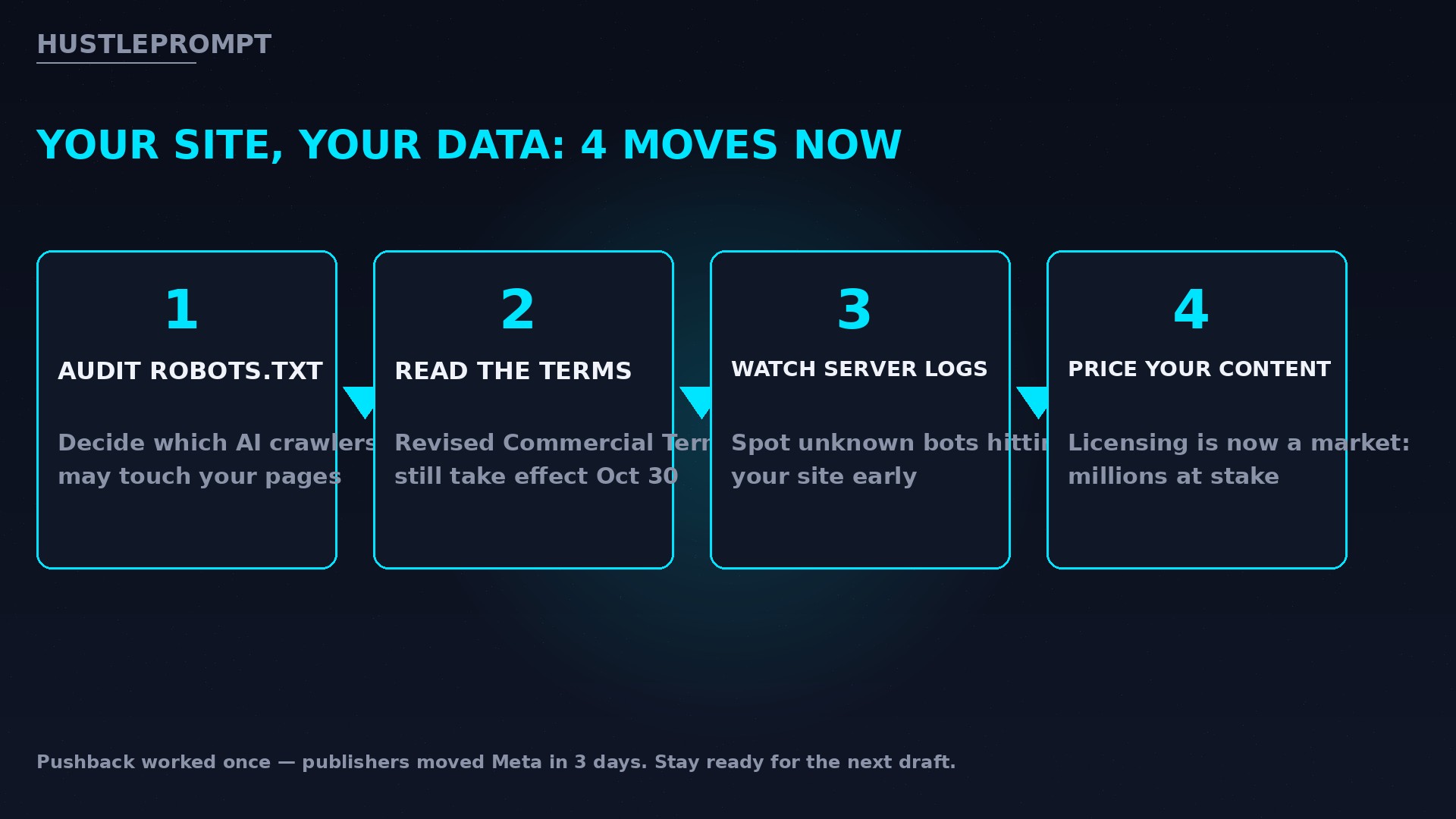
Pushback worked: publishers spotted the clause, experts amplified it, and Meta folded in 72 hours. That is the playbook — and the licensing market is the prize.
Frequently asked questions
Did Meta remove the AI training language from its terms?
Yes. On October 17, 2026, The Verge reported the passage no longer appears on Meta’s Commercial Terms page; TechCrunch confirmed it. The word “train” was removed and crawling limited to ads and business products.
What did the original clause say?
Meta claimed it could “use any content” from a business account’s domains, pages, or URLs to “provide, develop, improve, research, train, and maintain” its products. Experts said that could cover scraping publishers’ sites to train AI.
Did Meta stop crawling websites?
No. Meta says the change does not alter how it uses web crawlers, and robots.txt preferences are still honored. The revision narrows what the terms claim the crawling is for.
Who was affected by the original terms?
Business customers — users of ads, marketing messages, product catalogs, Pages, Groups used for business, Ads Manager, and Meta Business Suite. The only opt-out was quitting Meta’s products for business.
When do the revised terms take effect?
The original update was set for October 30, 2026, but reporting hasn’t confirmed whether that date holds for the revised text.
Can I get paid for content used in AI training?
Possibly. Labs increasingly license publisher content, and trade groups cite a market worth millions or billions. Audit robots.txt and consult a lawyer before granting rights.
Why did Meta back down so fast?
Legal experts called it “absurdly broad,” publishers pushed back publicly, and the story spread in days. “We’ve heard you” is about as close to a concession as Big Tech gets.
Keep Reading