
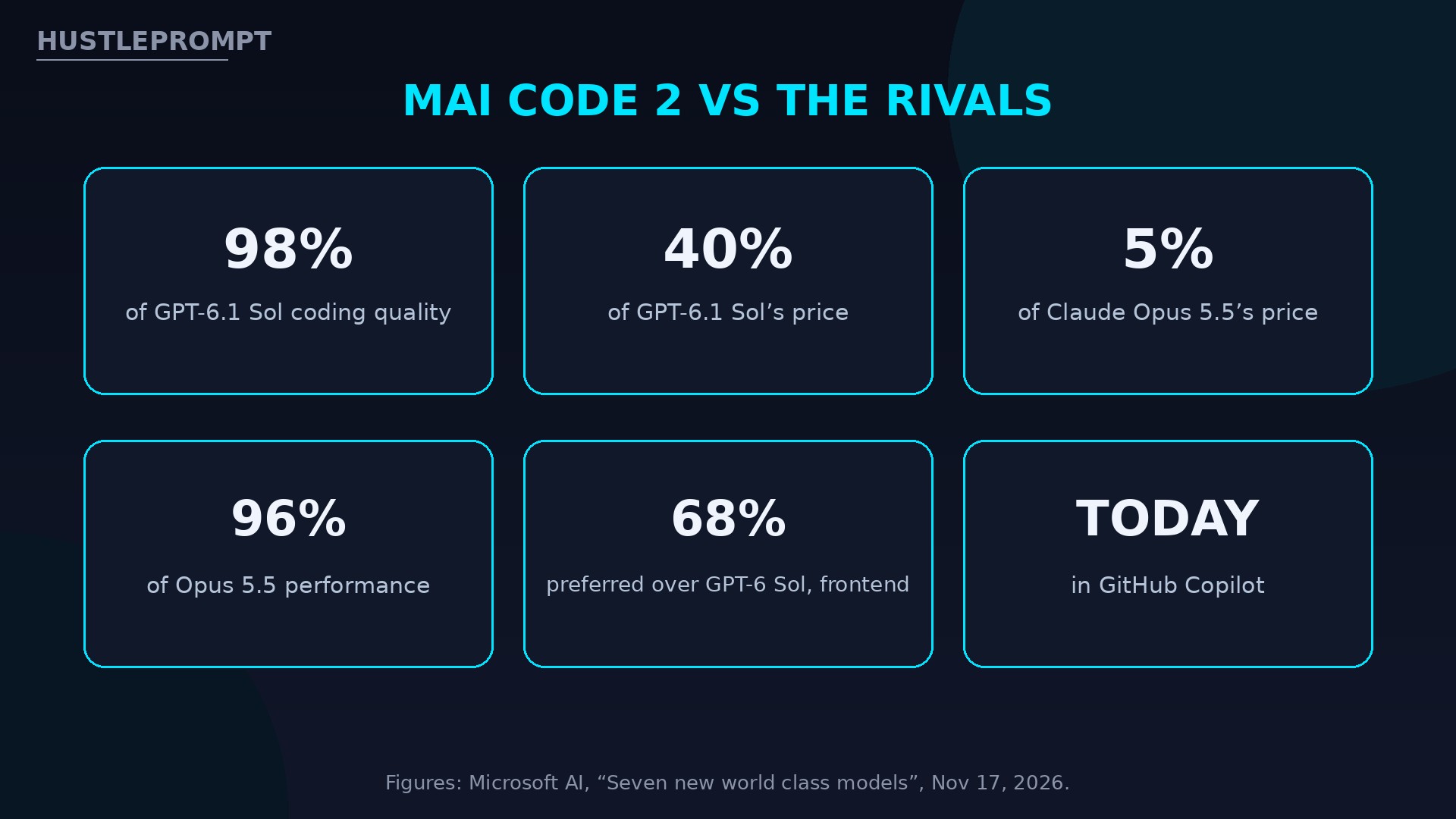
MAI Code 2 does 98% of what GPT-6.1 Sol does in everyday coding, at about 40% of the price. That is the headline from Microsoft Ignite 2026, where Microsoft on November 17 launched a family of seven new MAI models built for one purpose: frontier-level work at a price that lets you run agents around the clock.
The timing is not an accident. OpenAI launched GPT-6.2 Astra and Sol on the very same day, cutting Astra’s price 20%. Microsoft answered within hours with its own price war — not one model, but seven, covering coding, cybersecurity, image editing, live voice, transcription and decision-making. For anyone who pays for AI by the token, the frontier just got a lot cheaper on both sides of the same day.
The strategy is specialization. Instead of one giant model that does everything, Microsoft builds smaller models tuned for one job and prices them far below the general-purpose flagships they compete with. Its AI chief, Mustafa Suleyman, put it plainly: specialization concentrates more tokens, knowledge and expertise within an unchanged number of parameters. The trade is explicit too: these models are built for everyday work, not for fundamental science research or very long-horizon agent jobs. Know the trade, and the savings are real.

The seven models at a glance
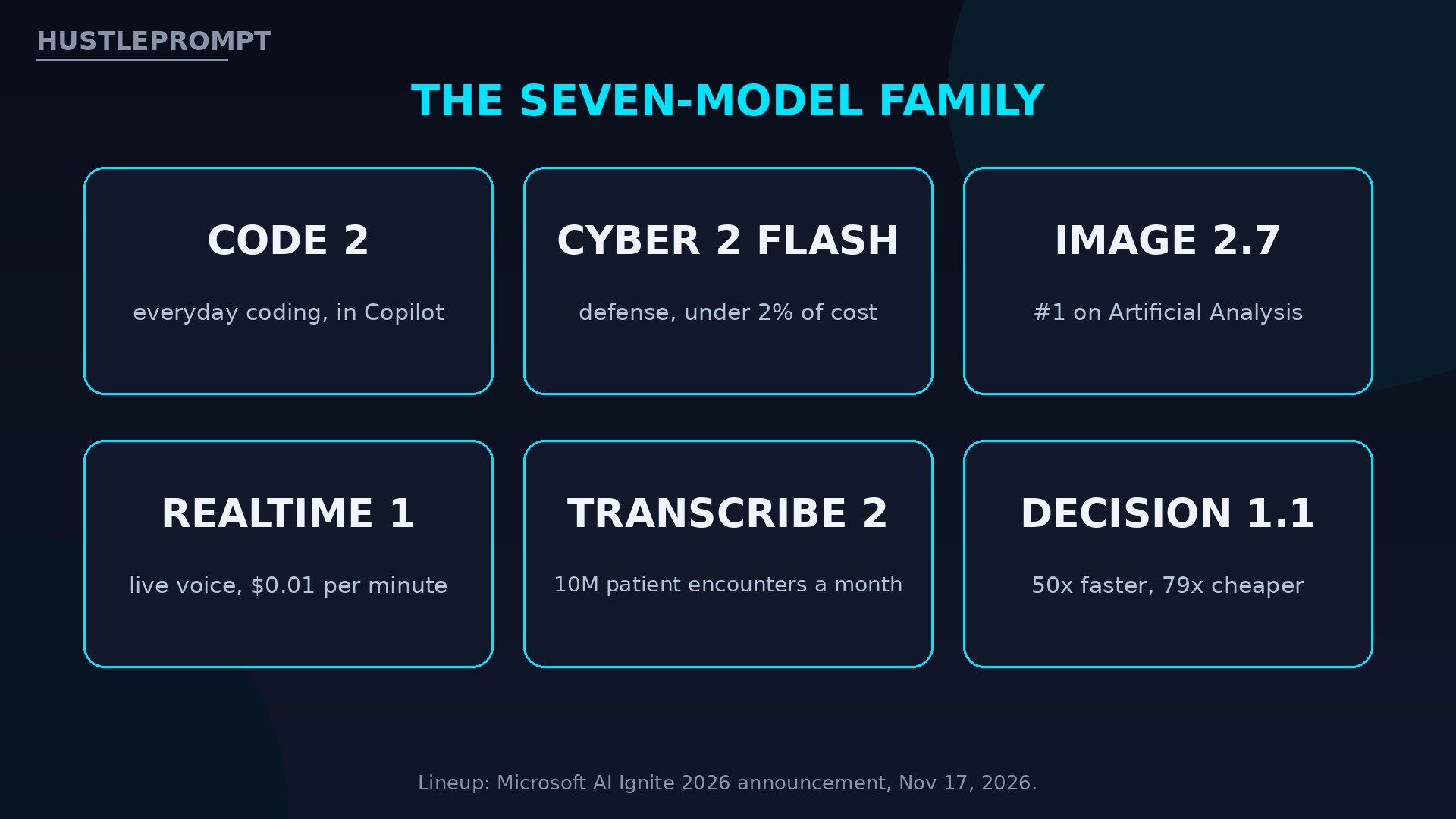
Microsoft says it is releasing a family of seven world-class models today. Here is the full lineup, with each model’s headline claim from Microsoft’s own announcement.
| Model | What it does | Microsoft’s headline claim | Available |
|---|---|---|---|
| MAI Code 2 | Everyday enterprise coding | 98% of GPT-6.1 Sol at 40% of the price; 96% of Claude Opus 5.5 at 5% | GitHub Copilot today |
| MAI Code 2 Flash | High-volume routine coding | Matches GPT-6 Luna at 65% of the price; Haiku 5.5 at 20% | GitHub Copilot; limited preview in Foundry |
| MAI Cyber 2 Flash | Cybersecurity defense | Matches GPT-6 Astra at under 2% of the cost per task | MDASH; Foundry |
| MAI Image 2.7 | Image editing | #1 on Artificial Analysis; beats GPT Image 2.6 Sunburst at 1/5 the price | Microsoft Foundry |
| MAI Realtime 1 | Live speech-to-speech | Outperforms GPT-Realtime 2.1; from $0.01 per audio minute | MAI Labs; register interest |
| Dragon Copilot Transcribe | Medical transcription (MAI Transcribe 2) | 10M patient encounters a month; multilingual error rates halved | Dragon Copilot, live |
| Decision 1.1 | Routing, classification, verification | 50x faster, 79x cheaper than GPT-Sol 6.1; 4,000 customers | Generally available |
Two notes on that table. First, MAI Image 2.7 was first previewed on October 27, 2026 — today’s news for it is availability in Microsoft Foundry as part of the family, plus a Flash variant at about $10 per 1,000 images. Second, every performance claim above is Microsoft’s own, measured on benchmarks Microsoft selected. The honest caveat, carried in Reuters’ reporting of the launch, is that promotional discounts account for some of the pricing advantages. Treat the percentages as Microsoft’s case, not as independent test results.
Watch: Satya Nadella and Judson Althoff open Microsoft Ignite 2026 on Microsoft’s official YouTube channel.
MAI Code 2: the headline act
MAI Code 2 is the model most readers will actually use, because it is the one that lands where developers already work: GitHub Copilot, starting today. Microsoft averaged its score over four widely used benchmarks for everyday enterprise coding — DeepSWE 1.1, Terminal Bench 2.1, SWE-Atlas and FrontierCode v1.1 — and reports 98% of GPT-6.1 Sol’s performance at about 40% of the price, and 96% of Claude Opus 5.5’s performance at just 5% of the price.
It is also tuned for the visible part of coding. In a blind, side-by-side evaluation of frontend work, developers preferred MAI Code 2 over GPT-6 Sol 68% of the time. Dashboards and visualizations are an explicit design goal, not an accident.
The limits are stated on the tin. Microsoft says Code 2 is built to prioritize the coding work customers do every day, and is explicitly not yet tuned for harder problems such as fundamental science research and very long-horizon agentic work. If your job is shipping features, fixing bugs and building internal tools, that trade costs you nothing. If your job is novel research, keep the frontier model.
| MAI Code 2 vs rival | Performance | Price | Benchmark basis |
|---|---|---|---|
| vs GPT-6.1 Sol | 98% | ~40% | 4 benchmarks: DeepSWE 1.1, Terminal Bench 2.1, SWE-Atlas, FrontierCode v1.1 |
| vs Claude Opus 5.5 | 96% | 5% | Same 4-benchmark average |
| vs GPT-6 Sol (frontend) | Preferred 68% of the time | — | Blind side-by-side developer evaluation |
| MAI Code 2 Flash vs GPT-6 Luna | Matches | 65% | 3 benchmarks: DeepSWE 1.1, Terminal Bench 2.1, SWE-Atlas |
| MAI Code 2 Flash vs Haiku 5.5 | Matches | 20% | Same 3-benchmark set |
MAI Cyber 2 Flash: frontier defense at 2% of the cost
The cybersecurity model is the most aggressive claim in the family. MAI Cyber 2 Flash matches GPT-6 Astra’s quality at less than 2% of the cost per task on the CyberGymE2E benchmark, according to Microsoft. It is also priced 86% lower on output tokens than MAI Cyber 1.1 Flash, so existing customers of Microsoft’s MDASH agentic code scanner get a stronger model at a lower price.
The adoption numbers behind it are concrete. MAI Cyber models already account for almost 40% of scans in MDASH, and 90% of scans that started with MAI continued to use it. That is not a launch claim — it is usage data from a product defenders already run. Microsoft’s pitch is that security monitoring has to run 24-7, and only a model this cheap makes always-on defense affordable. With AI tools surfacing more software vulnerabilities every month, a defender that costs 2% of the flagship is a budget line that finally fits.
SWITCH → ROUTE → FINE-TUNE → SAVE
1. SWITCH
Move everyday coding in GitHub Copilot to MAI Code 2: 98% of GPT-6.1 Sol at 40% of the price.
2. ROUTE
Put Decision 1.1 in front of your agents: 50x faster, 79x cheaper, so the big model only runs when it must.
3. FINE-TUNE
Tune Code 2 Flash on your own data in Foundry. Alaska Airlines went from 81.2% to 91.1% accuracy.
4. SAVE
Pocket the difference: the same agent workload, a fraction of the token bill, every single day.
Image, voice and transcription
MAI Image 2.7 is now the top-ranked image editing model on Artificial Analysis, outperforming GPT Image 2.6 Sunburst at just one-fifth of the price, according to Microsoft. For text-to-image generation it ranks fourth, making Microsoft the second-best lab on that measure. The Flash variant brings high-volume image generation at about $10 per 1,000 images. Both are available in Microsoft Foundry.
MAI Realtime 1 is Microsoft’s first live speech-to-speech model, built for natural, low-latency conversations. Microsoft says it outperformed GPT-Realtime 2.1 across external and Dynamics 365 benchmarks, and prices it from $0.01 per audio minute. You can try it at MAI Labs.
Dragon Copilot Transcribe, built on MAI Transcribe 2, is the quiet giant of the family. Microsoft calls it the world’s fastest and most accurate multilingual transcription model. It already powers 10 million patient encounters a month, halves error rates in multilingual workflows, and is in the hands of a third of US physicians. It now powers 100% of doctor-patient conversation transcriptions inside Dragon Copilot. That is a deployed product at national scale, not a demo.
Decision 1.1 and Licensed Weights: the enterprise play
Decision 1.1 is the model most businesses will feel first, because it sits in front of everything else. It handles routing, classification, prioritization, verification and workflow control — the small decisions that decide whether an expensive model ever needs to run. Microsoft says it is 50 times faster and 79 times cheaper than GPT-Sol 6.1, is used by 4,000 customers, and leads on the AA Decision Index. It is generally available now.
MAI Licensed Weights is the bigger strategic move. Enterprises can take a frontier MAI model, customize it with their own data, and run it securely inside their own Azure environment, under their own control. Suleyman said the arrangement would “feel like open source” while giving customers greater security and control. The proof point Microsoft offers is AT&T, which built a custom model for 5G network operation analytics that outperformed GPT-6.1 Sol at 50 times cheaper cost.
“My team is building true superintelligence.”
— Mustafa Suleyman, Microsoft AI chief, speaking to Reuters at Ignite, November 17, 2026
Suleyman declined to give a release timeline for Microsoft’s frontier general-purpose model, the one meant to compete across all tasks rather than one at a time. He said Microsoft has reached state-of-the-art results in pre-training and is progressing strongly in reinforcement learning. The seven specialized models are the business today; the general-purpose model is the promise.
The proof: Alaska Airlines and Docusign
Two customer stories in Microsoft’s own Foundry blog show what fine-tuning the cheap models can do. Alaska Airlines tested fine-tuning MAI-Code-2-Flash to help trained staff classify aircraft maintenance reports. The model scored 81.2% out of the box and 91.1% after tuning — outperforming GPT-6 Astra and GPT-6.1 Sol at a fraction of the cost, with qualified employees keeping responsibility for review and final decisions.
Docusign, which already cut AI processing costs by 90% with fine-tuned models in Foundry, is now fine-tuning MAI models to read agreements. The pattern is the same in both cases: take a cheap specialized model, tune it on your own data, beat the flagship on your own task. That is the playbook Microsoft is selling, and it is the one that turns a 40%-of-the-price model into a 10%-of-the-cost workflow.
Beyond the models: the rest of Ignite day one
The models were the headline, but the keynote covered the whole stack. Microsoft IQ is a new enterprise context platform that lets teams package their know-how into reusable business plugins. Copilot Workspaces gives people and agents a shared space to work as a team, Autopilot runs recurring tasks without being prompted, and Copilot Code lets anyone build dashboards and apps in plain language. Salesforce in Copilot arrives in preview with more than 38 pre-built sales skills, as part of a new Copilotforce partnership.
On trust, Microsoft Perception is now generally available, bringing specialized agents to find, defend and remediate vulnerabilities, and Microsoft launched an AI Transparency Initiative with customers and partners. On infrastructure, Cobalt 200 virtual machines are generally available today, delivering up to 50% better performance than the previous generation and reaching 23 regions by year end. Azure Catalyst brings Azure and GitHub agentic tools together for modernizing apps, data and infrastructure.
How to profit from the MAI price war: 5 moves
Seven cheaper models are only useful if you switch something to them. Five concrete moves:
- Switch everyday coding to MAI Code 2 in GitHub Copilot. It is available today. Start with routine work — explanations, targeted edits, fixes — and measure the token bill for a week against your current model.
- Put Decision 1.1 in front of your agents. Let the 50x-faster, 79x-cheaper router decide which requests deserve the expensive model. Most will not.
- Fine-tune Code 2 Flash on your own data. Follow the Alaska Airlines playbook: a small model tuned on your task can beat the flagship on that task. Foundry’s managed training does the heavy lifting.
- Price voice agents on Realtime 1. At $0.01 per audio minute, a voice agent that was too expensive to run all day becomes a rounding error. Rebuild your cost model around the new rate before you rebuild the agent.
- Ask about Licensed Weights if you hold sensitive IP. If your data cannot leave your Azure environment, a licensed MAI model you customize and control is the way to keep the savings without giving up the keys.
What to watch
Three things will show whether the MAI price war is real or just a launch-day chart.
- Independent benchmarks. Microsoft’s comparisons use selected benchmarks. Watch Artificial Analysis, LMArena and the coding leaderboards for independent scores on Code 2 and Cyber 2 Flash.
- GitHub Copilot traffic. Suleyman predicted substantial adoption of MAI Code 2 in Copilot but declined to set a target for the share of traffic moving to Microsoft’s own models. The traffic split is the number that matters.
- The frontier model’s timeline. Microsoft is building a general-purpose model to compete across all tasks. When it ships — and at what price — decides whether the seven specialists are a strategy or a stopgap.
The honest summary is this: Microsoft just made it dramatically cheaper to run coding, security, image, voice and decision workloads, with the receipts from real customers to back the claim. The benchmarks are Microsoft’s own, the discounts are partly promotional, and the frontier model is still to come. But the models are live today in the tools developers already use, and the price gap — 40% of the cost for 98% of the performance — is too big to ignore. Try the cheap model first. Keep the expensive one for the work that proves it needs it.
Frequently asked questions
What did Microsoft announce at Ignite 2026?
On November 17, 2026, Microsoft launched a family of seven MAI models at its Ignite conference in San Francisco: MAI Code 2, MAI Code 2 Flash, MAI Cyber 2 Flash, MAI Image 2.7, MAI Realtime 1, Dragon Copilot Transcribe and Decision 1.1. The keynote also introduced Microsoft IQ, new Copilot features, Salesforce in Copilot, Microsoft Perception and Cobalt 200 virtual machines.
How cheap is MAI Code 2 really?
Microsoft says MAI Code 2 delivers 98% of GPT-6.1 Sol’s everyday coding quality at about 40% of the price, and 96% of Claude Opus 5.5’s performance at just 5% of the price, averaged over four coding benchmarks. The comparisons use benchmarks Microsoft selected, and Reuters notes promotional discounts account for some of the pricing advantage.
Where can I use MAI Code 2 today?
MAI Code 2 is available in GitHub Copilot starting today, November 17, 2026. MAI Code 2 Flash is in GitHub Copilot and in a limited-access preview in Microsoft Foundry, where it can also be fine-tuned on your own data.
Is MAI Cyber 2 Flash really as good as GPT-6 Astra?
Microsoft says MAI Cyber 2 Flash matches GPT-6 Astra’s quality at less than 2% of the cost per task on the CyberGymE2E benchmark, and it is priced 86% lower on output tokens than MAI Cyber 1.1 Flash. MAI Cyber models already handle almost 40% of scans in Microsoft’s MDASH code scanner. Independent verification of the benchmark claim is still to come.
What is MAI Realtime 1?
MAI Realtime 1 is Microsoft’s first live speech-to-speech model, built for natural, low-latency voice conversations. Microsoft says it outperformed GPT-Realtime 2.1 in its evaluations and prices it from $0.01 per audio minute. You can try it at MAI Labs.
What are MAI Licensed Weights?
MAI Licensed Weights let enterprises take a frontier MAI model, customize it with their proprietary data, and run it securely inside their own Azure environment, under their own control. Microsoft’s example is AT&T, whose custom model for 5G network analytics outperformed GPT-6.1 Sol at 50 times cheaper cost.
When will Microsoft ship a frontier general-purpose model?
Microsoft has not given a timeline. AI chief Mustafa Suleyman told Reuters at Ignite that Microsoft has reached state-of-the-art results in pre-training and is progressing strongly in reinforcement learning, but declined to provide a release date. The seven specialized models are the offer today.
Keep Reading
Sources: Microsoft AI, “Seven new world class models at scalable price-performance” (Nov 17, 2026); Microsoft Source, “Microsoft Ignite 2026: Empowering human ambition, intelligence and trust” (Nov 17, 2026); Microsoft Azure, “Microsoft Foundry continuous improvement helps agents learn” (Nov 17, 2026); Reuters on the MAI launch and Suleyman interview (Nov 17, 2026).