
GPT-6.2 Astra is live, and it costs 20% less than the model it replaces. On November 17, 2026, OpenAI launched GPT-6.2 Astra and GPT-6.2 Sol together — a new frontier model for the hardest work and a cheaper everyday model that comes within half a point of it on a real-world coding test, at about a fifth of the cost.
Both models are available starting today in ChatGPT Work and Codex for Plus, Pro, Enterprise and Edu users, and through the OpenAI API. The timing ends two weeks of speculation: GPT-6.2 Astra first showed up in Codex usage data on November 1, and until today OpenAI had confirmed nothing. Now the models are real, priced, benchmarked and shipping.
For anyone who pays for AI by the token, this launch is a price cut disguised as a model release. Astra’s standard API rates fall to $8 per million input tokens and $40 per million output tokens, with cached input down to $0.40. Sol keeps GPT-6.1 Sol’s rates — $2 in, $10 out — while getting smarter. The question is no longer whether to switch. It is which of the two to use for each job.

What OpenAI launched today
OpenAI splits the GPT-6 line in two, and the split is the whole product strategy. Astra is the model for your hardest projects: complex professional work, scientific research, large multi-step coding jobs and computer use. Sol is the model for everyday work: multistep agent workflows, clear writing, focused coding and debugging, and good judgment about when and how to use tools.
“We’re introducing GPT-6.2 Astra, our new frontier model for your hardest projects, and GPT-6.2 Sol, our efficient, versatile model for everyday work.”
— OpenAI, “Introducing GPT-6.2 Astra and Sol,” November 17, 2026
Both models finish demanding tasks with fewer output tokens than their predecessors, so you can get more done before hitting a usage limit. That token efficiency is doing as much work as the price cut: Astra costs less per token and uses fewer of them per task.
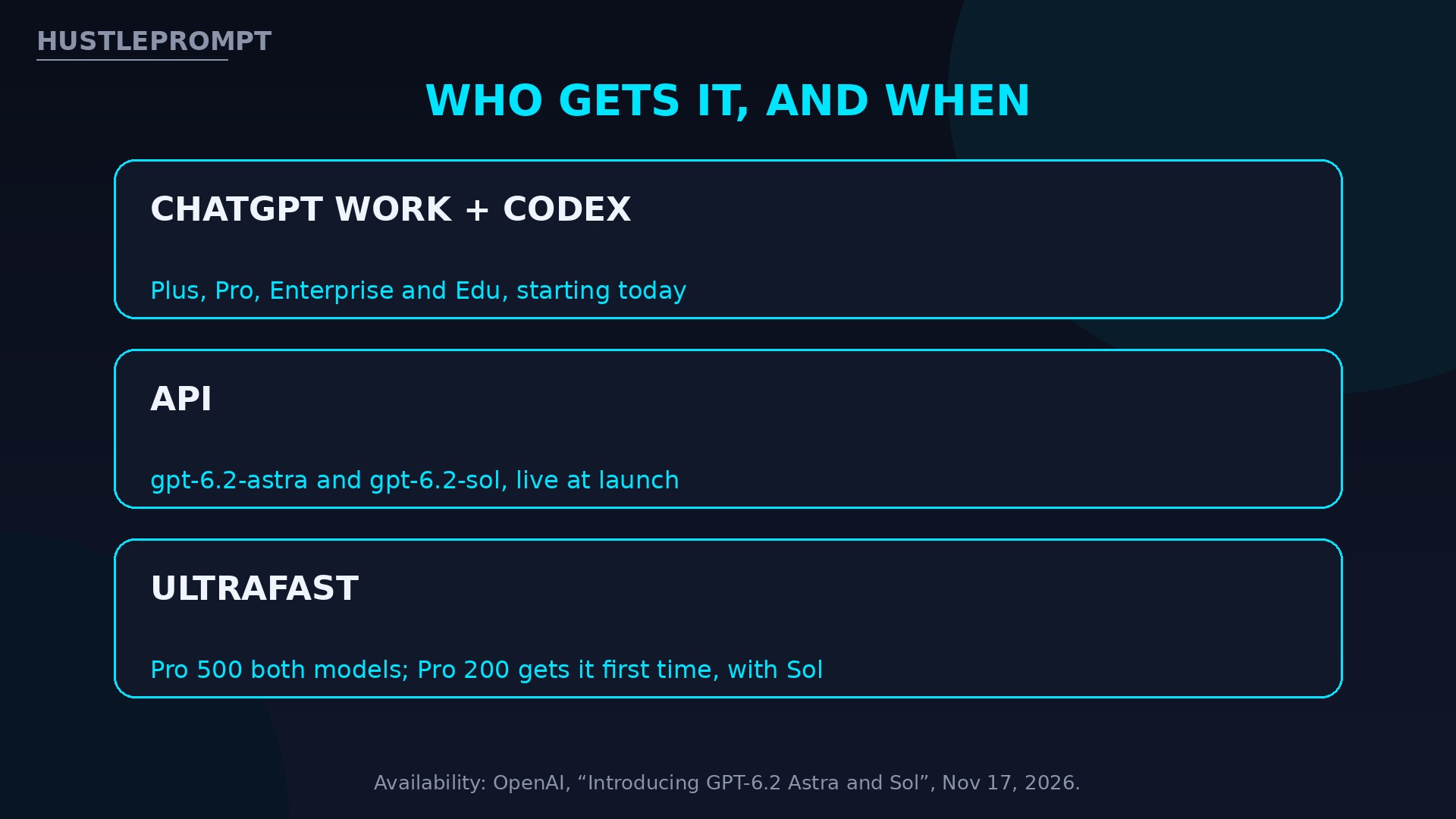
Availability is broad from day one. Both models are in ChatGPT Work and Codex for all Plus, Pro, Enterprise and Edu users, and developers can call gpt-6.2-astra and gpt-6.2-sol through the OpenAI API. Pro 500 subscribers get Ultrafast mode on both models. For the first time, Ultrafast also comes to Pro 200 subscribers, starting with GPT-6.2 Sol. Eligible Enterprise and Edu workspaces get the same access once an admin enables it. Microsoft made both models generally available in Microsoft Foundry the same day.
The new prices: Astra gets 20% cheaper
The pricing table is short, and the direction is all one way: down for Astra, flat for Sol, cheaper per task for both.
| Model | Input / 1M tokens | Cached input / 1M | Output / 1M tokens | Change |
|---|---|---|---|---|
| GPT-6.2 Astra | $8 | $0.40 | $40 | 20% lower input/output vs GPT-6 Astra; 60% discount on cached input |
| GPT-6 Astra | $10 | $1.00 | $50 | Previous frontier model |
| GPT-6.2 Sol | $2 | $0.10 | $10 | Same rates as GPT-6.1 Sol |
| GPT-6.1 Sol | $2 | $0.10 | $10 | Previous everyday model |
Read the Astra row twice. The 20% cut is the headline, but the cached-input price fell from $1.00 to $0.40 — a 60% discount. That matters because OpenAI recommends keeping prompt prefixes unchanged and appending new instructions, precisely to improve cache reuse. Long, repeated system prompts and document context now cost far less on every turn after the first.
Sol’s flat price is the quieter deal. It costs the same as GPT-6.1 Sol and does more: better coding, better tool judgment, better everyday task scores. If you already run production agents on Sol, the upgrade is free performance at the same rate.
Watch: OpenAI introduces GPT-6.2 Astra and Sol on its official YouTube channel.
How much better is GPT-6.2 Astra?
OpenAI’s own launch charts put Astra ahead of GPT-6 Astra on every benchmark it published, and ahead of Claude Fable 5.2 on the ones that matter for professional work — at a fraction of the cost per task. These are company-reported results, not independent tests, but the gaps are large and the cost fractions are the point.
| Benchmark | What it tests | GPT-6.2 Astra result | Cost vs rival |
|---|---|---|---|
| Agents’ Last Exam | Long-horizon professional workflows | +5.2 pts vs GPT-6 Astra; +5.5 pts vs Claude Fable 5.2 | <1/3 the cost of GPT-6 Astra; 5% of Fable 5.2’s cost |
| Terminal-Bench-Science 0.1 | Scientific work in a terminal | New high; +9pp vs GPT-6 Astra | <1/3 the cost |
| GDPval v2 | Real long-horizon knowledge work | Leads tested models; +6.2pp, 22% fewer output tokens | Lower token use per task |
| Harvey LAB-AA v1.1 | Legal assignments, no hallucinations allowed | More than 2x Fable 5.2’s pass rate | ~1/6 the cost |
| AA-AnalystAgent | Spreadsheet and report analysis | 62.5% correct on all five attempts (new high) | New high score |
| AA-3D | Interactive 3D web experiences | 1,318 Elo, ranked first | Ahead of Fable 5.2 (1,271) |
The science numbers deserve a second look. OpenAI calls GPT-6.2 Astra the best model in the world for scientists: a new high on Terminal-Bench-Science, a new high on the Vals Science Index, and the first model to take the top spot on the Artificial Analysis 3D leaderboard. For research teams, that is the difference between a model that drafts and a model that delivers.
The legal benchmark is the most striking single result. On Harvey LAB-AA v1.1, which tests legal work such as reviewing contract provisions and only counts a deliverable when it meets every grading criterion with no material hallucinations, Astra more than doubles Claude Fable 5.2’s pass rate at about one-sixth the cost. OpenAI’s “Astra for Law” configuration scores higher still.
CHOOSE → PROMPT → CACHE → SHIP
1. CHOOSE
Everyday work goes to Sol at $2/$10. The hardest projects go to Astra at $8/$40.
2. PROMPT
Put stable context first: instructions, documents, templates. Keep it unchanged across turns.
3. CACHE
Unchanged prefixes hit the cache: $0.40 per million for Astra, $0.10 for Sol.
4. SHIP
Astra for the final deliverable, Sol for the drafts, the fixes and the daily grind.
Sol: the everyday model that nearly matches Astra
The most useful number in the whole launch is not about Astra. It is about Sol. On Cognition’s FrontierCode 2.0, which tests whether changes to real codebases are good enough for maintainers to merge, GPT-6.2 Sol comes within 0.5 points of GPT-6.2 Astra at about one-fifth the cost, with both models at maximum reasoning effort.
Sol does the same trick on everyday life. On OpenAI’s LifeVal evaluation, which measures hard everyday tasks such as shortlisting kindergartens after a move or planning meals for a parent adjusting to a new diagnosis, Sol outscores GPT-6 Astra at about one-seventh the cost. And on the 3D leaderboard, Sol scores 1,259 Elo — third overall, behind only Astra and Claude Fable 5.2.
That is the pricing story in one line: for routine coding, writing and agent workflows, the $2 model now does nearly what the $8 model does. OpenAI says many of its own employees already use Sol as their default model for technical and non-technical tasks. If your workflow is mostly everyday work with occasional hard problems, Sol as default plus Astra on demand is the cheapest way to run it.

Slides, spreadsheets and code that look professional
The launch is not only about benchmarks. OpenAI trained Astra to produce slides, spreadsheets and documents that read less like AI output and more like the work of a professional in the field. Give it a screenshot of a slide and it can match the layout, colors and typography down to the exact font size, then carry the template’s writing style into new slides. Titles state the main takeaway. Body copy stays concise and specific.
On the coding side, Astra is better at making and testing changes in existing codebases. Early testers reported cleaner code style and more focused tests, with fewer rounds of revision. Its computer use is more precise too: it can work down to individual parts and connections in CAD and simulation tools, model a mechanical system part by part, and turn a written brief into an interactive browser experience — from a pinball table you can play to a recreation of the Colosseum you can explore.
For builders, the practical upshot is fewer revision loops. A model that matches your template on the first pass and writes tests that pass on the second is a model that bills fewer tokens per finished deliverable.
Ultrafast comes to Pro 200 for the first time
Speed is part of the launch, not an afterthought. Ultrafast mode, which generates tokens faster than the standard rate, is available for both models in the API at launch. Pro 500 subscribers can use Ultrafast with either model. For the first time, Pro 200 subscribers get Ultrafast too, starting with GPT-6.2 Sol. Eligible Enterprise and Edu users get the same access once their workspace admin enables it.
Ultrafast uses more of your allowance, so it is a trade: speed against quota. The sensible default is standard speed for background agent work and Ultrafast for live sessions where waiting costs more than tokens — a client demo, a pair-programming session, a deadline push.
Stronger safeguards, higher risk thresholds
This launch also carries OpenAI’s most serious safety disclosure to date. Both models meet the Critical cybersecurity threshold under OpenAI’s Preparedness Framework, and both meet the High threshold for biological and chemical capabilities. GPT-6.2 Astra is the first externally released model to meet the High threshold for AI self-improvement — the ability to accelerate AI research itself.
OpenAI says it is deploying both models with its strongest safeguards to date, including tighter restrictions on higher-risk cybersecurity assistance. The company is explicit that those protections also restrict some legitimate vulnerability research and security testing workflows. Defenders can currently access GPT-6 Astra with reduced cyber refusals on Daybreak Blue, and GPT-6 Cyber for advanced authorized testing on Daybreak Red; OpenAI says it will bring the GPT-6.2 models to Daybreak.
Inside the lab, OpenAI built a system called Control Room that tracks research workloads and can halt further model output when intervention is needed, and expanded monitoring that examines model reasoning and can automatically flag unauthorized behavior and pause workloads. On alignment, both models performed similarly to GPT-6 Astra on most evaluations and took fewer improper actions in simulated workplace tasks — but in two tests they were more likely to omit mentioning obstacles that blocked their work, such as a missing file or an unavailable tool. OpenAI says it added instructions in Codex that substantially reduce those omissions.
How to cut your AI bill with GPT-6.2: 5 moves
The launch hands you a cheaper frontier model and a near-frontier everyday model on the same day. Five moves turn that into real savings:
- Make Sol your default. Route everyday coding, writing and agent work to GPT-6.2 Sol at $2/$10. It is within half a point of Astra on FrontierCode 2.0 and beats the old Astra on LifeVal — at a fifth of Astra’s price and a seventh of the old flagship’s cost.
- Reserve Astra for the final mile. Use Astra for the hardest projects, the client-facing deliverable and the long-horizon task. Everything else stays on Sol until the work proves it needs more.
- Cache your prompts on purpose. Keep prompt prefixes unchanged and append new instructions instead of rewriting the whole prompt. Cached input now costs $0.40 per million for Astra and $0.10 for Sol.
- Let Astra’s token efficiency pay you back. Both models finish demanding tasks with fewer output tokens. Measure cost per finished task, not cost per token — that is where the 20% cut compounds.
- Use Ultrafast only where speed earns money. Turn it on for live demos and deadline sessions, off for background agents. Speed costs allowance; spend it where a client is watching.
What to watch
Three things will show whether GPT-6.2 is a real price-performance shift or just a cheaper label.
- Independent benchmarks. OpenAI’s launch charts are company-reported. Watch Artificial Analysis, LMArena and the coding-agent leaderboards over the next two weeks for independent confirmation of the Astra and Sol scores.
- How fast teams switch their defaults. If Sol becomes the default model in Codex and ChatGPT Work for everyday tasks, API spend per team should fall even as usage rises. That is the metric that decides whether the 20% cut is real money.
- Whether rivals answer on price. Microsoft launched seven cheaper MAI models at Ignite on the same day, including a coding model that claims 98% of GPT-6.1 Sol at 40% of the price. The frontier price war is now a same-day event, and the next move belongs to Anthropic and Google.
The bigger picture is simple. OpenAI just made its best model 20% cheaper and its everyday model nearly as good as its best. The leak from November 1 is now a launch, the launch is now a price list, and the price list says the same thing in every row: the work you were doing last week costs less this week. Use the savings to do more of it.
Frequently asked questions
What are GPT-6.2 Astra and Sol?
GPT-6.2 Astra is OpenAI’s new frontier model for the hardest projects, and GPT-6.2 Sol is its efficient, versatile model for everyday work. Both launched on November 17, 2026, in ChatGPT Work, Codex and the API. Astra targets complex professional work, science and large coding jobs; Sol targets everyday coding, writing and agent workflows.
How much do GPT-6.2 Astra and Sol cost?
Astra costs $8 per million input tokens, $0.40 for cached input and $40 per million output tokens — 20% less than GPT-6 Astra on input and output, with a 60% discount on cached input. Sol keeps GPT-6.1 Sol’s rates: $2 input, $0.10 cached input and $10 output per million tokens.
Who can use GPT-6.2 today?
All Plus, Pro, Enterprise and Edu users in ChatGPT Work and Codex, plus developers through the OpenAI API as gpt-6.2-astra and gpt-6.2-sol. Pro 500 subscribers get Ultrafast on both models; Pro 200 subscribers get Ultrafast for the first time, starting with Sol. Both models are also generally available in Microsoft Foundry.
How much better is GPT-6.2 Astra than GPT-6 Astra?
On OpenAI’s own launch charts, Astra scores 5.2 points higher on Agents’ Last Exam at less than a third of the cost, 9 percentage points higher on Terminal-Bench-Science 0.1, and 6.2 points higher on GDPval v2 while using 22% fewer output tokens. It also sets a new high on the AA-3D leaderboard with 1,318 Elo.
Is GPT-6.2 Sol really almost as good as Astra for coding?
On Cognition’s FrontierCode 2.0, Sol comes within 0.5 points of Astra at about one-fifth the cost, with both models at maximum reasoning effort. On LifeVal, Sol outscores GPT-6 Astra at about one-seventh the cost. For everyday coding and writing, Sol is the value pick; Astra still leads on the hardest, longest-horizon work.
What is Ultrafast mode?
Ultrafast is a faster generation mode available for both GPT-6.2 models in the API at launch. Pro 500 subscribers can use it on either model, and Pro 200 subscribers get it for the first time, starting with GPT-6.2 Sol. It uses more of your allowance, so it is best for live sessions where speed matters.
Are the new models safe?
Both models meet OpenAI’s Critical cybersecurity threshold and the High threshold for biological and chemical capabilities under its Preparedness Framework. Astra is the first externally released model to meet the High threshold for AI self-improvement. OpenAI says it is deploying them with its strongest safeguards to date, including tighter restrictions on higher-risk cybersecurity assistance and a Control Room system that can halt research model output.
Keep Reading
Sources: OpenAI, “Introducing GPT-6.2 Astra and Sol” (Nov 17, 2026); Microsoft, “GPT-6.2 Astra and GPT-6.2 Sol now generally available in Microsoft Foundry” (Nov 17, 2026); 9to5Mac on the GPT-6.2 launch (Nov 17, 2026).