
The slowest part of engineering is about to get a AI upgrade. On October 21, 2026, Mistral AI and NVIDIA announced a collaboration to build AI-native engineering workflows — combining Mistral’s models and physics AI with NVIDIA’s accelerated computing to speed up simulations and close the loop between design, simulation, and AI model training. And crucially, they plan to publish public benchmarks and open datasets so the whole industry can measure what actually works.
“For too long, the pace of engineering has been set by the pace of simulation,” said Neil Ashton, Mistral’s VP of Computational Engineering. If this collaboration delivers, waiting hours for a simulation to finish becomes the exception, not the rule.
What Mistral and NVIDIA actually announced
According to Mistral’s official announcement, the partnership has four moving parts:
- AI-native engineering workflows — combining Mistral Large 4 with Mistral’s data-generation and physics-modeling pipelines, accelerated by NVIDIA’s CUDA-X libraries and NVIDIA Warp.
- Omniverse integration — Mistral’s models plugged into NVIDIA Omniverse libraries for GPU-accelerated 3D scene generation and SimReady asset creation.
- Public benchmarks and open datasets — a shared, open foundation to compare physics-model accuracy and validate automated CAD-to-simulation workflows.
- Agentic AI evaluations for CAE and EDA — tests that measure whether AI agents can use engineering tools, complete multistep workflows, and produce technically correct results — while also measuring execution time and computational cost.
The targets are computer-aided engineering (CAE: software that tests how designs behave under stress, heat, or airflow) and electronic design automation (EDA: the software chipmakers use to design and verify semiconductors). The industries in scope: aerospace, automotive, and semiconductors.
The tech stack, side by side
| Mistral brings | NVIDIA brings |
|---|---|
| Mistral Large 4 (~1T total params, 49B active), physics AI, data-generation pipelines | CUDA-X libraries + Warp for accelerated simulation |
| Open-weight models for sovereign, on-prem deployment | Omniverse for 3D scene generation and SimReady assets |
| European training infrastructure and engineering expertise | GPU-accelerated computing stack + expanding AI infrastructure |
This isn’t the pair’s first project: they previously co-developed Mistral NeMo and are working together through the NVIDIA Nemotron Coalition on a frontier open-weight base model.
The evidence: what we actually know
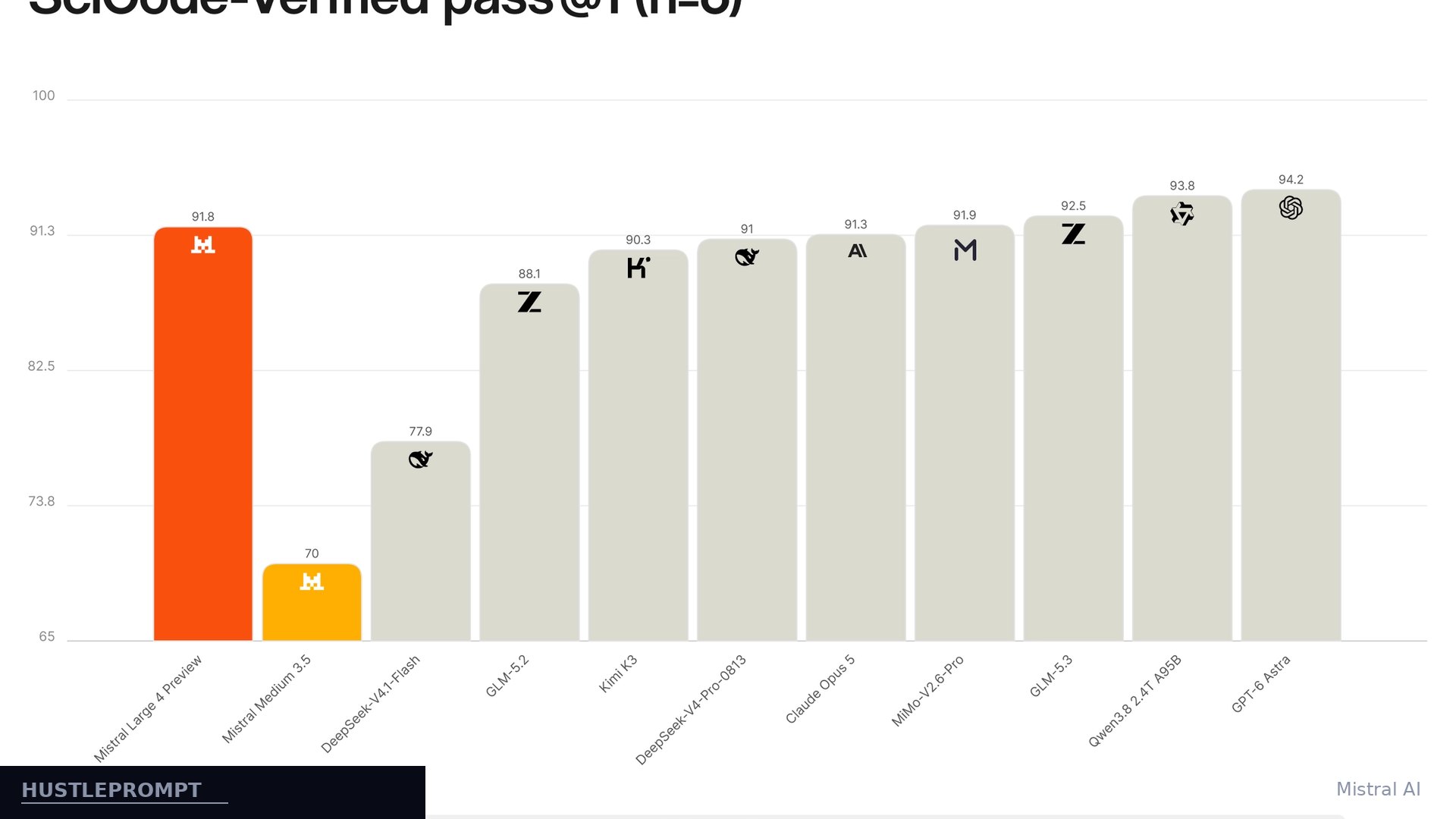
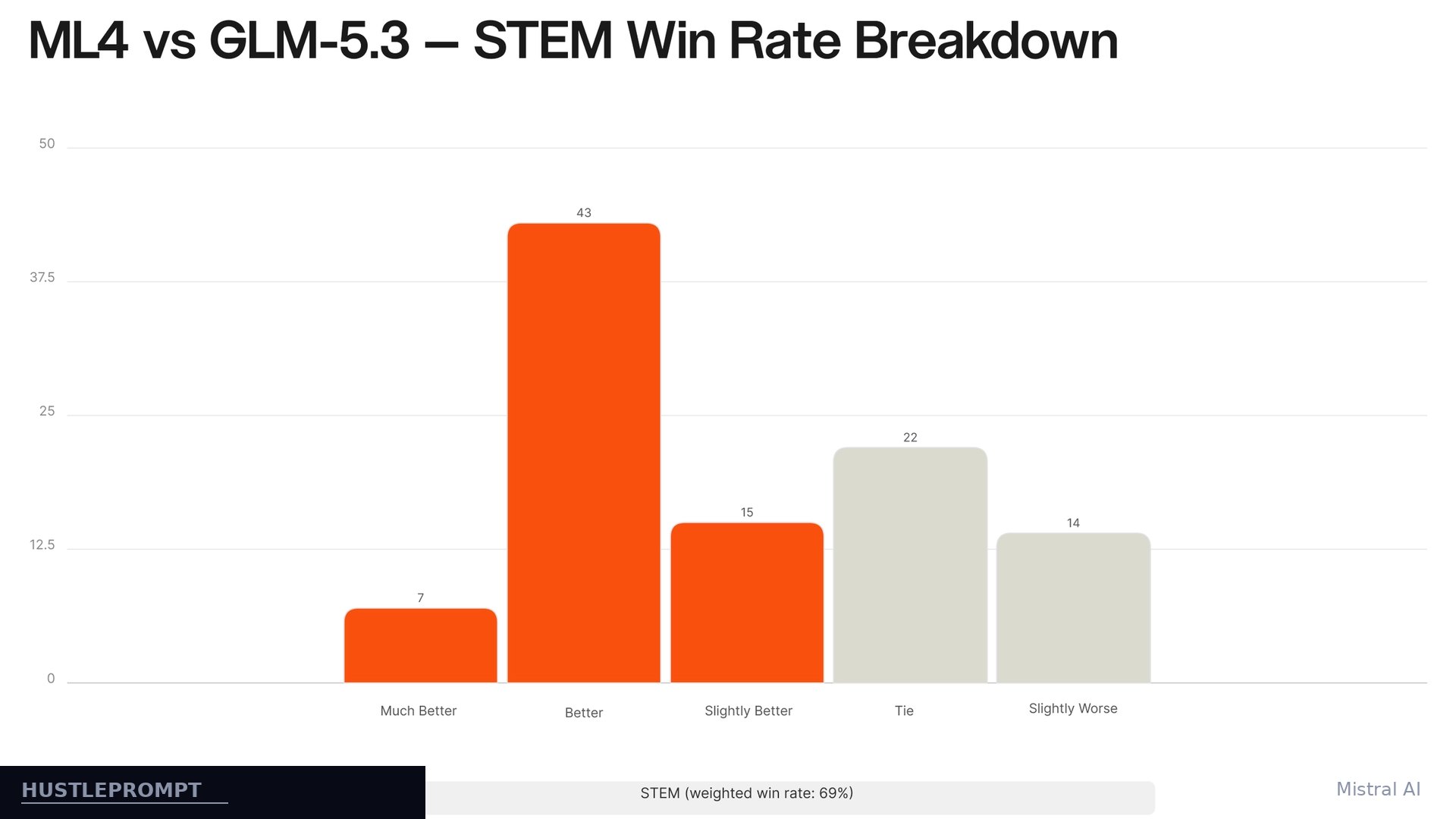
Mistral Large 4 — nicknamed “Le Chonk” — is the engine at the center of the plan. The official numbers:
- ~1 trillion total parameters, 49 billion active per token (mixture-of-experts).
- Trained on 3,800 NVIDIA Grace Blackwell GPUs in Mistral-operated European datacenters.
- Weights planned for release end of October (public preview API live now).
- State-of-the-art among open models on cybersecurity, finance, and legal workloads; 93% of Cybench challenges solved.
On the infrastructure side, Mistral says it is bringing additional NVIDIA-powered AI infrastructure online toward a 1 GW compute target by 2030. “The next wave of engineering breakthroughs will come from exploring ideas that were once too complex or time-consuming to test,” said Tim Costa, NVIDIA’s VP and GM of industrial and computational engineering.
One honest caveat: the announcement includes no measured simulation speedups and no release timetable for the benchmarks yet. This is a plan with serious backing, not a shipped product.
The closed loop, visualized
AI-NATIVE ENGINEERING WORKFLOW
CAD model
CUDA-X + Warp
Physics AI trains
Agent iterates
Public benchmarks + open datasets sit underneath the loop — measuring accuracy, tool use, execution time, and cost for physics models and CAE/EDA agents.
How to profit from AI-native engineering
The announcement is a roadmap of where engineering jobs and contracts are heading. Position early:
- Learn the stack now. CUDA-X, Warp, and Omniverse skills are already billable; physics-AI fluency on top of them will be rare and expensive. NVIDIA’s and Mistral’s docs are the free starting point.
- Watch the open benchmarks. When the public datasets land, build demos on them. A freelancer who can show “my agent passes the Mistral-NVIDIA CAE benchmark” will outbid generic AI consultants for manufacturing clients.
- Serve the simulation bottleneck. Aerospace, automotive, and semiconductor firms pay dearly for simulation time. Offer AI-assisted simulation audits that cut iteration cycles — the exact pain this partnership targets.
- Bet on open weights. Mistral Large 4’s weights drop end of October. European and regulated-industry clients needing sovereign, on-prem AI (cybersecurity, defense-adjacent, finance) are a ready market for deployment services.
- Build for the agent evaluations. The planned CAE/EDA agent tests define what “good” looks like. Tooling that helps agents use engineering software reliably is a product category about to get a measuring stick — and a market.
Frequently asked questions
What did Mistral and NVIDIA announce?
On October 21, 2026, they announced a collaboration to develop AI-native engineering workflows: Mistral Large 4 and Mistral’s physics AI combined with NVIDIA’s CUDA-X, Warp, and Omniverse — plus public benchmarks and open datasets for evaluating physics AI and engineering agents.
What is physics AI?
AI models trained to understand and predict physical behavior — how materials deform, fluids flow, or heat moves — so simulations run faster and engineers can test designs that were previously too complex or slow to evaluate.
What are CAE and EDA?
CAE (computer-aided engineering) is software that tests designs under stress, heat, or airflow. EDA (electronic design automation) is the software chipmakers use to design and verify semiconductors before manufacturing. Both lean heavily on simulation.
When will the open benchmarks and datasets arrive?
No date was given. The announcement commits to developing them as a central focus, but provides no measured speedups or release timetable yet.
What is Mistral Large 4’s role in the partnership?
It’s the flagship model at the center: ~1 trillion total parameters (49B active), trained on 3,800 NVIDIA Grace Blackwell GPUs in Europe, with open weights planned for end of October. Its multimodal and engineering capabilities feed the simulation and design workflows.
How can developers and businesses benefit?
Learn CUDA-X, Warp, and Omniverse now; build on the open benchmarks when they ship; offer AI-assisted simulation services to aerospace, automotive, and semiconductor firms; and prepare open-weight deployment services for regulated industries when Large 4’s weights land.
Keep Reading
Sources: Mistral AI official announcement, October 21, 2026; Mistral Large 4 launch details.