
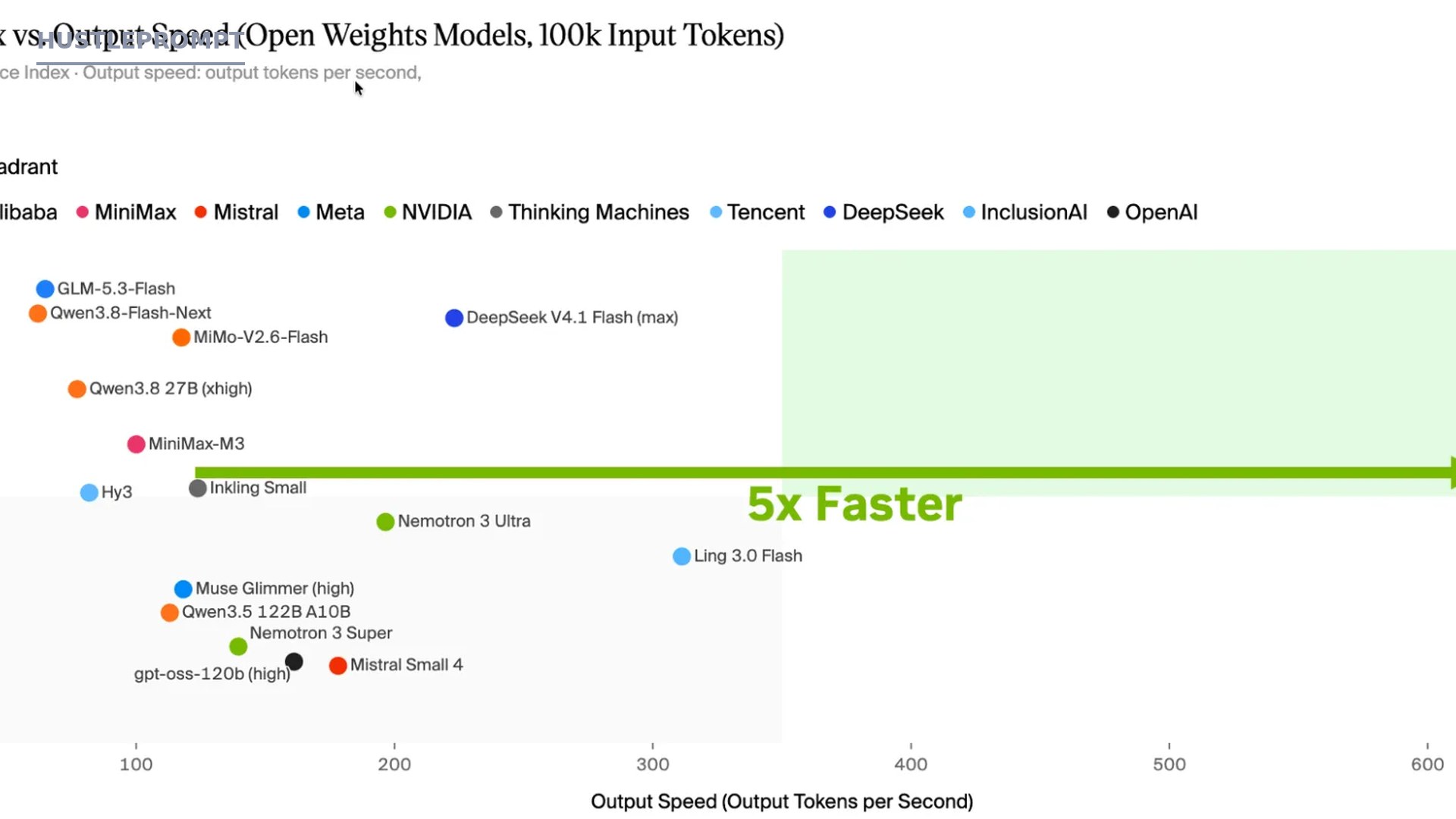
Your next enterprise AI agent might not need an API key. On October 15, 2026, NVIDIA released Nemotron 3.5 Super VL — a 120-billion-parameter open-weights multimodal model built specifically for always-on AI agents — and claims it delivers up to 5x higher throughput than other open models in its class.
That is NVIDIA’s own single-GPU test result. The real story for freelancers and agencies is economic: open weights you can download and fine-tune flip the unit economics of selling agent services — no per-token API bill, no sending client documents to a third-party cloud.
Here is what the model actually does, what the official numbers say, and how to turn it into paid work.
What NVIDIA just released
NVIDIA’s technical blog calls Nemotron 3.5 Super VL an open, customizable multimodal model for specialized enterprise workflows: one model that reads text, images, documents, and video — then reasons, calls tools, and writes code.
It uses a mixture-of-experts (MoE) architecture. Think of it as a hospital with 120 billion parameters of “staff,” where only 12 billion clock in for each token. You get the knowledge of a 120B model at roughly the compute cost of a 12B one.
| Spec | Nemotron 3.5 Super VL |
|---|---|
| Parameters | 120B total, 12B active per token (MoE) |
| Modalities | Text, image, document, video in; text out |
| License | Open weights (OpenMDW-1.1, per launch coverage) |
| Key techniques | NVFP4 quantization, speculative decoding (LiLiCorr), multi-token prediction |
| Customization | Post-train with NVIDIA NeMo (SFT, LoRA, RL); open datasets on Hugging Face |
| Deployment | Local (DGX Spark), data center, cloud; NVIDIA NIM and Dynamo |
Source: NVIDIA technical blog, October 15, 2026.
The numbers that matter
NVIDIA published unusually specific numbers — vendor claims, but real tests:
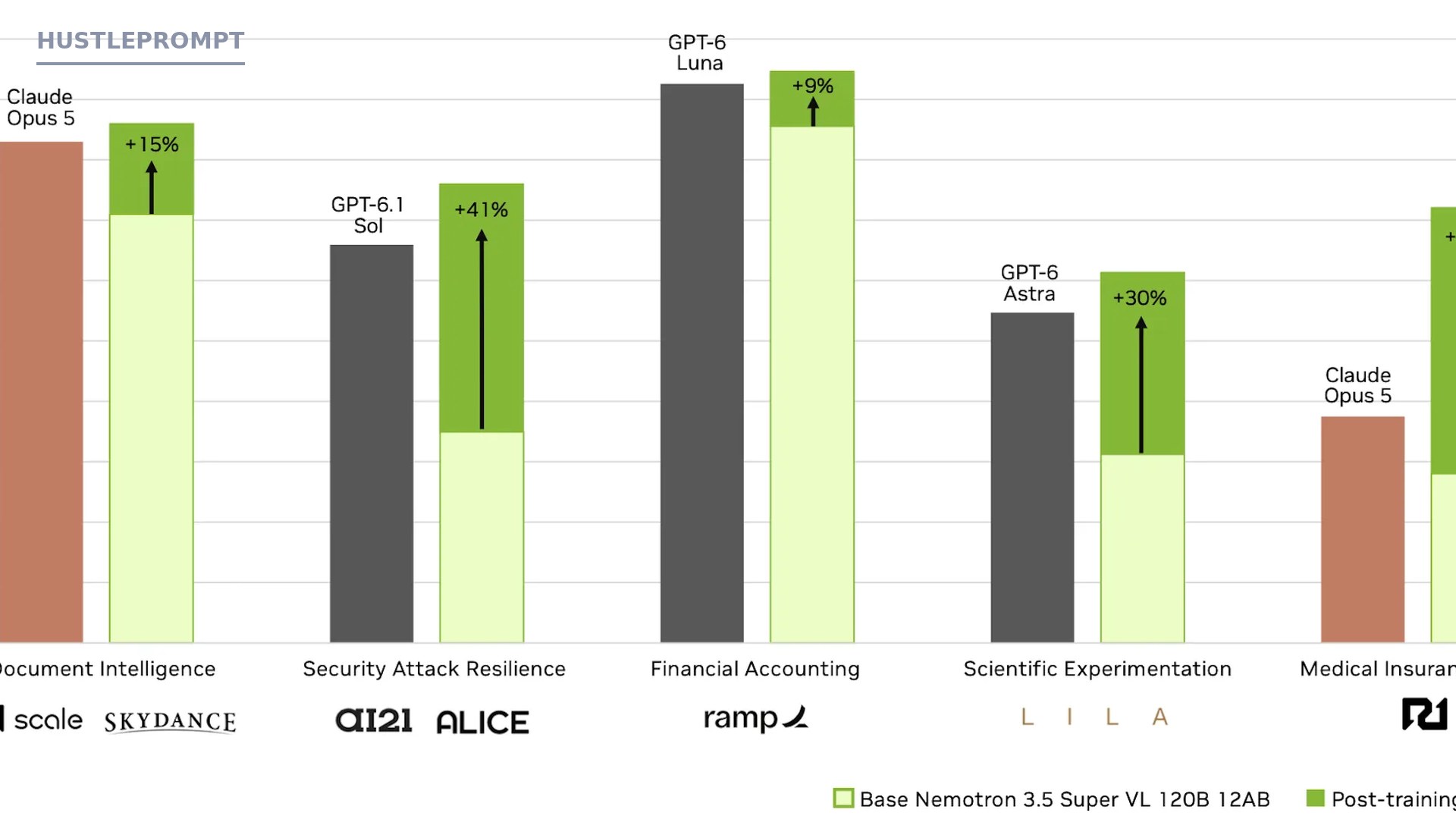
The business numbers are striking. NVIDIA says real customers are already post-training it:
- Scale AI post-trained it for vendor credit processing at Skydance Corporation: inference cost down 40x, latency down 5x.
- Ramp converts receipt images into structured JSON: up to 50% higher throughput and 10x lower latency.
- AI21 and Alice used it for threat intelligence and vulnerability analysis: accuracy improved by 41%.
NVIDIA’s Joey Conway summed up the pitch: “Open models give enterprises a head start on building with their own data and intelligence.” That is the whole business model in one sentence.
How it works: speed without the hardware bill
Three engineering tricks make it unusually cheap to run. Mixture-of-experts: only 12B of 120B parameters activate per token, so each token costs roughly as much compute as a 12B dense model. NVFP4 quantization shrinks weights and activations to 4-bit precision on Blackwell GPUs, with training that closes most of the accuracy gap.
Speculative decoding and multi-token prediction draft several tokens in parallel and verify them in one pass — NVIDIA’s open LiLiCorr technique delivers up to 2.3x faster generation on DGX Spark. Add prefix caching, which reuses computation from repeated instructions across agent turns, and NVIDIA’s Dynamo stack claims 8x as many users per 16-GPU node with 85% lower first-token latency.
The open-model money math
• Client docs leave their network
• Costs scale with every customer
• Margins shrink as volume grows
• Data never leaves the client’s walls
• Costs stay flat as customers grow
• Margins expand with volume
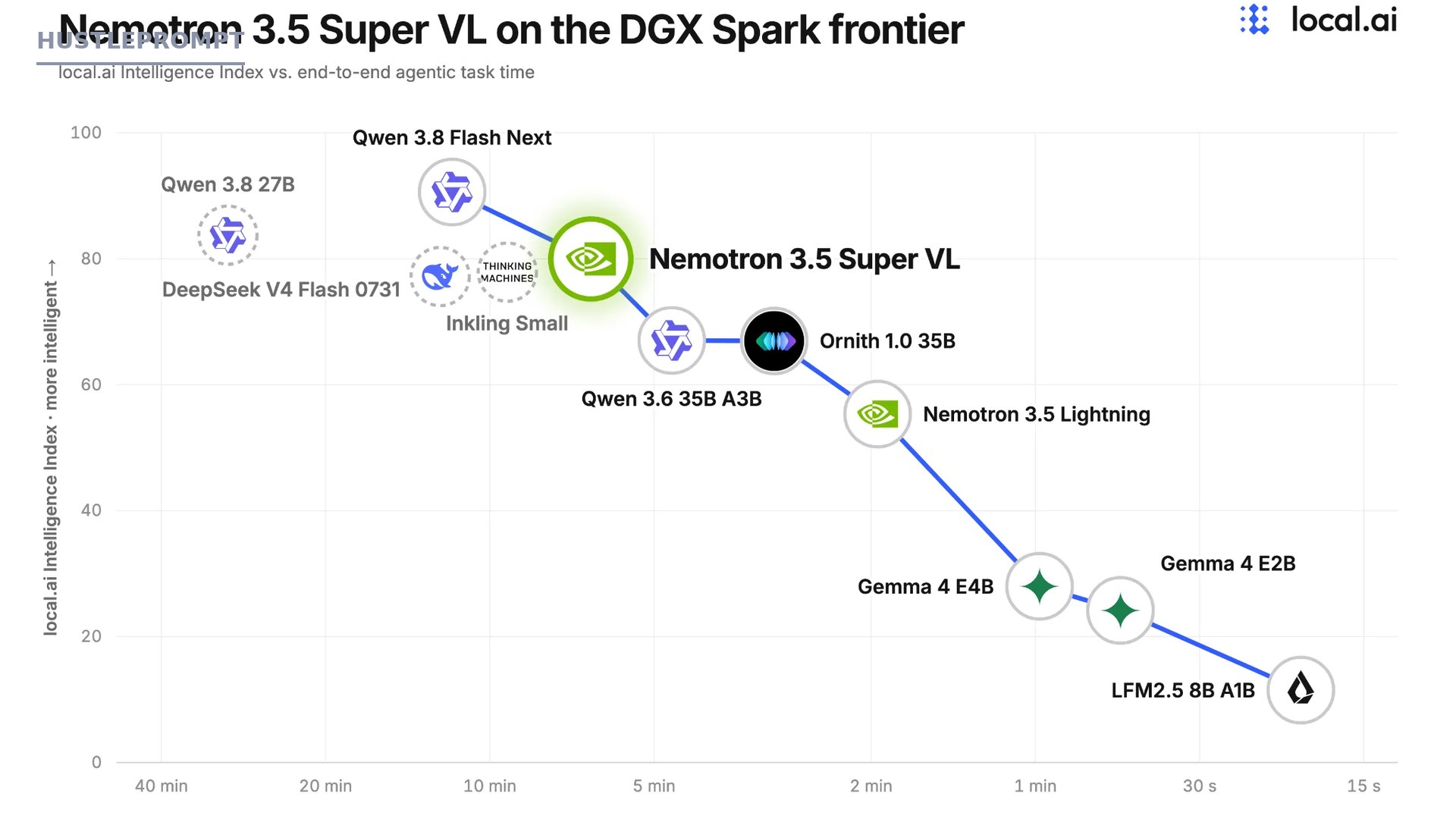
NVIDIA optimized Super VL to run on a single DGX Spark, and an independent EXO Labs evaluation placed it on the Pareto frontier for accuracy vs. task completion time. Local deployment is the reference design now, not a science project.
How to profit: sell document agents on open weights
The clearest paid service is document intelligence: agents that turn invoices, contracts, and receipts into structured data. NVIDIA’s own examples are the pitch deck. The playbook:
- Pick one document-heavy vertical: law firms (contracts), clinics (insurance forms), logistics (freight invoices). Specialists charge 3–5x generalists.
- Download the weights from Hugging Face and the usage cookbook from NVIDIA’s Nemotron GitHub. Start with the NVFP4 checkpoint.
- Fine-tune with NVIDIA NeMo: supervised fine-tuning (SFT) or LoRA, a low-rank adaptation technique that teaches a domain at a fraction of full-training compute. A few hundred labeled client documents is enough to start.
- Sell fixed-price services: “$0.02 per document” or a “$1,500/month document agent.” Your cost per document is a fraction of a cent of GPU time — the margin is the product.
- Lead with privacy: “Your documents never leave your infrastructure” beats “we use GPT” in regulated industries — the line that closes deals in finance, legal, and healthcare.
- Publish your benchmarks: run task evaluations and show clients the before/after. Numbers beat vague “AI-powered” pitches.
Watch it in action
Official NVIDIA Developer video.
FAQ
Is Nemotron 3.5 Super VL really free to use commercially?
Open weights under the OpenMDW-1.1 license (per launch coverage) permit commercial deployment — but always verify current terms on the official Hugging Face model page before shipping.
How much GPU do I need to run it?
A single DGX Spark, one H200, two H100s, or one GB200 with the NVFP4 checkpoint — the quantization is what makes single-GPU serving practical.
What does “12B active parameters” actually mean?
A router sends each token to a small subset of specialist “experts.” Only 12B of 120B parameters compute per token — 12B-model costs, much-larger-model quality.
Can I fine-tune it on my clients’ data?
Yes — NVIDIA released NeMo post-training recipes (SFT, LoRA, RL) plus open datasets on Hugging Face. That is the intended workflow.
How does it compare to closed models like GPT-6 or Claude?
On specialized, post-trained agent workflows, NVIDIA claims it can match or beat frontier models (see the Scale AI, Ramp, and AI21 results). On general knowledge, closed frontier models still lead — the advantage is cost, privacy, and customization.
What about the two Bolt models announced alongside it?
Bolt 74B-A9B (24GB, fits an RTX workstation) and Bolt E4B (4GB) target local and edge agents — the on-device options to Super VL’s enterprise workhorse.
Is this a good first open model to build a business on?
For multimodal agents, yes: document and video understanding are built in, not bolted on. The tradeoff is hardware lock-in to NVIDIA’s stack — which is also its performance edge.
Sources
- NVIDIA technical blog: Nemotron 3.5 Super VL Powers Specialized Agents with Multimodal Reasoning (October 15, 2026)
- NVIDIA Developer: Nemotron AI Models
- NVIDIA Developer on YouTube: Introducing NVIDIA Nemotron 3.5 Super VL