
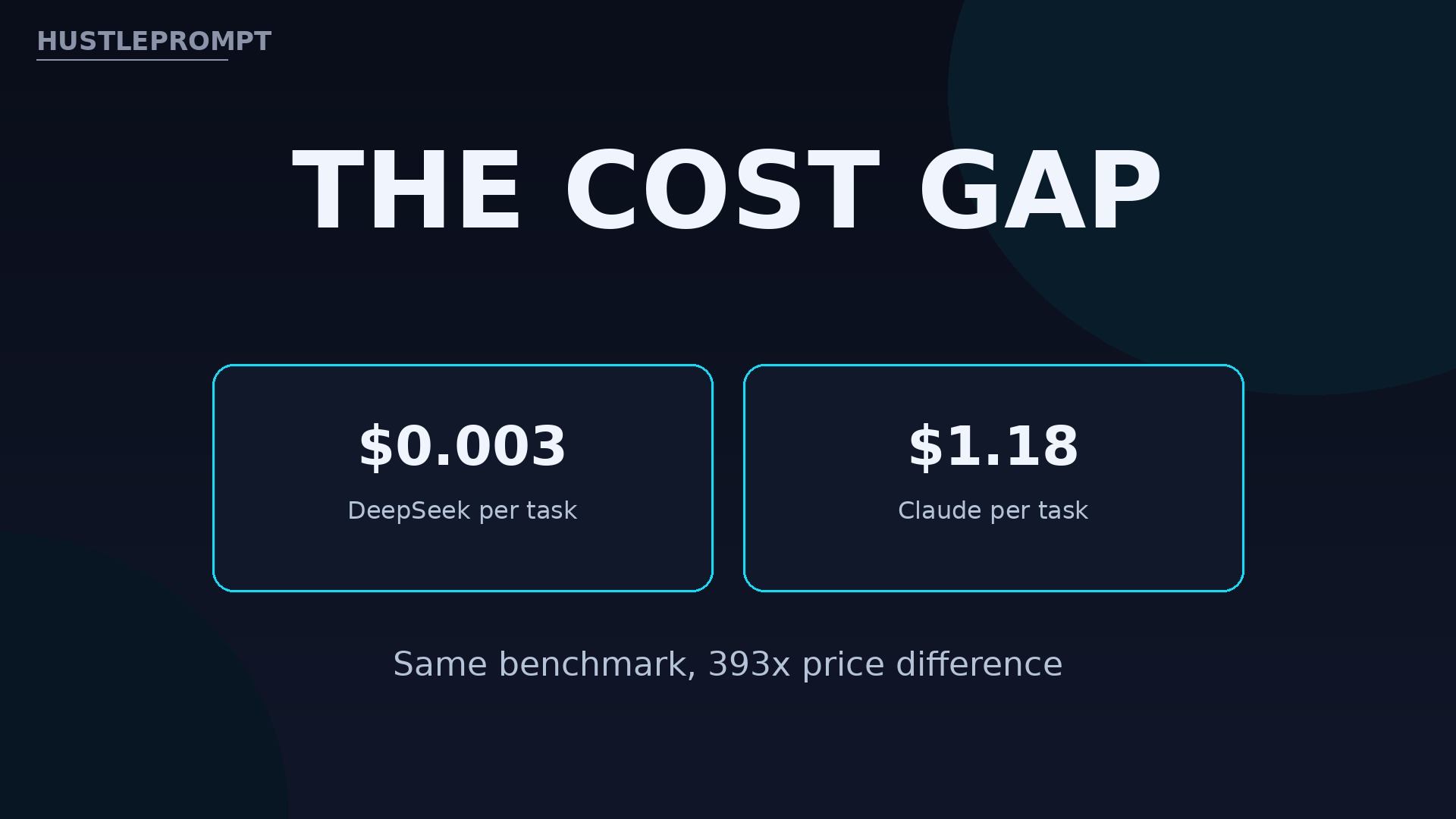
Would you pay $1.18 for a result you could get for $0.003? That is the gap at the heart of the new open AI accounting benchmark published on Monday, October 26, 2026.
Moonshot AI’s open model Kimi K3.1 Pro scored 86.1% on the DualEntry Accounting AI Benchmark. That put it fourth overall — and ahead of every tested model from Anthropic, OpenAI, and Meta.
Google’s Gemini 4 Argon still leads at 91.1%, but the best open model trails it by only 3.0 points — a gap that changes the math for bookkeepers and small finance teams.
What the benchmark found
DualEntry tested 20 models: seven open, thirteen closed. Two of the top four are now open, and open models hold four of the top seven places.
| Model | Type | Score | What stands out |
|---|---|---|---|
| Gemini 4 Argon (Google) | Closed | 91.1% | Overall leader |
| GLM-5.3 Flash (Zhipu AI) | Open | 88.1% | Tied for second |
| Grok 4.7 (xAI) | Closed | 88.1% | Tied for second |
| Kimi K3.1 Pro (Moonshot AI) | Open | 86.1% | Up from 84.2% |
| Claude Fable 5.1 (Anthropic) | Closed | 85.1% | $1.18 per task |
| DeepSeek V4.1 Flash | Open | 84.2% | $0.003 per task |
Across the board, open models averaged 83.9% versus 81.3% for closed models.
On bank reconciliation, Kimi scored 100% versus 75% for overall leader Gemini 4 Argon.
Evidence in one line: open models averaged 83.9% vs. 81.3% for closed models — and the cheapest open result cost 393 times less per task than the closed model just above it.
Benedict Dohmen of DualEntry said: “Finance teams have assumed that choosing an open model meant trading accuracy for cost and control. On accounting work that trade is mostly gone. What’s left is consistency, and that is the gap to watch.”
Why open models closed the gap
This is not one lucky model. GLM-5.3 Flash tied for second, Kimi K3.1 Pro took fourth, and DeepSeek V4.1 Flash scored 84.2% — close behind Claude Fable 5.1 at 85.1%.
The improvement is fast, too. Kimi rose from 84.2% for its predecessor, Kimi K3, to 86.1% in one generation.
Then there is cost. Divide $1.18 by $0.003 and you get about 393. The premium option bought less than one point of extra accuracy at roughly 393 times the execution cost.
The catch: closed models still win on reliability
Before you switch everything to the cheapest model, read this part carefully. DualEntry is clear about where closed models still lead.
- Hard tasks: the top score on hard tasks, 82.1%, is shared by three closed models.
- Consistency: the five models that most often passed a task in all three runs are closed models.
- Repeatability leader: Gemini 4 Argon leads that consistency measure at 86.1%.
That matters for client work: a model must give the same correct answer every time, especially on month-end close. So the smart reading is split — open models win on price and average accuracy for routine work, closed models win when consistency on hard tasks is the priority.
How to profit from this shift
This points to a practical service: low-cost AI bookkeeping help for small businesses.
- Start with routine work. Offer classification, journal entries, and bank reconciliation first — the areas DualEntry tested, and the easiest to check.
- Use an open model for the first pass. Run routine tasks cheaply, then review the output yourself. Your review is the product.
- Keep a premium model for hard cases. Route month-end close and anything unusual to a closed model or a human accountant, and charge more for that tier.
- Price on the saving, not the cost. Your margin comes from doing the work faster, not from reselling tokens.
- Prove it on their books. Run a free 20-transaction test on a prospect’s own data and let the accuracy sell the monthly plan.
Do not promise tax advice or audited results — keep a qualified accountant in the loop for anything regulated.
Open route vs. closed route — which job fits which?
Open route — routine work
Classification, reconciliation. Low cost. You check it.
Closed route — hard work
Month-end close, edge cases. Higher cost, higher consistency.
Open for volume, closed for risk. Never post unchecked.
How the test worked
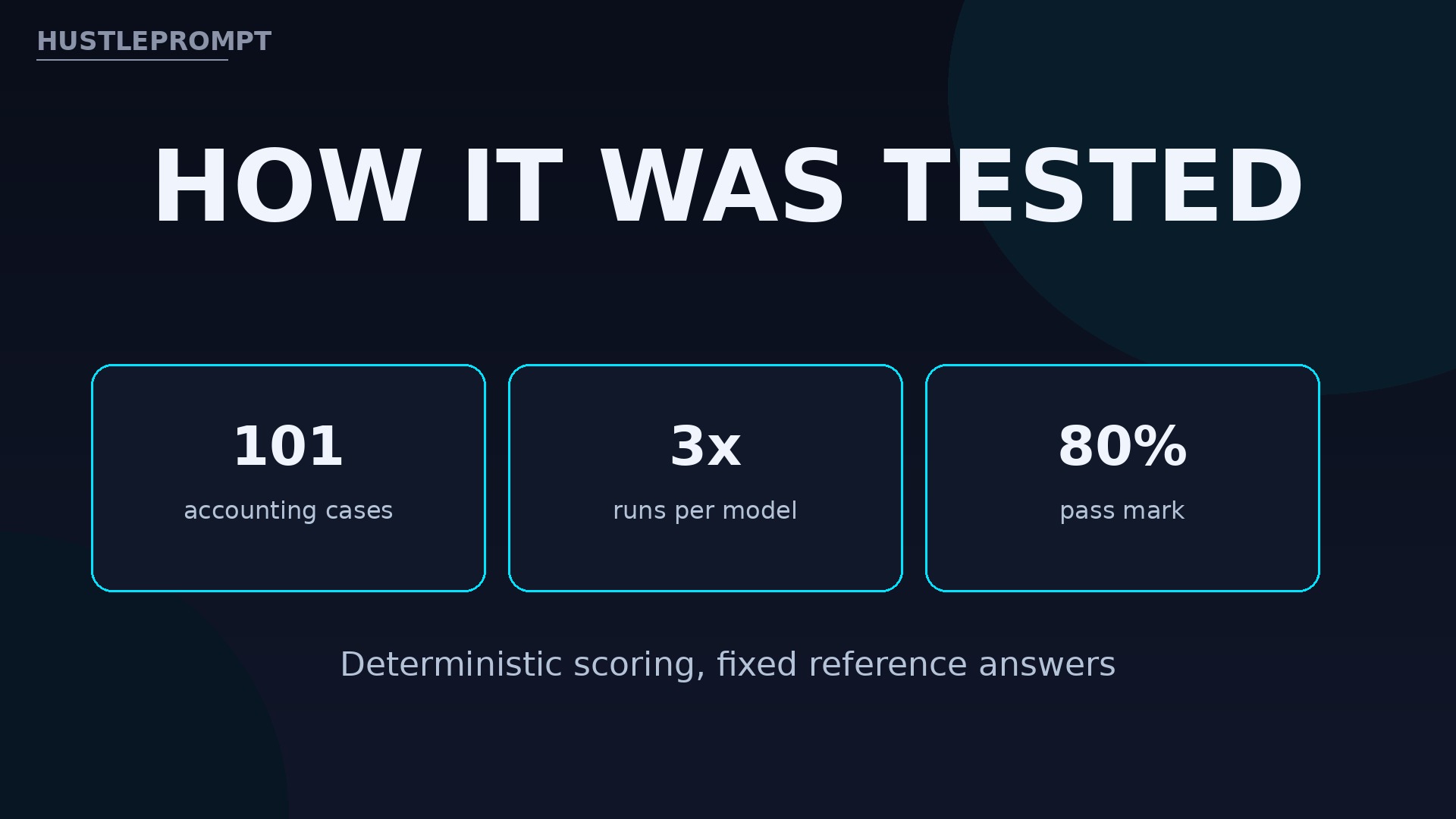
DualBench100 uses 101 synthetic cases across eight areas:
- Transaction classification
- Journal entries
- Financial reporting
- Bank reconciliation
- Accounts payable
- Accounts receivable
- Month-end close
- Accounting knowledge
The cases split into 37 easy, 36 medium, and 28 hard tasks, each with a fixed reference answer and deterministic scoring at an 80% pass mark. Every model ran the full set three times, and a task counted as passed when it passed in at least two runs.
What this means for you
If you sell bookkeeping help, your cost floor just dropped: 1,000 tasks cost $3 versus $1,180. Winners will build a checked workflow — open for volume, premium or human review for risk.
Frequently asked questions
What is the DualEntry Accounting AI Benchmark?
DualEntry’s DualBench100 test: 101 synthetic cases across eight accounting areas, scored against fixed reference answers.
Which model scored highest overall?
Google’s Gemini 4 Argon, at 91.1%. The best open model, GLM-5.3 Flash, tied for second at 88.1%.
How did Kimi K3.1 Pro perform?
It scored 86.1%, placing fourth and ahead of every tested Anthropic, OpenAI, and Meta model — with 100% on bank reconciliation.
Are open models really cheaper for accounting work?
On this benchmark, yes. DeepSeek V4.1 Flash cost $0.003 per task versus $1.18 for Claude Fable 5.1 — about 393 times more for 0.9 points of extra accuracy.
Should I replace my accountant with an open AI model?
No. Use open models for routine, checked work, and keep a qualified accountant for regulated or high-risk decisions.
Where can I see the full results?
On DualEntry’s benchmark page, linked from DualEntry’s official benchmark announcement on BusinessWire.