
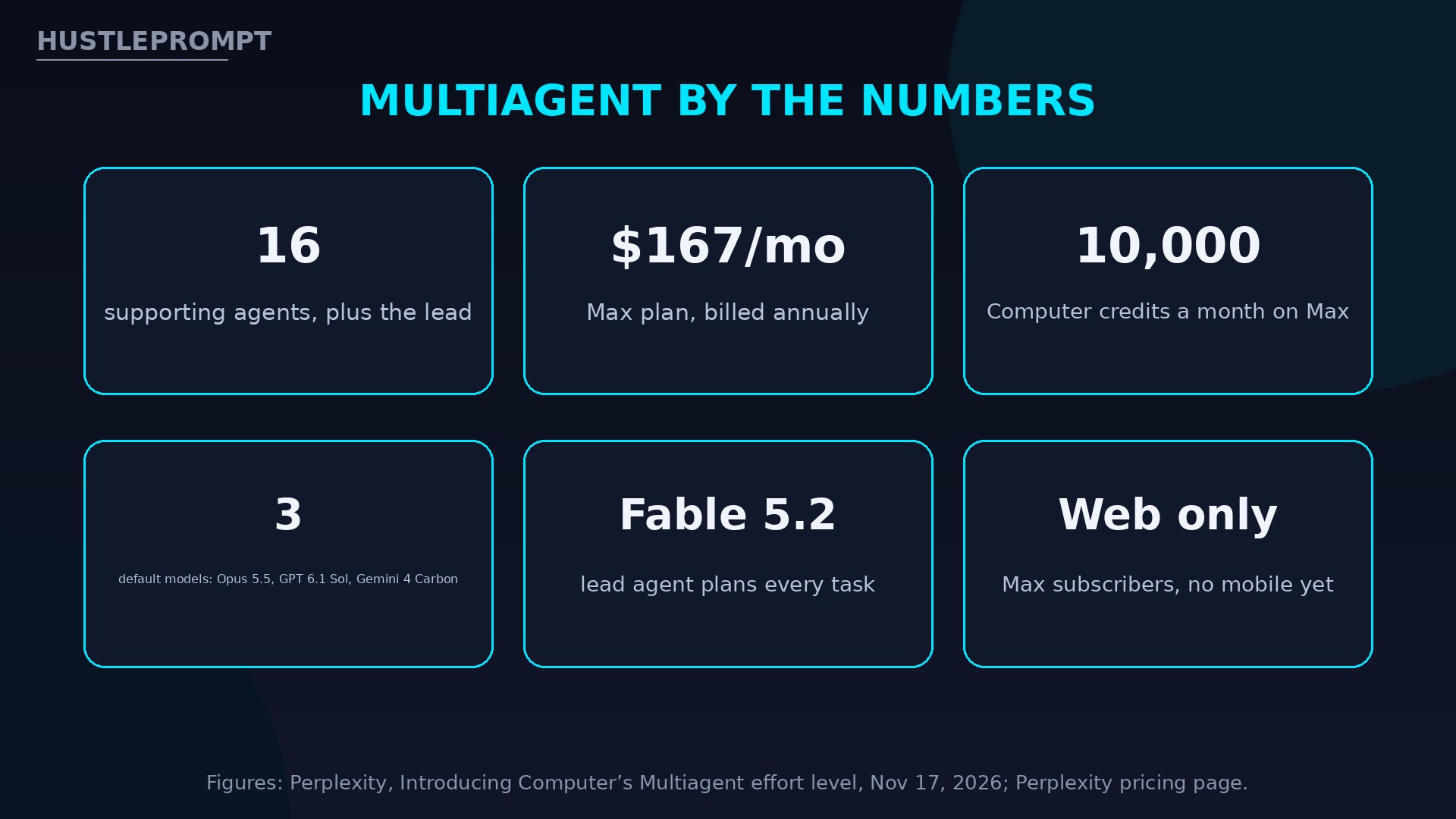
Perplexity Multiagent is the first AI feature that makes three rival models argue with each other before they answer you. Perplexity announced it on November 17, 2026, as a new effort level for Computer, its agent platform for research and multistep work. One lead agent now runs a team of up to 16 supporting agents on different frontier models, and those agents share findings directly, question each other’s assumptions and flag discrepancies before the lead delivers a single answer.
The idea is simple, and it is a break from how AI assistants normally work. A single model can be confident and wrong. A team of models that check each other’s work is harder to fool. Perplexity calls Multiagent the top effort level in Computer, above Ultra, and it is built for the kind of work where a mistake costs real money: financial forecasts, annual report reviews, deal diligence and year-end tax planning.
There is a catch, and it is a price tag. Multiagent is available only to Perplexity Max subscribers, on the web. Max costs $167 a month billed annually ($2,000 a year). If you run a business that pays for research, diligence or analysis, that number is the whole story: either the cross-checking is worth $2,000 a year, or it is not. Here is what the feature actually does, what it costs, and who it pays for.

What Multiagent actually does
Multiagent sits above the four effort settings Perplexity launched in September 2026: Light, Standard, High and Ultra. In those settings, one lead agent plans the task and delegates parts of it to supporting agents, which report back only to the lead. Multiagent changes the plumbing. The agents talk to each other.
Here is how a task runs, according to Perplexity’s announcement:
- Claude Fable 5.2 plans the task. The lead agent breaks the assignment into parts and divides them among the supporting agents, while taking on part of the work itself.
- Three frontier models do the work. The default team runs Claude Opus 5.5, GPT 6.1 Sol and Gemini 4 Carbon, so different models bring different strengths to the same assignment.
- Agents share findings as they work. One agent can use evidence another has found, question an assumption, or flag a discrepancy for more investigation.
- They coordinate shared files. One agent might update the revenue assumptions in a financial model, then notify another agent to use those figures in its valuation analysis.
- The lead delivers one answer. The lead stays the point of contact in the conversation, brings the team’s findings together and delivers the final response with the asked-for deliverables.
Two more models can join the team on request. Fable 5.2 and GPT 6 Astra work as supporting agents only when a user asks for them, or when a particular part of the task calls for them. Users pick the models they want in their query, and they select Multiagent in Computer’s effort slider. For a follow-up task, the lead tells the affected agents what has changed and the team continues its existing work. You can see the agents and the models they are running as the task runs, and stopping the thread stops the whole team.
| Role in the team | Model | Job |
|---|---|---|
| Lead agent | Claude Fable 5.2 | Plans the task, divides it, delivers the final answer |
| Supporting agent | Claude Opus 5.5 | Analysis on Anthropic’s most capable model |
| Supporting agent | GPT 6.1 Sol | Analysis on OpenAI’s everyday model |
| Supporting agent | Gemini 4 Carbon | Analysis on Google’s frontier model |
| On request only | Fable 5.2 / GPT 6 Astra | Join when the user asks, or when a task part calls for them |
Team and model facts from Perplexity’s official Multiagent announcement (November 17, 2026).
What it is built for
Perplexity is not pitching Multiagent for quick questions. It is designed for work with distinct parts that benefits from parallel analysis and cross-checking, and the announcement names five concrete uses:
- Forecasting and finance: agents build different financial scenarios in parallel, compare their assumptions, and check how changes in revenue, costs or market conditions affect the forecast.
- Annual report review: agents examine financial statements, footnotes and management commentary separately, then compare findings to flag inconsistent figures or disclosures for an auditor’s review.
- Deep analysis: agents investigate competing explanations for a business or research question, exchange evidence and test which conclusions hold up across sources.
- Deal data room diligence: agents review financial records, contracts and operating documents in parallel, then connect findings such as a customer contract that changes the revenue outlook.
- Complex tax returns and year-end planning: agents organize income and deduction records, research relevant tax rules and compare year-end scenarios to prepare questions and supporting analysis for a tax professional.
Notice the pattern. Every one of these is work where a single confident answer is dangerous and a second opinion is the product. That is the bet: cross-checking is worth more than speed when the output goes into a board deck, a filing or a deal.
“The lead agent runs a team of agents on different frontier models that work in parallel, share findings directly with each other, and check each other’s work.”
— Perplexity, “Introducing Computer’s Multiagent effort level,” November 17, 2026
Watch: Perplexity explains Computer, the agent platform Multiagent runs on, on Perplexity’s official YouTube channel.
Ultra vs Multiagent vs Model Council
Computer now offers three ways to organize hard work, and picking the wrong one wastes credits. Perplexity’s own comparison is the clearest guide:
ASK → PLAN → SPLIT → CROSS-CHECK → DELIVER
1. Ask: you describe the assignment and pick Multiagent in the effort slider.
2. Plan: Claude Fable 5.2 breaks the work into parts and assigns them.
3. Split: up to 16 agents run in parallel on Opus 5.5, GPT 6.1 Sol and Gemini 4 Carbon.
4. Cross-check: agents share evidence, question assumptions and flag discrepancies.
5. Deliver: the lead brings the findings together into one response.
| Option | How the work is organized | Use it for |
|---|---|---|
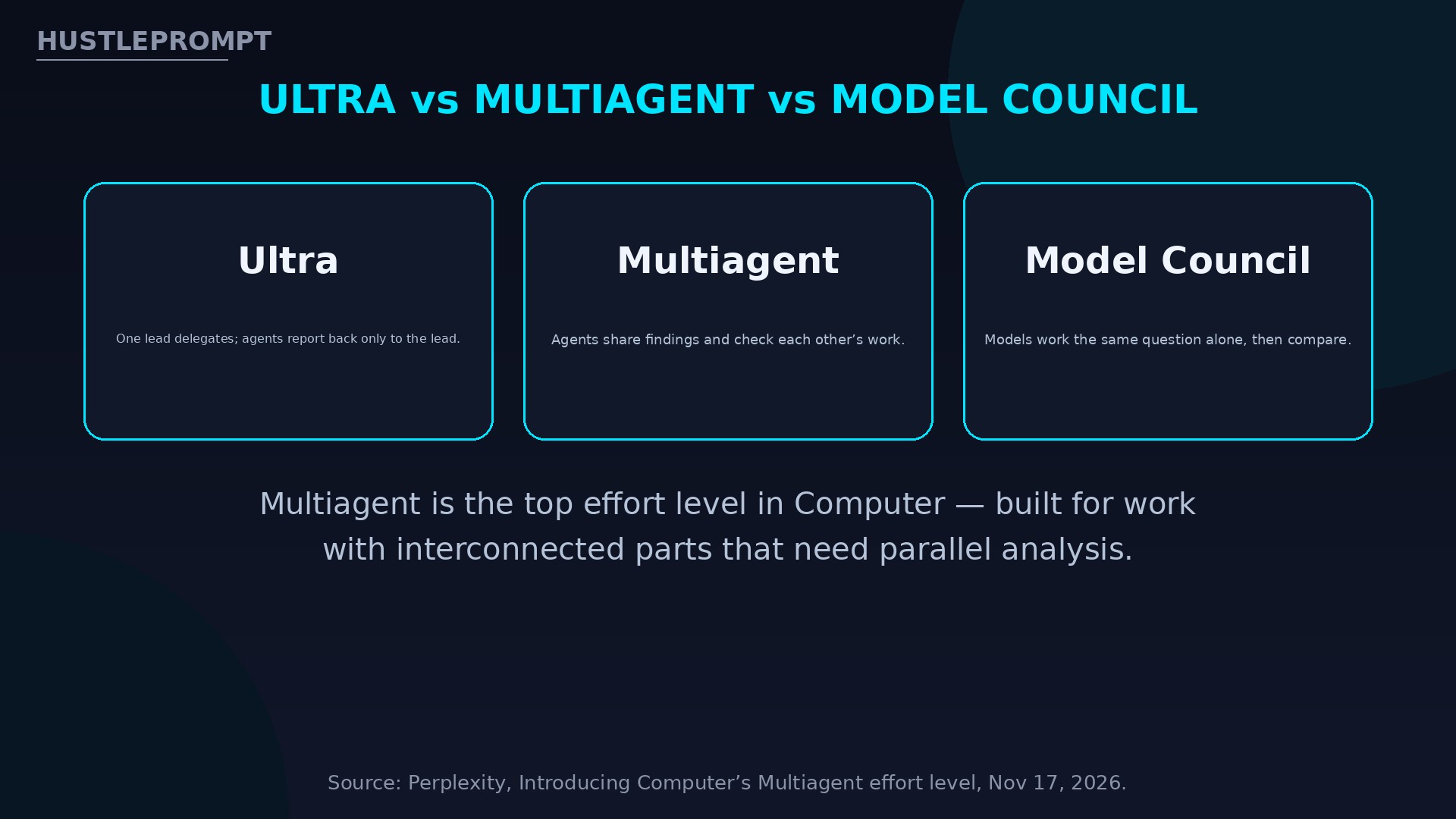
| Ultra | One lead delegates parts of a task to supporting agents, which report back only to the lead. | Open-ended problems where several approaches need testing, such as evaluating a new market under different growth assumptions. |
| Multiagent | The same lead model coordinates agents that share findings directly, check each other’s work, and contribute to shared deliverables. | Large assignments with interconnected parts that can be worked on in parallel, such as data room diligence or a financial forecast with several scenarios. |
| Model Council | Several models investigate the same question independently, then Computer combines their findings and shows where they agree and disagree. | Judgment calls where independent perspectives on the same question are useful. |
Comparison from Perplexity’s official Multiagent announcement. The rule of thumb: Ultra tests approaches, Model Council tests opinions, Multiagent tests connected work.
What it costs
Multiagent is not a free upgrade. It is the top tier of a paid ladder, and the pricing is the first thing to understand before you try it.
| Plan | Price | Computer access |
|---|---|---|
| Free | $0 | Limited usage, basic models |
| Pro | $17/mo billed annually | Deep Research, choice of top models, 400+ app connectors |
| Max | $167/mo billed annually | Multiagent, 10,000 monthly Computer credits plus 35,000 bonus credits, highest limits |
Prices from Perplexity’s pricing page, as listed in November 2026. Max costs $2,000 a year on annual billing, or $200 a month if you pay month to month. Computer runs on credits, and Perplexity says credit usage depends on the work Computer performs. Lower effort settings use less expensive models. The launch note does not break out the credit cost of a single Multiagent run, so you will not know how many credits a 16-agent job burns until you run one. Treat the first runs as a paid test, not a blank check.
The honest catch: no benchmarks yet
Perplexity has published no accuracy or speed numbers for Multiagent. No benchmark scores, no error-rate comparisons, no timing figures. That matters, because the whole pitch is that cross-checking produces better answers, and right now that is a design argument, not a measured result. Independent testing will take time.
The other limits are practical. Multiagent is web-only, so there is no mobile or desktop-app access yet. It is Max-only, so Pro subscribers cannot try it. And 16 agents on one task will cost more credits than one agent on the same task, which means the feature only makes economic sense when the work is valuable enough to justify the extra compute. A routine summary does not need a committee. A diligence memo might.
How to profit from Multiagent
A 16-agent team that cross-checks its own work is a service business waiting to happen. Here is how to use it, whether you sell research or buy it.
- Sell diligence as a service. Offer data-room and annual-report reviews to small funds, founders and acquirers, with Multiagent doing the parallel document work and you doing the judgment. The cross-checking is your quality story.
- Sell scenario forecasts. Build three-scenario revenue and cost forecasts for small businesses, with each scenario built and checked by a different model. Clients pay for the disagreement between scenarios, not just the headline number.
- Package tax-prep question packs. Use Multiagent to organize a client’s income and deduction records, research the relevant rules and compare year-end scenarios, then hand the pack to their CPA. You sell preparation, not tax advice.
- Run research with receipts. For content, consulting or investment research, deliver the cross-checked findings plus the conflicting assumptions the agents flagged. The flagged conflicts are often the most valuable part.
- Price it by the deliverable, not the hour. A cross-checked diligence memo or forecast pack is a fixed-price product. Quote the deliverable, run Multiagent inside your margin, and keep the upside when the team works fast.
What to watch next
The first question is whether the cross-checking shows up in independent tests. Watch for benchmarks that compare Multiagent against a single top model on the same diligence or forecasting task, and for the credit cost per run once heavy users publish their bills. The second question is distribution: Perplexity says Multiagent is web-only for now, and Computer has already spread to iOS, Android, Slack, Teams and email, so watch for the tier to follow. The third is competition. Perplexity’s own comparison pits Multiagent against Kimi’s Agent Swarm and SuperGrok Heavy, and the multi-agent race is now the main event in AI agents: whoever proves that teams beat solo models wins the high-value work.
For now, the fact is simple. Sixteen agents, three frontier models, one answer, $167 a month. If your work is worth checking twice, Perplexity just built the team that does it.
Frequently asked questions
What is Perplexity Multiagent?
Multiagent is a new effort level above Ultra in Perplexity Computer, announced November 17, 2026. A lead agent runs a team of up to 16 supporting agents on different frontier models that work in parallel, share findings directly and check each other’s work before delivering a single response.
Which models run a Multiagent task?
Claude Fable 5.2 plans the task as the lead. The default team runs Claude Opus 5.5, GPT 6.1 Sol and Gemini 4 Carbon. Fable 5.2 and GPT 6 Astra can join as supporting agents when a user requests them or when a particular part of the task calls for them.
How much does Perplexity Multiagent cost?
Multiagent is available only to Perplexity Max subscribers on the web. Max costs $167 a month billed annually ($2,000 a year), or $200 a month month to month, and includes 10,000 Computer credits a month plus 35,000 bonus credits. Computer runs on credits, and the credit cost of a Multiagent run is not published.
How is Multiagent different from Ultra?
In Ultra, a lead delegates parts of a task to supporting agents that report back only to the lead. In Multiagent, the agents share findings directly with each other, question assumptions, flag discrepancies and coordinate edits to shared files. Ultra tests approaches; Multiagent tests connected work.
What is Model Council, and how is it different?
Model Council is a separate Computer option where several models investigate the same question independently, and Computer combines their findings and shows where they agree and disagree. Use it for judgment calls that benefit from independent perspectives, and Multiagent for large assignments with interconnected parts.
What work is Multiagent built for?
Perplexity names five uses: financial forecasting, annual report review, deep analysis of competing explanations, deal data room diligence, and complex tax returns and year-end planning. All five are work where a mistake costs real money and a second opinion is the product.
Are there benchmarks for Multiagent?
Not yet. Perplexity has published no accuracy, speed or benchmark numbers for the new tier. The cross-checking advantage is a design claim for now, and independent results will take time.
Keep Reading
Sources: Perplexity, “Introducing Computer’s Multiagent effort level” (November 17, 2026); Perplexity, “Computer adds effort mode for model selection” (September 2026); Perplexity pricing page (perplexity.ai/hub/pricing); MarkTechPost (November 17, 2026). All figures are Perplexity’s own unless labeled otherwise.