
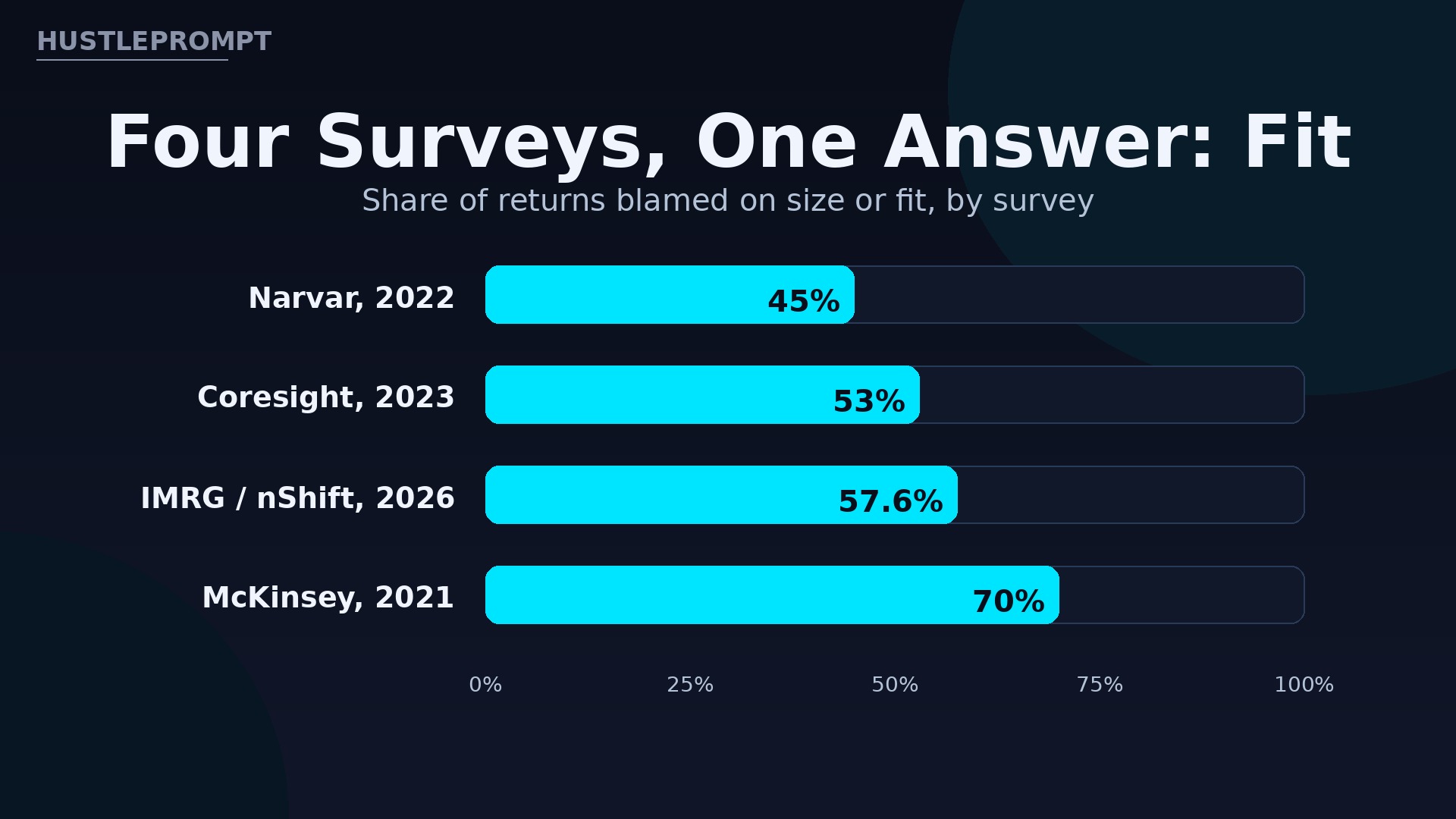
Retailers expect 19% of holiday sales to come back as returns — and the wrong size is the reason most of them leave. Narvar puts size and fit behind 45% of all returns. That is the market for AI size and fit recommendations: a size recommender on the product page, a fit-data feedback loop, and fit-based segmentation, sold to fashion e-commerce stores as a done-for-you service. Cyber Monday, November 30, is fashion’s biggest buying day. Returns automation (post 11641) handles the return after it happens; a fit service prevents the wrong-size return. Quiz funnels (post 11646) ask questions; fit uses measurements and fit feedback.
Disclaimer: general business information, not legal advice. Use written agreements and the client’s own tools. Prices are illustrative, never promises of income.
What the service is, exactly
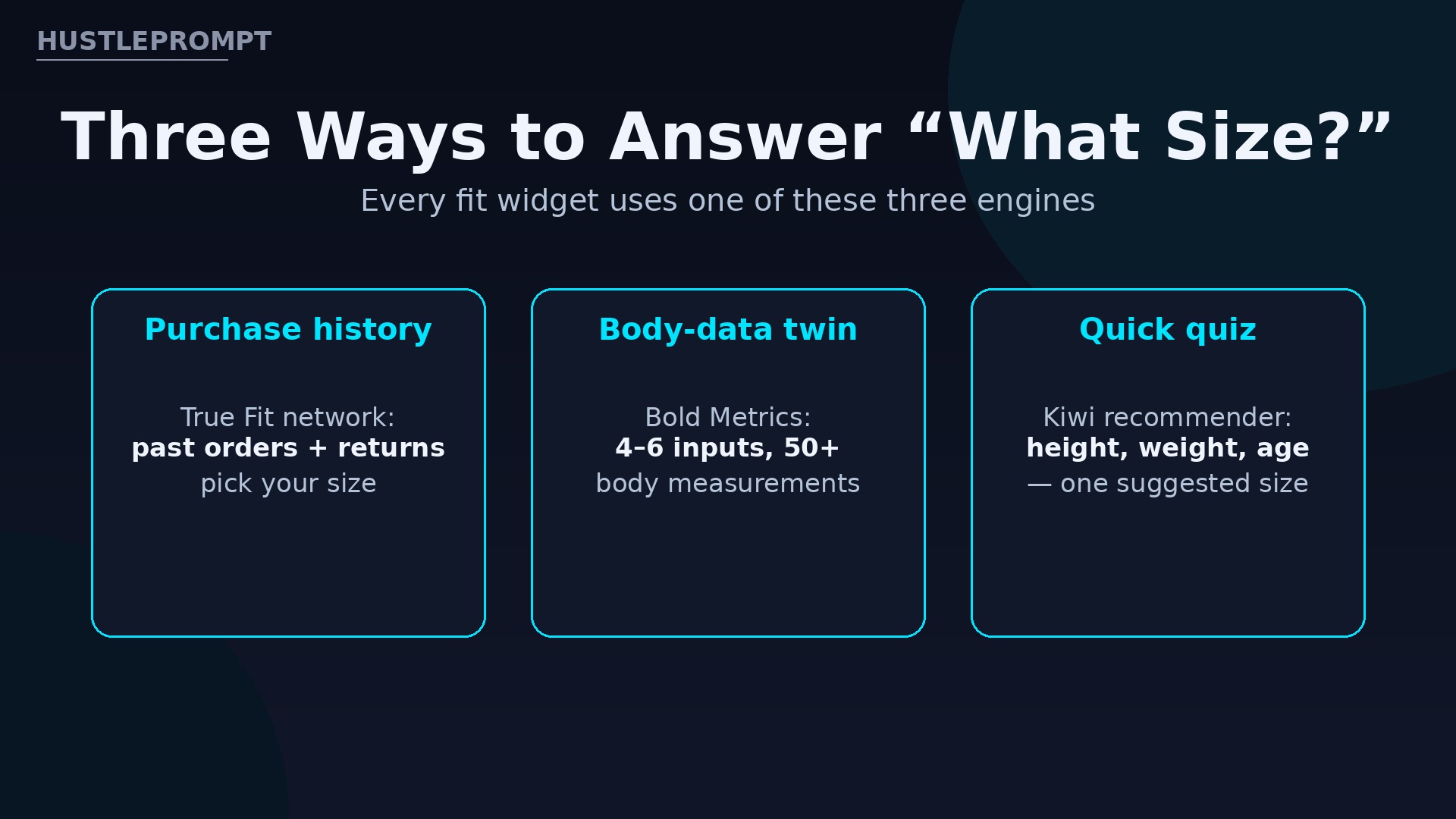
You install and run a store’s fit system for one fixed fee: the widget that tells each shopper their size, the data loop that learns from every order, and the segments that turn fit data into marketing. The shopper answers a few questions or signs in once, and the product page shows one recommended size. AI weighs purchase history, garment measurements, and return feedback; you set it up and report the results.
- The size recommender: a widget on every product page that returns one size.
- The fit profile: height, weight, and usual sizes, saved once and reused.
- The feedback loop: kept and returned orders flow back, so recommendations sharpen weekly.
- Fit-based segmentation: email and ad audiences built from fit data.
- The fit report: return rate by size, bracketing rate, and the worst-sized products.
One size on the page.
Right size, no second size.
Every outcome recorded.
Fit data retrains it.
Sharper sizes, fewer returns.
The evidence: the wrong size is the return
Fit is the reason. Every survey that asks why online orders come back lands on the same answer: the item did not fit.
| Figure | Value | Source |
|---|---|---|
| Returns blamed on size and fit | 45% | Narvar, 2022 |
| Apparel leaders naming fit the top reason | 53% | Coresight, 2023 |
| UK returners citing poor fit first | 57.6% | IMRG / nShift, 2026 |
| Returns blamed on poor fit or style | 70% | McKinsey, 2021 |
| US online apparel orders returned | 24.4% | Coresight, 2023 |
| Holiday sales expected returned, 2026 | 19% (was 17%) | Happy Returns |
Coresight puts US online apparel returns at 24.4% of orders. If 45% trace to size and fit, a store doing 1,000 orders a month sends back about 240 — and roughly 108 are wrong-size orders a fit service could have prevented. That is our calculation.
Your costs: what the tools charge
| Tool | Price (Nov 28, 2026) | What you get |
|---|---|---|
| Kiwi (Free) | $0/mo | 3 size charts, watermark |
| Kiwi (Plus) | $14.99/mo + order charges | 20 charts, 10 recommenders, analytics |
| True Fit | Quote only, reported floor ~$1,000/mo | Fit network, reporting |
| Bold Metrics | Quote only | Body-data twin, 50+ measurements |
| ChatGPT Plus | $20/mo | Fit copy, segments, client reports |
Kiwi Plus at $14.99 a month covers a small store’s pilot, with order-volume charges on top as orders grow. True Fit and Bold Metrics price by quote, for bigger brands; the reported True Fit floor near $1,000 a month comes from TrustRadius, not True Fit. The client pays for their own fit tool.
How it works: the fit service you sell
Here is how you sell it, step by step.
Step 1: pick one niche and twenty stores
Pick one niche: women’s dresses on Shopify, or men’s footwear. Audit 20 targets: does the product page answer “what size am I?” A store with 200 orders a month, a 25% return rate, and no recommender is a warm lead.
Step 2: build the fit kit on a demo store
Build the whole service once for a demo store: a Kiwi recommender on ten products, a fit profile flow, and a one-page fit report. Feed it the store’s real size charts. Test five body types — tall, petite, between sizes, broad shoulders, wide feet — before you show anyone.
Step 3: sell it with a one-page fit audit
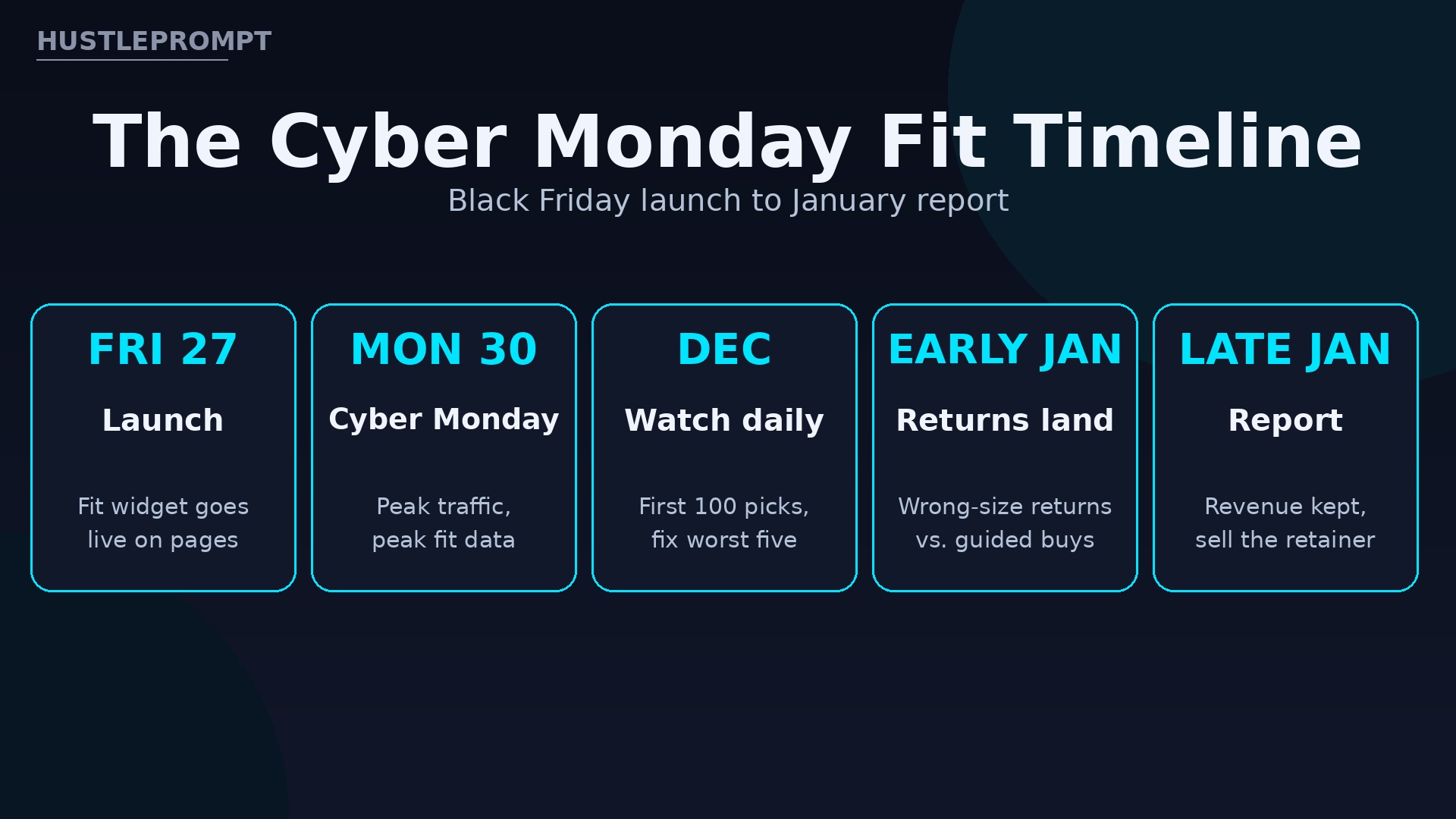
Skip the slide deck. Send one free page: the store’s own return math — 24 returns per 100 orders, roughly 11 wrong-size. Add a live demo: their best-selling dress with a working size recommendation. Your best line: “Cyber Monday brings the orders. The wrong sizes come back in January.”
Step 4: launch before Cyber Monday and watch the fit data
Install the recommender in the client’s own Kiwi or True Fit account, on every product page, before Cyber Monday, November 30. Watch the first hundred recommendations daily: which sizes get picked, which products shoppers skip. Fix the five worst products in week one.
Step 5: report results and sell the year-round version
In late January, send a one-page report: return rate before and after, fit-related returns, and revenue kept. Then pitch the monthly retainer: it runs the feedback loop, fixes sizing, and builds fit-based segments. The setup is a one-time fee; the retainer is year-round.
The vendor numbers: what fit tools claim
These are vendor claims, not independent studies — never promise them to a client.
| Claim | Value | Vendor |
|---|---|---|
| Shoppers using fit guidance likelier to convert | 2–4× | True Fit |
| Cut in fit-related returns | Up to 40% | True Fit |
| Sitewide conversion lift | 1–2% | True Fit |
| Cut in size bracketing | 24% | True Fit / Moosejaw |
| Average cut in fit-related returns | 18% | Bold Metrics |
| Incremental revenue lift | 4% | True Fit / PacSun |
True Fit’s network drives its claims: 80 million-plus shoppers and 91,000-plus brands, per True Fit’s own site. Bold Metrics builds a digital body twin from four to six inputs, predicting 50-plus measurements. In March 2026, Gap Inc. began piloting its agentic sizing protocol across four brands.
What to charge
No official price list exists — these are illustrative ranges.
| Package | Illustrative price | What it includes |
|---|---|---|
| One-page fit audit | Free | Return math, live demo |
| Fit setup | $900 to $1,600 one-time | Recommender, profile, report |
| Setup + January management | $1,600 to $2,600 one-time | Above + daily monitoring |
| Monthly retainer | $750 to $1,250 a month | Feedback loop, fixes, segments |
Scale it: 6 stores at $1,200 is $7,200 for the season, and 2 on a $950-a-month retainer add $22,800 a year. Bill the fit app to the client.
The mistakes that kill this business
- Selling the widget, not the loop. A recommender without return data never improves.
- Promising the vendor’s numbers. Up to 40% is True Fit’s claim at enterprise scale, not your guarantee.
- Dirty size charts. A wrong chart trains the model wrong — audit every chart first.
- Launching after Cyber Monday. The peak traffic is the data; miss it and you wait a year.
- Ignoring bracketing. Shoppers ordering two sizes are telling you the fit guidance failed.
- Working in your own account. The client must own the fit tool and the fit data.
Frequently Asked Questions
What is an AI size and fit recommendation service?
A done-for-you service that installs a size recommender on a store’s product pages and runs the fit-data feedback loop, with AI weighing purchase history, garment measurements, and return feedback.
How is a fit service different from returns automation or quiz funnels?
Returns automation (post 11641) handles the return after it happens. Quiz funnels (post 11646) ask questions to recommend products. A fit service prevents the wrong-size return by recommending one size before checkout.
When should a fit recommender launch?
Before Cyber Monday, November 30, 2026 — the peak traffic is the data the model learns from.
Which tools do I need to sell fit recommendations?
Kiwi Plus at $14.99 a month for small stores, or True Fit and Bold Metrics, both quote-only, for bigger brands.
How much can I charge for AI size and fit recommendations?
Illustrative: $900 to $1,600 for setup, $1,600 to $2,600 with January management, and $750 to $1,250 a month on retainer.
Do size recommenders really cut returns?
True Fit claims up to 40% fewer fit-related returns when guidance is followed; Bold Metrics claims an 18% average reduction. Both are vendor claims — measure your own client’s rate before and after.
Keep Reading
- Sell AI Returns Automation to E-Commerce Stores.
- Sell AI Quiz Funnels to E-Commerce Stores.
- Sell AI Gift Guides to E-Commerce Stores.
Sources: return-reason figures via Rendered Fits — renderedfits.com; IMRG / nShift via ComRedix — comredix.com; Happy Returns 2026 via Supply Chain 24/7 — supplychain247.com; True Fit — truefit.com; Bold Metrics CEO interview — websiteplanet.com; Gap / Bold Metrics pilot — trendsonfire.com; Kiwi pricing, Oct 31, 2026 — traion.me; True Fit pricing floor — size.ly; ChatGPT Plus — help.openai.com. Checked Nov 28, 2026.