
SpaceX just put the biggest number yet on its AI ambitions. The SpaceX $74B AI campuses plan, announced on Thursday, November 12, 2026, commits more than $74 billion to two supercomputing sites: over $24 billion at Starbase in Texas and about $50 billion in Cochise County, Arizona. The Arizona campus alone could draw up to 6 gigawatts of power at full build-out — roughly the output of several large power plants, dedicated to training frontier AI models.
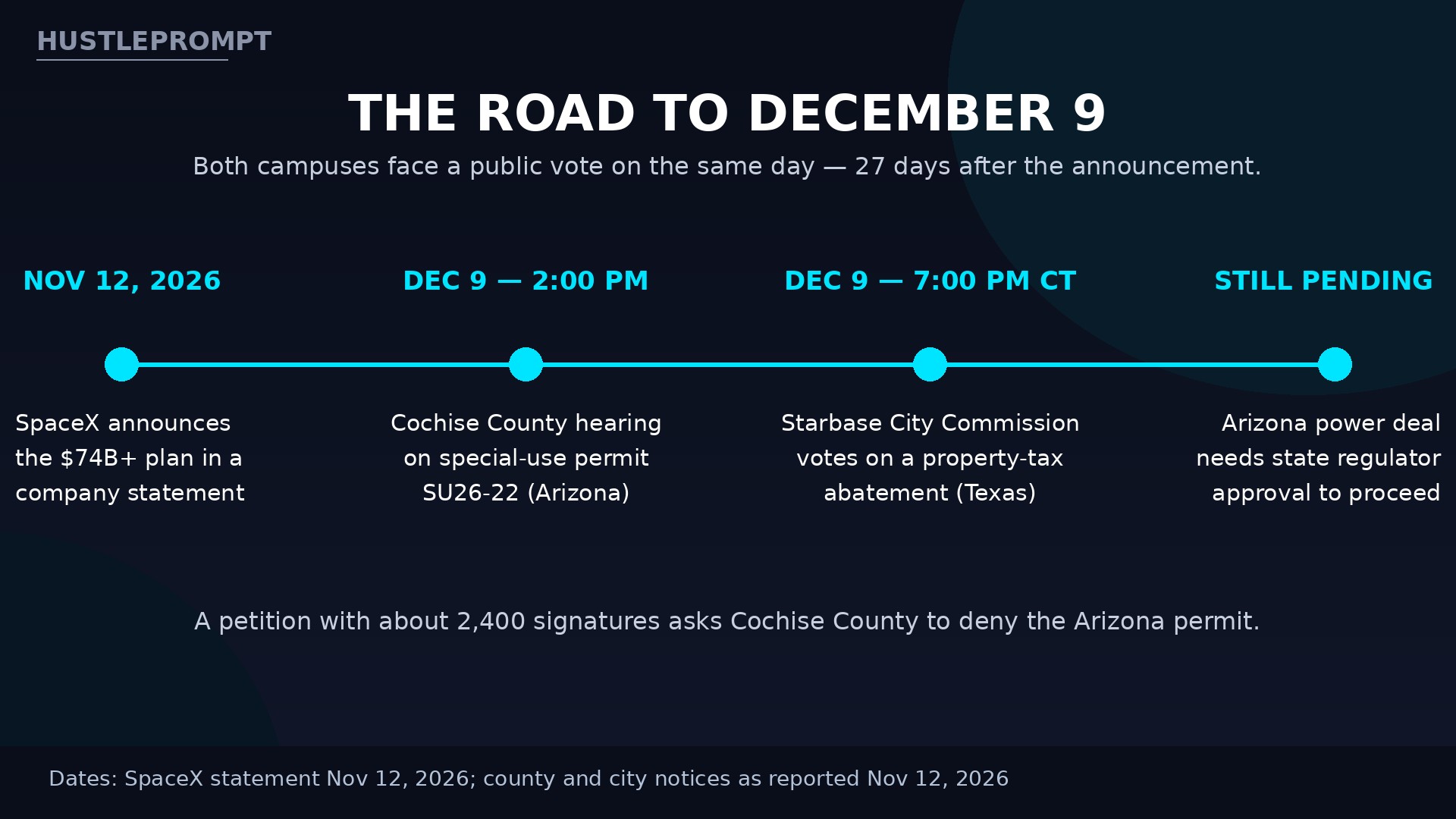
Here is the catch that makes this story different from every other AI data-center announcement this year: none of it is approved yet. Both campuses face a public vote on the same day, December 9 — 26 days from today — and the Arizona power deal still needs state regulator approval. The money is promised. The permission is not.
The $74B plan, at a glance
| Announced | November 12, 2026, in a SpaceX company statement under its “Building the Future” initiative, reported by Reuters and The Wall Street Journal |
| Total planned investment | More than $74 billion across two campuses |
| Texas \u2014 Starbase | More than $24 billion; gas-fired power plant on 444 acres; generates its own electricity; trains frontier AI models |
| Arizona \u2014 Cochise County | About $50 billion; up to 6 GW at full build-out in four 1.5 GW phases; nine buildings of about 493,000 sq ft each on 747 acres |
| Jobs (Arizona) | About 5,500 construction jobs at peak and about 1,000 permanent positions, per SpaceX |
| Deciding votes | December 9, 2026: Cochise County Planning & Zoning hearing on special-use application SU26-22, and a Starbase City Commission vote on a property-tax abatement |
| Status | Planned, not approved. Arizona power deal still needs state regulator approval. |
Source: SpaceX updates page (official) and SpaceX’s November 12, 2026 statement as reported by Reuters and The Wall Street Journal. Figures are SpaceX’s announced plans, not completed spending.
Two campuses, two very different bets
SpaceX framed the announcement in its own words: “We’re advancing two extraordinary projects: a major new supercompute facility at Starbase in the Rio Grande Valley in Texas, and a second campus in Cochise County, Arizona.” The two sites solve the same problem — where to put the enormous computing power behind frontier AI — in opposite ways. One makes its own electricity. The other buys it from the grid.
That split matters for anyone trying to understand the bet. A gas-fired plant at Starbase means SpaceX controls its own power supply and timeline, but also owns the fuel cost, the emissions debate, and the local politics of a gas plant. A grid-connected campus in Arizona means negotiating with electric cooperatives and a state regulator — slower, but with no power plant to build and a pitch to locals that their bills could fall.

Arizona: 6 GW in the desert
The Arizona campus is the bigger and bolder half of the plan. SpaceX is pursuing roughly $50 billion for a site on 747 acres along U.S. Highway 191 near the Willcox Playa, in Cochise County. The application was filed by Tombstone Resources LLC, a SpaceX affiliate. At full build-out, the campus would draw up to 6 gigawatts — built in four phases of about 1.5 GW each, across nine single-story compute buildings of about 493,000 square feet each, plus electrical buildings, an operations and security building, and outdoor yards for dry coolers, transformers, and battery storage.
To put 6 GW in perspective: it is about ten times the capacity of the nearby Apache Generating Station, according to reporting on the project. It would also make this one of the largest single-site data-center proposals in the United States. SpaceX has not disclosed which accelerator suppliers it would use, what network architecture the campus would run, or any commissioning schedule — and no dates have been given past the first phase.
The local pitch is jobs and cheaper power. SpaceX estimates about 5,500 construction jobs at peak and about 1,000 permanent positions. The site would draw power from the grid through Sulphur Springs Valley Electric Cooperative and Arizona Electric Power Cooperative, with no on-site power plant. SpaceX says the arrangement could cut cooperative members’ power bills by up to 20%.
Water was always going to be the flashpoint in the Arizona desert, and SpaceX has an answer ready: the site would use dry cooling, with no planned industrial groundwater use. That claim will be tested in public. A petition with about 2,400 signatures already asks Cochise County officials to deny the permit, according to Reuters, and the county does not allow data centers by right — they need a special-use permit. The county’s Planning and Zoning Commission will hear application SU26-22 on Wednesday, December 9, with the hearing moved up to 2:00 p.m.
Texas: its own power plant at Starbase
The Texas campus is the smaller check but the more advanced project. SpaceX plans to spend more than $24 billion on a supercomputing facility at Starbase, on a 444-acre tract within the city limits, east of Brownsville between Boca Chica Boulevard and the Port of Brownsville. The site would include a gas-fired power plant that SpaceX would build, own, and operate — generating its own electricity rather than drawing from the Texas grid.
The Starbase facility is intended to train frontier AI systems for medical research, emergency response, advanced manufacturing, and national security, while supporting development and testing of future space-based computing. That last point connects the campuses to SpaceX’s longer game: computing in orbit, not just on the ground.
Starbase is also where SpaceX is putting money into the surrounding community. The company has committed $220 million to Brownsville-area water and wastewater infrastructure, including $40 million already provided. The 444-acre site was released from Brownsville city limits this summer at SpaceX’s request, in exchange for that water funding.
The Texas vote is about taxes, not permission to build. The Starbase City Commission will consider a property-tax abatement agreement and a related economic development agreement for the project at its meeting at 7:00 p.m. CT on December 9. Two of the commission’s three members are SpaceX executives, according to Politico — a fact critics will raise and supporters will dismiss, but one that makes the vote itself a story.
What the $74B number does not mean
A $74 billion announcement is not $74 billion spent. The figure is SpaceX’s own, and none of it is contracted capacity or revenue. The Texas $24 billion covers only the first phases, the Arizona plan runs in four phases with no dates past the first, and SpaceX gave no split between buildings, power, and chips. Until the December 9 votes and the Arizona regulator’s decision, the plan is a proposal with a price tag — not a construction schedule.
That honesty matters because the AI infrastructure boom is full of numbers that sound like spending and are actually intentions. The right way to read this announcement is as a statement of where SpaceX wants its AI business to go, backed by a real revenue engine that is already paying for the build-out. Which brings us to the money behind the promise.
The AI business paying for it: SpaceX Q3 2026
| Metric | Q3 2026 (ended Sep 30) | Context |
|---|---|---|
| Total revenue | $14.575 billion | Up 161% year over year, from $5.6 billion; $7.814 billion in Q2 2026 |
| Super Intelligence (AI) revenue | $7.6 billion | Up 195% sequentially and 830% year over year; more than half of total Q3 revenue |
| AI operating income | $431 million | First profitable quarter for the segment, after a $1.7 billion loss a year earlier |
| Nameplate compute | 1.7 GW | Up from 1.4 GW at end of Q2 and 0.6 GW a year earlier; target 2.5–3 GW by end of Q4 |
| Cursor acquisition | Closed Aug 14, 2026 | $60 billion implied equity value; contributed $608 million of revenue from Aug 14 to Sep 30 |
| AI segment capex | $16.4 billion in Q3 alone | The build-out was already running at full speed before this announcement |
Source: SpaceX Reports Third Quarter 2026 Results (PDF), October 20, 2026, and the Q3 earnings call transcript. The AI segment, called Super Intelligence, covers Grok, the Cursor coding app, advertising on X, and renting computing power to other companies.

Watch Starbase up close
Starbase is busy this week for another reason: Starship Flight 15 is targeted for today, November 13, with the first attempt to catch both the Super Heavy booster and the Ship upper stage with the launch tower’s arms. The same patch of Texas coast that launches rockets is about to host a gas plant and a supercomputer. SpaceX’s own film below shows what the site looks like from the inside — engineers at Starbase working through the final days before the first Starship V3 launch:
Watch: SpaceX’s “Starship – Critical Path” (July 13, 2026), a 34-minute film following Starbase engineers through the final days before the first Starship V3 launch. Video: SpaceX (official channel).
From announcement to first electrons
How a $74B campus plan becomes a working supercomputer
1. Announce it
November 12, 2026: SpaceX publishes its “Building the Future” statement with the $74B+ figure, the two sites, and the jobs and power promises.
2. Win the votes
December 9, 2026: Cochise County hears permit SU26-22 at 2:00 p.m.; Starbase votes on the tax abatement at 7:00 p.m. CT. Both must go SpaceX’s way.
3. Clear the regulators
The Arizona power deal still needs state regulator approval, and the county permit can be appealed to the Board of Supervisors. This is the slow step.
4. Build in phases
Arizona builds in four 1.5 GW phases; Texas starts with its first phases and its own gas plant. No completion dates have been disclosed.
The December 9 votes are the near-term catalyst. If both pass, the story becomes construction timelines and chip orders. If either fails, the $74B figure gets re-cut.
How to profit from a $74B buildout
A $74 billion construction program is a money trail, not just a headline. The spending has not started, the permits are not granted, and nothing here is investment advice — but the angles below are concrete, and each one has a specific thing to watch:
- Trade the December 9 catalyst, not the announcement. The announcement is priced into the conversation already. The votes are the event: a Cochise County approval and a Starbase tax abatement would green-light two of the largest AI infrastructure projects in the country. Mark December 9 on your calendar and watch the county hearing and the city commission meeting, not the press releases.
- Sell services to the buildout. A 747-acre campus with nine buildings needs electrical contractors, cooling specialists, security, fencing, concrete, and logistics. A 444-acre gas plant and supercomputer in Texas needs the same. If you run a trades or services business in Cochise County or the Rio Grande Valley, get on the vendor lists now — before the permits land, not after.
- Follow the housing and services demand. About 5,500 peak construction jobs and 1,000 permanent positions in Arizona alone mean workers need housing, food, transport, and services near Willcox. Small landlords, short-term rentals, and local service businesses near a 1,000-person permanent workforce have a multi-year demand signal — if the permit passes.
- Watch the power story. SpaceX says the Arizona deal could cut cooperative members’ power bills by up to 20%. If that holds, it becomes the template every other AI campus pitches to every other rural county. Energy suppliers, grid equipment makers, and the cooperatives themselves are the second-order winners — and the state regulator’s decision is the signal to watch.
- Build on the compute, not just the concrete. SpaceX’s AI segment already earns most of its money renting compute to other companies — $7 billion of its $7.6 billion in Q3 came from AI solutions and infrastructure. Every gigawatt SpaceX adds is capacity it can rent. If you build AI products, the question is not whether to use rented frontier compute, but whose — and SpaceX is now openly competing to be one of the biggest landlords.
- Track the permits as a leading indicator. The SU26-22 docket, the Starbase commission minutes, and the Arizona regulator’s filings are public. They move weeks before press coverage. Set up alerts on the county and city sites: the permit paper trail is the earliest, most reliable signal of whether the $74B becomes real.
Frequently asked questions
What did SpaceX announce on November 12, 2026?
SpaceX announced plans to invest more than $74 billion in two AI supercomputing campuses: more than $24 billion at Starbase, Texas, and about $50 billion in Cochise County, Arizona. The announcement came in a company statement under its “Building the Future” initiative, reported by Reuters and The Wall Street Journal.
How much is SpaceX spending on each campus?
More than $24 billion is planned for the Starbase campus in Texas, which covers only the first phases, and about $50 billion for the Cochise County campus in Arizona. The $74 billion total is SpaceX’s own announced figure for planned investment — not money already spent.
What does 6 GW mean for the Arizona campus?
A gigawatt is one billion watts. The Arizona campus would draw up to 6 GW at full build-out — about ten times the capacity of the nearby Apache Generating Station — built in four phases of about 1.5 GW each. That power would run nine compute buildings of about 493,000 square feet each, training frontier AI models.
Why do both campuses face a vote on December 9, 2026?
Neither project is approved yet. On December 9, the Cochise County Planning and Zoning Commission holds a public hearing on special-use application SU26-22 for the Arizona campus, and the Starbase City Commission votes on a property-tax abatement for the Texas campus. A petition with about 2,400 signatures asks the county to deny the Arizona permit.
How will the Arizona campus get its power?
From the grid, through Sulphur Springs Valley Electric Cooperative and Arizona Electric Power Cooperative — unlike Starbase, which will generate its own electricity from a gas-fired plant. The Arizona power deal still needs state regulator approval, and SpaceX says it could cut cooperative members’ power bills by up to 20%.
How is SpaceX paying for a $74B buildout?
Its AI business is now its biggest. In Q3 2026, SpaceX’s Super Intelligence segment earned $7.6 billion — up 830% year over year and more than half of the company’s $14.575 billion in total revenue. The segment spent $16.4 billion on capital expenditure in the quarter alone, so the build-out was already running before this announcement.
When will the campuses open?
No opening dates have been disclosed. The Arizona campus would be built in four phases with no dates given past the first, and the Texas figure covers only the first phases. The December 9 votes and the Arizona regulator’s decision come first — construction timelines will follow the approvals.
Keep Reading
- SpaceX Q3: AI Revenue Tops Starlink for First Time — The quarter that made this $74B plan possible: AI revenue of $7.6 billion, up 830% year over year.
- Anthropic IPO Wobbles as $1.5T Valuation Questioned — The other side of the AI money race: Anthropic’s IPO pricing and the valuation debate around frontier labs.
- Grok Bot 1.0 Turns AI Teammates Into Coworkers — What SpaceX’s AI actually does for paying customers — the product behind the Super Intelligence revenue.
Sources: SpaceX updates page (official); SpaceX Reports Third Quarter 2026 Results (PDF), October 20, 2026; SpaceX’s November 12, 2026 statement as reported by Reuters and The Wall Street Journal. Investment, jobs, and power figures are SpaceX’s announced plans and estimates, not completed outcomes; the December 9 votes and Arizona regulator approval are still pending.