
For four years, Washington banned shipping America’s best AI chips to China. On Monday, it closed the workaround: renting them instead. The Commerce Department’s Bureau of Industry and Security (BIS) released an interim final rule on November 16, 2026, that puts a license wall around remote access to advanced AI chips — the cloud loophole in America’s AI chip export controls that Chinese firms used to train frontier models on American hardware they were never allowed to buy. The rule also adds license requirements for chip shipments to five more countries, tightens oversight of chip factories, and formally buries the Biden-era AI Diffusion Rule. If you build, rent, or invest in AI compute, the rules of the game changed today.
AI chip export controls are the US rules that decide who can buy America’s most powerful processors — the Nvidia and AMD chips that train frontier AI models. Since 2022, they have blocked direct sales to China. The new rule extends the same logic to rented compute. As the Commerce Department put it, the rule is “designed to ensure that existing restrictions on access to sensitive American technology cannot be circumvented through remote computing arrangements involving data centers in third countries.” In plain English: if you cannot export the chip to Beijing, you cannot export the compute either.
What the rule actually does
The interim final rule, RIN 0694-AK50, runs to 132 pages and does four things. The Bureau of Industry and Security says it was “written by and at the direction of the Department of Treasury and the National Security Council” — not a routine update, but a White House-directed move. Here are the four changes, in the order the rule lists them.
The four changes in the rule
| Change | What it does | Who it hits |
|---|---|---|
| 1. Remote-access control (new §744.24) | A license is now required to export advanced AI chips to a data center anywhere in the world if you know it will give more than 12 million aggregate TPP of compute to companies headquartered in Macau or a Country Group D:5 country (China, Russia, Iran, North Korea and 18 others) — or whose ultimate parent is headquartered there | Chip exporters, data-center operators, cloud providers |
| 2. Five-country licensing | A license is now required to ship advanced semiconductors to Indonesia, Malaysia, Singapore, Thailand and Brazil, which BIS says present a “higher-than-normal risk of diversion” | Exporters shipping to those five countries |
| 3. Chip-factory oversight | Tighter presumptions for front-end chip fabricators and packagers exporting advanced-node logic chips — fewer ways around the rules for designers in countries facing license requirements | Foundries and chip packagers |
| 4. AI Diffusion Rule rescinded | Formally removes the Biden-era country-tier framework from January 2025, which BIS says “has never been enforced” (its rescission was announced in May 2025) | Everyone — the old tier system is gone for good |
Source: Interim final rule RIN 0694-AK50, “Addressing Remote Access to Advanced Semiconductors,” U.S. Department of Commerce, November 16, 2026 (full text read this run). Country Group D:5 membership per TechCrunch, November 16, 2026.
“This new control is a logical extension of existing controls. These restrictions will undermine the ability of companies headquartered in countries of concern from using U.S. advanced Super Intelligence (SI) semiconductors to train advanced SI models.”
— Interim final rule RIN 0694-AK50, U.S. Department of Commerce
The rule is deliberately written in the language of “Super Intelligence” rather than “artificial intelligence” — per Executive Order 14434, “Inaugurating the Era of Super Intelligence,” the government now uses “SI” for the most advanced systems. The items covered are the advanced-computing chips controlled under export classifications 3A090 and 4A090 — in practice, Nvidia’s H100 and H200, its Blackwell line, and AMD’s competing accelerators. The license applications under the new remote-access control will be reviewed case by case, and the rule covers indirect access too: a customer outside the restricted group still counts if it trains models for, participates in training for, or provides models to a covered company. Data centers and exporters must now perform due diligence on their customers’ direct and indirect ownership — not just on where the servers sit.
The numbers that matter
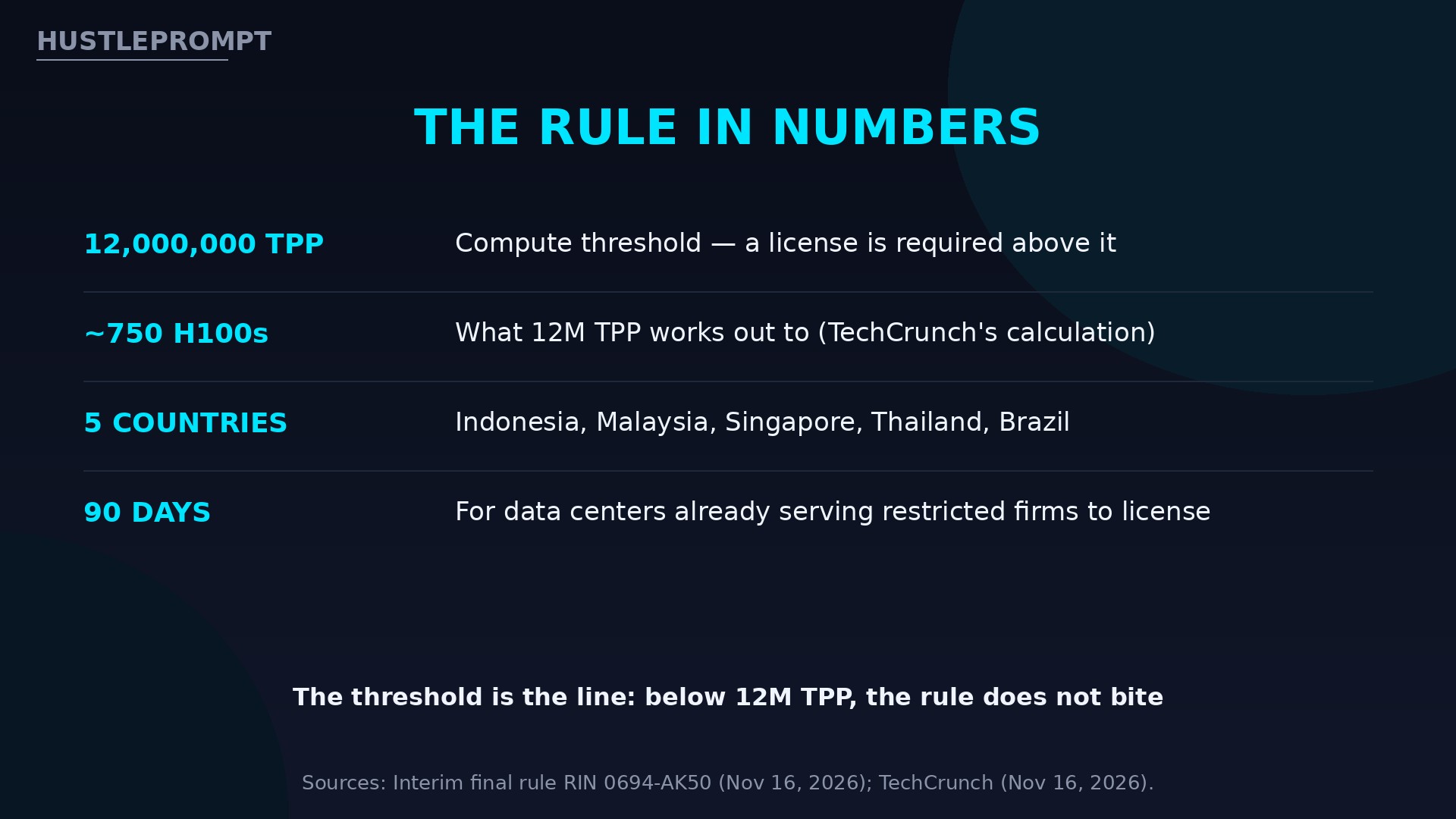
The rule’s power sits in one number: 12 million aggregate TPP. TPP — total processing performance — is the government’s measure of a chip’s computing power, defined in the rule as two times a chip’s peak multiply-accumulate operations per second, in trillions, times the bit length of the operation. Cross that line in compute given to a restricted company, and a license is required. Here is the rule in numbers.
The rule in numbers
| Figure | What it means | Source |
|---|---|---|
| 12,000,000 aggregate TPP | The compute threshold. A data center giving more than this to a Macau or Country Group D:5-headquartered company triggers the license requirement — including across linked data centers | Rule text, §744.24 |
| ~750 Nvidia H100/H200 chips | What 12 million TPP works out to in hardware, per TechCrunch’s calculation (about 758 H100s on the FP8 spec, per AIStockWire’s reading of the rule) | TechCrunch; AIStockWire |
| 5 countries | Indonesia, Malaysia, Singapore, Thailand, Brazil — new license requirements for advanced chip shipments, with an exception for US-headquartered recipients that meet reporting rules | Rule text, §742.6 |
| 90 days | Transition window: data centers already providing covered compute to restricted companies must get a license within 90 days of the effective date, or face future export restrictions | Rule text |
| 60 days | Comment period: comments on the rule are due 60 days after it is published in the Federal Register | Rule text |
| ~100 licenses / $1,900 a year | BIS’s own paperwork estimate: about 100 additional license applications a year, 50 extra burden hours, about $1,900 in added cost | Rule text (paperwork section) |
Sources: Interim final rule RIN 0694-AK50 (full text read this run); TechCrunch, November 16, 2026; AIStockWire, November 16, 2026. The H100 equivalence is a calculation by the cited outlets, not a figure in the rule itself.
One carve-out matters for anyone building consumer products. The license requirement does not apply to commercial recommender systems — the ranking and suggestion engines used by online retailers and social media companies. But the rule explicitly excludes systems designed or used to generate new text, images, audio, video, software or other content, even when recommendation functions are also present. If your system generates content, the carve-out does not cover you.
Why now: the Nvidia scandal
The timing is not a coincidence. Four days before the rule, Nvidia co-founder Jensen Huang resigned as CEO amid a scandal involving an alleged Chinese spy linked to one of the chipmaker’s customers. TechCrunch reports that the US government has reportedly wanted to put that customer, Megaspeed, on a special entity list, believing it bought thousands of Nvidia chips to provide compute to Chinese businesses and get past existing export controls. The day after Huang stepped down, Treasury Secretary Scott Bessent went on Fox News and told Nvidia’s board to hire an outsider as CEO — and to answer within 10 days on export-control compliance.
The pressure was building from two directions at once. Reuters reported last week that Chinese AI companies are rushing to secure computing capacity overseas amid fears of tighter restrictions — the exact behavior the new rule targets. And Seoul Economic Daily framed the rule as a “hurried response after criticism mounted over the department’s slow reaction to the scandal involving former Nvidia CEO Jensen Huang.” Congress has been moving the same way: the House passed the Remote Access Security Act by 369 votes to 22 in January 2026, writing remote access into export-control law — though the bill has sat in the Senate since. The rule does by regulation what the bill would do by statute, and it does it now.

How the loophole worked — and how it closes
What it means for your money
This is a policy story with a direct price tag for four groups.
- Nvidia and AMD. The rule protects their legal markets by choking the gray market for their chips — but it also adds compliance friction to every sale that touches the five countries. Nvidia reports third-quarter earnings on Tuesday, November 17, the day after the rule landed. Watch what management says about the rule: the company is already in the middle of a CEO transition, a boardroom fight and a federal compliance deadline. The earnings call is now a policy call too.
- Data centers in the five countries. Singapore is the big one — a major data-center hub where American hyperscalers and local operators host large GPU fleets. Chips destined for US-headquartered companies there are exempt if reporting requirements are met, which favors American operators over local ones. Smaller operators face new licensing delays and due-diligence costs on every large customer.
- GPU rental prices abroad. Compliance costs and licensing delays tend to raise the price of renting high-end GPUs in the affected countries — and to push demand toward jurisdictions outside the list. Neoclouds with heavy exposure in Singapore, Malaysia or Thailand now carry a regulatory risk premium.
- Chinese AI labs. The cheap overseas-compute path just narrowed. Expect a rush to lock in capacity before the rule takes effect — Reuters already reported that rush last week — and a bigger push toward domestic chips. The 12-million-TPP line is also a design constraint: clusters kept under it stay outside the rule, so expect smaller, distributed setups to proliferate.
And the rule carries a warning for everyone else. Commerce says it will “actively monitor” countries that tolerate evasion, and lists the consequences: import restrictions, new license requirements for advanced semiconductor exports, downgrading a country’s status in the export-control regime, Entity List designations, and temporary export prohibitions. The five-country list is not fixed — the Secretary of Commerce can designate additional countries in consultation with the State Department and the National Security Advisor.
How to profit from it
Policy shifts create work. Five concrete moves follow from the rule, and none of them requires predicting the next headline.
- If you rent GPUs abroad, audit your provider now. Ask for its BIS compliance plan before the rule takes effect: does it check ultimate beneficial ownership, does it monitor linked data centers, and what happens to your workloads if a license is delayed? The 90-day window starts at Federal Register publication — the time to ask is before the clock starts.
- If you invest, watch the earnings call. Nvidia reports on Tuesday, November 17. Listen for management’s read on the rule, on the Megaspeed allegations, and on the 10-day compliance deadline Bessent set. The stock has already fallen about 13% since the scandal broke; the rule is the policy answer to the scandal, and the market will price the answer this week.
- If you build AI products, check which side of the line you are on. Commercial recommender systems are exempt; generative systems are not. If your product generates text, images, video, audio or software, the carve-out does not cover you — and your cloud provider will ask about your ownership structure.
- If you sell AI services, compliance is now a product. Data centers and exporters need customer due diligence: ownership checks, ultimate-parent checks, indirect-arrangement checks. The rule projects only about 100 extra license applications a year — but each one carries legal fees, and every data center in the five countries needs a compliance review. That is billable work, starting now.
- Play the calendar. Two clocks start when the rule is published in the Federal Register: 90 days for existing operators to license, 60 days for public comments. The publication date is the trigger — watch the Federal Register, not the headlines, and position before each deadline lands.

The catches
Three things temper the story. First, the rule is not in force yet. It takes effect on the day it is published in the Federal Register, and as of 2 p.m. ET on November 16 it had not appeared there. The announcement date is not the effective date, and the 90-day and 60-day clocks have not started. Second, the licenses are reviewed case by case — there are no blanket approvals and no blanket denials, so nobody knows how strict the first decisions will be until they land. Third, the rule’s bite depends on enforcement: it requires exporters and data-center operators to police their own customers’ ownership structures, including indirect arrangements and linked facilities. A rule that depends on self-policing is only as strong as the audits behind it. And the threshold itself is a line, not a wall: compute below 12 million TPP stays outside the rule, and older or less powerful chips are not the target. The loophole is closed for frontier training runs. It is not closed for everything.
FAQ
What is the BIS remote-access rule?
It is an interim final rule (RIN 0694-AK50) from the Commerce Department’s Bureau of Industry and Security, released November 16, 2026. It adds a license requirement for advanced AI chips destined for data centers that give large amounts of compute to companies in China, Macau and other restricted countries, adds licensing for chip shipments to five more countries, tightens oversight of chip factories, and formally rescinds the Biden-era AI Diffusion Rule.
What is 12 million TPP?
TPP — total processing performance — is the government’s measure of a chip’s computing power, defined in the rule as two times a chip’s peak multiply-accumulate operations per second, in trillions, times the bit length of the operation. The 12-million-TPP threshold is the line above which a data center’s compute for a restricted company triggers a license. TechCrunch calculates it as roughly the power of about 750 Nvidia H100 or H200 chips.
Which five countries face new AI chip license requirements?
Indonesia, Malaysia, Singapore, Thailand and Brazil. BIS says they present a “higher-than-normal risk of diversion” — chips shipped there have ended up in restricted hands. Chips destined for companies headquartered in the United States, or whose ultimate parent is US-headquartered, are exempt if the exporter meets specified reporting requirements.
When does the rule take effect?
On the day it is published in the Federal Register. It had not been published as of 2 p.m. ET on November 16, 2026. Comments are due 60 days after publication, and data centers already providing covered compute to restricted companies have 90 days from the effective date to obtain a license.
Does the rule ban all AI chip exports to Singapore?
No. It requires licenses for advanced super-intelligence items — the chips controlled under export classifications 3A090 and 4A090 — shipped to Singapore and the other four countries. Chips destined for US-headquartered recipients are exempt with reporting, and the rule does not cover older or less powerful chips below the controlled classifications.
What was the AI Diffusion Rule, and why was it rescinded?
The AI Diffusion Rule was a Biden-era framework from January 15, 2025, that sorted the world into tiers for access to advanced AI chips. BIS says it “has never been enforced,” and the Trump administration announced its rescission in May 2025. The new rule formalizes that rescission and replaces the country-tier approach with targeted controls on remote access and the five diversion-risk countries.
How does this connect to Nvidia and Jensen Huang?
Huang resigned as Nvidia CEO on November 12, 2026, amid a scandal involving an alleged Chinese spy linked to a customer, Megaspeed, which the US reportedly believes bought thousands of Nvidia chips to provide compute to Chinese businesses. The next day, Treasury Secretary Scott Bessent told Nvidia’s board to hire an outsider CEO and answer within 10 days on export-control compliance. The BIS rule, released four days after the resignation, is the policy response to that scandal — and Nvidia reports earnings the day after the rule landed.
Sources
- Bureau of Industry and Security (official press release, November 16, 2026): “BIS Issues Rule Addressing Remote Access to American Super Intelligence Technology”
- Interim final rule RIN 0694-AK50 (official rule text, U.S. Department of Commerce, November 16, 2026): “Addressing Remote Access to Advanced Semiconductors” — section 744.24, five-country licensing, rescission of the AI Diffusion Rule, paperwork estimate
- TechCrunch, Ram Iyer (November 16, 2026): “US tightens AI chip export controls to deter Chinese companies from accessing compute remotely” — the ~750 H100/H200 equivalence, D:5 membership, Megaspeed and Huang context
- AIStockWire (November 16, 2026): “What is the US remote-access rule for Nvidia (NVDA) chips?” — the ~758 H100 equivalence and the rule’s TPP definition
- CASRAI (November 16, 2026): “BIS issues rule on remote access to AI chips” — section-by-section reading of the rule text and the publication-dependent timetable
- Seoul Economic Daily (November 16, 2026): “U.S. Curbs AI Chip Exports to Singapore and Four Other Nations” — the “hurried response” framing of the rule’s timing
Keep Reading
- Bessent: Nvidia Needs an Outsider as Huang Eyes Return — the Treasury Secretary’s 10-day compliance deadline, four days before the rule landed
- Musk Signs Petition to Bring Jensen Huang Back to Nvidia — the boardroom fight behind the CEO transition
- Jensen Huang Resigns as Nvidia CEO — the resignation that started the week the rule closed