
NVIDIA just put a supercomputer on a desk. The DGX Spark HPC Developer Kit, announced November 16, 2026 at the SC26 supercomputing conference in Chicago, links four DGX Spark systems into a single ring cluster with 512GB of combined memory — enough to run AI models with up to 700 billion parameters locally, with no supercomputer queue and no network switch to buy.
For researchers, that changes the daily math of getting work done. Instead of waiting in line for shared GPU time, a lab can develop, debug, and test multi-node workloads at a desk — then spend its precious server allocation only on production runs. NVIDIA says the kit is on display at SC26 and available for sale now.
This is the story of what the kit actually is, what it can run, what it costs — and what it does not cost yet — and how a small lab or a solo AI builder can turn it into income.
What NVIDIA announced at SC26
NVIDIA published the announcement on its official blog late on November 16, 2026. The kit is a four-node cluster of NVIDIA DGX Spark systems, each built around the GB10 Grace Blackwell Superchip.
Each node connects directly to its two neighbors in a ring, using NVIDIA ConnectX-7 networking. There is no network switch to buy, configure, or maintain. The cluster scales from one system to four, so a buyer can start with a single desk unit and add nodes as workloads grow.
At four nodes, the kit provides 512GB of combined memory and 20TB of NVMe storage, giving researchers more room to spread models and scientific workloads across the cluster. With NVFP4 quantization, researchers can deploy models with up to 700 billion parameters locally across the four systems — NVIDIA names DeepSeek V4.1 as the example.
For scale, a single DGX Spark carries 128GB of memory and handles models with up to 200 billion parameters, according to NVIDIA’s own product description. Four nodes do not just quadruple the memory. They move the ceiling from a 200-billion-parameter model to a 700-billion-parameter one.
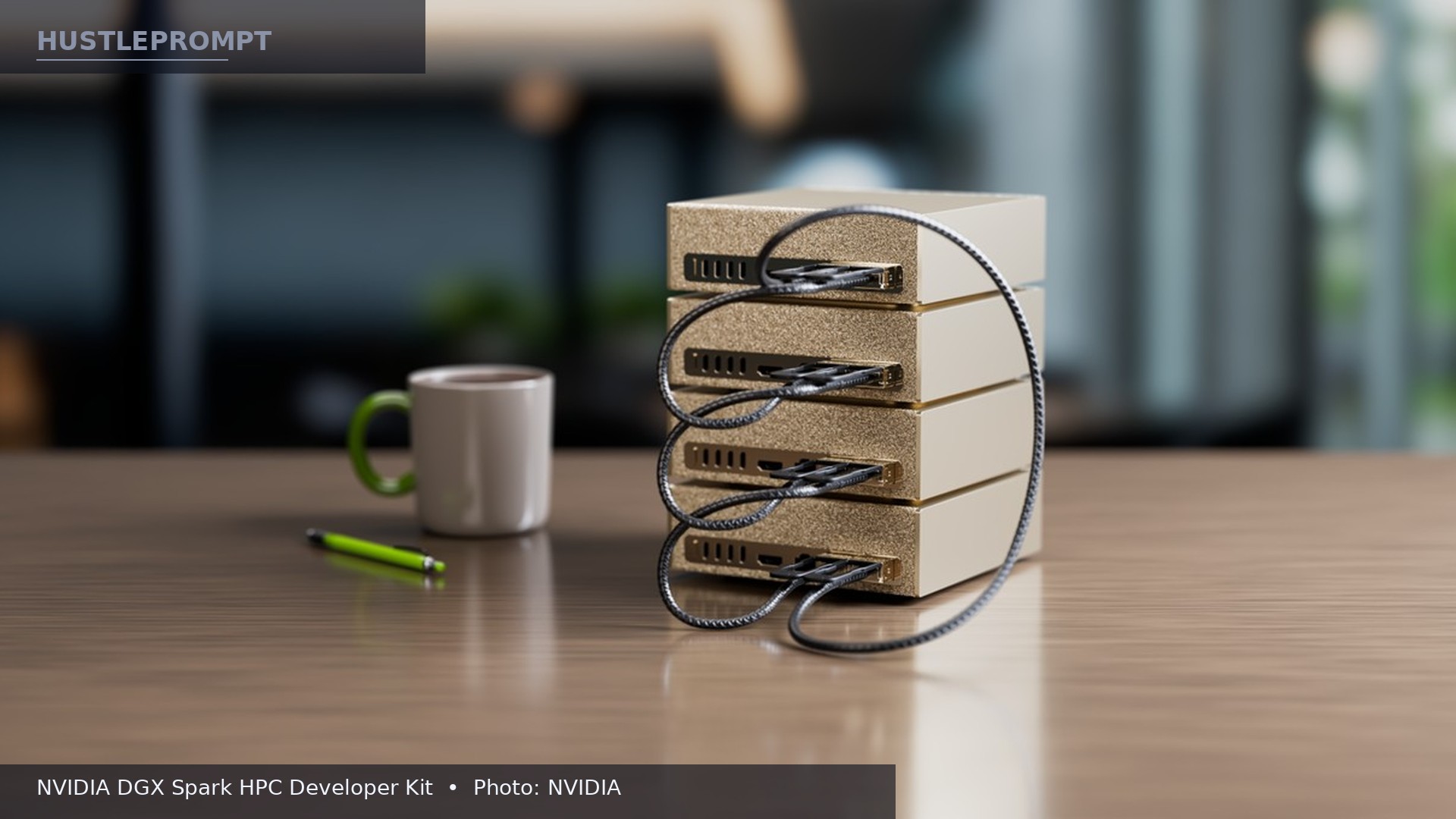
The four-node DGX Spark HPC Developer Kit on a desk. Photo: NVIDIA.
One node vs. the four-node kit
The numbers below come from NVIDIA’s announcement and its official DGX Spark product description. The jump that matters is not the memory alone — it is the size of model the cluster can hold.
| Specification | One DGX Spark | Four-node HPC kit |
|---|---|---|
| Systems | 1 | 4, in a ring |
| Chip | GB10 Grace Blackwell Superchip | GB10 Grace Blackwell Superchip, per node |
| Combined memory | 128GB | 512GB |
| Storage | Not stated in the kit announcement | 20TB NVMe |
| Largest model, local | Up to 200B parameters | Up to 700B parameters (NVFP4) |
| Networking | ConnectX-7 | ConnectX-7 ring, no switch needed |
| Example model | Latest reasoning models | DeepSeek V4.1 |
Sources: NVIDIA blog, DGX Spark HPC Developer Kit (Nov 16, 2026); NVIDIA DGX Spark product description.
How the four-node ring works
The design is deliberately simple. Four identical boxes, each wired to two neighbors, form a closed loop. There is no central switch, so there is no extra box to buy and no single networking component to fail.
NODE 1
GB10 Superchip
128GB memory
NODE 2
GB10 Superchip
128GB memory
NODE 3
GB10 Superchip
128GB memory
NODE 4
GB10 Superchip
128GB memory
Each node links directly to two neighbors over ConnectX-7 — a ring, with no network switch to buy or configure.
512GB combined memory • 20TB NVMe • up to 700B parameters with NVFP4
That ring is the whole point of the kit. It is the smallest possible multi-node cluster: big enough to develop and debug distributed workloads, small enough to sit on a desk. Teams can build and test scientific applications across four nodes, check how computation and data are distributed, and debug communication issues before scaling to larger systems.
What researchers can actually run on it
A launch announcement is only as good as the workloads behind it. NVIDIA’s post names demonstrated four-system workloads and a longer list the wider DGX Spark community has already validated.
- LAMMPS with Kokkos — materials simulation, demonstrated across four systems.
- NAMD — molecular dynamics, demonstrated across four systems.
- GROMACS — molecular dynamics, validated by the community.
- OpenFOAM — fluid dynamics, validated by the community.
- WRF — weather modeling, validated by the community.
- OpenFold3 and Boltz-2 — NVIDIA NIM microservices for predicting biomolecular structures.
Beyond simulations, the kit is built for AI agents. Researchers can explore agent-assisted workflows that prepare simulation inputs, launch runs, and summarize results — while the scientists validate the setup and conclusions. They can also train AI models that approximate slow simulations, then use those models to refine designs. NVIDIA’s example: refining a wing design toward minimum drag.
One concrete number shows the scale of the shortcut. Before committing supercomputer time, a team can narrow a 10-million-cell simulation to the 50 to 500 dimensions that actually matter.
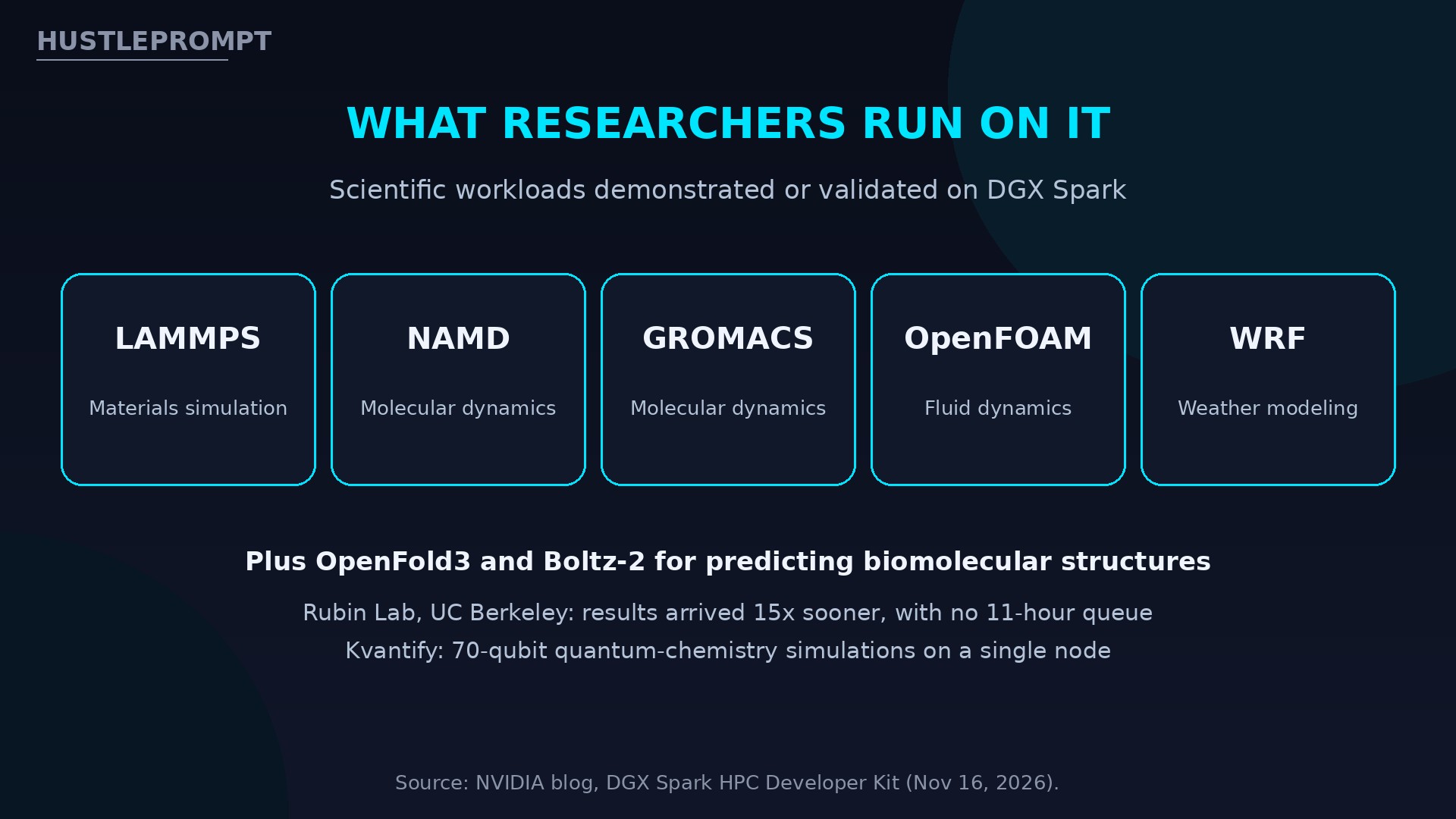
Workloads demonstrated or validated on DGX Spark. Source: NVIDIA blog (Nov 16, 2026).
Proof from real labs, not just benchmarks
NVIDIA’s announcement leans on five named research groups already running real work on DGX Spark hardware. Their results are the strongest evidence in the launch — and the strongest argument for the money case below.
| Lab / team | What they ran | Result NVIDIA reports |
|---|---|---|
| Rubin Lab, UC Berkeley | Evo 2 model, predicting bacterial traits from genome sequences | Results 15x sooner, with no 11-hour cluster queue |
| Kvantify | cuQuantum tensor-network simulations of quantum-chemistry circuits | Up to 70 qubits and 975 gates on a single node |
| Hartwig Group, UC Berkeley | LoRA fine-tuning of Nemotron 3 Super 120B-A12B for chemistry ML | 120B-class model fit on one device; 8- to 24-hour fits back-to-back |
| CYRAN AI (IIT Delhi spin-out) | PixelFlux library, JPEG 2000 decoding for satellite images | Faster local geospatial analysis |
| OpenFold | Fine-tuning OpenFold3 for protein-ligand structure prediction | Improved drug-discovery predictions on local hardware |
Source: NVIDIA blog, DGX Spark HPC Developer Kit (Nov 16, 2026).
The Rubin Lab number deserves a second look. An 11-hour queue is not an edge case in shared computing — it is the normal cost of sharing. Removing it turned a wait into same-day results. That is the product: not just hardware, but the hours around the hardware.
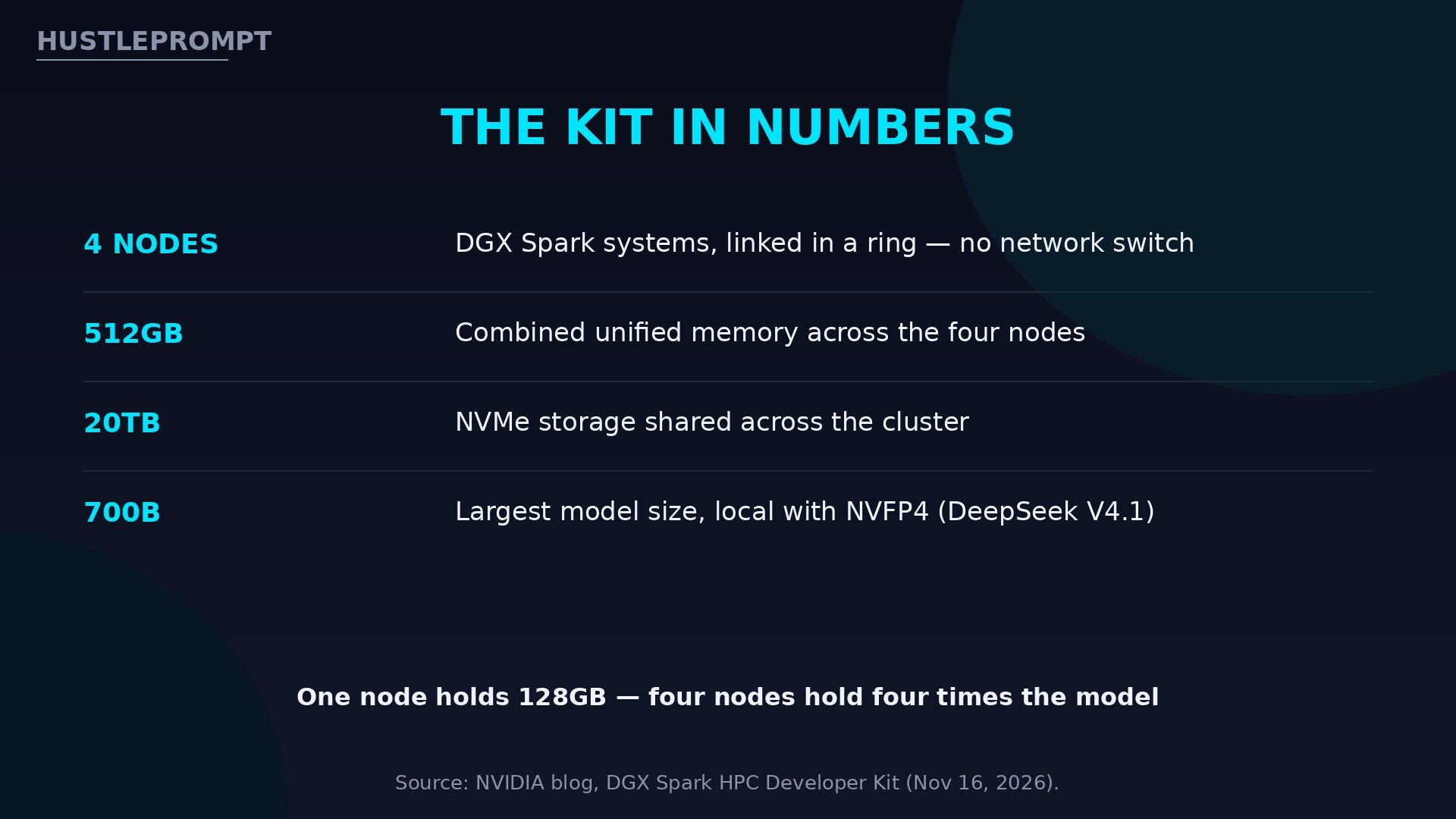
The kit in numbers. Source: NVIDIA blog (Nov 16, 2026).
The money math: what a desk cluster saves
The kit’s value is not a spec sheet. It is the cost of the alternative: waiting for shared infrastructure, and paying for it when you finally get it.
- Queue time becomes work time. The Rubin Lab’s 11-hour queue vanished, and results arrived 15 times sooner. For a small lab, that is the difference between one experiment a day and several.
- Server hours go to production only. NVIDIA’s pitch is explicit: develop and debug on the desk, and save server hours for production runs. Shared-cluster time is the most expensive compute a lab buys.
- No switch, no setup project. A four-node ring needs no network switch and no switch configuration. The networking cost is two cables per node, not a purchase order.
- Data stays on premises. Unpublished results and proprietary datasets never leave the lab. For commercial research, that removes a compliance conversation entirely.
There is one number NVIDIA did not announce: the price of the four-node kit. The announcement lists no bundle price, and the kit is sold through NVIDIA Marketplace and nine OEM partners — Acer, ASUS, Dell Technologies, GIGABYTE, H3C, HP, Lenovo, MSI, and xFusion — who set their own pricing. Buyers should check with partners for current pricing rather than assume a bundle discount.
For scale, the only official DGX Spark price point NVIDIA has published is the smaller 64GB configuration, which starts at $4,999, according to NVIDIA’s October 2, 2026 blog post. That is a different, smaller SKU — not the kit’s price — but it sets the floor for what one node costs.
How to profit from a desk-sized supercomputer
The kit is aimed at researchers, but the same hardware is a business for AI builders. Here is a concrete path from a four-node cluster to paid work.
- Sell local fine-tuning as a service. The Hartwig Group’s workflow — LoRA fine-tuning of a 120-billion-parameter-class model on one device — is a service small companies will pay for. Offer it to biotech and chemistry startups that cannot wait for cluster time.
- Sell simulation time to small labs. University groups and startups without cluster access need LAMMPS, GROMACS, and OpenFOAM runs. A desk cluster with no queue is a product: fast turnaround, fixed price, data stays local.
- Build agents on the kit, sell the agent. Train and test AI agents that prepare simulation inputs and summarize results, then sell the finished agent to labs running the same tools. The kit is the development environment; the agent is the product.
- Offer “queue insurance” to research teams. When a team’s shared cluster is booked, their deadline still exists. A local four-node cluster that runs the same workloads is the backup they rent by the week.
- Document everything and sell the playbook. The HPC SDK installation playbook is still coming from NVIDIA. The first builders to publish working multi-node recipes for LAMMPS, NAMD, and OpenFold3 on this exact hardware will own the search traffic for it.
The common thread is simple: the kit removes the two things that slow small teams down — the queue and the setup. Anything you sell that depends on either one gets faster and cheaper the day the kit arrives.
What is still missing
Two gaps matter for buyers, and NVIDIA is open about both of them.
First, the HPC SDK installation playbook is coming soon, not shipping today. It will bring GPU-accelerated C, C++, and Fortran compilers, libraries, and message-passing tools to the cluster — the same development tools used on NVIDIA-powered supercomputers. Until it lands, buyers are working with the DGX Spark software stack and community recipes, not NVIDIA’s finished HPC setup guide.
Second, there is no bundle price yet. The kit is on display at SC26 and available for sale, but pricing runs through Marketplace and OEM partners. Anyone budgeting for four nodes should get a quote before assuming the per-unit price holds at four units.
Neither gap changes the announcement. The hardware is real, the workloads are demonstrated, and the labs NVIDIA names are already running production science on it. The playbook and the price are the next two things to watch.
Watch: NVIDIA’s official DGX Spark setup walkthrough
No video of the four-node HPC kit itself exists yet — the kit was announced hours ago. The video below is NVIDIA’s official first-boot walkthrough for DGX Spark, the same GB10 hardware in each node of the new kit. It shows exactly what the first hour with the machine looks like.
NVIDIA’s official “Getting Started with the NVIDIA DGX Spark” — the first-boot walkthrough for the same GB10 hardware in the new four-node kit. Video: NVIDIA.
Frequently asked questions
What is the NVIDIA DGX Spark HPC Developer Kit?
It is a four-node cluster of NVIDIA DGX Spark systems, announced November 16, 2026 at SC26. Each node uses the GB10 Grace Blackwell Superchip, and the four nodes link in a ring over ConnectX-7 networking with no network switch.
How much memory does the four-node kit have?
512GB of combined memory and 20TB of NVMe storage across the four nodes. A single DGX Spark has 128GB of memory.
What size AI models can it run?
With NVFP4 quantization, the four-node kit can deploy models with up to 700 billion parameters locally — NVIDIA names DeepSeek V4.1 as the example. A single node handles models up to 200 billion parameters.
Do I need a network switch?
No. Each node connects directly to its two neighbors in a ring over NVIDIA ConnectX-7, so there is no switch to buy or configure.
How much does the kit cost?
NVIDIA did not announce a bundle price. The kit is sold through NVIDIA Marketplace and nine OEM partners, who set their own pricing. For scale, the smaller 64GB DGX Spark starts at $4,999, according to NVIDIA’s October 2026 blog post — a different SKU, not the kit’s price.
When and where can I buy it?
The kit is on display at SC26 in Chicago (November 15-20, 2026) and available for sale now through NVIDIA Marketplace and partners Acer, ASUS, Dell Technologies, GIGABYTE, H3C, HP, Lenovo, MSI, and xFusion.
Does it replace a supercomputer?
No — and NVIDIA does not claim it does. It replaces the queue. Teams develop, debug, and test multi-node workloads on the desk cluster, then spend their shared-cluster allocation on production runs. The HPC SDK playbook for full multi-node development is still coming soon.
Keep Reading
Sources: NVIDIA blog — DGX Spark HPC Developer Kit (Nov 16, 2026); NVIDIA blog — SC26 news overview; NVIDIA blog — DGX Spark 64GB (Oct 2, 2026).