
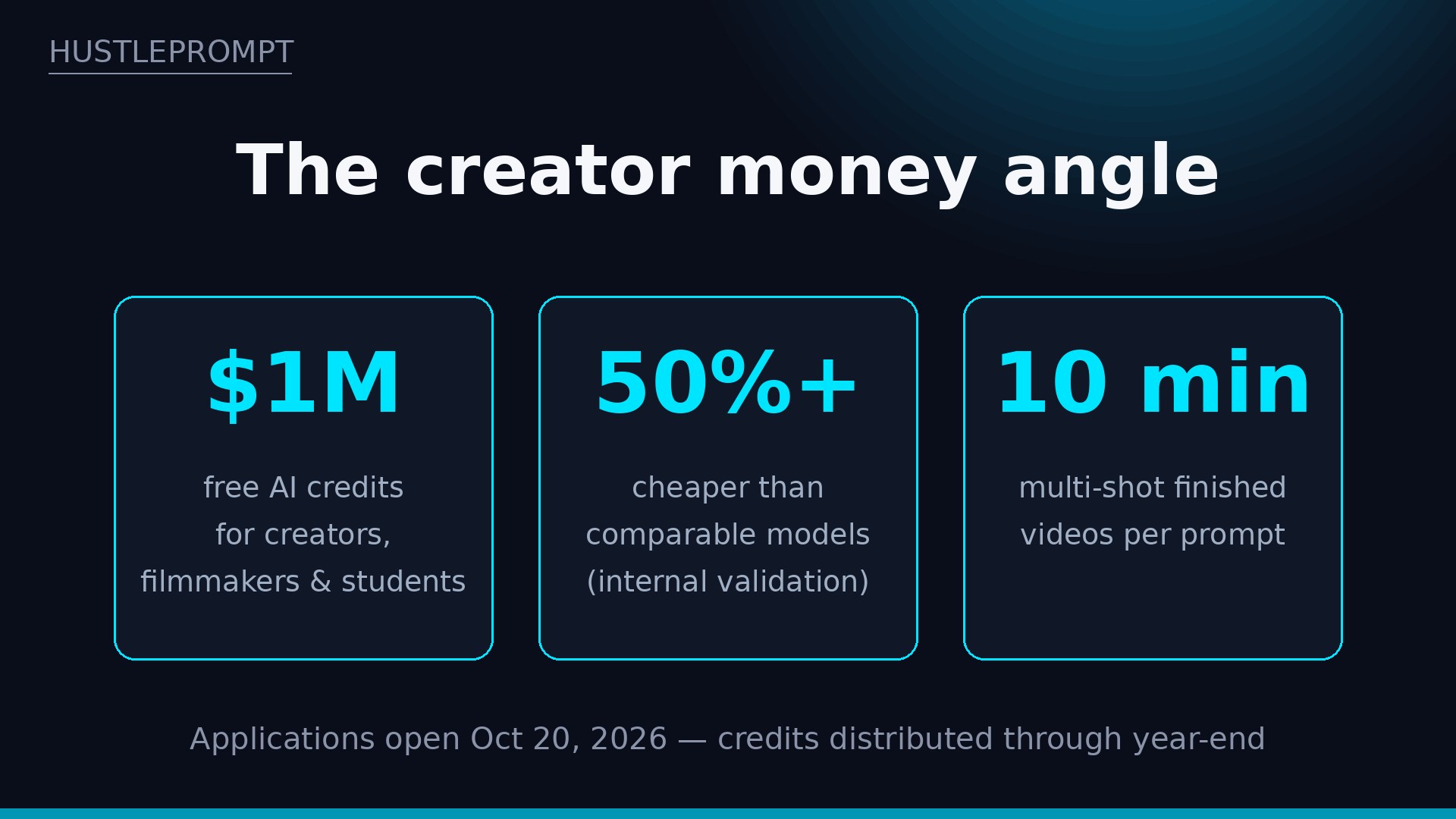
A single prompt. A finished, multi-shot video up to ten minutes long. That’s the promise of VideoGen Model 1, unveiled October 20, 2026 by the Y Combinator-backed AI video company — and it’s arriving with a $1 million pool of free AI credits for creators, filmmakers and studios.
If you’ve been watching the AI video race, you know the pattern: five-second clips that look amazing and do nothing useful. VideoGen is attacking the opposite end — long-form, multi-shot videos with dialogue, sound and music generated together. Here’s what the company actually announced, what it costs, and how creators can profit from it.
What VideoGen Model 1 actually is
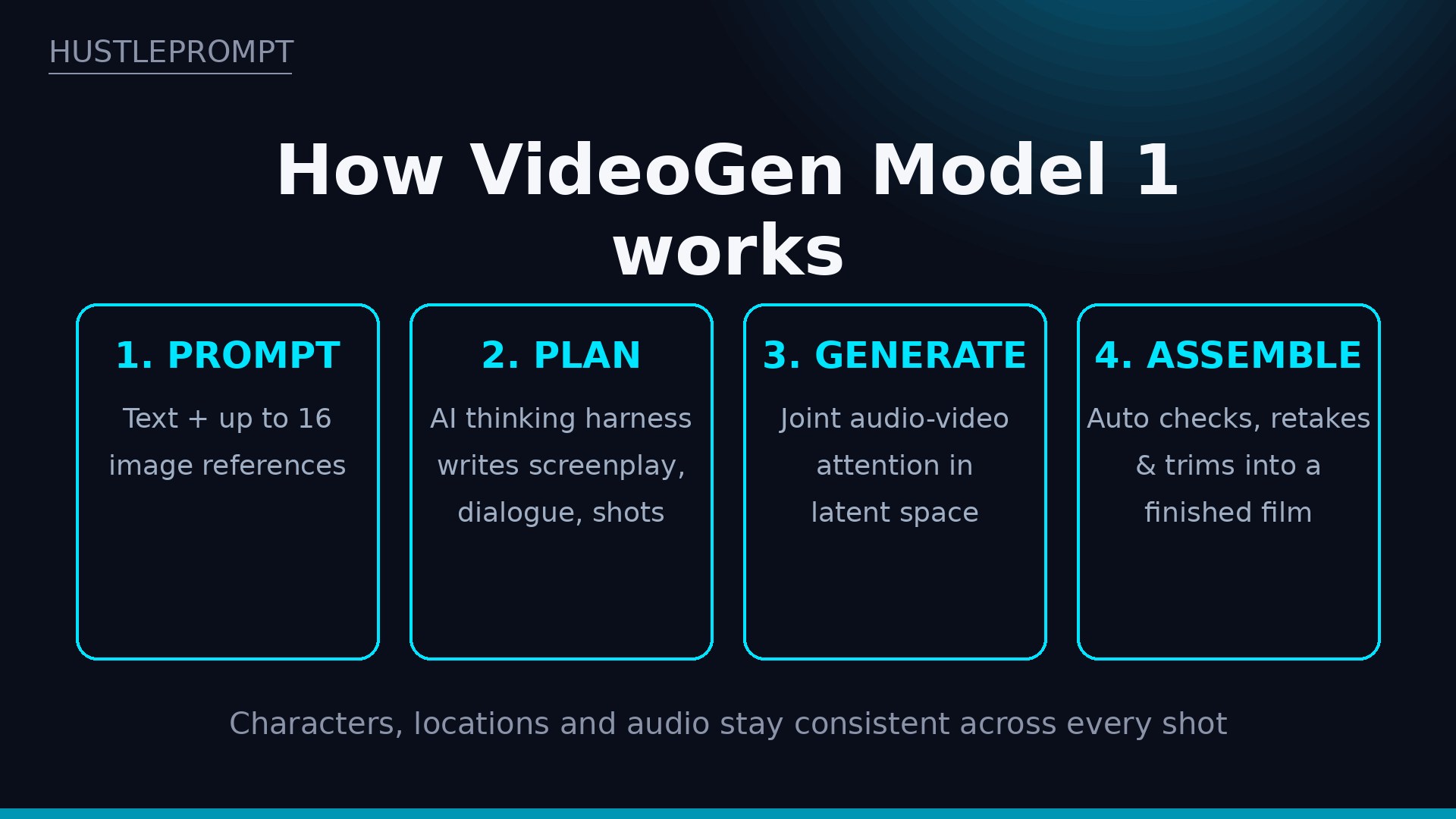
Model 1 is VideoGen’s first AI video generation model. You start with a written brief and optional visual references; an AI “thinking harness” develops the screenplay, dialogue, shots and pacing — carrying context across scenes so characters, locations, visuals, audio and narrative stay consistent. Then it generates and assembles the whole thing.
The technical core is joint audio-video attention: instead of generating silent video and bolting sound on later, the model learns visual and audio information together in latent space, using compressed representations that are decoded into video frames and sound. In practice, that means dialogue and music are part of the generation, not an afterthought.
The specs that matter
Source: VideoGen official launch announcement (GlobeNewswire, Oct 20, 2026). Final pricing, official benchmarks and third-party validation are still underway.
Proof it’s real: the example films
On videogen.io/model-1, the company published example films it says were each generated from a single prompt with no editing or post-production — including a 5-minute anime short film, plus shorter pieces like Red Door (0:41), The Bloom (0:36) and Last Table (0:43). Take vendor demos with the usual grain of salt, but the breadth (film, animation, ads, social) is the point: this is pitched as a production tool, not a toy.
The $1M free credit program — the real money story
Alongside the model, VideoGen opened applications for a $1 million pool of free AI credits for selected creative projects. The details from the announcement:
- Who can apply: creators, filmmakers and studios — plus students and amateurs. Journalists and software reviewers covering Model 1 get some credits too.
- How it works: apply from October 20 at the company’s site (sign in, request access, describe what you plan to create or cover). Selection weighs the creative work and a viable distribution plan.
- Timeline: credits will be distributed through the end of 2026, with individual allocations based on each project’s scope and scale.
Translation: if you have a real distribution plan — a YouTube channel, a client roster, an ad agency — you can get professional-grade AI video generation for free through year-end. That’s a genuine zero-cost window to build a portfolio, land clients, or test a faceless channel format.
How the pipeline works (and what it fixes)
Write a text prompt and attach up to 16 reference images. Pick duration and aspect ratio.
The thinking harness writes the screenplay, dialogue, shots and pacing — and plans for narrative arcs and marketing persuasion.
Joint audio-video attention generates video and sound together, keeping characters and locations consistent shot to shot.
The pipeline checks for issues (incomplete dialogue, visual glitches), retries renders within budget, then trims and joins the clips.
Two details stand out for anyone who’s fought with AI video tools. First, consistency: the system maintains AI representations of recurring characters, objects and locations and reuses shared visual references across independently generated shots — the standard fix for faces that morph between scenes. Second, self-correction: the pipeline checks for incomplete dialogue and visual inconsistencies, retries selected renders within a set budget, and trims and joins the chosen clips automatically.
On cost, the company says that based on internal validation it expects Model 1 to cost more than 50% less than comparable models — though it also says final pricing, official benchmarks and third-party validation are still underway. Treat the 50% as a directional claim until the numbers land.
“Lower costs and longer video generation give filmmakers room to work through scenes before they shoot and creators the ability to tell longer stories. Model 1 represents a major step toward AI becoming part of everyday production, from film pre-visualization to full-length YouTube videos and ads.”
— Anton Koenig, CEO and co-founder of VideoGen — official launch announcement
How to profit from VideoGen Model 1
Concrete steps, in order:
- Apply for credits now. Applications opened October 20. Write a one-paragraph project plan with a real distribution channel — that’s what selection weighs. Free compute through year-end is the cheapest possible start.
- Pick a long-form niche. Ten-minute generation is the differentiator: explainer channels, ad creatives, training videos, pre-visualization for filmmakers. Don’t compete on 5-second clips.
- Sell the workflow, not the tool. Agencies pay for finished assets. Offer “AI video ad packages” — script to final cut — at 50–70% of traditional production cost. Your margin is the automation.
- Build the portfolio during the free window. The example films on the site show the expected quality bar. Ship 5–10 pieces before the credits run out, then charge.
- Watch the pricing. Final pricing isn’t public yet. Model your offers on the “50%+ cheaper” claim, but keep contracts flexible until VideoGen publishes real rates.
What to watch next
Three open questions: real pricing (the 50%-cheaper claim needs numbers), independent benchmarks (the 58.2% render-time figure is an internal experiment, not a guarantee), and general availability (right now it’s a limited private-partner rollout with more safety testing before GA). The technical whitepaper VideoGen promised will be the document to read.
Also note the guardrails: Model 1 includes safety systems designed to block adult and illegal content, and generated outputs carry invisible watermarks identifying their synthetic origins — relevant if you publish commercially, since disclosure rules are tightening.
Watch: Introducing VideoGen Model 1 — official VideoGen channel.
FAQ
What is VideoGen Model 1?
VideoGen Model 1 is a first-generation AI video model from Y Combinator-backed VideoGen (San Francisco) that turns text prompts and up to 16 reference images into finished, multi-shot videos up to ten minutes long, with dialogue, sound and music generated together.
How much does VideoGen Model 1 cost?
Final pricing hasn’t been published. VideoGen says that based on internal validation it expects Model 1 to cost more than 50% less than comparable models, with official pricing, benchmarks and third-party validation still underway.
How do I get the $1M in free AI credits?
Apply from October 20 through VideoGen’s site: sign in, request access, and describe what you plan to create or cover. Selection considers your creative work and a viable distribution plan; credits are distributed through the end of 2026. Students, amateurs, filmmakers and studios are all eligible.
How long are VideoGen Model 1 videos?
Up to ten minutes, assembled from multiple generated shots. You specify the target duration and aspect ratio up front, and the pipeline plans, generates, checks and joins the clips automatically.
Is VideoGen Model 1 available now?
October 20 began a limited private-partner rollout, with general availability expected after additional safety testing. Journalists can request early access and demonstrations via press@videogen.io.
Are VideoGen outputs watermarked?
Yes. Generated outputs carry invisible watermarks identifying their synthetic origins, and the model includes safety guardrails designed to block adult and illegal content.
Keep reading
Sources: VideoGen official launch announcement (GlobeNewswire, Oct 20, 2026); videogen.io/model-1.