
Isomorphic Labs just raised $5 billion in a single round — more money than any biotech company has ever raised from venture investors. The Alphabet-owned AI drug company announced the Series C on November 17, 2026, and the round was oversubscribed, with Greenoaks and Sequoia Capital co-leading and Andreessen Horowitz joining as a new investor.
The number is the story. Five billion dollars is about 2.4 times the $2.1 billion Isomorphic raised only six months earlier, and it beats the previous biotech record — the $3 billion Altos Labs raised at its 2022 launch — by two-thirds. In twenty months, the company has pulled in roughly $7.7 billion of outside capital without selling a single drug. No Isomorphic medicine has been tested in people yet. That gap, between the money and the medicine, is what makes this round worth understanding.
For investors, the catch is immediate: you cannot buy Isomorphic Labs. It is private, and Alphabet already owns at least 75% of it. But the round still moves money you can reach — Alphabet stock, three pharma giants with Isomorphic deals, and a biotech sector that just got its biggest validation ever. This is what the $5 billion buys, what it does not prove, and how to position for it.

What Isomorphic announced
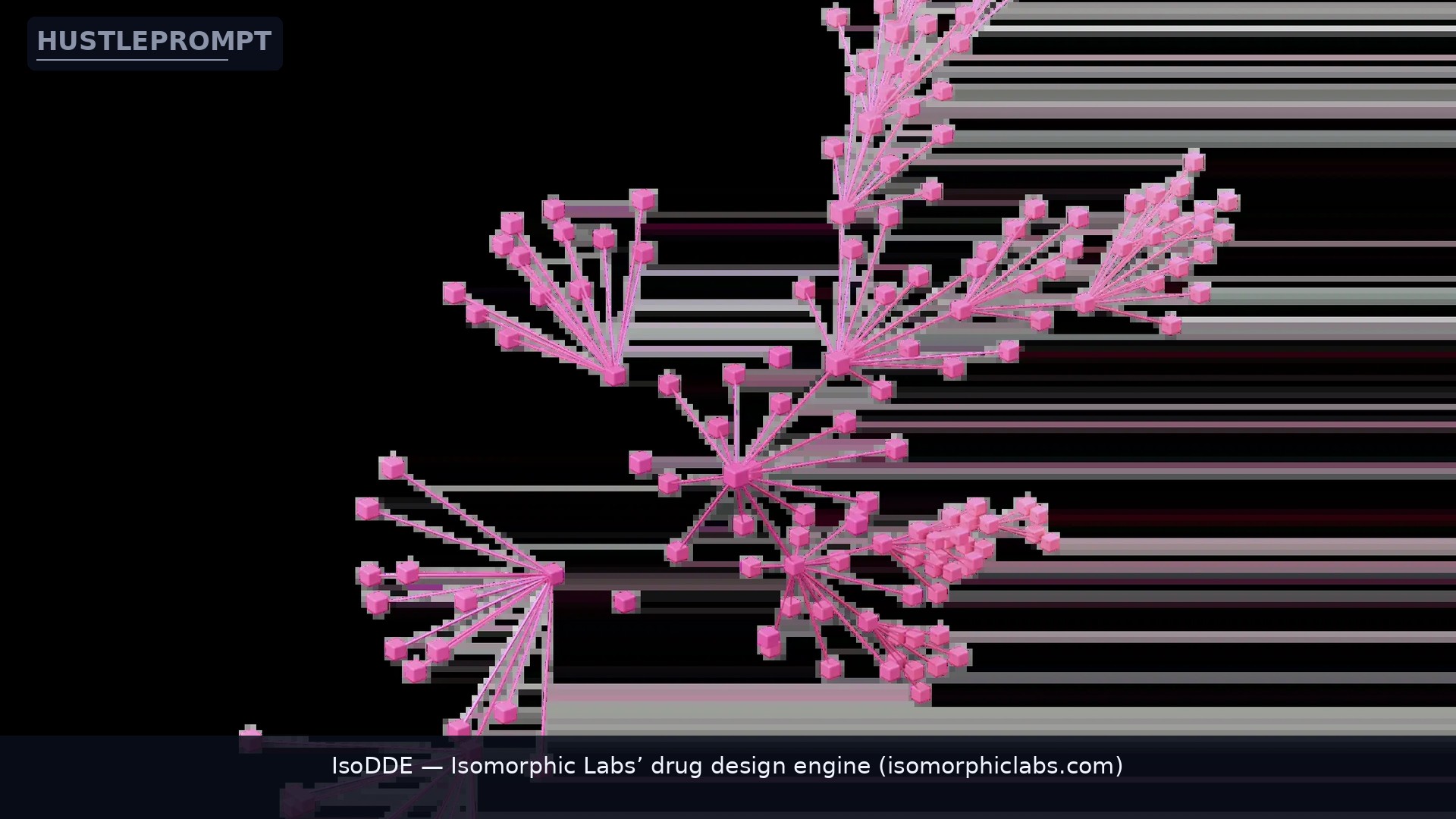
Isomorphic Labs is the AI drug company Demis Hassabis spun out of Google DeepMind in 2021. It builds a drug design engine called IsoDDE, which uses AI simulation models to design new molecules, predict their properties and refine them before scientists ever make and test them. The work builds on AlphaFold, the DeepMind system that predicts protein structures — the breakthrough that won Hassabis the 2024 Nobel Prize in Chemistry.
“When we founded Isomorphic, our conviction was that biology could be understood and modelled at the most fundamental molecular level and radically accelerated through AI. Our drug design engine is generating molecules with unprecedented precision and speed.”
— Sir Demis Hassabis, Founder and CEO of Isomorphic Labs, November 17, 2026
The Series C brings in a heavyweight syndicate. Greenoaks and Sequoia Capital co-led the round, Andreessen Horowitz joined as a new investor, and Alphabet made what the company called a significant investment. Every existing backer returned: Thrive Capital, MGX, GV, CapitalG, Temasek and the UK Sovereign AI Fund. Isomorphic called the round oversubscribed, meaning investors wanted more of it than the company was selling.
The company says the money will push its first drug candidates toward clinical trials. Its internal programs in oncology and immunology, and its partnered programs, have shown what the company calls positive preclinical results. Preclinical means tested in labs and animals, not in people — and the announcement names no candidate, no target disease, no trial date and no trial phase.
Three rounds in twenty months
The pace of the fundraising is as striking as the size. Isomorphic took its first outside money in March 2025, and has now raised three times in under two years.
| Round | Date | Amount | Led by | What changed |
|---|---|---|---|---|
| First outside round | March 2025 | $600 million | Thrive Capital | First external capital; previously wholly owned by Alphabet |
| Series B | May 12, 2026 | $2.1 billion | Thrive Capital | Scaled IsoDDE and the internal pipeline |
| Series C | November 17, 2026 | $5 billion | Greenoaks + Sequoia Capital | Oversubscribed; a16z joins; clinical push begins |
| Total external funding | Mar 2025 – Nov 2026 | ~$7.7 billion | — | Largest biotech venture total ever assembled |
Each round roughly doubled or tripled the last. The Series C alone is bigger than the previous two rounds combined, and bigger than the entire venture funding of most biotech sectors. BioSpace calls it the largest venture round in biotech history, ahead of the $3 billion Altos Labs raised in 2022. The money is flowing into AI drug discovery across the board: investor funding for the sector more than doubled from $4.1 billion in 2023 to $8.4 billion in 2025, and Dealroom counts $23.2 billion flowing into AI-enabled drug discovery in 2026 alone.
Where the $5 billion goes
The announcement lists four uses for the money, and they show where Isomorphic thinks its bottleneck is. It is not just building bigger models.
- Maturing IsoDDE. The drug design engine itself keeps getting better, with new biological capabilities and deeper models of how diseases work at the molecular level.
- A partner ecosystem for disease biology. Isomorphic is building partnerships to advance the understanding of mechanistic disease biology — how diseases actually work, not just what their targets look like.
- Global AI-led bioengineering infrastructure. The labs, compute and automation needed to design, make and test molecules at industrial scale.
- AI-first clinical development infrastructure. The teams and systems to run human trials — the step the company has never taken before.
That last item is the tell. A company that only needed better models would spend the money on compute and researchers. Isomorphic is spending it on the machinery of getting a drug into people. President Max Jaderberg put it bluntly in the announcement: “Every week we are making repeatable scientific advancements enabled by our models. These translate directly into better molecular profiles with the potential to be new medicines.”
What IsoDDE actually does
Traditional drug discovery starts with a protein target and screens millions of existing molecules to find one that binds to it. Most fail. Analyses of clinical-trial data attribute 40% to 50% of drug failures to lack of efficacy — the molecule simply does not work well enough in the body. The process takes a decade and costs billions, and most candidates die along the way.
IsoDDE flips the process. Instead of screening what already exists, it designs the molecule from scratch: it explores vast chemical spaces, predicts how a candidate will bind, scores its drug-like properties and refines it — all in simulation, before a chemist makes anything. Isomorphic described the engine in a technical report in February 2026, saying it doubles AlphaFold 3 on a protein-ligand structure prediction benchmark, predicts binding strength better than physics-based methods at a fraction of the time and cost, and can spot druggable pockets on a protein using only its amino-acid sequence.
| Step | Traditional drug discovery | Isomorphic’s IsoDDE approach |
|---|---|---|
| Find a starting molecule | Screen libraries of millions of existing compounds | Design new molecules from scratch in simulation |
| Predict whether it binds | Lab assays, one molecule at a time | AI models predict binding strength before synthesis |
| Improve the molecule | Months of chemist-led iteration | Rapid simulated refinement of drug-like properties |
| Pick what to test | Best guess from limited data | Only the most promising candidates go to the lab |
| Time to first human trial | Often 5–7 years from target to clinic | Company targets first trials by end of 2026 — 5 years after founding |
Those IsoDDE claims are the company’s own, from its own technical report, and they have not been independently verified. That matters, because the whole investment case rests on them. What is independently verifiable is the pedigree: AlphaFold’s Nobel, DeepMind’s track record, and the fact that the world’s biggest pharma companies keep signing deals. Isomorphic lists Novartis, Eli Lilly and Johnson & Johnson as partners, and the Lilly and Novartis deals from 2024 alone carry nearly $3 billion in potential milestone payments.
Watch: Google DeepMind explains how Isomorphic Labs designs drugs with AI on its official YouTube channel.
DISCOVER → DESIGN → REFINE → TRIAL
1. DISCOVER
Pick a disease target. IsoDDE models the protein and finds pockets a drug could bind to, from sequence alone.
2. DESIGN
Generate new molecules in simulation, engineered for binding strength and drug-like properties.
3. REFINE
Iterate in software, not in the lab. Only the best candidates get made and tested.
4. TRIAL
Preclinical results in oncology and immunology set up the first human trials — the step that proves it.
The $50 billion question
Isomorphic declined to share its valuation. Bloomberg reported in early November that the company was in talks to raise about $5 billion at a valuation of roughly $50 billion, and an earlier October report put the figure at $40 billion or more. Neither number is confirmed by the company, and the spread between them — $10 billion — is itself a signal: nobody outside the deal knows what this company is worth, because there is no public market to price it.
A $50 billion valuation would make Isomorphic one of the most valuable private companies in the world, and the most valuable biotech startup ever by a wide margin. It would also value a company with no revenue from its own drugs, no clinical-stage asset and no approved product at roughly the market value of a mid-sized listed pharma company. The investors writing these checks are betting that the platform, not any single drug, is worth that much.
That bet has a precedent inside Alphabet. The parent company already owns at least 75% of Isomorphic’s shares and voting rights, according to UK Companies House records. For Alphabet, the $5 billion round is a way to bring in outside capital and outside validation while keeping control of an asset it clearly intends to keep. For the new investors, it is a ticket into the most credible AI drug platform on the planet — at a price set by negotiation, not by a market.

What the $5 billion does not prove
Three honest caveats belong in any article about this round, because the announcement is careful not to claim what it has not done.
- No drug has entered human trials. Hassabis said at Davos in January that Isomorphic expected its first clinical trials by the end of 2026. The Series C release gives no trial date, and as of early November the company had not publicly confirmed that any trial had started. A sponsor must file an investigational new drug application before a first-in-human study can proceed in the US.
- The preclinical results are self-reported. The announcement cites positive preclinical results in oncology and immunology but publishes no data, names no partner, target, program count or trial phase. Until a candidate enters the clinic, those results are a company claim, not a verified fact.
- No AI-designed drug has been approved yet. No drug designed by AI has received FDA approval. The first company to get one through will have proved the model; until then, every AI drug platform is a promise backed by benchmarks, not by patients.
None of that makes the round a bad bet. It makes it an early bet, at a very large price, on a platform whose proof point is still ahead of it. The $5 billion buys the time and the infrastructure to reach that proof point. Whether it was worth it will be decided in a clinic, not in a funding announcement.
How to play the Isomorphic story: 5 moves
You cannot buy Isomorphic Labs shares. But the round moves three assets you can buy, and one event you can watch.
- Alphabet is the direct proxy. Alphabet owns at least 75% of Isomorphic and keeps investing in every round. If IsoDDE works, the value accrues to Alphabet first. A $50 billion valuation on a subsidiary is small next to Alphabet’s market value, but the option value of owning the leading AI drug platform is not.
- Watch the three pharma partners. Novartis, Eli Lilly and Johnson & Johnson all have Isomorphic programs. The Lilly and Novartis deals from 2024 carry nearly $3 billion in potential milestones between them. A clinical candidate from any of these partnerships is the first public proof the engine works — and it shows up in the partner’s pipeline first.
- Track the AI drug discovery sector, not just one company. Funding for AI-enabled drug discovery hit $23.2 billion in 2026, and the sector’s funding more than doubled between 2023 and 2025. Biotech ETFs and sector funds are the diversified way to bet that the model works, even if one company’s molecule fails.
- Mark the trial date. Hassabis targeted first clinical trials by the end of 2026. The filing of an investigational new drug application — a public event — is the single most important milestone to watch. If it slips into 2027 without explanation, the story changes.
- Wait for the IPO window. A company that raises $5 billion at a reported $50 billion valuation is building toward a public listing. Anthropic is pricing its own record IPO this week, and a successful debut would open the door for the next wave of AI companies — Isomorphic included. The Series C is the last private round before that conversation starts.
What to watch
Three things will show whether this $5 billion was the smartest money in biotech or the most expensive lesson in it.
- The first clinical trial. A named candidate, a named disease, a trial phase and a start date. That is the moment IsoDDE stops being a benchmark story and becomes a medicine story.
- The valuation at the next round or IPO. If the next raise prices above $50 billion, the market has validated the Series C. If it prices below it, the November round was the top.
- Partner announcements. New deals — or new milestone payments — from Novartis, Lilly or J&J would show that the pharma giants, who see the data, like what they see. Silence from the partners would say the opposite.
The bigger picture is simple. In five years, Isomorphic went from a DeepMind spinout to the best-funded drug discovery company in history, without a single drug in a human being. The $5 billion is a bet that the next five years will look nothing like the last five — that AI will design the medicines, and the medicines will work. The money is real. The proof is still to come.
Frequently asked questions
How much did Isomorphic Labs raise in its Series C?
Isomorphic Labs raised $5 billion in a Series C financing round announced on November 17, 2026. The round was co-led by Greenoaks and Sequoia Capital, with Andreessen Horowitz joining as a new investor and Alphabet making a significant investment. The company called the round oversubscribed.
What is Isomorphic Labs worth?
The company did not disclose its valuation. Bloomberg reported in early November 2026 that the round was discussed at a valuation of roughly $50 billion, and an earlier October report put it at $40 billion or more. Neither figure is confirmed by Isomorphic Labs, so treat the valuation as reported, not official.
What is IsoDDE?
IsoDDE is the Isomorphic Labs Drug Design Engine, a suite of AI simulation models that designs new drug molecules, predicts their properties and refines them before scientists make and test them. Isomorphic described it in a technical report in February 2026, saying it doubles AlphaFold 3 on a protein-ligand structure prediction benchmark and predicts binding strength better than physics-based methods.
Has Isomorphic Labs put a drug in human trials?
Not yet. The company reports positive preclinical results in oncology and immunology, but no candidate has entered human trials. CEO Demis Hassabis said in January 2026 that he expected the first clinical trials by the end of 2026; the Series C announcement names no trial date or candidate.
Who invested in Isomorphic Labs?
The Series C was co-led by Greenoaks and Sequoia Capital. New investors include Andreessen Horowitz. Alphabet invested again, and all existing backers returned: Thrive Capital, MGX, GV, CapitalG, Temasek and the UK Sovereign AI Fund. Thrive Capital led the $2.1 billion Series B in May 2026 and the $600 million round in March 2025.
Can I invest in Isomorphic Labs?
Not directly — Isomorphic Labs is private, and Alphabet owns at least 75% of its shares and voting rights. The closest public exposure is Alphabet stock, plus the three listed pharma partners with Isomorphic programs: Novartis, Eli Lilly and Johnson & Johnson. Biotech ETFs offer diversified exposure to the wider AI drug discovery sector.
Why is this the biggest biotech round ever?
At $5 billion, the Series C beats the previous record — the $3 billion Altos Labs raised at its launch in 2022 — by two-thirds, according to BioSpace. It is also bigger than Isomorphic’s previous two rounds combined, and it brings the company’s total external funding to about $7.7 billion in twenty months.
Keep Reading
Sources: Isomorphic Labs, “Isomorphic Labs announces $5 Billion Series C funding” (Nov 17, 2026); Reuters on the Isomorphic Labs Series C (Nov 17, 2026); TechCrunch on the Isomorphic Labs Series C (Nov 17, 2026).